Category: Luxury Business

The brands, founders and strategies shaping India’s growing luxury industry.

  • THE BAG THAT MONEY CAN’T BUY

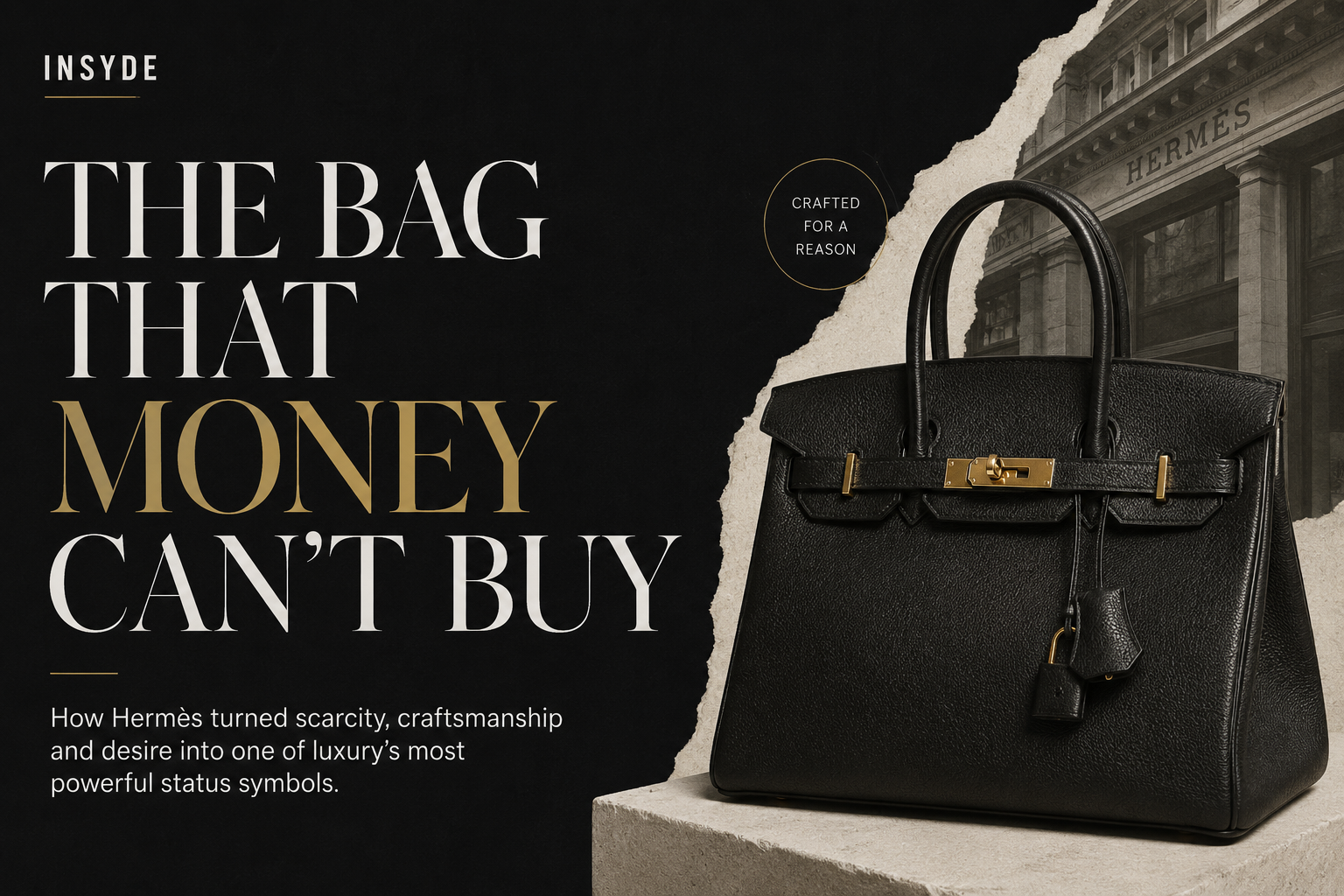
    THE BAG THAT MONEY CAN’T BUY

    How Hermès turned scarcity, craftsmanship and desire into one of luxury’s most powerful status symbols.

    There are handbags that cost hundreds.

    There are handbags that cost thousands.

    And then there is the Hermès Birkin — a handbag so deeply embedded in the language of luxury that its price is no longer the most interesting thing about it.

    The real question is much simpler:

    What happens when having the money still doesn’t guarantee that you can have the thing you want?

    That is where Hermès becomes fascinating.

    Because luxury has traditionally followed a straightforward formula:

    More money. Better things.

    Hermès built something more complicated:

    More money gives you access to luxury. But it doesn’t necessarily give you access to everything.

    And that distinction transformed a handbag into something far bigger than a fashion accessory.

    The Birkin became a symbol of wealth, yes.

    But also of taste.

    Scarcity.

    Craftsmanship.

    Access.

    And, perhaps most importantly, desire.

    Because when something is difficult to obtain, the price is only the beginning of the story.


    THE BAG WAS NEVER DESIGNED TO BECOME A STATUS SYMBOL

    The origin of the Birkin is almost too ordinary for the mythology that eventually surrounded it.

    In 1984, British actress and singer Jane Birkin found herself seated next to Jean-Louis Dumas, then chairman and chief executive of Hermès, on a flight from Paris to London.

    Birkin explained that she couldn’t find a leather bag that worked for her as an everyday carryall.

    Dumas listened.

    The idea evolved into a new handbag.

    The Birkin was born.

    There was no grand plan to create one of the world’s most recognisable symbols of extreme wealth.

    It began with functionality.

    Make it practical.

    Make it beautiful.

    Make it exceptionally well.

    The mythology came later.

    And that may be one of the most important details in the entire story.

    Because Hermès didn’t begin by manufacturing status.

    It manufactured quality.

    Status followed.


    HERMÈS WAS BUILDING LUXURY LONG BEFORE THE BIRKIN

    To understand why the Birkin became so powerful, you have to go back much further.

    Hermès was founded in Paris in 1837 by Thierry Hermès, originally as a workshop producing harnesses and other equestrian equipment.

    Its early clientele included members of Europe’s wealthy and aristocratic society.

    As transportation changed, Hermès changed with it.

    The company moved into bags, luggage, silk, fashion, jewellery and other categories while maintaining a central commitment to craftsmanship.

    That history matters.

    Because the Birkin didn’t create Hermès’ luxury reputation.

    Hermès’ reputation created the environment in which the Birkin could become legendary.

    The bag arrived with decades of credibility already behind the name.


    THE REAL LUXURY IS IN THE MAKING

    A Birkin is not valuable simply because it carries the Hermès name.

    The construction itself is part of the story.

    Hermès leather goods are made by highly trained artisans, with the house emphasising manual craftsmanship and individual attention throughout the production process. The company says leather artisans undergo extensive training before becoming fully qualified.

    The leather is selected carefully.

    Pieces are cut and prepared.

    Edges are finished.

    Hardware is fitted.

    Stitching is performed by hand.

    And the artisan’s work becomes part of the character of the finished bag.

    This is important because modern luxury often creates the illusion of infinite choice.

    Hermès does something different.

    It reminds the customer that human time is finite.

    A skilled artisan can only make so many pieces.

    A particular material can only exist in a certain quantity.

    A particular finish requires a certain amount of attention.

    And suddenly, scarcity isn’t just a marketing strategy.

    It is built into the production process.


    THE DIFFERENCE BETWEEN EXPENSIVE AND EXCLUSIVE

    This is where the Birkin story becomes particularly interesting.

    An expensive product asks:

    Can you afford it?

    An exclusive product asks:

    Can you get it?

    Those are completely different questions.

    A wealthy customer can have the financial means to purchase a Birkin and still not be able to walk into a boutique and simply select any model, colour or leather they want.

    Availability varies.

    Relationships matter.

    Specific pieces are limited.

    And the exact bag someone wants may not be waiting behind the counter.

    That creates a psychological effect that money cannot completely eliminate:

    anticipation.

    You want it.

    You search for it.

    You wait.

    And the longer the desire survives, the more emotionally valuable the eventual acquisition can become.


    WHEN “NO” BECOMES PART OF THE LUXURY

    Modern commerce has been built around convenience.

    See it.

    Click it.

    Buy it.

    Tomorrow, it’s at your door.

    Luxury operates differently.

    At its highest level, friction can become part of the experience.

    The wait.

    The discovery.

    The relationship.

    The invitation.

    The moment when the right piece finally appears.

    That is a radical idea in a world obsessed with instant gratification.

    Hermès doesn’t need to make the Birkin feel like something everyone can have immediately.

    In fact, the opposite can make the product more desirable.

    The less ordinary the acquisition feels, the less ordinary the object can feel.

    The purchase becomes an event.


    THE BOUTIQUE ISN’T JUST A STORE

    This is another important distinction.

    For most consumer products, the store exists to facilitate the transaction.

    In luxury, the environment is part of the product.

    The boutique.

    The service.

    The packaging.

    The conversation.

    The anticipation.

    The feeling of discovering something rather than simply ordering it.

    These details matter because luxury is fundamentally emotional.

    A customer isn’t only purchasing leather and hardware.

    They’re purchasing an experience around the object.

    And Hermès has spent generations protecting that experience.


    THEN THE BIRKIN BECAME A CULTURAL SYMBOL

    The bag’s transformation accelerated as it became associated with celebrities, socialites, entrepreneurs and some of the world’s wealthiest consumers.

    Its shape became recognisable.

    Its hardware became recognisable.

    Its name became recognisable.

    The Birkin became something you could identify without seeing the logo.

    That is powerful branding.

    Hermès didn’t need to cover the bag in enormous symbols.

    The silhouette did much of the work.

    And this created an interesting form of status:

    the people who knew, knew.

    The bag could be visible without being loud.

    It could communicate wealth without announcing a price.

    It could sit quietly on an arm while carrying an enormous amount of cultural meaning.


    WHY THE BIRKIN DOESN’T NEED A GIANT LOGO

    Modern luxury has spent decades teaching consumers to recognise logos.

    Hermès took a different route.

    The Birkin’s identity comes from its proportions, construction, hardware, craftsmanship and association with the house.

    That makes the bag part of a more sophisticated form of luxury communication.

    A large logo says:

    Look at the brand.

    A recognisable object can say:

    If you know, you know.

    And that distinction has become increasingly relevant as luxury consumers become more interested in subtlety, provenance and craftsmanship.

    The most sophisticated status signal isn’t necessarily the loudest one.

    Sometimes it is the thing only a certain audience recognises.


    THEN THE SECONDARY MARKET CHANGED THE GAME

    The Birkin became even more fascinating when it entered the world of resale and collecting.

    Certain colours.

    Certain leathers.

    Certain sizes.

    Certain years.

    Exceptional condition.

    Rare examples.

    All can influence desirability in the secondary market.

    Some Birkins have sold for extraordinary sums at auction, particularly rare or historically significant examples.

    But there is an important distinction:

    A Birkin is not automatically an investment.

    The resale market is influenced by condition, provenance, rarity, demand and market conditions.

    The existence of a strong secondary market doesn’t guarantee appreciation.

    But it does demonstrate something important.

    The Birkin can exist simultaneously as:

    a handbag,

    a collectible,

    a status symbol,

    and a cultural asset.

    That is an extraordinary amount of meaning for an object originally designed to carry personal belongings.


    THE PSYCHOLOGY OF SCARCITY

    Why does scarcity work?

    Because humans don’t always value things according to their practical usefulness.

    When something is limited, difficult to obtain or perceived as disappearing, its psychological value can increase.

    Luxury brands have understood this for generations.

    But scarcity only works when the underlying product deserves desire.

    Make something rare without making it desirable and you have nothing.

    Hermès combined the two.

    Exceptional craftsmanship created the desire.

    Limited availability intensified it.

    And the result became a self-reinforcing cycle.

    Desire creates demand.

    Demand reinforces scarcity.

    Scarcity increases desirability.

    And the cycle continues.


    THE MOST POWERFUL WORD IN LUXURY

    No.

    No mass-market production.

    No constant discounting.

    No desperate promotions.

    No need to make every product available to everyone immediately.

    That ability to say no is one of the most powerful tools a luxury brand can possess.

    Because the moment a luxury product becomes permanently available at a discount, something changes.

    The consumer stops asking:

    “Can I get it?”

    and starts asking:

    “Should I buy it?”

    Hermès has spent decades making the first question more important.

    And that is incredibly powerful.


    WHEN THE BAG BECAME CULTURAL CURRENCY

    Eventually, owning a Birkin stopped being solely about owning an exceptional handbag.

    It became a form of cultural knowledge.

    You could recognise the bag.

    Understand the leather.

    Understand the construction.

    Understand why one version might attract more attention than another.

    Understand why rarity matters.

    That knowledge becomes part of the luxury experience.

    And suddenly, the Birkin communicates something beyond financial capability.

    It can communicate:

    I know this world.

    That’s cultural capital.

    And cultural capital is one of the most powerful currencies in luxury.


    HERMÈS DOESN’T NEED TO CHASE THE MOMENT

    Fashion is built around change.

    New season.

    New collection.

    New trend.

    New colour.

    New obsession.

    Luxury operates on a different clock.

    Hermès has the advantage of being able to build on heritage rather than constantly replacing it.

    The Birkin doesn’t need to become radically different every season.

    Its enduring appeal comes partly from consistency.

    The design can evolve.

    Materials can vary.

    Colours can change.

    But the underlying identity remains recognisable.

    That gives the brand something most fashion businesses desperately want:

    timelessness.


    THE BAG MONEY ALONE CAN’T GUARANTEE

    This is where the title becomes meaningful.

    The Bag That Money Can’t Buy.

    Of course money matters.

    A Birkin is a luxury purchase, and financial ability is an obvious part of accessing the category.

    But money isn’t the entire equation.

    There is availability.

    There is demand.

    There is craftsmanship.

    There is scarcity.

    There is knowledge.

    There is patience.

    There is the relationship with the house.

    And there is something even more important:

    desire.

    Because a luxury brand’s greatest achievement isn’t convincing you that you need its product.

    It’s convincing you that you want this particular product.

    Even when you could buy something else.


    WHEN THE WAIT BECOMES PART OF THE PRODUCT

    Think about the psychology.

    If something arrives tomorrow, you enjoy it tomorrow.

    If you’ve spent months wanting something, searching for it and imagining owning it, the moment you finally receive it carries something else:

    a story.

    The acquisition has emotional history.

    You remember the search.

    You remember the anticipation.

    You remember finally finding it.

    And that story becomes part of the object.

    This is one of luxury’s greatest tricks:

    the journey can become part of the value.


    THE BIRKIN ISN’T REALLY ABOUT THE BAG

    This is the point where the story becomes bigger than Hermès.

    The Birkin reveals something fundamental about modern luxury.

    People don’t simply buy objects.

    They buy:

    identity.

    belonging.

    recognition.

    craftsmanship.

    scarcity.

    emotion.

    And sometimes, they buy the feeling of possessing something that most people cannot simply obtain.

    That is why luxury cannot be measured purely by material cost.

    A handbag doesn’t become extraordinary because leather suddenly became priceless.

    It becomes extraordinary because people collectively decided that it means something.

    Hermès understood that better than most.


    WHAT HERMÈS REALLY SELLS

    It would be easy to say Hermès sells handbags.

    It doesn’t.

    Not entirely.

    Hermès sells craftsmanship.

    It sells heritage.

    It sells patience.

    It sells scarcity.

    It sells access.

    And, above everything else, it sells desire.

    The Birkin is simply one of the most successful containers for all of those ideas.

    And that’s why copying the shape isn’t enough.

    Another company can make a beautiful leather bag.

    Another company can use expensive hardware.

    Another company can create limited editions.

    But it cannot instantly manufacture decades of heritage.

    It cannot manufacture the artisans.

    It cannot manufacture the cultural mythology.

    And it cannot simply manufacture desire.

    That has to be earned.


    THE BAG THAT MONEY CAN’T BUY

    The Birkin became one of the world’s most powerful luxury symbols because Hermès understood a principle that many brands eventually forget:

    Luxury isn’t created by making something expensive.

    It’s created by making something desirable, distinctive and difficult to replace.

    The craftsmanship matters.

    The leather matters.

    The history matters.

    The scarcity matters.

    But the real magic happens when all of those things meet.

    Then a handbag becomes something else.

    A statement.

    A collectible.

    A cultural signal.

    A piece of personal identity.

    And perhaps that is the ultimate lesson of the Birkin.

    In a world where almost anything can be bought instantly, luxury has discovered a new form of power:

    making you wait for what you already have the money to buy.

    Because when money stops being the only barrier between you and the thing you want—

    desire becomes the real currency.

    And Hermès has spent generations becoming one of the world’s greatest masters of it.

    INSYDE — Beyond the Spotlight.
  • The New Bengaluru Status Symbol Is Access

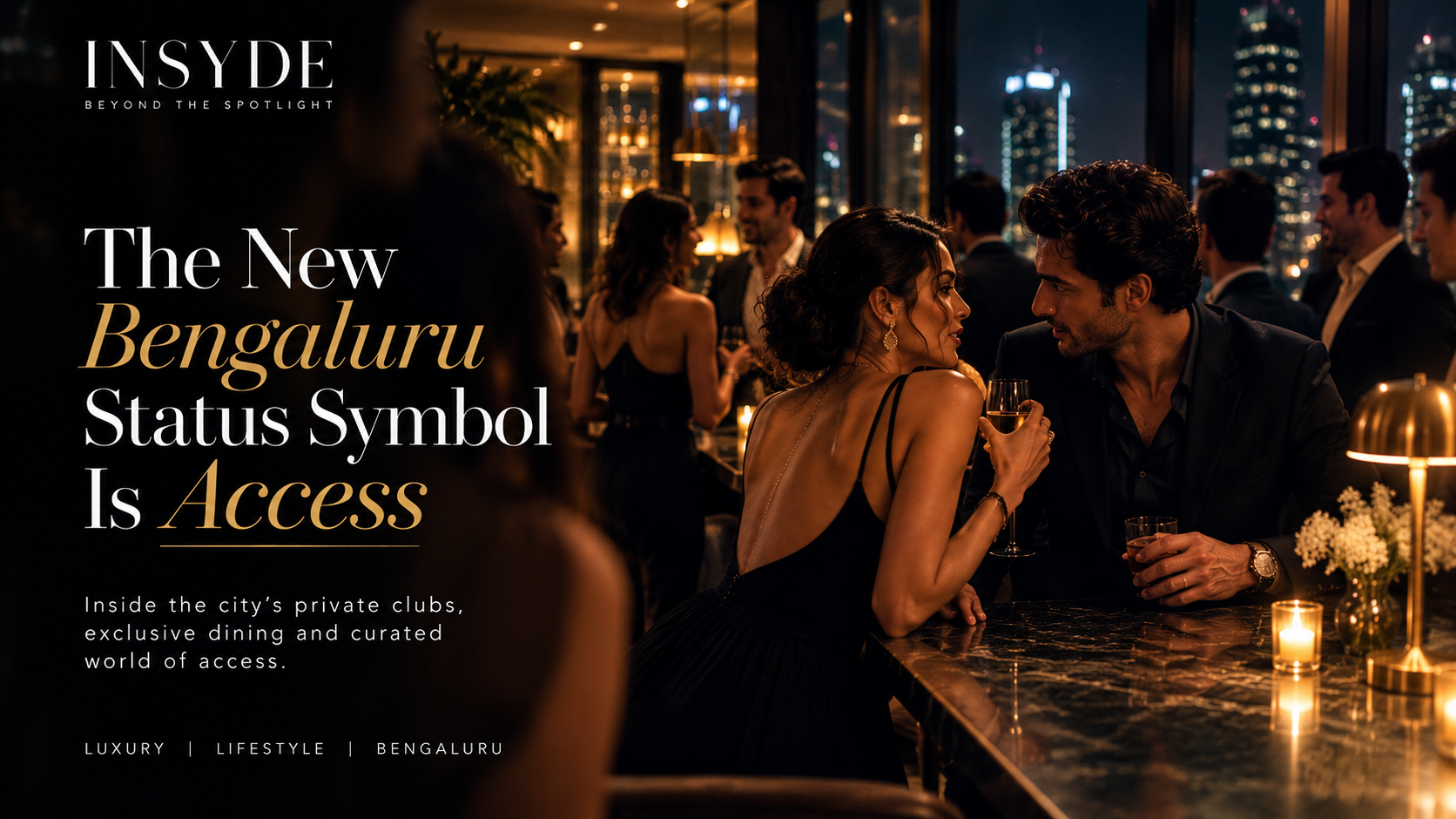
    The New Bengaluru Status Symbol Is Access

    In a city built on networks, wealth is beginning to buy something more elusive than ownership: entry. Private clubs, curated communities, exclusive dining and invitation-only experiences are redefining what luxury means in Bengaluru.

    For a long time, luxury had a fairly recognisable vocabulary.

    A larger home. A more expensive car. A watch that could be recognised across a room. A restaurant reservation that was difficult to secure.

    The symbols were visible.

    But Bengaluru is developing a different relationship with status.

    Increasingly, some of the city’s most desirable experiences are defined not by what they cost, but by who can enter.

    A private room. A members-only club. A dining experience with limited seats. A wellness space built around a carefully selected community. An invitation that does not arrive simply because you can afford it.

    The product is no longer only the place.

    It is access to the people, atmosphere and experience inside it.

    And in Bengaluru—a city whose modern economy has been built on networks, founders, investors and professional connections—that distinction is becoming particularly significant.

    From Ownership to Access

    Luxury has always involved scarcity.

    What is difficult to obtain tends to become more desirable.

    But modern luxury is increasingly moving beyond physical scarcity towards social scarcity.

    There may be thousands of luxury apartments in a city. There may be hundreds of premium restaurants. But there are far fewer rooms where entry is controlled, the community is curated and the experience changes depending on who is sitting around the table.

    That is the appeal of the modern members’ club.

    The idea itself is not new. Bengaluru has long had established clubs with histories, traditions and membership structures of their own. What is changing is the proposition being built for a newer generation.

    The new club is less likely to be defined solely by sport or tradition and more likely to combine hospitality, dining, wellness, work, culture and social life.

    In other words, it is selling a way of belonging.

    The Room Is the Product

    This is where the economics of access become interesting.

    A beautiful building can be replicated.

    A restaurant can be copied.

    A spa can be recreated.

    But a community is considerably harder to reproduce.

    That is why the most sophisticated membership concepts increasingly place the member at the centre of the proposition.

    Bengaluru has begun to see luxury hospitality groups and independent operators experiment with members-only environments that combine dining, meetings, social occasions, wellness and curated experiences.

    The distinction is subtle but important.

    The club is no longer simply the building.

    The room is the product.

    The people in it determine its energy.

    The conversations determine its value.

    The relationships determine whether members return.

    And the exclusivity determines whether the experience remains desirable.

    Why Bengaluru?

    Bengaluru may be uniquely suited to this model.

    The city has produced an enormous amount of first-generation wealth through technology, entrepreneurship, venture capital and the startup ecosystem.

    But wealth does not automatically create community.

    A founder can build a company from a laptop.

    An executive can work with teams across five time zones.

    An investor can conduct an entire business relationship without leaving a screen.

    The more digitally connected professional life becomes, the more valuable physical spaces for meaningful interaction can become.

    This is one reason the new generation of private clubs is less interested in simply offering a place to sit.

    It wants to create a reason to stay.

    To meet.

    To return.

    To know the people around you.

    To become part of something that exists beyond the transaction.

    The Evolution of the Private Club

    Traditional clubs were often built around institutions: golf, sport, professional associations, family connections and long-established social networks.

    The newer generation is being built around interests and identity.

    Entrepreneurship.

    Design.

    Food.

    Wellness.

    Art.

    Technology.

    Culture.

    Or simply a particular understanding of how people want to spend their time.

    That distinction matters in Bengaluru.

    The city is full of people who arrived without inherited networks and built their own.

    Now, a new generation of businesses is attempting to build physical spaces around those networks.

    The result is a different kind of exclusivity.

    Less about lineage.

    More about relevance.

    Luxury Without the Logo

    The rise of access-based luxury also reflects a broader change in how affluent consumers think about status.

    A logo can demonstrate what you own.

    Access demonstrates where you belong.

    That difference matters.

    The most interesting luxury experiences increasingly do not need to announce themselves.

    A discreet entrance.

    A familiar face at reception.

    A reservation that never appears on a public booking platform.

    A room where the atmosphere depends as much on the people inside it as the interiors around them.

    This is luxury stripped of some of its traditional theatre.

    It is quieter.

    More personal.

    And often considerably more difficult to replicate.

    When Going Out Becomes an Experience

    The same logic extends beyond private clubs.

    Bengaluru’s premium hospitality scene is increasingly built around experiences rather than simple consumption.

    Consider the growing appeal of chef-led dinners, limited-seat culinary events, private tastings and highly curated hospitality experiences. The meal remains important, but it is no longer the entire proposition.

    The chef matters.

    The room matters.

    The guest list matters.

    The rarity matters.

    The memory matters.

    Luxury dining is increasingly operating in the same territory as fashion, entertainment and culture: people are paying for participation in a moment.

    That moment might last two hours.

    Its perceived value can last much longer.

    Wellness Becomes Social

    Perhaps the most revealing evolution is happening in wellness.

    Traditionally, wellness was private.

    A gym membership. A spa appointment. A personal trainer.

    The newer model turns wellness into a social environment.

    Across Bengaluru, emerging premium wellness concepts are beginning to combine health, recovery, social interaction and curated membership rather than treating wellness as a purely individual pursuit.

    The proposition is telling.

    Wellness is no longer being sold only as something you do for yourself.

    It is becoming something you belong to.

    That is a distinctly modern version of luxury.

    Access as a Business Model

    For businesses, this shift is significant.

    Membership creates something ordinary hospitality often struggles to build: a recurring relationship.

    A restaurant has a customer.

    A hotel has a guest.

    A club has a member.

    That difference changes the economics.

    A member can generate recurring revenue, attend events, dine repeatedly, bring guests, participate in programming and become part of the community that attracts the next member.

    The physical space becomes the stage.

    The membership becomes the business.

    And the community becomes the moat.

    That is why the most valuable question for a new private club may not be:

    How beautiful is the building?

    It may be:

    Who will be in the room?

    The New Currency of Bengaluru

    There is an irony to all of this.

    Bengaluru built its modern economy around connectivity.

    Now, some of its most premium experiences are being designed around controlled connectivity.

    Not everyone.

    Not everywhere.

    Not all the time.

    Just the right people, in the right room, at the right moment.

    That is the new appeal of exclusivity.

    And perhaps that is why access is becoming more valuable than another object sitting on a shelf.

    You can buy a watch.

    You can buy a house.

    You can buy a car.

    But you cannot simply buy a community with chemistry.

    You have to be admitted into one.

    Beyond Ownership

    Bengaluru’s luxury story is entering another chapter.

    The first was about accumulation.

    Then came the desire for better design, better homes and better experiences.

    Now comes something more intangible.

    Belonging.

    The next generation of luxury businesses will not necessarily compete by offering more.

    They will compete by offering something fewer people can have.

    A room.

    A relationship.

    A conversation.

    A moment.

    An invitation.

    Because in a city where almost everything is connected, the ultimate luxury may be deciding who gets access.

    — INSYDE Editorial

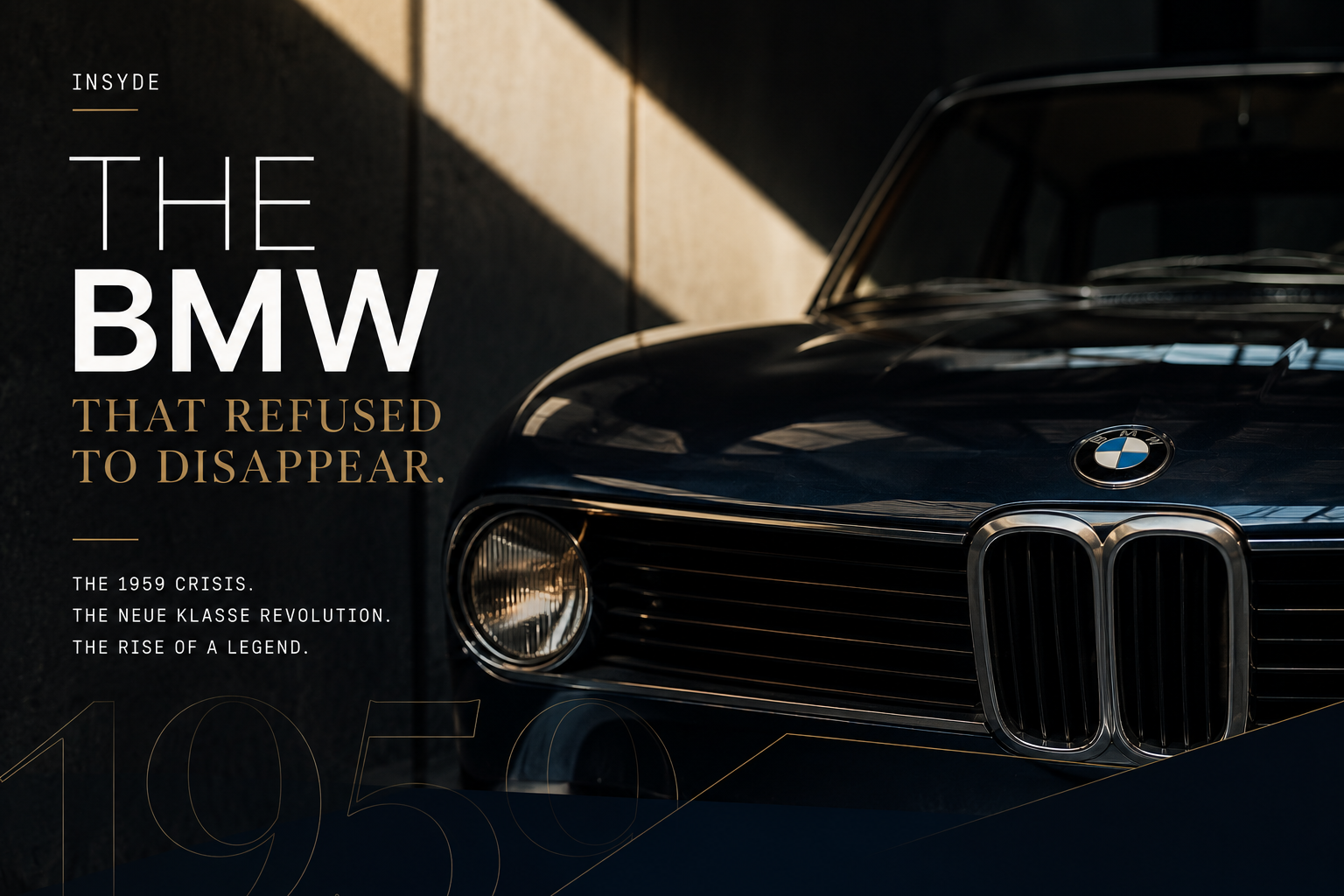
  • THE BMW THAT REFUSED TO DISAPPEAR

    THE BMW THAT REFUSED TO DISAPPEAR

    How a company that nearly fell into Daimler-Benz’s hands reinvented itself — and became one of the world’s defining premium automotive brands.

    Today, the BMW badge carries a certain expectation.

    Performance.
    Precision.
    Design.
    Status.

    For millions of drivers, it represents something more specific than simply owning an expensive car: the idea that luxury should still be felt from behind the wheel.

    But in 1959, BMW was fighting for something much more basic.

    Survival.

    The company was in serious financial difficulty. Its automobile and motorcycle businesses were struggling, and its future independence was in question. Daimler-Benz — the company behind Mercedes-Benz — submitted a time-limited restructuring offer that could have brought BMW under its control.

    At BMW’s Annual General Meeting on 9 December 1959, the proposed takeover was rejected after determined opposition from small shareholders and employees. The offer subsequently expired. BMW remained independent, but its financial crisis was far from over. (BMW Group)

    What happened next would become one of the most remarkable transformations in automotive history.

    BMW didn’t simply survive the crisis.

    It discovered what it could become.


    THE BMW THAT ALMOST BECAME MERCEDES

    The BMW of the late 1950s was a very different company from the one the world knows today.

    It had built beautiful and technically ambitious automobiles, including the 503 and 507, but its larger cars were expensive to produce and difficult to sell profitably. The company was caught between expensive luxury automobiles at one end and smaller, lower-margin products at the other.

    The result was a dangerous financial position.

    By the end of the decade, the possibility of BMW losing its independence was no longer theoretical.

    Daimler-Benz had presented a restructuring proposal.

    The situation reached a dramatic point at the December 1959 shareholders’ meeting. Small shareholders challenged the proposed restructuring, including the valuation assigned to BMW’s brand and workforce. The meeting was adjourned, and the time-limited Daimler-Benz offer expired. (BMW Group Press)

    BMW had escaped.

    But escaping Mercedes was not the same as saving BMW.

    The company still needed a future.


    THEN CAME HERBERT QUANDT

    That future was closely tied to industrialist Herbert Quandt.

    Impressed by the determination of BMW’s shareholders and employees, Quandt increased his investment in the company and backed a restructuring built around keeping BMW independent. Temporary government assistance also helped give the company room to reorganise. (BMW Group)

    The strategy was simple in principle and enormous in consequence:

    BMW would not survive by standing still.

    It needed new products.

    The BMW 700 helped put the company back on a path toward recovery.

    But the decisive breakthrough was still ahead.

    It would arrive in 1961.

    And it would wear a name that would eventually become one of the most important phrases in BMW’s history:

    Neue Klasse.


    THE CAR THAT CHANGED EVERYTHING

    At the 1961 Frankfurt Motor Show, BMW unveiled the BMW 1500.

    It was compact by the standards of the time. Sporty. Modern. Four-door. Engineered around a new approach to performance and everyday usability.

    And people noticed.

    BMW says the car filled a gap in the market and became the breakthrough that established the company as a successful, contemporary automaker. Demand was so strong that initial orders exceeded production capacity. (BMW Group)

    The 1500 was more than a successful model.

    It gave BMW a direction.

    It showed that the company didn’t need to compete by simply building larger, softer or more traditionally prestigious cars.

    It could build something different.

    A premium automobile designed around the person driving it.

    The philosophy was beginning to take shape.


    BMW DIDN’T TRY TO BECOME MERCEDES

    This is where the story becomes more interesting.

    BMW’s great strategic victory wasn’t beating Mercedes at Mercedes’ own game.

    It was refusing to play the same game.

    Mercedes-Benz already had extraordinary heritage, engineering credibility and a powerful association with prestige.

    BMW needed its own territory.

    The Neue Klasse gave it one.

    The company increasingly built its identity around agility, performance, design and the relationship between driver and machine.

    Mercedes could represent arrival.

    BMW could represent the journey.

    That distinction would become incredibly valuable.

    Because BMW wasn’t simply selling another interpretation of luxury.

    It was creating a different one.


    WHEN PERFORMANCE BECAME LUXURY

    Traditional luxury had always been associated with refinement.

    Leather.

    Wood.

    Comfort.

    Silence.

    Status.

    BMW added something else.

    Emotion.

    The driving experience itself became part of the luxury proposition.

    The steering.

    The balance.

    The response of the engine.

    The position of the driver.

    The way the car behaved through a corner.

    These weren’t merely engineering specifications.

    They became part of the emotional value of owning a BMW.

    The brand’s promise of “Sheer Driving Pleasure” eventually gave that philosophy a simple expression — and the roots of that promise can be traced directly back to the Neue Klasse era. (BMW Group)

    BMW had discovered a powerful idea:

    Luxury doesn’t have to separate you from the machine. It can bring you closer to it.


    THE 02 SERIES MADE THE IDEA SCALABLE

    The Neue Klasse created the foundation.

    The 02 Series helped turn that foundation into a brand identity.

    Introduced in the 1960s, the compact two-door models brought BMW’s sporting character to a wider audience. BMW describes the 02 Series as a benchmark for the brand’s approach to combining everyday usability with driving pleasure. (BMW Group)

    This mattered enormously.

    BMW wasn’t creating one successful car.

    It was developing a repeatable philosophy.

    Compact could still be premium.

    Practical could still be exciting.

    Everyday transportation could still have character.

    And that gave BMW something luxury brands desperately want:

    a recognisable point of view.


    THE 3 SERIES CHANGED THE GAME AGAIN

    Then came the car that would turn BMW’s philosophy into a global phenomenon.

    The BMW 3 Series arrived in 1975.

    Compact dimensions.

    Rear-wheel drive.

    Driver-focused ergonomics.

    Sporty proportions.

    Premium quality.

    Everyday practicality.

    BMW describes the 3 Series as the world’s bestselling premium car and says the model has attracted more than 20 million customers worldwide across seven generations. (BMW Group)

    Its importance goes beyond sales.

    The 3 Series made the BMW formula understandable.

    You didn’t have to be a racing driver.

    You didn’t have to own a chauffeur-driven limousine.

    You simply had to enjoy driving.

    That was the genius.

    BMW had taken something traditionally associated with sports cars and integrated it into a practical premium sedan.

    Luxury became something you could experience every morning on the way to work.


    THE MERCEDES RIVALRY BECAME A CULTURAL ONE

    By this point, the relationship between BMW and Mercedes had changed.

    BMW was no longer the company that had nearly been absorbed.

    It was becoming one of Mercedes-Benz’s defining competitors.

    But the rivalry wasn’t simply about price or horsepower.

    It was about identity.

    Mercedes could represent authority, heritage and formal prestige.

    BMW increasingly represented performance, independence and the pleasure of driving.

    Neither interpretation needed to destroy the other.

    In fact, their differences made both brands stronger.

    The competition created a question that would shape the premium automotive market for decades:

    What should a luxury car make you feel?

    BMW had its answer.


    THEN BMW TURNED PERFORMANCE INTO MYTH

    BMW’s relationship with motorsport added another layer to the brand.

    Performance was no longer merely something engineers claimed.

    It could be demonstrated on a track.

    That credibility eventually became central to BMW M.

    Motorsport technology, performance engineering and road-car development began reinforcing one another.

    The M badge became more than a specification.

    It became a symbol.

    That matters in luxury.

    Because luxury consumers don’t only buy features.

    They buy provenance.

    A reason to believe.

    A story that existed before the product arrived.

    BMW had one.


    THE BRAND BECAME PART OF THE PRODUCT

    Eventually, BMW reached a point that every luxury company dreams of reaching.

    The product no longer had to explain the brand.

    The brand explained the product.

    You could recognise a BMW from its proportions.

    Its design language.

    Its cockpit.

    Its grille.

    Its stance.

    And, increasingly, the way it behaved on the road.

    The badge itself had accumulated meaning.

    This is when a manufacturer becomes more than a manufacturer.

    It becomes a brand with a worldview.

    BMW wasn’t simply selling cars anymore.

    It was selling a particular relationship between the driver and the machine.


    BMW DIDN’T BEAT MERCEDES BY COPYING IT

    This is the part of the story that matters most.

    BMW’s eventual success was not built on becoming a cheaper Mercedes.

    It wasn’t built on becoming a louder Mercedes.

    And it wasn’t built on simply offering more luxury features.

    BMW found a different route to desirability.

    It made performance aspirational.

    It made driving part of luxury.

    It turned engineering into emotion.

    And it created a customer who didn’t simply want to be transported.

    They wanted to be involved.

    That distinction became BMW’s competitive advantage.


    FROM SURVIVAL TO GLOBAL POWER

    The transformation took decades.

    The Neue Klasse established the direction.

    The 02 Series broadened the philosophy.

    The 3 Series turned it into a global formula.

    BMW M gave performance a halo.

    The 5 Series and 7 Series expanded the brand into higher segments.

    The X family opened another enormous market.

    And BMW continued evolving as luxury itself changed.

    Today, BMW operates at enormous global scale. In financial year 2025, BMW Group delivered 2.46 million premium vehicles, while BMW M reached a record 213,449 deliveries. (BMW Group Press)

    That doesn’t mean BMW literally “defeated” Mercedes-Benz.

    Mercedes remains one of the world’s most important luxury automotive brands.

    The more significant achievement is that BMW became powerful enough to challenge Mercedes from a completely different position.

    It didn’t need to become Mercedes.

    It built an identity Mercedes couldn’t own.


    THE REAL BMW LUXURY

    That is why BMW’s story is ultimately not about cars.

    It is about positioning.

    A company that was nearly absorbed had to decide what made it worth saving.

    The answer wasn’t simply its factory.

    It wasn’t simply its engineering.

    It wasn’t simply its history.

    It was the possibility of creating something distinctive.

    BMW realised that it could make luxury emotional.

    That it could make engineering desirable.

    That it could make performance aspirational.

    And, most importantly, that independence could itself become part of the brand.


    THE BMW THAT REFUSED TO DISAPPEAR

    In 1959, BMW was fighting to remain independent.

    One year later, Herbert Quandt backed a restructuring that kept the company on its own path.

    In 1961, the BMW 1500 gave that path a product.

    The Neue Klasse gave it a philosophy.

    The 02 Series gave it momentum.

    The 3 Series gave it scale.

    BMW M gave it mythology.

    And the decades that followed turned that philosophy into one of the world’s most recognisable premium automotive brands. (BMW Group)

    That is the extraordinary part of the story.

    BMW didn’t inherit its position at the top.

    It engineered its way there.

    And perhaps the most important lesson is not about automobiles at all.

    When a company is pushed to the edge, the instinct is often to become more like the competitor that appears to be winning.

    BMW did something more difficult.

    It discovered what it could become that its competitor couldn’t.

    It didn’t survive by becoming Mercedes.

    It survived by becoming BMW.

    And that may be the most valuable luxury of all:

    having an identity nobody else can own.

    INSYDE — Beyond the Spotlight.

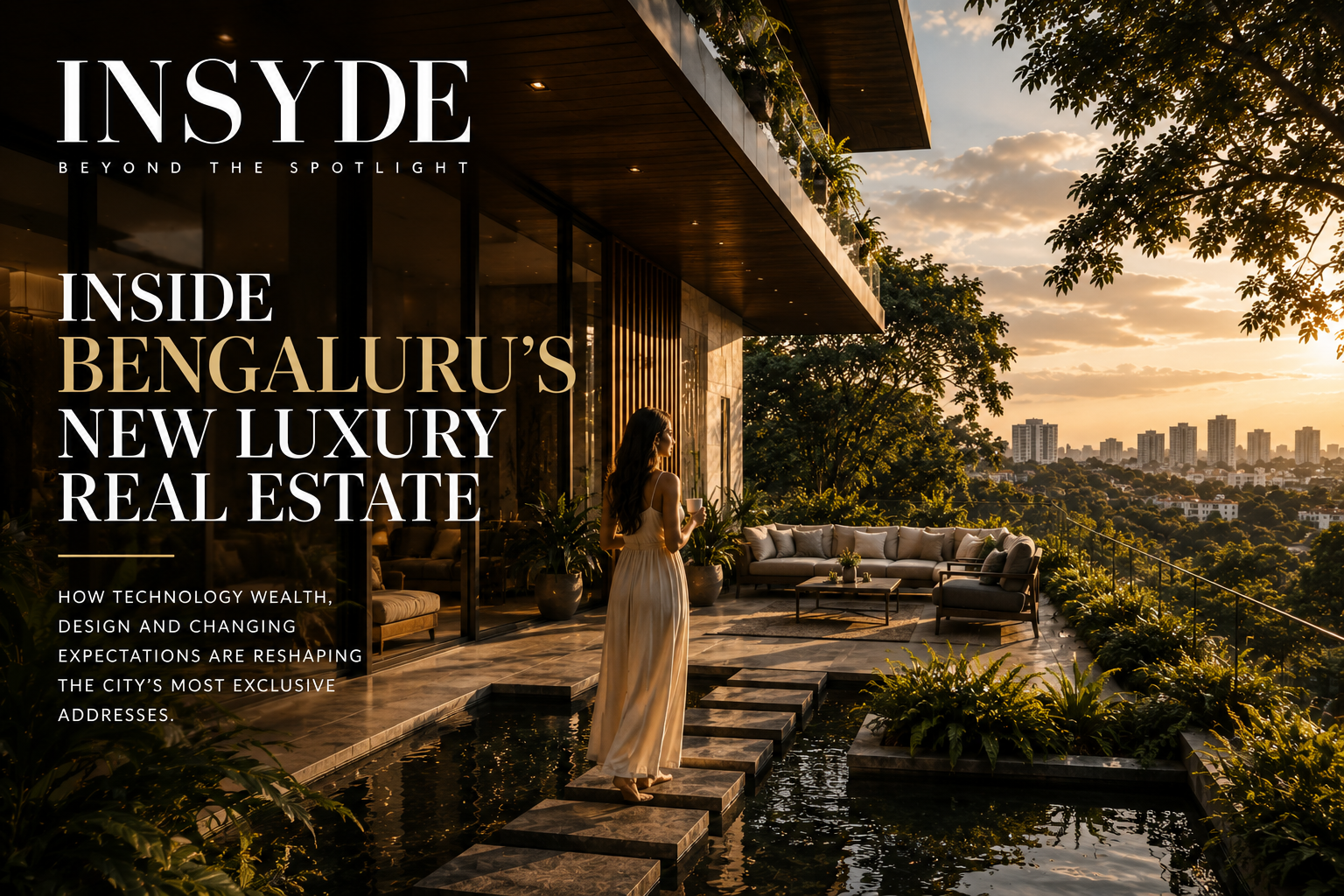
  • Inside Bengaluru’s New Luxury Real Estate

    Inside Bengaluru’s New Luxury Real Estate

    Technology wealth, changing consumer expectations and a new appetite for design are reshaping Bengaluru’s high-end housing market. At the top end, a home is no longer simply a property—it is becoming an expression of how the city wants to live.

    Bengaluru has always understood the language of growth.

    For decades, the city built its reputation on technology, entrepreneurship and the companies that transformed India’s relationship with the global economy. But as that wealth has matured, another transformation is becoming increasingly visible.

    The city is beginning to spend its wealth differently.

    Nowhere is that more apparent than in luxury real estate.

    Bengaluru’s most expensive homes are no longer being defined simply by their size or their address. Increasingly, buyers are paying for privacy, architecture, wellness, technology, service and the experience of living well.

    The numbers suggest that this is no longer a niche phenomenon.

    It is becoming a market of its own.

    When ₹10 Crore Became a Market

    In FY2025, Bengaluru’s residential market for homes priced at ₹10 crore and above crossed ₹1,000 crore in annual sales for the first time. Seventy-eight homes in the segment were sold that year, compared with 51 in the previous financial year.

    The momentum continued into FY2026.

    Data from CRE Matrix and India Sotheby’s International Realty recorded 128 Bengaluru homes priced at ₹10 crore and above sold during FY2026, representing ₹1,957 crore in transaction value. Unit sales increased 52% year on year, making Bengaluru the fastest-growing southern market covered in their report.

    The significance of those numbers is not simply that more expensive homes are being sold.

    It is that Bengaluru now has a sufficiently deep pool of affluent buyers for ultra-premium residential property to behave like a distinct consumer market.

    The ₹10 crore threshold is no longer merely a marker of exceptional wealth.

    It is becoming part of the city’s expanding luxury economy.

    The New Bengaluru Buyer

    Bengaluru’s luxury consumer is different from the traditional image of the Indian high-net-worth buyer.

    The city’s wealth has been shaped heavily by technology, entrepreneurship, global businesses and the startup ecosystem. Its affluent population includes founders, CXOs, senior technology executives, entrepreneurs, HNIs and globally mobile Indians.

    That background influences what they expect from a home.

    The FY2025 luxury housing data identified startup founders, CXOs, HNIs and global Indians among the key buyers in the ₹10 crore-plus segment.

    For this consumer, luxury is increasingly about what the price enables.

    More privacy.

    More space.

    Better design.

    Better security.

    Better amenities.

    Better access.

    And, perhaps most importantly, a home that feels aligned with the life they have built.

    That distinction matters.

    Because when buyers begin choosing residences based on experience rather than square footage alone, real estate starts behaving like luxury.

    When a Home Becomes an Experience

    The traditional luxury residence was often defined by scale.

    The larger the home, the greater the sense of status.

    That equation is changing.

    Today’s premium developments increasingly compete through what surrounds the residence: architecture, landscape, wellness facilities, private amenities, smart-home technology, hospitality-style services and carefully designed communal spaces.

    The home is becoming an ecosystem.

    This reflects a broader transformation in luxury consumption. Across India, affluent consumers are increasingly placing value on experiences, personalisation, hospitality and environments rather than visible symbols of wealth.

    Bengaluru is particularly suited to this evolution.

    A city accustomed to paying a premium for technology, convenience and efficiency is beginning to apply the same logic to where it lives.

    The Rise of the Design-Led Residence

    At the upper end of the market, architecture is no longer background.

    It is part of the product.

    Natural materials. Generous proportions. Landscape design. Light. Privacy. Technology. Wellness.

    These details are increasingly becoming part of the value proposition.

    Knight Frank’s H1 2026 research recorded a 9% year-on-year increase in Bengaluru’s average weighted residential price, reaching ₹9,354 per square foot. The research also found continued momentum in premium housing, with the ₹2–5 crore segment recording a 50% year-on-year increase in new launches.

    The figures point to a broader premiumisation of the market.

    But at the very top end, the competition is less about simply adding square footage.

    It is about creating differentiation.

    A luxury residence needs to feel considered.

    Bengaluru’s Luxury Map Is Moving

    Luxury has traditionally been associated with Bengaluru’s established central neighbourhoods.

    But the geography of premium living is expanding.

    Hebbal has emerged as one of the city’s strongest luxury markets. In FY2025, it accounted for 22% of Bengaluru’s ₹10 crore-plus luxury apartment sales value, while markets including Domlur, Sudhamnagar and Bommanahalli also featured among emerging high-end locations.

    North Bengaluru is particularly significant.

    Knight Frank identified North Bengaluru as the city’s fastest-growing residential corridor in H1 2026, with launches increasing 10% and sales rising 11% year on year. Infrastructure development, expanding commercial activity, employment growth and airport connectivity are helping reshape the area’s residential appeal.

    This matters beyond property.

    When the geography of wealth changes, the geography of the city changes with it.

    Restaurants follow affluent neighbourhoods.

    Retail follows.

    Hospitality follows.

    Wellness, design and premium services follow.

    Real estate is therefore not simply responding to Bengaluru’s growth.

    It is helping create the next version of the city.

    The Space Equation

    One of the clearest indicators of changing expectations is the demand for larger residences.

    In FY2025, luxury apartments in the 5,000–7,000 square-foot range attracted particularly strong buyer interest.

    But space itself is becoming more nuanced.

    The value of a large residence increasingly lies in what that space allows.

    A private office.

    A library.

    A home gym.

    A guest suite.

    A larger kitchen designed for entertaining.

    A terrace that functions as an outdoor room.

    A private garden.

    A space for art.

    The modern luxury residence is beginning to resemble a private hospitality environment—one designed around the rituals of its occupants.

    That is a very different proposition from simply buying a bigger apartment.

    The Business of Premiumisation

    For developers and luxury brands, this shift has significant implications.

    A growing affluent consumer base creates opportunities well beyond residential property. Architecture, interiors, furniture, fashion, jewellery, automobiles, hospitality, wellness and premium entertainment increasingly occupy the same ecosystem.

    India’s luxury retail market is expanding alongside this affluent consumer base, while brands are increasing their presence in major metropolitan markets and experimenting with more experience-led physical spaces.

    Bengaluru is becoming an important part of that story.

    The city’s luxury real estate market can therefore be understood as more than a property segment.

    It is a gateway into a broader premium economy.

    A high-value residence can create demand for interior design.

    A new luxury neighbourhood can create demand for restaurants and hospitality.

    A concentration of affluent households can attract international brands.

    And a sophisticated consumer base can raise expectations across the entire market.

    The luxury home becomes the starting point rather than the end product.

    The Limits of Luxury

    There is another side to Bengaluru’s premiumisation.

    Prices are rising, but buyers are also becoming more selective.

    Knight Frank reported that Bengaluru’s residential sales moderated sequentially in H1 2026, even as year-on-year demand remained positive. The report also identified affordability pressures and elevated property prices as factors influencing buyer and developer behaviour.

    For the luxury segment, that selectivity may ultimately be healthy.

    When buyers have more choices and higher expectations, developers cannot rely solely on a prestigious address or a large floor plan.

    They have to create a reason for the premium.

    That means better architecture.

    Better service.

    Better design.

    Better experiences.

    Luxury, after all, only works when the buyer believes there is something genuinely rare about what is being offered.

    What Bengaluru Is Building

    The most interesting part of Bengaluru’s luxury real estate story is not the price of its homes.

    It is what those homes represent.

    For a technology entrepreneur, a residence can be a private retreat from an intensely connected professional life.

    For a global Indian, it can be a return to Bengaluru with expectations shaped by international cities.

    For a young founder or CXO, it can be both an asset and an expression of identity.

    For developers, it represents an opportunity to move beyond conventional residential construction and create complete lifestyle environments.

    And for Bengaluru itself, it signals something larger:

    A city that once built its identity around creating wealth is becoming increasingly comfortable with living it.

    The Next Address

    Bengaluru’s luxury real estate market is entering a more sophisticated phase.

    The first chapter was about accumulation.

    The next is about curation.

    As affluent buyers become more discerning, the winning residences will not necessarily be the largest or the most conspicuous.

    They will be the ones that understand what luxury increasingly means:

    Privacy without isolation. Technology without intrusion. Architecture without excess. Comfort without compromise.

    Bengaluru’s luxury real estate story is ultimately not about houses.

    It is about what the city’s wealth wants its future to look like.

    And increasingly, that future has an address.

    — INSYDE Editorial

    Sources: CRE Matrix & India Sotheby’s International Realty; Knight Frank India; Fortune India; Business Standard.

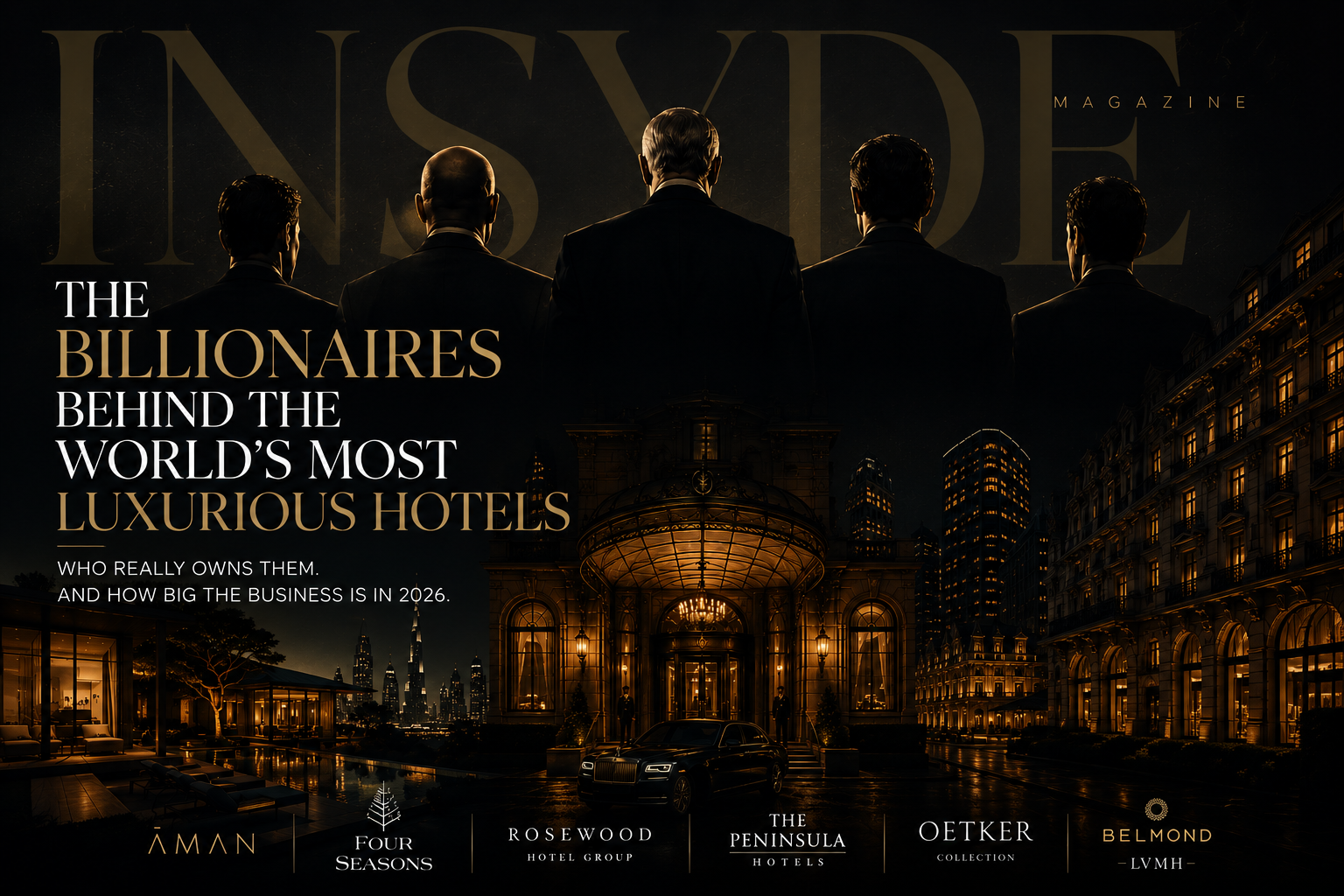
  • THE BILLIONAIRES BEHIND THE WORLD’S MOST LUXURIOUS HOTELS

    THE BILLIONAIRES BEHIND THE WORLD’S MOST LUXURIOUS HOTELS

    You know the hotel. You know the name. But do you know who actually owns the world behind it?

    Walk into one of the world’s great luxury hotels and you see the same things.

    Marble.

    Chandeliers.

    Immaculate suites.

    Private entrances.

    Restaurants where reservations can feel harder to secure than flights.

    Service so polished that almost everything appears effortless.

    But behind that effortless experience is a business most guests never think about.

    Who owns it?

    The answer is rarely as simple as the name above the entrance.

    A billionaire might own the hotel company.

    A family office might own the building.

    An investment fund might own the land.

    Another company might operate the property.

    And a global luxury group might own the brand and manage the experience.

    That complexity is not a technical footnote.

    It is the story.

    Because in 2026, some of the world’s most powerful fortunes are increasingly connected to the business of luxury hospitality.

    And the money involved is enormous.

    A $10 billion valuation for Four Seasons.

    A $3.2 billion enterprise-value acquisition of Belmond by LVMH.

    A $500 million new investment vehicle targeting Aman and Janu hotels, residences and mixed-use developments.

    A $230 million acquisition of Rosewood that helped turn it into a global luxury-hospitality group.

    These aren’t simply hotel deals.

    They are bets on the future of luxury itself.


    THE HOTEL YOU SEE IS ONLY THE FRONT END

    The first thing to understand about luxury hotels is that the brand and the building are not necessarily the same business.

    This is where the industry becomes fascinating.

    A hotel group can create the brand, design the service standards and manage the property without owning the real estate.

    A property company can own the building and hire a hotel company to operate it.

    An investment group can finance the development.

    And a billionaire can ultimately control the company sitting somewhere above all of them.

    So when someone says a billionaire “owns a hotel”, that can mean several different things.

    They may own:

    The hotel brand.

    The operating company.

    The property.

    The development company.

    Or simply a controlling stake in the company that controls the brand.

    At the top end of hospitality, understanding that distinction is essential.

    Because sometimes the most valuable thing in the building isn’t the building at all.

    It’s the name.


    AMAN: THE BILLIONAIRE WHO TURNED PRIVACY INTO AN EMPIRE

    Few names represent ultra-luxury quite like Aman.

    The brand began in 1988 with Amanpuri in Phuket and built its reputation around something that was almost the opposite of conventional luxury-hotel expansion:

    scarcity.

    Then came Vlad Doronin.

    The billionaire real-estate entrepreneur acquired Aman in 2014, after having been a long-time Aman guest himself. Since then, he has expanded the brand from secluded resorts into city hotels, residences, private clubs, interiors and new forms of travel.

    Aman has now grown into a global portfolio of hotels and resorts, while its ecosystem has expanded far beyond traditional hospitality.

    And then came the number that reveals where Aman is really heading.

    In July 2026, Doronin’s OKO Group announced a $500 million joint venture with Shinsegae Property to develop Aman and Janu hotels, branded residences and mixed-use properties.

    But the most striking part may be the residential business.

    Doronin told Bloomberg that Aman had sold close to $9 billion in branded residences over the previous four years, according to Forbes.

    Suddenly, Aman looks very different.

    It isn’t simply a company selling extraordinarily expensive hotel rooms.

    It is building a world where the same customer can stay at Aman, live at Aman, join Aman and eventually travel with Aman.

    The hotel becomes the entry point.

    The brand becomes the real asset.


    FOUR SEASONS: THE $10 BILLION BET

    If Aman represents scarcity, Four Seasons represents something else:

    global scale without abandoning luxury.

    Four Seasons is backed by Cascade Investment, associated with Bill Gates, alongside Kingdom Holding Company and founder Isadore Sharp.

    In 2021, Cascade agreed to acquire an additional 23.75% stake for $2.21 billion, taking its ownership to 71.25% and valuing Four Seasons at approximately $10 billion in enterprise value.

    That wasn’t a bet on one hotel.

    It was a bet on a global luxury machine.

    Four Seasons has continued expanding and says it has 135 hotels and resorts and 61 residential properties across 47 countries.

    And this is what makes the Four Seasons strategy so interesting.

    Aman tells the customer:

    You are entering a world very few people can access.

    Four Seasons tells the customer:

    You can expect an extraordinary standard wherever in the world you go.

    Two completely different interpretations of luxury.

    Both extraordinarily valuable.


    ROSEWOOD: THE $230 MILLION ACQUISITION

    Rosewood’s story demonstrates another way fortunes enter luxury.

    In 2011, Chow Tai Fook Enterprises, the Hong Kong company behind the Cheng family’s business empire, acquired Rosewood for roughly $230 million.

    The interesting part isn’t simply what they paid.

    It is what happened afterwards.

    Rosewood Hotel Group has expanded into a global hospitality platform, with 60 properties across 26 countries and territories and more than 30 additional properties in development.

    The group also operates other hospitality and lifestyle businesses.

    That makes Rosewood an important example of a larger trend:

    wealthy owners aren’t necessarily buying hotels to collect hotels.

    They’re buying brands that can be expanded across multiple categories.

    Hotels.

    Residences.

    Wellness.

    Private clubs.

    Experiences.

    And eventually, entire lifestyles.


    THE PENINSULA: WHEN LUXURY BECOMES A FAMILY LEGACY

    Then there is The Peninsula.

    Its story feels almost completely different.

    The Peninsula Hotels are part of Hongkong and Shanghai Hotels, a business with roots going back to 1866 and long associated with the Kadoorie family.

    Its chairman, Sir Michael Kadoorie, represents a very different model of luxury ownership: generational wealth.

    The Peninsula portfolio remains deliberately selective, with properties across major cities and destinations including Hong Kong, Shanghai, Tokyo, New York, London and Paris.

    This is not the story of a billionaire buying a trendy hospitality brand and rapidly multiplying its properties.

    It is something much older:

    generational ownership.

    That distinction matters.

    Because luxury isn’t always built through growth.

    Sometimes it is built through continuity.

    The Peninsula doesn’t need to be everywhere.

    Its power comes partly from the fact that it isn’t.


    OETKER: THE FAMILY BUSINESS BEHIND EUROPEAN HOTEL ROYALTY

    If there is one group that demonstrates the relationship between family wealth and luxury heritage, it is Oetker.

    Oetker Collection sits within the family-owned Oetker business, whose interests extend well beyond hotels.

    The group identifies Dr. Alfred Oetker and Ferdinand Oetker among its shareholders, while the wider family business spans multiple industries, including real estate and luxury hospitality.

    Its hotel portfolio includes names such as Le Bristol Paris and Hotel du Cap-Eden-Roc.

    And this is where luxury hospitality becomes different from almost every other industry.

    You can spend billions building a new hotel.

    But you cannot spend billions and instantly purchase a century of history.

    A historic address has something money alone cannot manufacture:

    memory.

    That is why heritage itself has become a luxury asset.

    You can construct a spectacular hotel in three years.

    You cannot manufacture decades of mythology.


    LVMH: WHEN THE LUXURY CONGLOMERATE ENTERS THE HOTEL BUSINESS

    Then there is the world’s ultimate luxury conglomerate.

    LVMH.

    The group already controlled brands across fashion, jewellery, watches, beauty and wine and spirits.

    Then it went deeper into hospitality.

    In 2018, LVMH agreed to acquire Belmond for $2.6 billion in equity value and $3.2 billion in enterprise value. The transaction was completed in 2019.

    Belmond brought with it hotels, restaurants, luxury trains and river cruises.

    That acquisition was important because it revealed a larger strategy.

    Luxury doesn’t have to mean selling a handbag.

    It can mean selling the entire journey surrounding the customer.

    A hotel.

    A train.

    A yacht.

    A destination.

    A restaurant.

    A fashion house.

    A piece of jewellery.

    Different products.

    One customer.

    One ecosystem.

    And in 2026, that strategy is becoming even more relevant as luxury groups push further into travel and experiential hospitality.


    THE BILLIONAIRE DOESN’T ALWAYS OWN THE HOTEL

    This is perhaps the most important part of the entire story.

    Imagine a luxury hotel carrying one of the world’s most famous names.

    The guest assumes the company behind that name owns everything.

    Not necessarily.

    The brand could belong to one company.

    The real estate could belong to another.

    The hotel operator could be a third.

    The financing could come from a fourth.

    And the ultimate investor could sit several layers above them.

    That structure is extremely common in modern hospitality.

    It allows hotel companies to expand without buying every building themselves.

    And it allows property investors to use powerful luxury brands to make their real estate more valuable.

    Which leads to perhaps the biggest transformation happening in luxury right now.


    THE REAL GOLDMINE: BRANDED RESIDENCES

    The hotel room is no longer necessarily the biggest prize.

    The residence might be.

    Luxury hotel brands are increasingly attaching their names to private residences.

    Why?

    Because selling a hotel room generates revenue from a stay.

    Selling a branded residence can create an enormous property transaction — while allowing the hotel company to earn branding, management and service fees without necessarily owning the entire building.

    Aman is one of the clearest examples.

    According to Forbes’ 2026 reporting, Aman has sold close to $9 billion in branded residences in four years, while Savills data cited in the same report indicated that buyers globally were willing to pay an average 33% premium for branded residences over comparable unbranded homes.

    That is a staggering proposition.

    Imagine buying an apartment.

    Now put a globally recognised luxury hotel brand on the front.

    Add hotel-level service.

    Concierge.

    Housekeeping.

    Wellness.

    Restaurants.

    Private clubs.

    Then charge a premium for the privilege.

    Suddenly the hotel brand is no longer just selling hospitality.

    It is selling real estate at a premium.


    WHY BILLIONAIRES WANT INTO HOSPITALITY

    So why would someone who already has billions want to own hotels?

    The obvious answer is money.

    But it isn’t the only answer.

    Luxury hospitality sits at an unusual intersection of industries.

    Real estate.

    Travel.

    Food.

    Fashion.

    Entertainment.

    Culture.

    Private wealth.

    A luxury hotel can become a meeting place for CEOs.

    A destination for celebrities.

    A home-away-from-home for billionaires.

    A platform for restaurants and chefs.

    A gateway into a city.

    A launchpad for branded residences.

    A private club.

    And a physical expression of a luxury brand.

    That makes the hotel much more powerful than a simple accommodation business.

    It becomes a social and commercial ecosystem.


    FROM ROOMS TO WORLDS

    This is where the luxury-hospitality business is ultimately heading.

    A hotel room was once the product.

    Then came the suite.

    Then the villa.

    Then the residence.

    Then the private club.

    Then the yacht.

    Then the private travel experience.

    The customer doesn’t necessarily want to buy one thing anymore.

    They want an entire world that feels consistent with their lifestyle.

    Aman understands this.

    Four Seasons understands this.

    LVMH understands this.

    Rosewood understands this.

    And the investors behind these companies understand something even more important:

    The luxury customer doesn’t stop being a luxury customer when they leave the hotel.

    So why should the brand stop selling to them?


    THE NEW LUXURY POWER PLAY

    This changes the economics of luxury.

    The most valuable hospitality brands aren’t necessarily the ones with the most rooms.

    They may be the ones that can convince customers to spend across the greatest number of categories.

    Stay at the hotel.

    Buy the residence.

    Join the club.

    Book the experience.

    Take the yacht.

    Return to another property.

    Bring the same brand into your lifestyle.

    That is a much bigger business than hotel occupancy.

    And it explains why billionaires, family fortunes and luxury conglomerates continue to look at hospitality as more than a place to park capital.

    They are buying access to a customer.


    SO, WHO REALLY OWNS LUXURY?

    There is no single answer.

    Vlad Doronin controls Aman.

    Cascade Investment is the controlling shareholder behind Four Seasons.

    The Cheng family’s Chow Tai Fook Enterprises controls Rosewood.

    The Kadoorie family sits behind The Peninsula’s long-running ownership structure.

    The Oetker family controls its luxury hospitality and wider family business.

    LVMH controls Belmond and has built a growing luxury-hospitality ecosystem around it.

    Different fortunes.

    Different generations.

    Different strategies.

    But they are all betting on the same fundamental idea:

    Luxury is becoming less about a product and more about an ecosystem.


    THE PEOPLE YOU NEVER SEE

    The guests are visible.

    The hotel is visible.

    The logo is visible.

    The billionaire behind the business usually isn’t.

    You won’t see them standing in the lobby.

    You probably won’t know which investment vehicle owns the building.

    You may never know which company controls the brand.

    And you certainly won’t see the spreadsheets behind the marble.

    But those decisions determine where the next hotel opens.

    Which neighbourhood becomes fashionable.

    Which destination receives billions in development.

    Which brands remain exclusive.

    Which become global.

    And which luxury experiences become available only to those who can afford them.

    That is the hidden side of hospitality.

    Not the room.

    Not the restaurant.

    Not the view.

    The ownership.

    Because the next time you walk into one of the world’s most luxurious hotels, look beyond the chandelier.

    Ask who owns the building.

    Who owns the brand.

    Who operates it.

    Who financed it.

    And who stands to benefit when the world’s wealthiest people decide they want to stay there.

    Because sometimes, the most interesting person in the hotel…

    is the one you never see.

    INSYDE — Beyond the Spotlight.

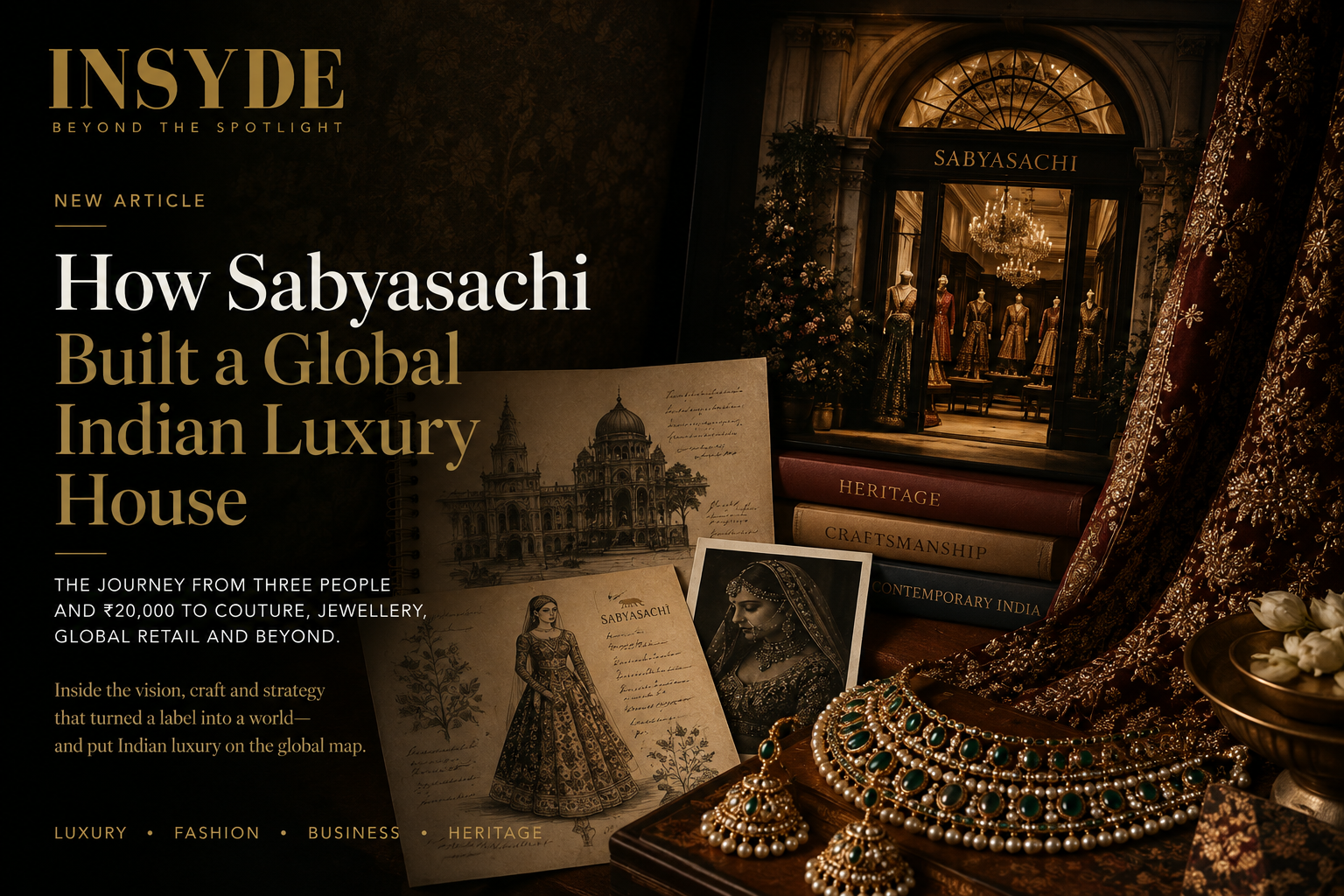
  • How Sabyasachi Built a Global Indian Luxury House | INSYDE

    How Sabyasachi Built a Global Indian Luxury House | INSYDE

    The Sabyasachi label began with three people and ₹20,000. Today, it spans couture, jewellery, retail, beauty, art and international markets. The real story is how a designer turned an aesthetic into an entire luxury ecosystem.

    A fashion label sells clothes.

    A luxury house sells something much harder to manufacture:

    a world.

    Sabyasachi has spent more than two decades building one.

    The clothes came first.

    Then came bridalwear.

    Then jewellery.

    Then accessories.

    Then stores that looked more like museums.

    Then international expansion.

    Then beauty.

    Then art.

    Then collaborations with global companies.

    At some point, calling Sabyasachi simply a fashion label stopped being enough.

    The more interesting question became:

    How did one designer turn a very specific idea of India into a global luxury business?

    The original ambition was never small

    The Sabyasachi story starts with an unusually clear ambition.

    After graduating from NIFT Kolkata in 1999, Sabyasachi rejected job offers from established designers and started his own label. His official history says he borrowed ₹20,000 from his family and began with a workforce of three.

    The ambition, according to the brand, was to create India’s biggest luxury house.

    That is important because it changes how we read everything that followed.

    The jewellery wasn’t a random extension.

    The stores weren’t simply retail expansion.

    The beauty collaboration wasn’t just another licensing opportunity.

    They were pieces of a larger plan.

    The goal was never only to design clothes.

    It was to build a house.

    The luxury proposition was craft

    The foundation of the business is not celebrity.

    It is craftsmanship.

    Sabyasachi’s official history describes work with weavers, block printers, embroiderers, dyers, goldsmiths, furniture artisans and other craftspeople across India. It currently says the house employs around 1,000 craftspeople and works regularly with more than 3,000 craftspeople and master weavers.

    That network gives the brand something modern luxury increasingly values:

    provenance.

    Where was it made?

    Who made it?

    How long did it take?

    What technique was used?

    What region does it come from?

    These questions turn an object into a story.

    And luxury has always been very good at selling stories.

    Sabyasachi’s innovation was to argue that India’s enormous craft tradition could be the foundation of a luxury proposition rather than simply a source of inspiration.

    The house explicitly describes the future of artisanal crafts and handwoven textiles as lying in luxury.

    That is not just a design philosophy.

    It is a business philosophy.

    The bridal business created the ecosystem

    Couture created prestige.

    Bridalwear created demand.

    Jewellery expanded the relationship.

    The wedding became the perfect environment for a luxury house because the customer often needs multiple categories at once.

    Clothing.

    Jewellery.

    Accessories.

    Beauty.

    Sometimes even décor and hospitality.

    Sabyasachi’s first bridal collection, Chand Bibi, marked a major turning point in the brand’s growth and helped establish what became known as the “Sabyasachi bride.”

    But the important business insight was broader.

    A bride doesn’t necessarily want a single product.

    She wants a world around the occasion.

    Sabyasachi was well positioned to provide it.

    Then jewellery became its own business

    The launch of Sabyasachi Jewellery was a significant step because jewellery is not simply another category of fashion.

    It changes the economics and lifespan of the relationship with the customer.

    A couture garment may be purchased for an occasion.

    Jewellery can become an heirloom.

    The house developed its jewellery language around Indian heritage, North Calcutta references and Byzantine influences. It also introduced a branded mangalsutra, presenting the traditional wedding necklace through a contemporary luxury lens.

    The jewellery business expanded internationally, including retail at Bergdorf Goodman and dedicated spaces in the brand’s New York and Mumbai stores.

    This was an important evolution.

    The customer no longer had to leave the Sabyasachi universe to complete the look.

    The house could increasingly provide the look itself.

    The store became the advertisement

    Then came retail.

    But Sabyasachi did not treat the store as somewhere to put clothes.

    The brand describes its retail spaces as “living museums.”

    The Mumbai flagship, opened in the city’s heritage district in 2023, expanded the idea dramatically. The brand describes the 25,862-square-foot space as its largest flagship, bringing together bridal and couture, ready-to-wear, jewellery, archival pieces and other elements of the Sabyasachi world.

    The New York flagship had already opened in 2022.

    The current official store network includes Kolkata, Mumbai, Delhi, Hyderabad, Bengaluru and New York.

    This is more than expansion.

    It is brand theatre.

    A luxury customer isn’t simply entering a shop.

    They are entering the story.

    And once the physical environment becomes distinctive enough, the store itself becomes marketing.

    People photograph it.

    Publications cover it.

    Visitors remember it.

    The building becomes part of the brand.

    New York wasn’t just another store

    The New York expansion carried a specific ambition.

    The brand described the goal as changing perceptions of Indian luxury—from “made in India” to “designed and made in India.”

    That distinction goes to the heart of Sabyasachi’s global strategy.

    The brand did not want India to be viewed simply as a production location.

    It wanted India to be understood as a source of design authority.

    That is a much bigger proposition.

    It changes the relationship between Indian luxury and the rest of the world.

    India is no longer merely where the artisan sits.

    India is where the luxury story begins.

    Collaboration without losing the identity

    Sabyasachi has also used collaborations as a way of extending the brand without abandoning its visual language.

    The house has worked with names including Christian Louboutin, H&M, Pottery Barn, Starbucks and Estée Lauder.

    The H&M collaboration is particularly interesting.

    It brought Sabyasachi into a mass global retail environment and included the retailer’s first sari. The collection was made available across approximately 50 countries, and the brand’s own history says the Indian online launch saw Myntra crash shortly after release, with the collection selling out rapidly.

    That kind of collaboration can easily dilute a luxury brand.

    Instead, it demonstrated something useful:

    recognition can travel across price points.

    People who could not access couture could still encounter the Sabyasachi universe.

    The brand remained aspirational.

    Then came beauty

    Beauty was a more significant move than it might initially appear.

    In its 25th year, Sabyasachi became the first Indian brand to collaborate with Estée Lauder on a global collection, launched across more than 20 countries.

    Why beauty?

    Because luxury houses don’t only sell what people wear.

    They sell codes.

    Colours.

    Textures.

    Packaging.

    Objects.

    Rituals.

    Beauty allowed Sabyasachi to take its visual identity into a category with a different price structure and a much wider global audience.

    The product changed.

    The world did not.

    That’s the real power of a luxury house.

    The corporate engine

    Behind the romance is another reality.

    Scaling a luxury business requires capital and infrastructure.

    In 2021, Aditya Birla Fashion and Retail acquired a 51% stake in Sabyasachi Calcutta LLP. ABFRL continues to include Sabyasachi within its designer-led ethnic portfolio.

    This relationship matters because it gives the house access to a larger corporate platform while the Sabyasachi identity remains the creative centre.

    And there is a larger lesson here.

    A designer can create desire.

    But a business has to deliver it.

    Supply chains.

    Retail.

    Inventory.

    International distribution.

    People.

    Technology.

    Capital.

    A global luxury house needs all of them.

    The glamour is the visible part.

    The infrastructure is the reason the glamour can exist at scale.

    The art foundation changes the definition again

    Another recent development pushes Sabyasachi beyond conventional fashion.

    The Sabyasachi Art Foundation opened its first gallery at Nilaya Anthology, with an inaugural exhibition by artist Atish Mukherjee. The brand describes the initiative as part of its commitment to cultural stewardship and to creating a permanent home where art can be nurtured and exhibited.

    This is strategically interesting.

    Because once a fashion brand begins collecting, exhibiting and supporting art, its cultural authority starts to change.

    It is no longer only making products.

    It is participating in cultural preservation.

    That is a much more ambitious position.

    Twenty-five years later, the house looks back

    The 25th-anniversary show in Mumbai in 2025 made the evolution visible.

    More than 150 looks revisited the Sabyasachi vocabulary while mixing traditional Indian craft with international references. Vogue described the show as a return to Calcutta and to the designer’s foundational aesthetic.

    The timing was significant.

    The house had spent years expanding outward.

    Now it was looking backward.

    But not nostalgically for nostalgia’s sake.

    The past had become an asset.

    The archive had become a resource.

    The signature had become a business advantage.

    And now the house is going back to New York

    The next chapter is already taking shape.

    The CFDA’s official preliminary September 2026 schedule lists Sabyasachi by Sabyasachi Mukherjee for New York Fashion Week on September 15, 2026.

    The return matters because the house is no longer arriving in New York as an ambitious young Indian label.

    It arrives with:

    A mature couture business.

    A global jewellery operation.

    International retail.

    A recognised visual identity.

    A craft ecosystem.

    Corporate backing.

    And a much larger understanding of what an Indian luxury house can be.

    The runway is almost the least interesting part.

    The interesting part is everything that had to be built before the runway could matter.

    So, what actually makes Sabyasachi a luxury house?

    It isn’t the price.

    It isn’t the celebrity list.

    It isn’t even the craftsmanship on its own.

    It is consistency.

    The same world appears across clothing.

    Jewellery.

    Stores.

    Beauty.

    Art.

    Packaging.

    Photography.

    Collaborations.

    The customer knows what Sabyasachi means before seeing the product.

    That is one of the hardest things to build in luxury.

    A recognisable world.

    The real Sabyasachi business

    There is a reason Sabyasachi has become such an interesting case study for Indian luxury.

    He didn’t build the business by abandoning India.

    He built it by making India itself part of the brand proposition.

    The craft is Indian.

    The references are Indian.

    The nostalgia is Indian.

    The jewellery is Indian.

    The wedding is Indian.

    But the ambition is global.

    That combination is what makes the house interesting.

    Because the real product isn’t a lehenga.

    It isn’t a necklace.

    It isn’t a store in New York.

    The product is the belief that all of these things belong together.

    That they can form one coherent world.

    And perhaps that is what separates a successful designer from a luxury house.

    A designer creates beautiful things.

    A luxury house creates meaning around those things.

    Sabyasachi has spent twenty-five years building that meaning.

    Now the question is no longer whether Indian luxury can travel.

    It already has.

    The question is how far the Sabyasachi idea of India can travel with it.

    — INSYDE

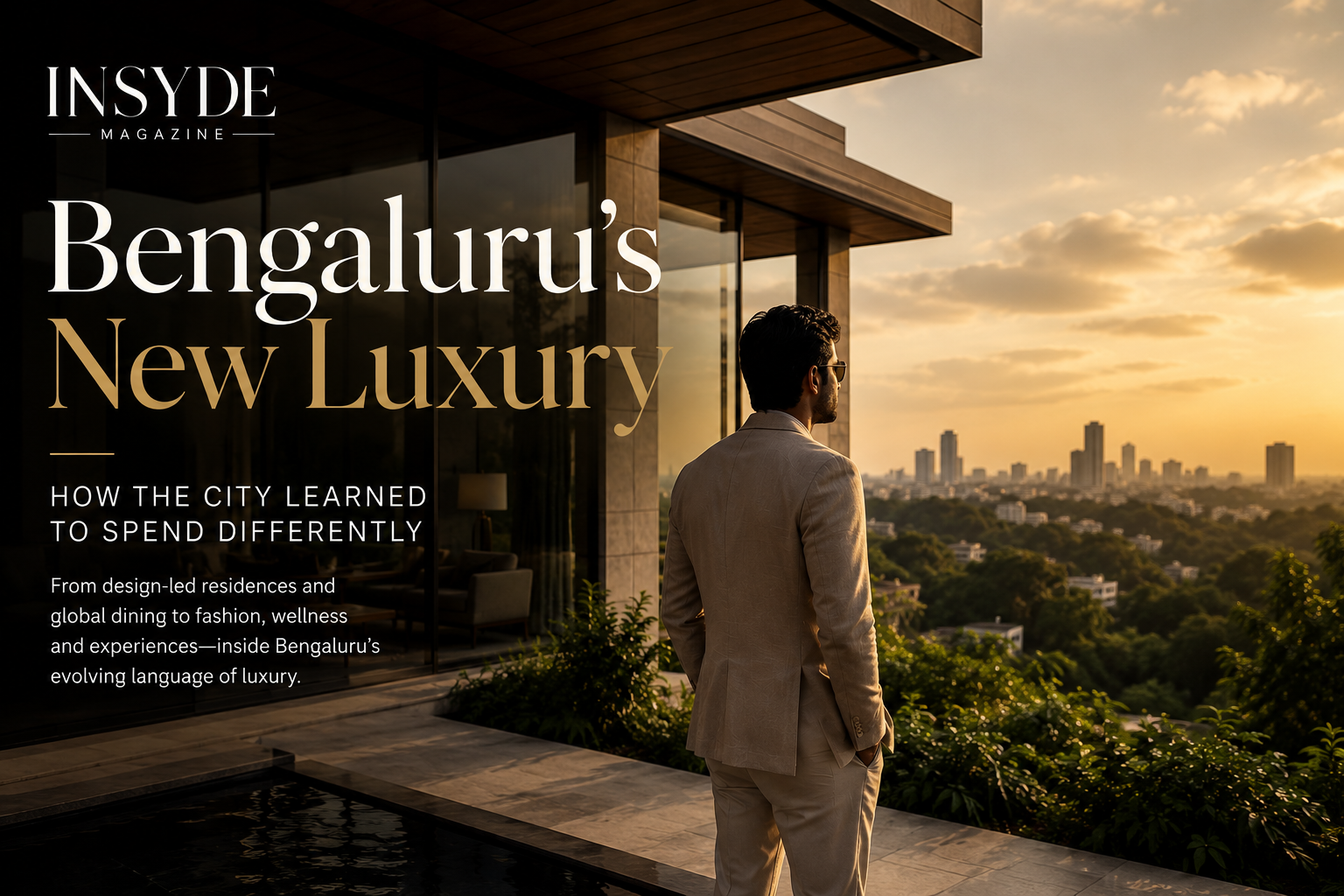
  • Bengaluru’s New Luxury: How the City Learned to Spend Differently

    Bengaluru’s New Luxury: How the City Learned to Spend Differently

    The city’s relationship with luxury is changing. Beyond logos and excess, Bengaluru is building a more considered culture of premium living—shaped by design, privacy, experience and a new generation of affluent consumers.

    There was a time when Bengaluru’s idea of success was relatively straightforward.

    A good career. A successful company. A home in a desirable neighbourhood. Perhaps a luxury car parked outside it.

    But the city has become wealthier, more global and considerably more sophisticated—and its relationship with luxury is evolving with it.

    Today, luxury in Bengaluru is increasingly less about simply owning something expensive and more about how one lives.

    A beautifully designed residence. A restaurant where the experience matters as much as the plate. A private club. A watch chosen for its craftsmanship rather than its recognisability. A fashion label that feels personal rather than obvious.

    It is a subtle shift, but an important one.

    Bengaluru is developing its own language of luxury.

    From Technology Wealth to Lifestyle Wealth

    For years, Bengaluru’s economic identity was dominated by technology.

    The city became synonymous with startups, software, multinational corporations and a generation of entrepreneurs who accumulated wealth differently from the traditional industrial and business families of older Indian metros.

    That wealth is now influencing the city’s consumption patterns.

    Bengaluru’s luxury market is no longer restricted to a small group of established families. Startup founders, CXOs, entrepreneurs, global Indians and high-net-worth professionals are becoming an increasingly visible part of the premium consumer landscape.

    The transformation is particularly clear in real estate.

    In FY2025, Bengaluru’s market for homes priced at ₹10 crore and above crossed ₹1,000 crore in annual sales for the first time. According to data from India Sotheby’s International Realty and CRE Matrix, 78 such homes were sold during the year, compared with 51 the previous year, while 42% of the city’s ₹10 crore-plus sales over the preceding four years occurred in FY2025 alone.

    The numbers are significant. But what matters more is what they reveal about the consumer behind them.

    The purchase of a luxury home is increasingly being framed around more than an address or an investment. Space, privacy, design, amenities and quality of life are becoming part of the proposition.

    Bengaluru is, in other words, becoming a city where wealth increasingly seeks quality of life.

    The New Luxury Is More Private

    Luxury has traditionally relied on visibility.

    The logo. The statement piece. The grand entrance.

    But contemporary luxury is moving in another direction.

    For an increasingly sophisticated consumer, exclusivity can mean something much quieter: an address with limited access, architecture that does not need to announce itself, personalised service, rare materials, thoughtful interiors or simply the freedom to enjoy something without an audience.

    This shift is particularly visible in Bengaluru’s premium residential market.

    The city’s high-end housing segment has seen strong price appreciation, while newer developments are increasingly competing through specifications, amenities, sustainability and future-ready design. In H1 2025, under-construction premium homes in Bengaluru recorded capital-value growth of roughly 32–35% year-on-year, according to Fortune India’s reporting on market data.

    The implication is clear.

    Luxury is becoming less about bigger and more about better.

    A City Learning to Buy Experiences

    The same shift extends beyond property.

    Luxury hospitality, fine dining, premium retail, wellness and entertainment are increasingly competing for the same consumer: someone willing to pay more when the experience feels distinctive.

    This matters because modern luxury is rarely confined to a product.

    A luxury restaurant is selling atmosphere, service, design and memory alongside food.

    A premium fashion boutique is selling curation and personal attention alongside clothing.

    A high-end residence is selling privacy, architecture, convenience and community alongside square footage.

    And a luxury hotel is selling a temporary version of a lifestyle.

    The wider Indian luxury market is moving in the same direction. Industry research has identified experiential categories—including fine dining, travel, hospitality and wellness—as increasingly important to affluent consumers, while luxury brands continue expanding their physical presence across India’s major cities.

    Bengaluru is particularly well placed for this evolution.

    It has the wealth, international exposure and young professional population to support it—and a consumer base increasingly comfortable moving between global and Indian ideas of luxury.

    The Bengaluru Consumer Doesn’t Need Everything to Look Expensive

    Perhaps the most interesting part of Bengaluru’s luxury story is that it does not necessarily resemble the traditional image of Indian affluence.

    Mumbai has its unmistakable glamour.

    Delhi has its grander, more visibly opulent side.

    Bengaluru has historically been more understated.

    The city’s relationship with fashion reflects this personality. A consumer might move between a technology office, a contemporary restaurant, an art space and a luxury retail environment in the same week.

    That creates a consumer who is not necessarily looking for one fixed definition of status.

    Instead, there is a growing appetite for curated luxury.

    A well-made garment.

    A beautifully designed home.

    A rare watch.

    A destination dinner.

    A thoughtfully planned weekend.

    A piece of art.

    A car that reflects taste rather than simply price.

    The common thread is discernment.

    And discernment is increasingly becoming one of luxury’s most valuable currencies.

    Bengaluru’s Luxury Map Is Expanding

    The geography of premium Bengaluru is changing too.

    Central Bengaluru remains synonymous with some of the city’s most established luxury addresses, while newer premium developments are expanding the map into emerging and well-connected micro-markets.

    That expansion is visible in the residential market. Bengaluru’s ₹10 crore-plus housing demand is no longer confined to a handful of traditional luxury neighbourhoods; the FY2025 data highlighted markets including Hebbal, Domlur, Sudhamnagar and Bommanahalli, with Hebbal accounting for 22% of luxury sales value among the high-end markets tracked in the report.

    This creates an interesting tension.

    Bengaluru’s old luxury is rooted in location, heritage and scarcity.

    Its new luxury is increasingly built around design, technology, convenience and experience.

    The future will likely be defined by the meeting point between the two.

    The Business of Becoming Luxury

    For brands, this shift matters.

    A growing luxury consumer base creates opportunities well beyond residential real estate. Fashion, jewellery, watches, automobiles, hospitality, restaurants, wellness, interiors and premium entertainment all compete for a consumer whose expectations are becoming more sophisticated.

    India’s luxury retail market is already expanding rapidly. Luxury and bridge-to-luxury brands accounted for a significant increase in retail leasing activity in 2025, reflecting an aggressive push by brands to capture India’s growing affluent consumer base.

    Bengaluru is part of that story—and increasingly, it is becoming an important market within it.

    The city’s retail environment is also evolving. In 2024, Bengaluru led retail space absorption among India’s top eight cities, while the wider retail landscape increasingly shifted towards destinations combining shopping, dining and entertainment.

    That convergence is important.

    The future of luxury may not be a store, a restaurant, a hotel or a residence in isolation.

    It may be the ecosystem around them.

    A neighbourhood where fashion, food, art, hospitality and design exist within the same cultural orbit.

    A place where consumers do not simply purchase products—they participate in a lifestyle.

    What Comes Next

    The most interesting question is no longer whether Bengaluru will become a luxury city.

    It already is.

    The more important question is what kind of luxury city it will become.

    Bengaluru has the economic foundation, entrepreneurial wealth and increasingly sophisticated consumer base to become one of India’s defining premium markets.

    But its opportunity lies in doing luxury differently.

    Not louder.

    Not necessarily bigger.

    Better.

    More personal. More experiential. More design-conscious. More connected to the way people actually want to live.

    For a city built on innovation, perhaps that is the most natural evolution of all.

    Bengaluru’s new luxury is not simply about having more.

    It is about having better—and knowing why it matters.

    — INSYDE Editorial