
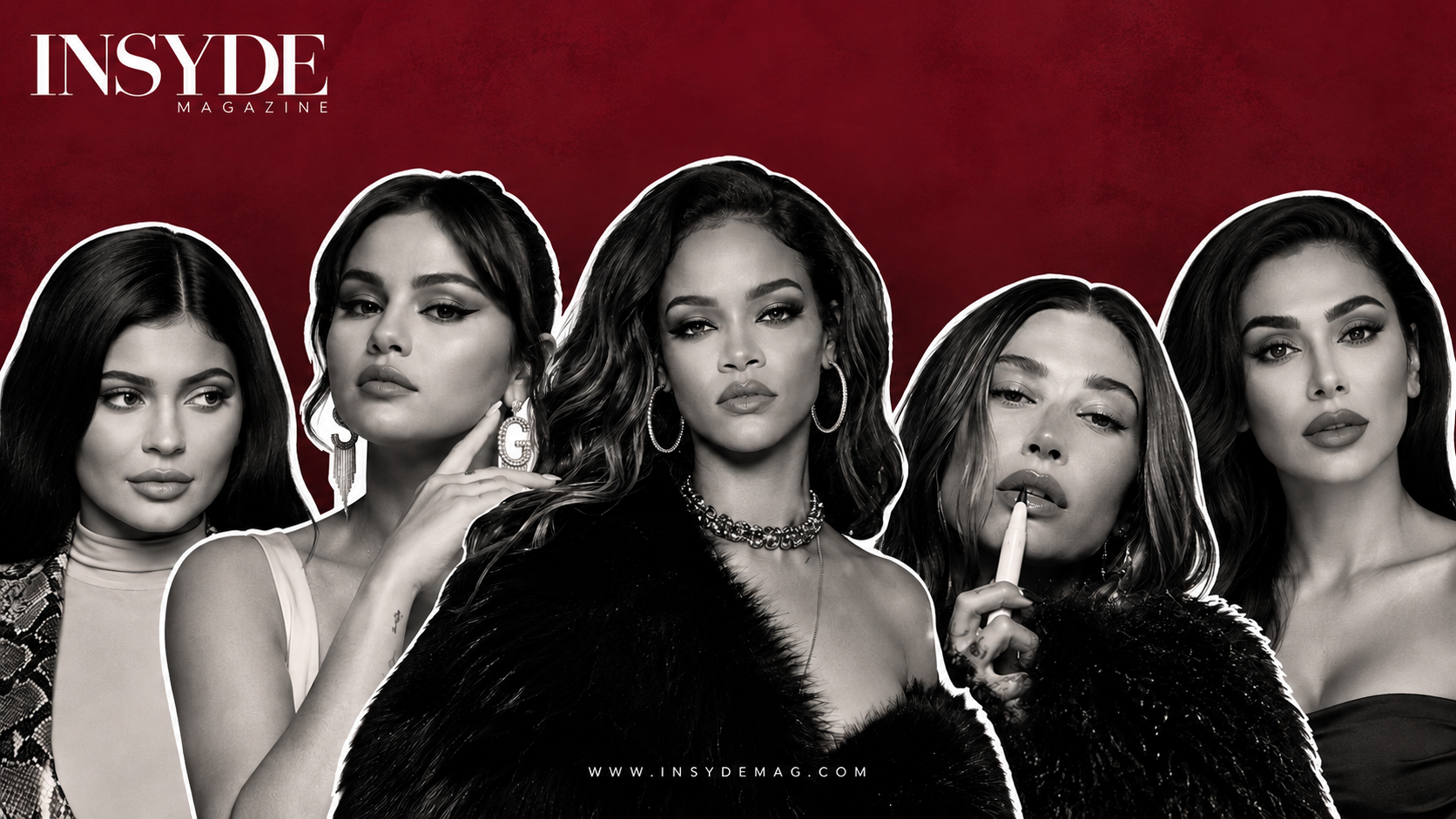
How celebrity founders turned beauty, fame and influence into commercial power.
BY INSYDE | BEAUTY & BUSINESS
There was a time when a celebrity’s relationship with beauty was simple. A famous face appeared in a campaign, a name went on a bottle, and a brand paid for the privilege of borrowing a little of that person’s desirability.
Today, some celebrities are doing something considerably more ambitious.
They are building the brands themselves.
Rihanna helped turn Fenty Beauty into a global cosmetics business. Selena Gomez built Rare Beauty around a distinctive philosophy of self-expression. Kylie Jenner transformed social-media attention into a cosmetics company. Hailey Bieber developed Rhode into an acquisition target for one of the beauty industry’s major players. Huda Kattan turned beauty expertise and an online audience into an international brand.
These are not simply celebrity endorsements. They are businesses with products, distribution networks, commercial strategies and, in some cases, billion-dollar valuations or acquisition deals.
The distinction matters.
In October 2026, Fortune, reporting on Traackr’s Creator Advantage 2026 research, highlighted how celebrity-founded companies had become powerful participants in the beauty economy. Five of the ten leading US beauty brands ranked by creator-marketing performance in 2025 were celebrity-founded, including Kylie Cosmetics, Rare Beauty, Rhode, R.E.M. Beauty and Huda Beauty.
That is a measure of marketing performance, not a ranking of revenue or profitability. But it reveals something important about the modern consumer market: influence is no longer merely an advertising tool. In the right hands, it can become a competitive advantage.
The financial results make the story even more interesting.
According to Reuters’ reporting on Fenty Beauty, the brand generated approximately $450 million in net sales in 2024. Rhode recorded $212 million in net sales during the twelve months ended March 31, 2025, before its acquisition by e.l.f. Beauty. Rare Beauty has also been associated with a reported valuation estimate of approximately $2.7 billion in 2026.
These figures measure different things. Sales are not valuations, acquisition prices are not guaranteed cash payouts, and the value of a company is not the same as its founder’s personal fortune.
But together, they point towards a larger shift.
Celebrity beauty is no longer simply about putting a famous face on a product. It is about turning identity, cultural relevance, product development and direct access to consumers into businesses with lasting value.
The question is no longer whether a celebrity can sell a lipstick.
It is whether that celebrity can build a beauty company that people continue to buy from long after the initial fascination fades.
01 — FENTY BEAUTY: WHEN INCLUSIVITY BECAME A BUSINESS STRATEGY
When Rihanna launched Fenty Beauty in September 2017, its initial foundation range of 40 shades made inclusivity a defining part of its identity.
The significance was not that no beauty brand had previously offered a wide shade range. It was that Fenty brought the conversation into the centre of a highly visible global launch, making the experiences of consumers who struggled to find suitable foundation difficult for the wider industry to ignore.
Its proposition was clear: more consumers should be able to find products that work for them.
Rihanna’s cultural reach gave the launch extraordinary visibility, while the brand’s partnership with LVMH’s Kendo division provided the infrastructure of an established beauty business.
The financial figures demonstrate the scale that followed.
Reuters reported in October 2025 that Fenty Beauty generated approximately $450 million in net sales in 2024. Sources cited in the same report estimated its valuation at between $1 billion and $2 billion. That valuation was an estimate, not a publicly disclosed transaction price.
The distinction matters. Sales describe the revenue generated by a business over a period; valuation estimates what that business might be worth.
Fenty’s wider influence is perhaps more revealing than either number. Its positioning helped make inclusive shade ranges a much more prominent part of the beauty industry’s commercial conversation.
The business lesson is straightforward. Rihanna’s fame helped Fenty attract attention, but the company needed a product proposition that consumers could understand and purchase.
THE INSYDE OBSERVATION: Influence becomes more powerful when it is attached to a proposition the market has a reason to believe in.
02 — RARE BEAUTY: THE POWER OF A POINT OF VIEW
Selena Gomez launched Rare Beauty in 2020 with an identity that extended beyond the products themselves.
The brand’s messaging around self-expression and a less perfection-driven understanding of beauty gave it a recognisable position in a crowded market. Its products, communications and social-impact commitments helped establish an identity that consumers could connect with beyond the founder’s celebrity.
That distinction matters in beauty, where packaging, product formats and trends can be replicated quickly.
A clear point of view gives a brand something more durable to build around.
Rare Beauty has become a significant participant in creator-led beauty. Its position among the leading brands in Traackr’s 2026 creator-marketing analysis demonstrates the scale of its digital and cultural relevance.
Financially, the company has also attracted substantial private-market estimates. Fortune’s October 2026 analysis reported an estimated valuation of approximately $2.7 billion. This should be understood as a reported estimate, not a confirmed transaction price or an independently disclosed current valuation.
It would be misleading to equate that figure with Gomez’s personal wealth. A company’s value belongs to the business and its shareholders; the founder’s financial position depends on ownership and other assets.
Rare Beauty’s challenge is to maintain its identity while growing distribution, introducing new products and sustaining customer loyalty.
The brand’s success suggests that a celebrity-led company can offer more than a famous face. It can create a coherent perspective on beauty that helps consumers understand what makes it different.
THE INSYDE OBSERVATION: A recognisable philosophy can become a commercial asset when it is supported by products consumers want to use.
03 — KYLIE COSMETICS: FROM SOCIAL-MEDIA ATTENTION TO CORPORATE SCALE
Kylie Jenner’s cosmetics business began with one of the most recognisable categories in beauty: lip products.
Kylie Lip Kits launched in 2015, drawing on Jenner’s public image and the attention surrounding her makeup looks. The products gave an existing audience something tangible to purchase.
The model was powerful because the launch did not have to build awareness from zero. Jenner already had an audience, a recognisable aesthetic and a direct channel through which to communicate with potential customers.
The business subsequently expanded beyond lip kits. In 2019, Coty acquired a 51% stake in the company for $600 million, implying an approximate $1.2 billion valuation at the time. This was a historical transaction, not a verified current valuation.
Coty’s subsequent reporting offers a more recent view of the brand. In March 2025, the company said Kylie Cosmetics had grown 1.5 times over the preceding two years. The brand has continued to operate within Coty’s prestige beauty portfolio.
Coty does not disclose a comparable standalone current valuation for Kylie Cosmetics in the reporting used for this article. Nor can the company’s valuation or sales be used as a direct measure of Jenner’s personal wealth.
The corporate partnership changed the nature of the business. Kylie Cosmetics became part of a larger beauty portfolio with access to established distribution, marketing and operational capabilities.
That brings advantages, but it also means the founder’s role and ownership must be distinguished from the company’s overall performance.
Kylie Cosmetics demonstrates how a celebrity’s audience can accelerate a product launch. Its longer-term commercial value depends on whether the brand can keep its products relevant after the initial excitement.
THE INSYDE OBSERVATION: An audience can give a business its first customers. It cannot guarantee its next decade of growth.
04 — RHODE: THE VALUE OF A CLEAR AESTHETIC
Hailey Bieber’s Rhode entered the beauty market with a focused skincare proposition, restrained packaging and an immediately recognisable visual identity.
Rather than launching with an enormous assortment, Rhode concentrated on skin-focused products and an aesthetic that translated naturally into social content. Its presentation made products recognisable in photographs and routines easy to communicate.
The brand’s commercial trajectory culminated in a major transaction.
In May 2025, e.l.f. Beauty announced an agreement to acquire Rhode for $800 million at closing, plus up to $200 million in potential earn-out payments. The acquisition closed on August 5, 2025.
Rhode had generated $212 million in net sales in the twelve months ended March 31, 2025, according to e.l.f. Beauty’s acquisition announcement.
The maximum announced deal value was therefore $1 billion, not a guaranteed $1 billion cash payment to Bieber. The transaction involved cash, shares and potential performance-linked consideration.
In its fiscal 2026 annual filing, e.l.f. Beauty recorded total acquisition consideration of approximately $897.5 million, including the estimated value of potential earn-out consideration at that time. The filing also reported that Rhode contributed $293.5 million in net sales to e.l.f.’s consolidated results between the acquisition date and March 31, 2026. This latter figure covers a different reporting period and should not be confused with Rhode’s standalone sales before the acquisition.
The details can be verified in e.l.f. Beauty’s fiscal 2026 SEC filing.
The transaction demonstrates why established beauty companies pay attention to fast-growing independent brands. An acquirer can bring distribution, retail relationships and international scale to a company that has already demonstrated consumer demand.
After an acquisition, the challenge changes. A brand must preserve the qualities that made it distinctive while expanding its reach and operating within a larger corporate structure.
Rhode’s story is not simply about a celebrity creating a successful skincare line. It is about a relatively young company developing enough commercial value to attract a major strategic buyer.
THE INSYDE OBSERVATION: A focused product range and coherent aesthetic can be commercially powerful when they are supported by genuine demand and operational execution.
05 — HUDA BEAUTY: WHEN BEAUTY EXPERTISE BECOMES AN EMPIRE
Huda Kattan’s path into beauty began with expertise and content rather than a traditional entertainment career.
Through beauty tutorials and product knowledge, she built an audience interested in makeup itself. Huda Beauty emerged from that relationship, launching with false eyelashes in 2013 before expanding into a wider cosmetics business.
The distinction is important. Kattan was not simply placing her name on a product. Her existing connection with beauty consumers helped establish the company’s initial credibility.
But turning an audience into a global brand required more than content. It required product development, manufacturing, distribution, inventory management and the ability to sell consistently across markets.
Huda Beauty became a significant name in the international cosmetics market. It also appeared among the leading brands in Traackr’s creator-marketing analysis reported by Fortune in October 2026.
Its financial history, however, requires careful treatment. Historical reports have associated the company with a valuation of around $1 billion in 2017, but that figure should not be presented as a verified current valuation. A sufficiently reliable, comparable standalone 2026 revenue or valuation figure has not been established for this article.
That limitation should not be filled with an unsupported estimate.
Huda Beauty remains an important case study because it shows how a founder can move from content creation into a product business with an identity that extends beyond the content that first attracted consumers.
It also highlights a broader feature of celebrity beauty: not every successful founder begins as a film star or musician. In some cases, beauty expertise and an audience built around a specific category can be the starting point.
THE INSYDE OBSERVATION: Fame is one route into beauty. Credibility built around the category itself can be another.
06 — THE NUMBERS BEHIND THE GLOW
The financial evidence behind these five brands is significant, but the figures describe different things.
Fenty Beauty — Rihanna
Approximately $450 million in reported net sales in 2024, alongside a $1–2 billion valuation estimate reported in 2025.
Rare Beauty — Selena Gomez
An estimated valuation of approximately $2.7 billion reported in October 2026.
Kylie Cosmetics — Kylie Jenner
An implied valuation of approximately $1.2 billion when Coty acquired its 51% stake in 2019.
Rhode — Hailey Bieber
$212 million in net sales for the twelve months ended March 31, 2025, followed by acquisition consideration recorded at approximately $897.5 million in e.l.f. Beauty’s fiscal 2026 filing.
Huda Beauty — Huda Kattan
Historical valuation reports around $1 billion in 2017, with no comparable verified current standalone valuation established for this article.
The sources for these figures include Reuters’ Fenty Beauty reporting, Fortune’s 2026 creator-economy analysis, Coty’s corporate reporting and e.l.f. Beauty’s SEC filing.
These figures come from different dates and sources. They are not a definitive ranking of the five largest celebrity beauty companies. Fenty’s figure is annual sales; Rare Beauty’s is an estimate; Kylie Cosmetics’ figure is historical; Rhode’s is an acquisition consideration figure; and Huda Beauty’s is historical.
A company’s valuation is not the same as its revenue. Revenue is not profit. And neither is equivalent to the founder’s personal fortune.
Those distinctions are essential to understanding how celebrity beauty businesses create and retain wealth.
07 — FAME IS AN ADVANTAGE. IT IS NOT A BUSINESS MODEL.
Celebrity-founded beauty companies begin with something many new businesses spend years trying to build: attention.
A famous founder can introduce a product to an established audience. Their personal style can help establish a visual identity, while social platforms provide channels through which customers can discover, discuss and recommend products.
But the competitive advantage has limits.
Products can be copied. Trends can move on. Social-media algorithms change. Consumers can lose interest. And a successful launch does not guarantee that customers will purchase again.
The October 2026 creator-marketing analysis offers a useful perspective. Five celebrity-founded brands appeared in the top ten US beauty brands ranked by creator-marketing performance for 2025. Yet the same market contains companies that have struggled despite high-profile founders.
Fortune reported that Gwen Stefani’s GXVE Beauty shut down in early 2026, while Drew Barrymore’s Flower Beauty ceased operations in September 2025.
These cases demonstrate why fame and commercial durability should not be confused. A celebrity can attract attention, but a company still needs products that consumers want, an effective route to market and a reason for customers to return.
The strongest model combines the founder’s visibility with a recognisable proposition and an organisation capable of operating beyond constant personal promotion.
Celebrity may open the door. The business must still earn its place.
08 — WHO REALLY OWNS THE BILLIONS?
The phrase celebrity beauty billionaire can blur several different ideas.
A founder may own a majority stake in a private company, a minority stake in a brand operated by a larger group, or an ownership interest that has changed through investment and acquisition. A transaction can involve cash, shares and future payments rather than a single guaranteed payout.
Rihanna’s personal wealth, for example, cannot be calculated by treating Fenty Beauty’s reported sales as money she personally receives. Coty’s stake in Kylie Cosmetics means the brand’s historical valuation cannot simply be assigned to Jenner. Rhode’s transaction similarly included closing consideration and potential earn-outs.
The distinction does not diminish what these founders have built. It makes the business story more meaningful.
The important questions are how much economic value a company creates, how its ownership is structured, how much of that value the founder retains and whether the business can continue to grow.
For a serious business editorial, those questions matter far more than a celebrity net-worth headline.
THE INSYDE TAKE
Beauty has always sold more than cosmetics. It sells identity, aspiration, ritual and the possibility of becoming a slightly different version of oneself.
Celebrity-founded brands have learned to turn those ideas into businesses.
Fenty Beauty helped bring inclusivity into the centre of the beauty conversation. Rare Beauty built a recognisable identity around self-expression. Kylie Cosmetics turned social-media attention into a business that entered a major corporate partnership. Rhode attracted an acquisition with consideration approaching the billion-dollar mark. Huda Beauty demonstrated how beauty expertise and an audience could develop into an international product company.
Their financial stories are different. Some figures are disclosed sales; others are historical valuations, estimates or acquisition values. None should be mistaken for the founder’s personal fortune.
But the larger lesson is consistent.
Fame creates visibility. Influence can create demand. A recognisable identity can help a brand stand apart.
What turns those advantages into a business is the harder work: product development, distribution, customer loyalty, operational execution and the ability to remain relevant after the first wave of attention fades.
The next generation of celebrity beauty brands will not succeed simply because their founders are famous.
They will succeed if consumers keep coming back.
Because in the beauty business, the first sale may come from influence.
The next one has to be earned.
BEAUTY. BILLIONS. & INFLUENCE.
INSYDE — BEAUTY, BUSINESS & CULTURE
NO.1 LUXURY MAGAZINE IN BENGALURU