
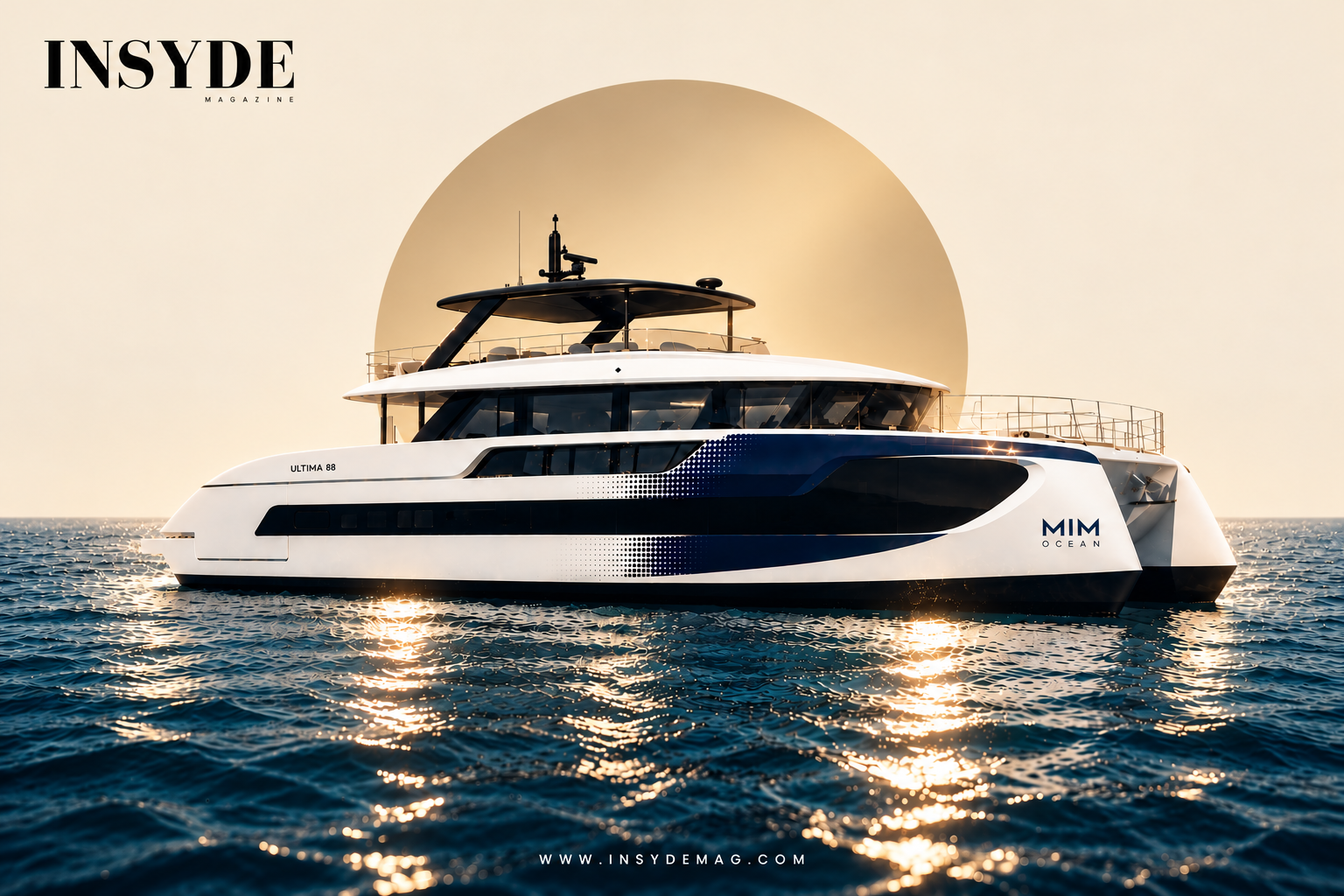
Beyond football’s greatest stages, Lionel Messi is entering another world of performance, privacy and privilege. His new Sunreef ULTIMA 88 reveals how the business of luxury is evolving — from owning extraordinary objects to creating extraordinary experiences.
INSYDE | Luxury | People | The Business of Luxury
There is a particular kind of luxury that does not need an audience.
It exists in the quiet of an open sea, in the freedom to change destinations without changing rooms, and in the knowledge that the world can continue moving while, for a moment, you are somewhere beyond its reach. No reservations to coordinate. No public spaces to navigate. No fixed view beyond the windows. Just the horizon, the water and the freedom to decide what comes next.
For Lionel Messi, that world is taking a new shape.
On 13 October 2026, Polish yacht builder Sunreef Yachts announced that the Argentine football icon had ordered a Sunreef ULTIMA 88, a 28.4-metre luxury power catamaran being built at the company’s shipyard in Ras Al Khaimah, United Arab Emirates. The yacht is intended to join MIM Ocean, the charter venture Messi operates in partnership with Med Cat Yachts.
The headline figure circulating around the order is approximately €8–9 million, or roughly US$9–10 million depending on exchange rates. The actual contract price has not been publicly disclosed by the builder or Messi, so the valuation remains an estimate rather than a confirmed purchase figure.
But the money is only the opening chapter.
The more revealing story is about the architecture of modern luxury: how performance engineering meets private hospitality, how a sporting icon’s commercial interests extend beyond the pitch, and why the most desirable possessions are increasingly judged by the experiences they make possible.
Messi’s new yacht is not simply another expensive addition to a celebrity’s lifestyle. It offers a compelling case study in the business, psychology and evolving design of extreme luxury.
THE PRICE OF A PRIVATE HORIZON
In the public imagination, wealth is often measured through objects. The supercar in the driveway. The watch beneath a tailored cuff. The residence overlooking a coastline that most people experience only on holiday.
A yacht occupies a different category.
It is a residence that moves, a transport system that doubles as a social environment, and a private setting that can travel between destinations. Its value is not restricted to the materials from which it is built. It also lies in the control it offers over time, space and access.
That distinction helps explain why the superyacht remains one of the most powerful symbols of extreme wealth.
A luxury hotel can provide exceptional service, but its spaces are shared with other guests. A private villa offers seclusion, but it remains tied to one location. A yacht combines elements of both while adding mobility. The owner can move between coastlines, anchor away from crowded marinas and create a highly personalised environment for family, friends or guests.
For a person whose professional life involves global attention, that degree of control has an obvious appeal. Nevertheless, Messi’s personal motivations for ordering this particular yacht have not been fully disclosed, and the significance of the purchase should not be reduced to speculation about his private life.
What is clear is the scale of the asset and the wider business context in which it sits.
At an estimated price approaching US$10 million, the ULTIMA 88 belongs to a world where the initial transaction is only one component of the commitment. Crew, maintenance, insurance, fuel, berthing, technical servicing and eventual refits can all contribute substantially to the cost of ownership.
Extreme luxury is not simply the ability to acquire an extraordinary object. It is the ability to operate, maintain and personalise it over time.
That is where the real economics of the superyacht begin.
INSIDE THE SUNREEF ULTIMA 88
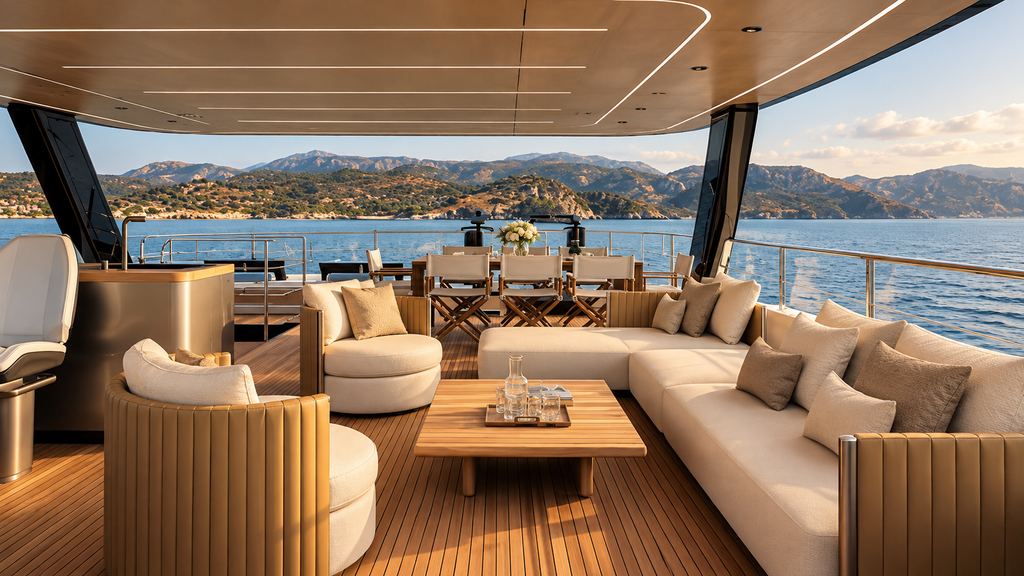
The Sunreef ULTIMA 88 occupies an interesting position within contemporary yacht design. It seeks to combine the dynamic character of a performance-oriented power yacht with the width, stability and living space associated with a multihull.
According to Sunreef’s published specifications, the model measures approximately 28.4 metres in length and 9.3 metres across the beam. The shipyard lists approximately 387 square metres of living space, an unusually expansive figure that illustrates the design priorities of the platform.
The distinction matters because yacht design is not only about how a vessel looks from the water. It is also about how people inhabit it.
The ULTIMA 88’s defining feature is its relationship with the sea. Opening side platforms and an aft garage create what Sunreef calls an Ocean Lounge, extending the usable space towards the water when the yacht is at anchor. The layout is intended to make the transition between interior living areas and the surrounding marine environment feel more immediate.
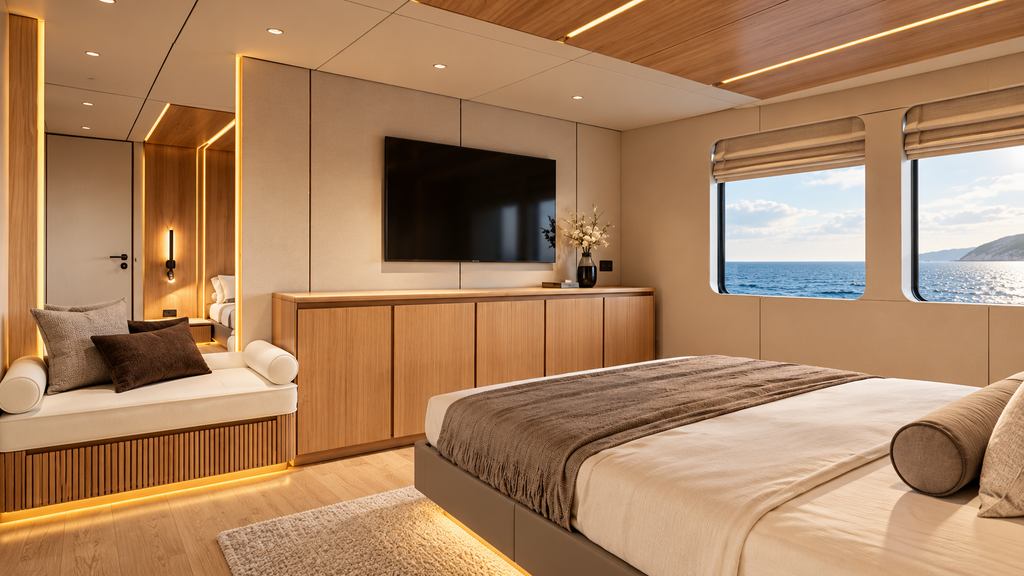
A full-beam owner’s suite, guest accommodation and open social areas complete the experience.
Instead of treating the sea as a view beyond the deck, the design brings it into the living environment. The aft area can become a place to relax beside the water, while the interior provides a more sheltered setting for dining, resting and socialising.
This is an important distinction in the contemporary luxury market. Increasingly, the product is not just the object itself; it is the quality of the interaction between the object, its surroundings and the person using it.
In a yacht, that interaction is shaped by everything from the arrangement of the decks to the ease with which guests can move between spaces. A spectacular exterior may attract attention, but a successful vessel must work just as well during the ordinary hours spent aboard.
Sunreef’s published model specifications also include different propulsion configurations. The exact technical specification selected for Messi’s commissioned yacht has not been publicly confirmed, so the model’s advertised features should not automatically be treated as the final specification of his individual vessel.
That distinction is important. A bespoke yacht is not always identical to a standard model description. Its final configuration can depend on the owner’s requirements and the contract agreed with the shipyard.
The ULTIMA 88’s appeal lies in its attempt to reconcile performance, generous space and contemporary onboard living within a single design.
For the modern luxury buyer, that balance may be more persuasive than sheer size alone.
WHY THE CATAMARAN MATTERS
For much of the superyacht market’s history, the conventional monohull has defined the familiar image of luxury at sea: a long hull, a prominent profile and a sequence of decks rising above the water.
A catamaran takes a different approach.
Its two-hull configuration creates a broad platform that can accommodate substantial interior and exterior space. Depending on the design, it can also offer stability and access to certain shallower anchorages compared with some monohull alternatives.
The trade-offs matter. A wider vessel can face different marina constraints, and performance, fuel consumption, handling and range depend on the engineering, propulsion system and operating conditions. No single hull configuration is automatically superior in every situation.
What the catamaran format offers is a different way of organising life aboard.
On the ULTIMA 88, that additional width supports the emphasis on open living spaces and the Ocean Lounge. The vessel is conceived not merely as a machine for travelling between destinations, but as a place in which people can spend meaningful time once they arrive.
This becomes especially relevant when considering the yacht’s intended role within a charter operation. Guests are not paying only for the journey from one port to another. They are paying for the environment, the accommodation, the service and the activities that take place during their time aboard.
The design therefore has implications beyond aesthetics. It influences how the yacht can be used, the type of experience it can deliver and the way it can be positioned within the luxury-hospitality market.
The ULTIMA 88 is an example of how yacht builders are attempting to compete through the intelligent use of space and the integration of leisure into the vessel’s architecture.
In this segment, engineering and experience are increasingly inseparable.
FROM FOOTBALL ICON TO LUXURY HOSPITALITY
The most commercially interesting aspect of Messi’s new yacht may not be its estimated price. It may be the business it is intended to join.
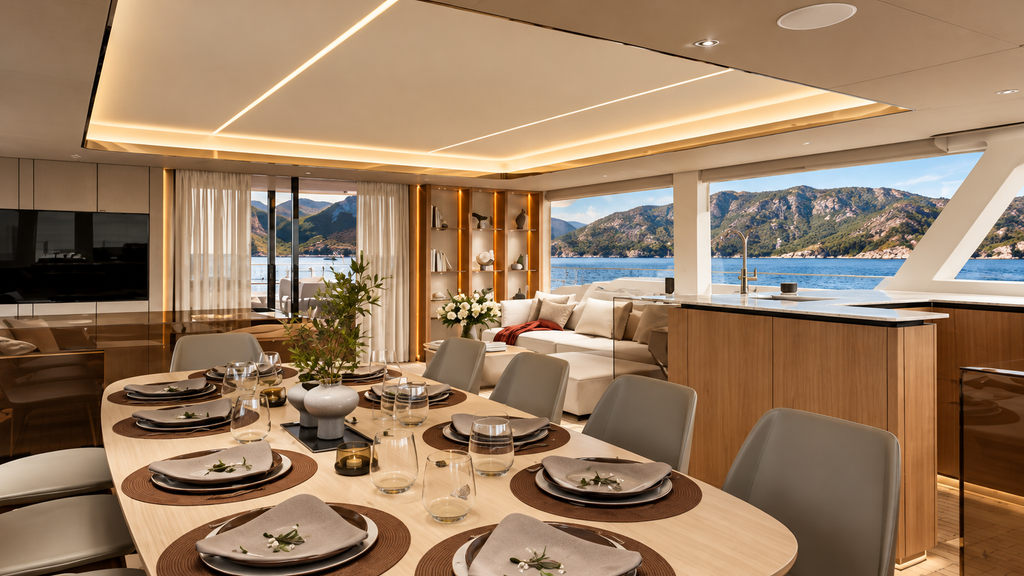
MIM Ocean’s official website describes a venture combining Messi’s MIM Hotels experience with the charter expertise of Med Cat Yachts. Its existing offering centres on professionally crewed Bali catamarans, with summer operations in the Balearic Islands and winter-season availability in the Caribbean and Bahamas.
The proposition is built around private sailing holidays, with accommodation, crew, food and water-based activities forming part of the guest experience.
The Sunreef order is intended to expand that wider offering.
This places the yacht within a business model that connects celebrity recognition with hospitality and premium leisure. The association with Messi can attract attention, but the long-term success of a charter operation depends on more practical considerations: service quality, operating costs, pricing, availability, customer satisfaction and the ability to deliver a consistent experience.
That distinction is essential when discussing celebrity wealth.
A high-value asset can be used for personal enjoyment, commercial activity or a combination of both. Its financial performance cannot be established simply by knowing who owns it or how much it may cost.
In Messi’s case, the yacht’s announced destination within MIM Ocean creates a clear connection to an existing commercial venture. It does not, however, establish the vessel’s future revenue, profitability or investment return.
Those outcomes would depend on information that has not been made public, including the final acquisition price, annual operating expenditure, charter rates, utilisation and the division of costs between private and commercial use.
The commercially relevant question is therefore not whether the yacht will make money. It is how the vessel will be integrated into a broader hospitality offering and what kind of experience it will enable the business to sell.
That is a more revealing way to understand the order than treating it solely as a display of celebrity spending.
Messi’s global profile and the yacht’s design may help differentiate the offering. But the business must ultimately be judged by its operations.
THE BUSINESS OF EXTREME LUXURY: WHAT THE 2026 MARKET REVEALS
The timing of the order is particularly interesting because the wider yacht market presents a more complicated picture than the familiar narrative of ever-rising luxury spending.
According to Northrop & Johnson’s Q3 2026 Superyacht Market Report, 472 pre-owned yachts measuring at least 24 metres were sold globally during the first nine months of 2026, compared with 477 over the same period in 2025.
That represents a year-on-year decline of approximately 1%.
The combined value of those transactions fell from US$5.46 billion to US$5.20 billion, a reduction of approximately 4.7%.
At first glance, those figures suggest a market that remains active but is not expanding uniformly in value. The number of transactions has remained relatively stable, while the aggregate value of completed sales has declined.
The supply side tells a complementary story. The report records 1,400 new central-agency listings during the first nine months of 2026, up 5.5% from 1,327 in the corresponding period of 2025. Price reductions also increased, rising 7.2% to 1,949.
For buyers in the brokerage market, that combination can mean greater choice and more scope to negotiate. For sellers, it reinforces the importance of pricing a vessel realistically in relation to competing inventory.
However, these numbers require careful interpretation. They concern the pre-owned brokerage market for yachts of at least 24 metres, not every segment of marine leisure, and they do not measure demand for Messi’s specific new-build order.
The report also shows why the market should not be reduced to a single growth or decline narrative.
During the first nine months of 2026, sales in the 40–50-metre pre-owned segment rose from 49 to 63, an increase of approximately 29%. Elsewhere, demand was more uneven.
New-build activity was more subdued overall. The same report recorded 216 reported new-build sales of yachts measuring at least 24 metres during the first nine months of 2026, compared with 266 in the corresponding period of 2025. The figures remain provisional because transactions can be reported retrospectively.
Charter activity, meanwhile, presented a more positive picture. Northrop & Johnson reported an 18.5% increase in charter bookings during the first nine months of 2026, alongside a 17.4% increase in booked days. The number of individual yachts receiving bookings rose by 1.8%, from 1,641 to 1,670.
These figures suggest that charter activity increased across a broadly similar number of vessels. They do not prove that every yacht or destination performed equally well, but they offer evidence of stronger activity in the reported charter market.
Taken together, the data illustrates a market with different dynamics across brokerage, new construction and charter operations.
That distinction is crucial to understanding Messi’s order.
The new yacht belongs to the new-build market, while its intended place in MIM Ocean connects it to the charter sector. The pre-owned sales figures offer useful context about the broader industry, but they cannot be used as a direct valuation benchmark for the ULTIMA 88.
The lesson is that extreme luxury is not one unified market. It is a collection of connected businesses, each with its own economics.
WHY EXPERIENCE HAS BECOME THE REAL LUXURY
A yacht can be evaluated through its dimensions, propulsion, finish and price. Yet these specifications explain only part of its appeal.
The rest lies in what ownership makes possible.
A yacht can turn a holiday into a private itinerary. It can bring accommodation, dining, transport and leisure together in one environment. It can provide a setting in which time is organised around the people aboard rather than around the operating hours of a hotel, resort or public attraction.
This is where the economics of extreme luxury intersect with its psychology.
For many affluent consumers, luxury is not simply a question of buying a more expensive version of an ordinary product. It is about reducing friction, increasing choice and gaining control over how time is spent.
That does not mean privacy and experience have replaced visible status. Both remain important, and their relative significance varies from one buyer to another.
But the ULTIMA 88 illustrates how a single asset can serve several dimensions of luxury at once. It can be a design object, a private retreat, a means of travel and a platform for hospitality.
The value lies in the combination.
For someone whose professional identity is constantly visible, a private environment may offer a different kind of appeal from another highly visible possession. Yet this remains an interpretation of the wider luxury market, not a claim about Messi’s undisclosed personal motivations.
What can be observed is the design and business proposition itself: a vessel built around performance and living space, intended for a venture that sells private sailing experiences.
The modern luxury proposition is increasingly about the complete experience rather than the isolated product.
THE COST OF OWNING A DREAM
An estimated US$10 million acquisition price may dominate the headlines, but it is not a complete measure of the yacht’s financial commitment.
Large yachts require ongoing expenditure on crew, servicing, insurance, fuel, berthing, technical support and provisions. The scale of these costs varies with the vessel’s systems, operating schedule, cruising distances and intended use.
A yacht that spends much of the year in private use may have a different financial profile from one operated commercially. A charter vessel also faces the challenge of balancing customer demand against maintenance periods, seasonal availability and the cost of delivering a premium service.
There is no reliable basis for assigning Messi’s yacht a specific annual running cost or projected charter income without its final specification and operating arrangements.
The same caution applies to resale value. A yacht’s future market price will depend on its condition, build quality, specification, maintenance history, market conditions and the availability of comparable vessels.
Nor should a commissioned yacht automatically be described as an investment. It may be a lifestyle asset, a business asset or a combination of the two. Whether it generates a financial return is a separate question that requires evidence.
These distinctions are important because luxury reporting often concentrates on the acquisition while overlooking the economics of ownership.
The price of entry is only one part of the story. Sustaining the experience is another.
For MIM Ocean, the commercial calculation will ultimately depend on how the vessel is operated and how effectively its offering matches customer demand. For Messi personally, the full balance between private use and commercial use has not been disclosed.
The responsible conclusion is not to assume profitability or extravagance beyond the evidence. It is to recognise the complexity behind an asset of this scale.
PERFORMANCE, DESIGN AND THE QUESTION OF SUSTAINABILITY
Luxury yachting also faces a question that extends beyond comfort and prestige: how can high-performance marine engineering become more efficient?
Sunreef’s wider ULTIMA and Eco product portfolio highlights areas such as hybrid propulsion, battery systems and solar technology. These are relevant developments in an industry exploring different ways to reduce energy consumption and improve the onboard experience.
However, a distinction must be made between technology available within a manufacturer’s wider range and the equipment installed on a particular vessel.
The exact propulsion and energy systems commissioned for Messi’s ULTIMA 88 have not been fully disclosed. It would therefore be inaccurate to describe his yacht as a specific hybrid or solar-powered configuration without confirmation.
More broadly, hybrid systems and solar generation do not automatically make a yacht emissions-free. Environmental performance depends on factors such as propulsion, energy demand, cruising speed, operating profile and the source of the energy used.
For the industry, the opportunity is to make efficiency part of the engineering brief rather than treating it as an afterthought. Improvements in energy management, hull design and onboard systems can matter, although their actual benefits must be assessed against the vessel’s full operating requirements.
For a luxury buyer, sustainability is increasingly a question of engineering and evidence, not merely a marketing label.
The future of premium yachting will depend partly on how successfully builders combine the expectations of performance and comfort with more responsible use of energy and resources.
MESSI’S NEW YACHT AND THE FUTURE OF CELEBRITY LUXURY
The relationship between celebrity and luxury has always been commercially powerful. A recognisable name can bring attention to a product, create cultural relevance and give a business a distinctive public identity.
But attention alone does not create a successful enterprise.
Messi’s yacht order brings these elements together. His global sporting profile gives the announcement immediate visibility. Sunreef contributes specialist design and engineering. MIM Ocean provides an existing hospitality context in which the vessel is intended to operate.
The combination is more interesting than any one element in isolation.
It shows how a global sporting identity can connect with a premium leisure business, while also demonstrating the importance of execution. The vessel must be built, delivered, operated and maintained. A charter business must attract customers and provide a consistently high-quality experience. The public profile can open the door, but the product and service must justify the proposition.
This is a useful lesson for the broader luxury sector.
The strongest luxury businesses do not sell only an object or a name. They build a coherent experience around design, service, access and trust.
In that sense, the ULTIMA 88 is more than a headline about an expensive yacht. It sits at the intersection of marine engineering, celebrity culture and experience-led hospitality.
Its commercial significance will become clearer as more information emerges about the final vessel and its operation.
For now, the order provides a tangible example of how luxury assets can connect private enjoyment with wider commercial ambitions.
THE ART OF EXTREME LUXURY
Extreme luxury is often presented through numbers: metres of hull, horsepower, cabin counts and estimated prices.
Those details are part of the story. They communicate the engineering involved, the space available and the scale of the financial commitment.
But they do not fully explain the attraction.
The deeper appeal is the freedom to shape an experience around personal preferences. It is the ability to travel without relying on a fixed location, to spend time in a carefully designed environment and to make decisions about how a day unfolds.
Messi’s Sunreef ULTIMA 88 captures that idea in a distinctly contemporary form. Its multihull architecture emphasises space and the relationship between the interior and the water. Its intended place in MIM Ocean links the yacht to a commercial hospitality venture. And its arrival comes at a time when the wider yacht industry is navigating uneven brokerage demand alongside stronger reported charter activity.
The estimated price may be the detail that attracts immediate attention, but it is not the most revealing one.
The more meaningful story is the convergence of design, privacy, engineering and experience — and the way those elements are being packaged into a modern expression of wealth.
The yacht is still under construction, its final contract price remains undisclosed, and its eventual commercial performance is yet to be established.
What is already clear is that luxury at this level is about more than possession.
It is about the ability to create a world of your own, even if only for a few days at a time.
At sea, the ultimate symbol of privilege may not be the vessel itself.
It may be the freedom to decide where the horizon leads next.
Price note: The approximately US$9–10 million valuation is an estimate reported by media outlets, not a confirmed contract price. The vessel’s final specification, delivery date and operating economics have not been fully disclosed.
INSYDE MAGAZINE
Luxury. Culture. People. What comes next.
BENGALURU’S NO. 1 LUXURY MAGAZINE