

5 Entrepreneurs Who Helped Build Modern India
India was not built by one industry. It was built by people willing to imagine a different one.
Long before India became one of the world’s largest startup ecosystems, before Bengaluru became synonymous with technology, before smartphones became essential infrastructure and before biotechnology became one of the country’s most promising frontiers, there were entrepreneurs building companies in a very different India.
They operated in an economy defined by scarcity, regulation and limited access to capital.
Yet they built.
They built factories, software companies, computers, telecommunications networks and biotechnology laboratories. More importantly, they built institutions that changed what Indian businesses could aspire to become.
Today, India has more than 200,000 startups recognised by the government, millions of jobs created by the startup ecosystem and a technology sector projected to cross $315 billion in FY2026.
The country is no longer simply asking whether something can be built in India.
It is asking whether it can be built in India and for the world.
That shift did not happen overnight.
It was shaped by generations of entrepreneurs who expanded the boundaries of Indian business — sometimes through industrial scale, sometimes through technology, sometimes through connectivity, and sometimes through scientific ambition.
There is no definitive list of the people who “built India.” The country is far too large, and its economic transformation far too complex, for that.
But these five entrepreneurs offer five compelling lenses through which to understand the making of modern Indian enterprise.
Dhirubhai Ambani.
N. R. Narayana Murthy.
Sunil Bharti Mittal.
Kiran Mazumdar-Shaw.
Shiv Nadar.
Five entrepreneurs.
Five industries.
Five different ideas of what India could become.

01
THE BUILDER OF SCALE
Dhirubhai Ambani
Reliance Industries
There is a particular word that follows Dhirubhai Ambani through the history of Indian business:
Scale.
In 1957, after returning to India, Dhirubhai began a yarn-trading business in Mumbai. Two decades later, Reliance Textile Industries went public.
The 1977 IPO became a defining moment. The issue was oversubscribed seven times, and Reliance credits it with helping usher in what became known as the “equity cult” in India.
But the significance of Dhirubhai’s story goes beyond the size of Reliance.
He understood something that would become central to modern Indian capitalism: scale could itself be a competitive advantage.
Reliance moved from textiles into petrochemicals and progressively deeper into the industrial value chain. The objective was not simply to operate a successful business in one category, but to build an integrated industrial enterprise capable of competing at a much larger level.
That ambition eventually became part of the foundation on which Reliance expanded into energy, retail, telecommunications and digital services.
The transformation is striking when viewed against the India in which Dhirubhai began.
Capital was scarce.
Markets were less developed.
Indian companies were rarely discussed in the same global terms as their Western counterparts.
Dhirubhai’s answer was not to think smaller because the environment was difficult.
It was to think bigger.
His public-market strategy also brought a new generation of individual investors into the story of corporate growth. Reliance’s 1977 public issue became an important moment in the widening participation of ordinary Indian investors in equity markets.
That legacy is complicated, as the history of any enormous business empire inevitably is.
But there is little ambiguity about the ambition.
Dhirubhai helped establish a model of Indian entrepreneurship built around scale, vertical integration, capital and mass participation.
The company that emerged from that philosophy would eventually become one of the world’s largest diversified business groups.
THE IDEA
India could build companies at industrial scale — and Indian capital could participate in that growth.
02
THE EXPORTER OF INDIAN TALENT
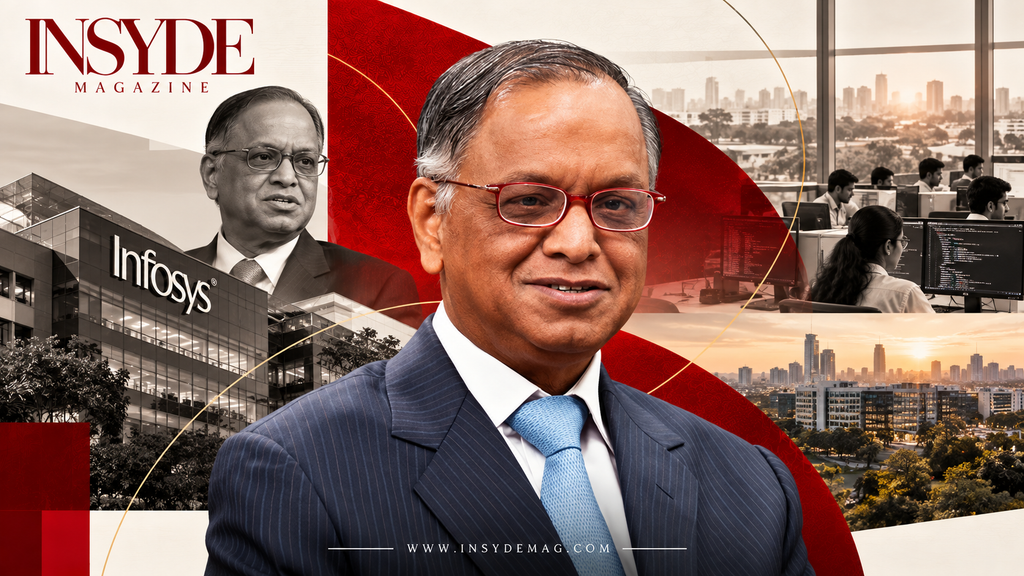
N. R. Narayana Murthy
Infosys
In 1981, seven engineers founded Infosys in Pune with initial capital of just US$250.
Four decades later, the company reported FY2026 revenue of roughly US$20.3 billion on a trailing basis, with more than 328,000 employees.
The distance between those two numbers tells part of the story.
The more important story is what happened in between.
Infosys emerged during a period when India’s greatest economic asset was increasingly recognised not as raw material or manufacturing capacity, but as human capital.
Engineers.
Programmers.
Mathematicians.
Problem-solvers.
Infosys helped turn that talent into a global business model.
The company pioneered the Global Delivery Model, allowing technology work to be delivered across borders and time zones. In 1999, Infosys became the first Indian IT company to be listed on NASDAQ.
Suddenly, the world was not simply outsourcing work to India.
It was increasingly recognising India as a source of sophisticated technology talent.
That distinction matters.
The growth of India’s IT services industry would go on to create an enormous ecosystem of engineers, entrepreneurs, technology professionals and new companies.
Bengaluru became one of the most important centres of that transformation.
Infosys was not responsible for India’s entire technology revolution. No single company was.
But it became one of the institutions through which the world began to see Indian technology capability differently.
Its employee stock-option programme also became an important part of the early Indian technology story, creating a pathway through which professional employees could participate directly in the value created by a rapidly growing company.
The broader result was a change in perception.
Indian talent was no longer simply a cost advantage.
It could become a global competitive advantage.
THE IDEA
India’s most valuable export did not always need to be a physical product. Sometimes it was knowledge.

03
THE CONNECTOR
Sunil Bharti Mittal
Bharti Airtel
There was a time when a mobile phone in India was a luxury.
Today, telecommunications is infrastructure.
As of March 2026, India had more than 1.26 billion wireless subscribers, more than 1.06 billion broadband subscribers and more than 1.09 billion internet subscribers.
That transformation was not created by one company.
But Sunil Bharti Mittal and Bharti Airtel became major participants in it.
Mittal began Bharti Enterprises in 1976, initially building businesses including bicycle components. Telecommunications became the defining chapter.
Airtel launched its Delhi mobile service in 1995.
The idea was deceptively simple:
Make telecommunications a mass-market business.
The implications were enormous.
As mobile connectivity spread, the telephone evolved into something much larger.
It became a gateway to banking, commerce, entertainment, education, navigation, work and social life.
By 2026, Bharti Airtel had crossed the 650 million customer milestone globally, making it the world’s second-largest telecom operator by customer base, according to Bharti.
The number is almost difficult to visualise.
But the real significance is not the number itself.
It is what that number represents.
Connectivity became democratised at extraordinary scale.
The Indian consumer moved from waiting for access to a fixed telephone line to carrying a connected computer in their pocket.
And that infrastructure became one of the foundations of India’s digital economy.
Mittal’s story therefore belongs in this conversation not simply because he built a large telecommunications company.
It belongs here because he helped participate in a transformation in which connectivity stopped being a privilege and became part of everyday life.
THE IDEA
Sometimes the most powerful businesses don’t sell a product. They build the infrastructure through which an entire economy operates.

04
THE SCIENTIST
Kiran Mazumdar-Shaw
Biocon
In 1978, Kiran Mazumdar-Shaw began Biocon in Bengaluru with three employees in a rented shed.
The company started by manufacturing and exporting enzymes.
It was an unlikely beginning for what would become one of India’s best-known biotechnology enterprises.
But the importance of Biocon lies precisely in that leap.
India’s economic transformation is often told through the stories of manufacturing, information technology and telecommunications.
Biotechnology offers another chapter.
It is the story of a country attempting to turn scientific capability into globally relevant businesses.
Biocon’s early history was built around enzymes. Its ambitions expanded into research, biopharmaceuticals, biosimilars and healthcare.
In FY2026, Biocon reported consolidated total income of approximately ₹17,270 crore, with operating revenue of around ₹16,927 crore, demonstrating the scale of the institution that grew from that original Bengaluru operation.
But financial scale only tells part of the story.
Mazumdar-Shaw was building in a field where the barriers were fundamentally different from those faced by consumer or software businesses.
Biotechnology demands scientific infrastructure.
Research.
Regulatory expertise.
Patient capital.
Global partnerships.
And an ability to remain committed to a problem for years rather than quarters.
That makes Biocon an important part of India’s larger entrepreneurial story.
The company did not simply demonstrate that an Indian company could manufacture biological products.
It demonstrated that Indian scientific capability could become the foundation of a global business.
And the sector is becoming increasingly important.
India’s bioeconomy reached approximately $195.3 billion in 2025, according to the India BioEconomy Report 2026.
The industry Mazumdar-Shaw entered in 1978 is no longer a niche experiment.
It is becoming a major part of India’s future economic architecture.
THE IDEA
India’s next great industries can be built in laboratories as well as factories.
05
THE TECHNOLOGY PIONEER
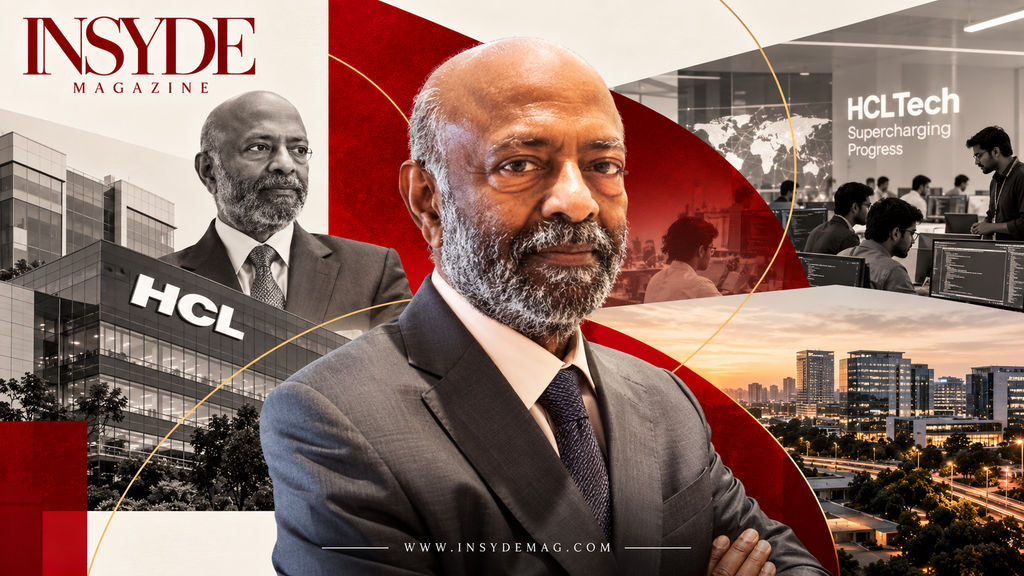
Shiv Nadar
HCL
Before India became known as the world’s technology-services powerhouse, it was already trying to build computers.
In 1976, Shiv Nadar and his co-founders established HCL.
The company began as one of India’s early technology ventures and moved into computer hardware at a time when the country’s computing ecosystem was still in its infancy.
HCL’s history includes a series of technological firsts, including the development of indigenous computing systems and early work in areas such as Unix-based computing and relational database technology.
The larger significance is easy to miss from today’s perspective.
India now has hundreds of millions of people working and studying around digital technologies.
In the 1970s, the country was still building much of the technological capability needed to participate in the coming information age.
Nadar’s bet was that India should not simply consume technology.
India should build it.
HCL began with hardware and eventually evolved into a global technology enterprise spanning engineering, software and services.
That evolution mirrors India’s own technological journey.
Hardware.
Computing.
Software.
IT services.
Engineering.
Digital transformation.
Artificial intelligence.
The industry kept changing.
HCL kept changing with it.
Nadar’s story also illustrates an important characteristic of India’s technology sector: it was not created entirely by the companies that later became household names.
It was built by an earlier generation that took risks when the market was smaller, the technology was expensive and the outcome was far from certain.
Today, HCLTech describes itself as a global technology company with more than 220,000 professionals operating across 60 countries.
But its origins were much smaller.
A handful of entrepreneurs.
A Delhi startup.
A belief in the microprocessor.
And a conviction that India could participate in the information age on its own terms.
THE IDEA
Before India could become a technology superpower, someone had to believe India could build technology.
THE FIVE BUILDERS
Dhirubhai Ambani built around scale.
Narayana Murthy helped turn Indian talent into a global technology export.
Sunil Bharti Mittal helped make connectivity mass infrastructure.
Kiran Mazumdar-Shaw demonstrated the potential of Indian biotechnology and scientific entrepreneurship.
Shiv Nadar helped establish an early foundation for Indian computing and technology.
Their businesses were different.
Their generations were different.
Their strategies were different.
But each expanded the boundaries of what Indian enterprise could attempt.
And that may be the most interesting way to understand their legacy.
Not through their net worth.
Not through a ranking.
Not through the size of their personal fortunes.
But through the possibilities their companies created for the people who came after them.
FROM BUILDING COMPANIES TO BUILDING POSSIBILITIES
The India these entrepreneurs entered was not the India we know today.
The economy was smaller.
Capital was harder to access.
Technology was expensive.
Global markets were further away.
The infrastructure required to build a world-class company was often missing.
Yet businesses were built anyway.
Then those businesses created talent.
Talent created new businesses.
Those businesses created capital.
Capital created more ambition.
And ambition created an ecosystem.
That compounding effect is perhaps the most important part of the story.
Today’s India has more than 2.07 lakh startups recognised by DPIIT, with nearly 2.8 million jobs attributed to the startup ecosystem.
The country’s technology industry is projected to cross $315 billion in FY2026.
Its telecommunications infrastructure now reaches more than a billion internet subscribers.
Its bioeconomy has crossed $195 billion.
These numbers belong to today’s India.
But the foundations were laid over decades.
THE NEXT BUILDERS
The question facing the next generation is therefore different.
The first generation had to ask:
Can India build?
The next generation asks:
Can India lead?
That distinction is already visible.
Artificial intelligence.
Semiconductors.
Space technology.
Electric mobility.
Biotechnology.
Defence technology.
Climate technology.
Consumer brands.
Financial technology.
Deep-tech.
India’s entrepreneurial story is moving into industries where the opportunity is not simply to build large companies, but to build globally consequential ones.
The builders of the previous era created institutions.
The builders of the next era will inherit those institutions — along with a vastly larger market, deeper pools of talent, greater access to capital and a generation of consumers who are increasingly connected to the world.
That does not make the next chapter inevitable.
Building anything consequential remains difficult.
Markets change.
Technology changes.
Capital disappears.
Competition intensifies.
And institutions must continually reinvent themselves.
But the ambition has changed.
India is no longer only a market waiting to be served.
It is increasingly a place from which products, technologies, companies and ideas can emerge for the rest of the world.
THE REAL LEGACY
Perhaps the phrase “builders of India” is too large for any five names.
It is.
A country of 1.4 billion people cannot be reduced to five entrepreneurs.
India was built by farmers and engineers, workers and scientists, entrepreneurs and educators, designers and factory workers, investors and consumers, public institutions and private enterprise.
The five people in this story represent only a handful of those forces.
But their stories reveal something important.
Countries change when their citizens begin to believe that the future can be built rather than simply inherited.
Dhirubhai Ambani showed what scale could look like.
Narayana Murthy showed what Indian talent could export.
Sunil Bharti Mittal showed what connectivity could unlock.
Kiran Mazumdar-Shaw showed what science could become.
Shiv Nadar showed that India could build technology rather than merely consume it.
Their greatest legacy may therefore not be the companies they left behind.
It may be the entrepreneurs who looked at those companies and thought:
Why not us?
THE BUILDERS
Five entrepreneurs.
Five industries.
One evolving India.
And the story is nowhere near finished.