
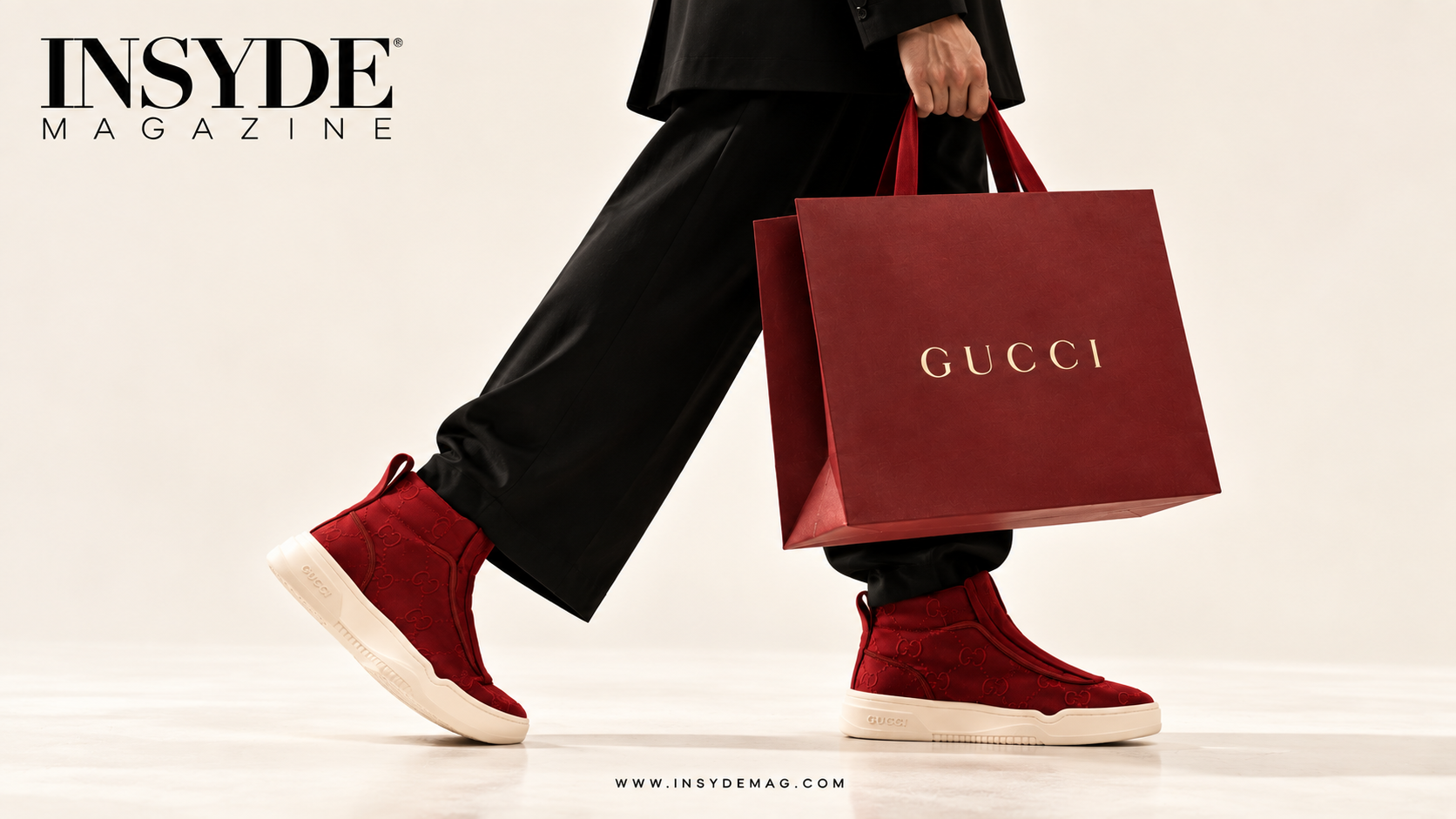
Inside the sneaker challenging what “Made in Italy” means in modern luxury.
By INSYDE
There are few phrases in fashion more powerful than Made in Italy.
Two words can evoke Florence workshops, generations of artisans, hand-finished leather and the kind of craftsmanship luxury houses have spent decades turning into mythology.
So when a Gucci sneaker arrives with “Made in China” printed on its product information, it creates an uncomfortable question.
Not because China cannot manufacture luxury products.
But because, for a brand like Gucci, where something is made has always been part of the story.
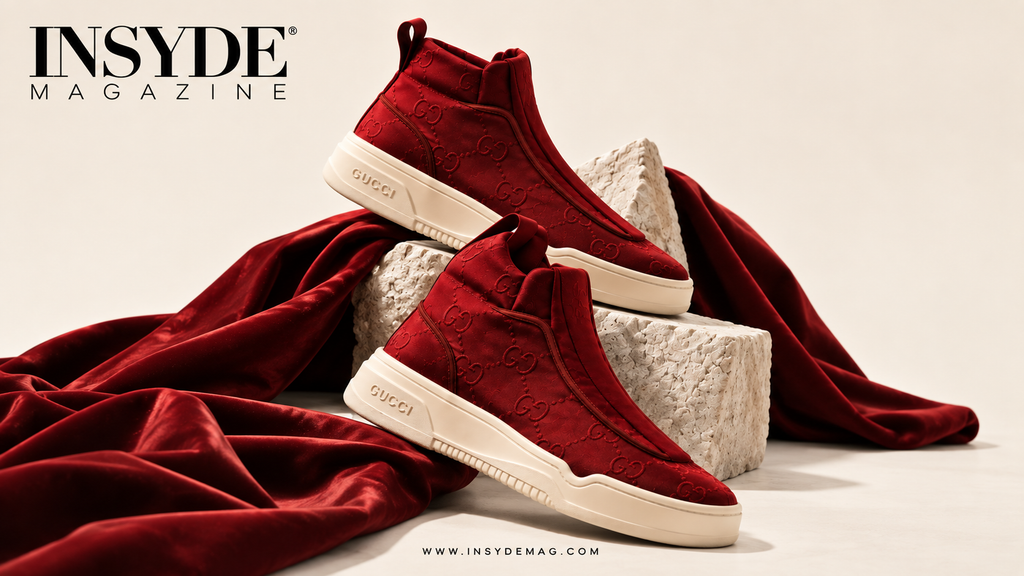
Gucci has now introduced specific sneaker models manufactured in China, including the Drip, the first sneaker designed under Demna’s creative direction at Gucci. The product is officially listed by Gucci as “Made in China.” A second slip-on sneaker from the same Primavera collection also carries the designation.
The internet can reduce that story to three words:
Gucci. Made in China.
The reality is considerably more interesting.
Because this isn’t really a story about China replacing Italy.
It is a story about what luxury means when the world that makes it becomes increasingly global.
THE SNEAKER THAT STARTED THE CONVERSATION
The Drip is not designed to look like a traditional Italian luxury sneaker.
Gucci describes it as a streamlined silhouette that combines the visual language of a basketball shoe with the ease of a loafer. It is available across materials and colourways including nylon, suede and GG canvas. Gucci identifies it as Demna’s first sneaker for the house.
Its positioning is also distinctly contemporary.
This is not a product attempting to recreate the romance of an old Gucci atelier.
It is a product designed for a fashion landscape where sneakers can carry the cultural weight once reserved for handbags, watches and couture.
And then comes the detail that changes the conversation:
Made in China.
The sneaker is still sold through Gucci.
It still carries the Gucci name.
It still sits within Gucci’s luxury ecosystem.
And depending on the market and version, it carries a price approaching the €800–$1,000 range.
That is where the question becomes unavoidable.
If the product is luxury, what exactly makes it luxury?
NO, GUCCI ISN’T MOVING TO CHINA
Before the headlines get ahead of the facts, there is an important distinction to make.
Gucci has not announced a broad relocation of its manufacturing from Italy to China.
According to Gucci’s statement reported by Reuters, Italy remains at the heart of its manufacturing model and identity, and the company has no broader plan to move production outside Italy. Gucci said the Chinese manufacturer was selected for the technical expertise and capabilities needed for the particular sneaker.
Gucci’s wider manufacturing structure tells the same story.
The house says that most Gucci products are made in Italy, while different categories are manufactured in other specialist markets. Gucci states that its watches are mainly produced in Switzerland, fragrances in France and the UK, cosmetics in the EU and some eyewear in Japan.
Its responsible supply-chain documentation states that 95% of Gucci’s manufacturers are based in Italy.
So the accurate story is not:
Gucci is abandoning Italy.
It is:
Gucci has chosen China for the manufacturing of specific sneakers.
That distinction matters.

WHY CHINA?
For years, “Made in China” was often used in luxury conversations as shorthand for mass production.
That perception is increasingly outdated.
China has become one of the world’s major manufacturing centres, including in footwear, technical materials and highly specialised production.
And Gucci’s public explanation for the Drip is not that China was chosen simply because it is cheaper.
The company has specifically pointed to the manufacturer’s technical know-how and capabilities as the reason for the decision.
That doesn’t mean cost is irrelevant to the economics of global luxury.
Gucci’s parent company Kering reported that Gucci’s first-half 2026 revenue declined 5% on a comparable basis to €2.757 billion, while the group also reported sequential improvement during the period. Mainland China remained a challenging market, although trends were improving.
The broader luxury industry is navigating a more demanding consumer environment, with brands looking for new ways to create relevance, excitement and value.
But there is not enough public evidence to say that Gucci selected China specifically to reduce manufacturing costs.
And that is precisely why the story is more interesting without that assumption.
THE MYTH OF “MADE IN ITALY”
Luxury has always understood the power of geography.
Paris.
Milan.
Florence.
Geneva.
Tokyo.
Certain places have become synonymous with particular forms of expertise.
For Gucci, Italy isn’t simply a manufacturing location.
It is part of the brand’s cultural identity.
But modern luxury supply chains are rarely as simple as a single country.
A product can involve materials, components, specialist techniques and manufacturing processes spanning several countries before it reaches a customer.
European Union rules on non-preferential origin recognise this complexity, generally determining origin for goods involving multiple countries through the concept of last substantial transformation, subject to the applicable rules.
That doesn’t make “Made in Italy” meaningless.
Quite the opposite.
It demonstrates why provenance is a sophisticated concept rather than simply a postcode.
The real question is no longer only:
Where was it made?
It is:
What expertise was required to make it?
FROM COUNTRY OF ORIGIN TO COUNTRY OF EXPERTISE
This may be where luxury is heading.
A watch can be Swiss.
An eyewear collection can involve Japanese manufacturing.
A fragrance can be produced in France.
A sneaker can be manufactured in China.
And the same global luxury house can still maintain a distinctly European identity.
Gucci’s own manufacturing footprint already reflects this reality.
The old luxury equation was relatively simple:
Italy = craftsmanship.
The new equation is considerably more complicated:
Design + expertise + materials + technology + craftsmanship + scarcity + brand identity + cultural relevance.
Geography remains part of that equation.
But it is no longer necessarily the entire equation.
THE PRICE OF THE NAME
Then there is the uncomfortable part.
What exactly is the customer paying for?
A sneaker doesn’t cost hundreds of dollars because of the rubber sole alone.
The price incorporates an entire ecosystem:
Design.
Creative direction.
Materials.
Manufacturing.
Distribution.
Brand heritage.
Marketing.
Retail experience.
Cultural relevance.
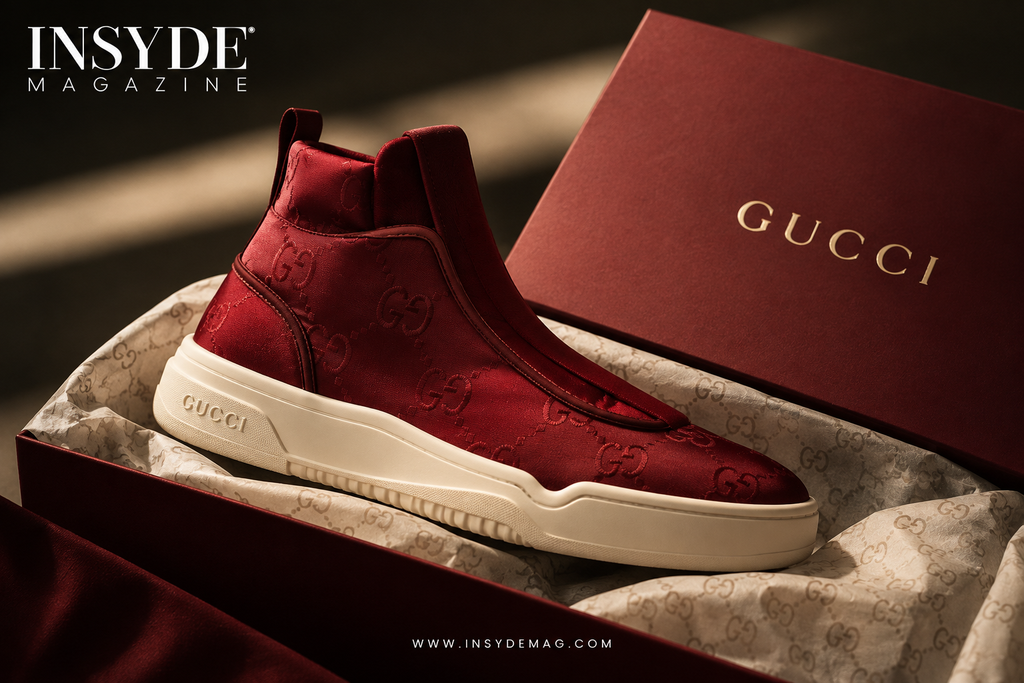
And, inevitably, the name printed on the box.
That last element is enormous.
Luxury has always sold objects, but it has also sold meaning.
A Gucci handbag is not simply leather.
A Rolex is not simply steel.
A Ferrari is not simply an engine.
The object becomes valuable partly because of the story surrounding it.
Which brings us back to the label.
If a Gucci sneaker is manufactured in China but designed under Demna, developed within Gucci’s creative and commercial system, sold through Gucci boutiques and presented as a Gucci product, does its country of manufacture change its luxury status?
There is no universal answer.
For some consumers, provenance will remain fundamental.
For others, design and cultural relevance may matter more.
And that tension is exactly what makes this moment worth watching.
DEMNA AND THE NEW GUCCI
The timing makes the story even more significant.
The Drip isn’t simply another Gucci sneaker.
It is part of the beginning of Demna’s Gucci era.
The designer’s arrival represents a new creative chapter for one of fashion’s most recognisable houses, and the Drip is one of the first products through which that direction becomes visible. Gucci itself identifies it as Demna’s first sneaker for the brand.
Its design feels deliberately contemporary.
Less about preserving an image of luxury.
More about asking what luxury can look like now.
That distinction matters.
The modern luxury consumer doesn’t necessarily want a product that looks expensive.
They want something that means something.
Something recognisable without being obvious.
Something culturally relevant.
Something that can move between fashion, street culture, social media and everyday life.
The Drip belongs to that world.
Its manufacturing origin simply adds another layer to the conversation.
WHEN THE LABEL BECOMES THE STORY
There is a strange irony here.
Luxury brands spend enormous amounts of money creating narratives around their products.
With the Drip, the manufacturing label has become part of the narrative itself.
That can be complicated.
Reuters reported that some luxury-industry analysts see potential tension between China-made products and Gucci’s long-standing association with Italian craftsmanship. Those are industry interpretations, however, rather than evidence that the product has already damaged Gucci’s positioning or consumer demand.
The eventual answer will come from consumers.
Not headlines.
Not social-media arguments.
Not assumptions about where a product should be made.
But whether customers believe the object delivers enough design, quality, desirability and cultural value to justify its price.
Because luxury has always been, at its core, an agreement between a brand and its customer.
The brand says:
This is special.
The customer decides whether to believe it.
THE NEW LUXURY MAP
Perhaps the most important consequence of Gucci’s China-made sneaker isn’t what it says about China.
It is what it says about Italy.
And, more broadly, about the future of luxury.
For decades, country of origin functioned almost like a guarantee.
Made in Italy.
Made in Switzerland.
Made in France.
The location itself communicated expertise.
But as technology improves and manufacturing capabilities become increasingly distributed around the world, luxury houses have more choices than ever.
The next generation of luxury may therefore be less interested in a single manufacturing postcode and more interested in why a particular place was chosen.
Where is the best leather?
Where is the strongest technical expertise?
Where is the most appropriate craftsmanship?
Where can a particular construction be executed at the required standard?
Where does the product make the most sense?
Those questions are far more complicated than simply asking whether something was made in Italy or China.
And they may become increasingly important as luxury brands rethink how they manufacture, price and position products.
SO, DOES “MADE IN CHINA” CHANGE GUCCI?
It changes the conversation.
It doesn’t erase Gucci’s Italian manufacturing heritage.
It doesn’t mean Gucci has moved its entire production operation to China.
It doesn’t make the sneaker counterfeit.
And it doesn’t, by itself, tell us whether the product is better or worse.
What it does do is challenge one of luxury’s oldest assumptions:
that geography and value are inseparable.
Gucci continues to have the overwhelming majority of its manufacturers in Italy, while also using specialist manufacturing capabilities across different countries and, now, China for specific sneaker models.
That may be less dramatic than the internet’s version of the story.
But it is far more revealing.
Because the future of luxury may not be about choosing between Italy and China.
It may be about understanding that modern luxury can be simultaneously local in identity and global in production.
The atelier still matters.
The designer still matters.
The material still matters.
The craftsmanship still matters.
But so does technology. So does cultural relevance. So does the ability to manufacture something precisely for the way people want to live now.
The Gucci Drip has simply made that evolution visible.
And perhaps that is the real story behind the label.
Luxury isn’t losing its borders.
It’s learning how to exist beyond them.
INSYDE
The world of luxury is changing. We’re watching what comes next.
Sources: Gucci product listings and FAQ; Gucci Responsible Supply Chain documentation; Kering H1 2026 results; Reuters reporting, September 2026; European Commission rules on non-preferential origin.
Inside the sneaker challenging what “Made in Italy” means in modern luxury.
By INSYDE
There are few phrases in fashion more powerful than Made in Italy.
Two words can evoke Florence workshops, generations of artisans, hand-finished leather and the kind of craftsmanship luxury houses have spent decades turning into mythology.
So when a Gucci sneaker arrives with “Made in China” printed on its product information, it creates an uncomfortable question.
Not because China cannot manufacture luxury products.
But because, for a brand like Gucci, where something is made has always been part of the story.
Gucci has now introduced specific sneaker models manufactured in China, including the Drip, the first sneaker designed under Demna’s creative direction at Gucci. The product is officially listed by Gucci as “Made in China.” A second slip-on sneaker from the same Primavera collection also carries the designation.
The internet can reduce that story to three words:
Gucci. Made in China.
The reality is considerably more interesting.
Because this isn’t really a story about China replacing Italy.
It is a story about what luxury means when the world that makes it becomes increasingly global.
THE SNEAKER THAT STARTED THE CONVERSATION
The Drip is not designed to look like a traditional Italian luxury sneaker.
Gucci describes it as a streamlined silhouette that combines the visual language of a basketball shoe with the ease of a loafer. It is available across materials and colourways including nylon, suede and GG canvas. Gucci identifies it as Demna’s first sneaker for the house.
Its positioning is also distinctly contemporary.
This is not a product attempting to recreate the romance of an old Gucci atelier.
It is a product designed for a fashion landscape where sneakers can carry the cultural weight once reserved for handbags, watches and couture.
And then comes the detail that changes the conversation:
Made in China.
The sneaker is still sold through Gucci.
It still carries the Gucci name.
It still sits within Gucci’s luxury ecosystem.
And depending on the market and version, it carries a price approaching the €800–$1,000 range.
That is where the question becomes unavoidable.
If the product is luxury, what exactly makes it luxury?
NO, GUCCI ISN’T MOVING TO CHINA
Before the headlines get ahead of the facts, there is an important distinction to make.
Gucci has not announced a broad relocation of its manufacturing from Italy to China.
According to Gucci’s statement reported by Reuters, Italy remains at the heart of its manufacturing model and identity, and the company has no broader plan to move production outside Italy. Gucci said the Chinese manufacturer was selected for the technical expertise and capabilities needed for the particular sneaker.
Gucci’s wider manufacturing structure tells the same story.
The house says that most Gucci products are made in Italy, while different categories are manufactured in other specialist markets. Gucci states that its watches are mainly produced in Switzerland, fragrances in France and the UK, cosmetics in the EU and some eyewear in Japan.
Its responsible supply-chain documentation states that 95% of Gucci’s manufacturers are based in Italy.
So the accurate story is not:
Gucci is abandoning Italy.
It is:
Gucci has chosen China for the manufacturing of specific sneakers.
That distinction matters.
WHY CHINA?
For years, “Made in China” was often used in luxury conversations as shorthand for mass production.
That perception is increasingly outdated.
China has become one of the world’s major manufacturing centres, including in footwear, technical materials and highly specialised production.
And Gucci’s public explanation for the Drip is not that China was chosen simply because it is cheaper.
The company has specifically pointed to the manufacturer’s technical know-how and capabilities as the reason for the decision.
That doesn’t mean cost is irrelevant to the economics of global luxury.
Gucci’s parent company Kering reported that Gucci’s first-half 2026 revenue declined 5% on a comparable basis to €2.757 billion, while the group also reported sequential improvement during the period. Mainland China remained a challenging market, although trends were improving.
The broader luxury industry is navigating a more demanding consumer environment, with brands looking for new ways to create relevance, excitement and value.
But there is not enough public evidence to say that Gucci selected China specifically to reduce manufacturing costs.
And that is precisely why the story is more interesting without that assumption.
THE MYTH OF “MADE IN ITALY”
Luxury has always understood the power of geography.
Paris.
Milan.
Florence.
Geneva.
Tokyo.
Certain places have become synonymous with particular forms of expertise.
For Gucci, Italy isn’t simply a manufacturing location.
It is part of the brand’s cultural identity.
But modern luxury supply chains are rarely as simple as a single country.
A product can involve materials, components, specialist techniques and manufacturing processes spanning several countries before it reaches a customer.
European Union rules on non-preferential origin recognise this complexity, generally determining origin for goods involving multiple countries through the concept of last substantial transformation, subject to the applicable rules.
That doesn’t make “Made in Italy” meaningless.
Quite the opposite.
It demonstrates why provenance is a sophisticated concept rather than simply a postcode.
The real question is no longer only:
Where was it made?
It is:
What expertise was required to make it?
FROM COUNTRY OF ORIGIN TO COUNTRY OF EXPERTISE
This may be where luxury is heading.
A watch can be Swiss.
An eyewear collection can involve Japanese manufacturing.
A fragrance can be produced in France.
A sneaker can be manufactured in China.
And the same global luxury house can still maintain a distinctly European identity.
Gucci’s own manufacturing footprint already reflects this reality.
The old luxury equation was relatively simple:
Italy = craftsmanship.
The new equation is considerably more complicated:
Design + expertise + materials + technology + craftsmanship + scarcity + brand identity + cultural relevance.
Geography remains part of that equation.
But it is no longer necessarily the entire equation.
THE PRICE OF THE NAME
Then there is the uncomfortable part.
What exactly is the customer paying for?
A sneaker doesn’t cost hundreds of dollars because of the rubber sole alone.
The price incorporates an entire ecosystem:
Design.
Creative direction.
Materials.
Manufacturing.
Distribution.
Brand heritage.
Marketing.
Retail experience.
Cultural relevance.
And, inevitably, the name printed on the box.
That last element is enormous.
Luxury has always sold objects, but it has also sold meaning.
A Gucci handbag is not simply leather.
A Rolex is not simply steel.
A Ferrari is not simply an engine.
The object becomes valuable partly because of the story surrounding it.
Which brings us back to the label.
If a Gucci sneaker is manufactured in China but designed under Demna, developed within Gucci’s creative and commercial system, sold through Gucci boutiques and presented as a Gucci product, does its country of manufacture change its luxury status?
There is no universal answer.
For some consumers, provenance will remain fundamental.
For others, design and cultural relevance may matter more.
And that tension is exactly what makes this moment worth watching.
DEMNA AND THE NEW GUCCI
The timing makes the story even more significant.
The Drip isn’t simply another Gucci sneaker.
It is part of the beginning of Demna’s Gucci era.
The designer’s arrival represents a new creative chapter for one of fashion’s most recognisable houses, and the Drip is one of the first products through which that direction becomes visible. Gucci itself identifies it as Demna’s first sneaker for the brand.
Its design feels deliberately contemporary.
Less about preserving an image of luxury.
More about asking what luxury can look like now.
That distinction matters.
The modern luxury consumer doesn’t necessarily want a product that looks expensive.
They want something that means something.
Something recognisable without being obvious.
Something culturally relevant.
Something that can move between fashion, street culture, social media and everyday life.
The Drip belongs to that world.
Its manufacturing origin simply adds another layer to the conversation.
WHEN THE LABEL BECOMES THE STORY
There is a strange irony here.
Luxury brands spend enormous amounts of money creating narratives around their products.
With the Drip, the manufacturing label has become part of the narrative itself.
That can be complicated.
Reuters reported that some luxury-industry analysts see potential tension between China-made products and Gucci’s long-standing association with Italian craftsmanship. Those are industry interpretations, however, rather than evidence that the product has already damaged Gucci’s positioning or consumer demand.
The eventual answer will come from consumers.
Not headlines.
Not social-media arguments.
Not assumptions about where a product should be made.
But whether customers believe the object delivers enough design, quality, desirability and cultural value to justify its price.
Because luxury has always been, at its core, an agreement between a brand and its customer.
The brand says:
This is special.
The customer decides whether to believe it.
THE NEW LUXURY MAP
Perhaps the most important consequence of Gucci’s China-made sneaker isn’t what it says about China.
It is what it says about Italy.
And, more broadly, about the future of luxury.
For decades, country of origin functioned almost like a guarantee.
Made in Italy.
Made in Switzerland.
Made in France.
The location itself communicated expertise.
But as technology improves and manufacturing capabilities become increasingly distributed around the world, luxury houses have more choices than ever.
The next generation of luxury may therefore be less interested in a single manufacturing postcode and more interested in why a particular place was chosen.
Where is the best leather?
Where is the strongest technical expertise?
Where is the most appropriate craftsmanship?
Where can a particular construction be executed at the required standard?
Where does the product make the most sense?
Those questions are far more complicated than simply asking whether something was made in Italy or China.
And they may become increasingly important as luxury brands rethink how they manufacture, price and position products.
SO, DOES “MADE IN CHINA” CHANGE GUCCI?
It changes the conversation.
It doesn’t erase Gucci’s Italian manufacturing heritage.
It doesn’t mean Gucci has moved its entire production operation to China.
It doesn’t make the sneaker counterfeit.
And it doesn’t, by itself, tell us whether the product is better or worse.
What it does do is challenge one of luxury’s oldest assumptions:
that geography and value are inseparable.
Gucci continues to have the overwhelming majority of its manufacturers in Italy, while also using specialist manufacturing capabilities across different countries and, now, China for specific sneaker models.
That may be less dramatic than the internet’s version of the story.
But it is far more revealing.
Because the future of luxury may not be about choosing between Italy and China.
It may be about understanding that modern luxury can be simultaneously local in identity and global in production.
The atelier still matters.
The designer still matters.
The material still matters.
The craftsmanship still matters.
But so does technology. So does cultural relevance. So does the ability to manufacture something precisely for the way people want to live now.
The Gucci Drip has simply made that evolution visible.
And perhaps that is the real story behind the label.
Luxury isn’t losing its borders.
It’s learning how to exist beyond them.
INSYDE
The world of luxury is changing. We’re watching what comes next.
Sources
European Commission — Non-Preferential Rules of Origin
Gucci — Where Gucci Products Are Made
Gucci Responsible Supply Chain