
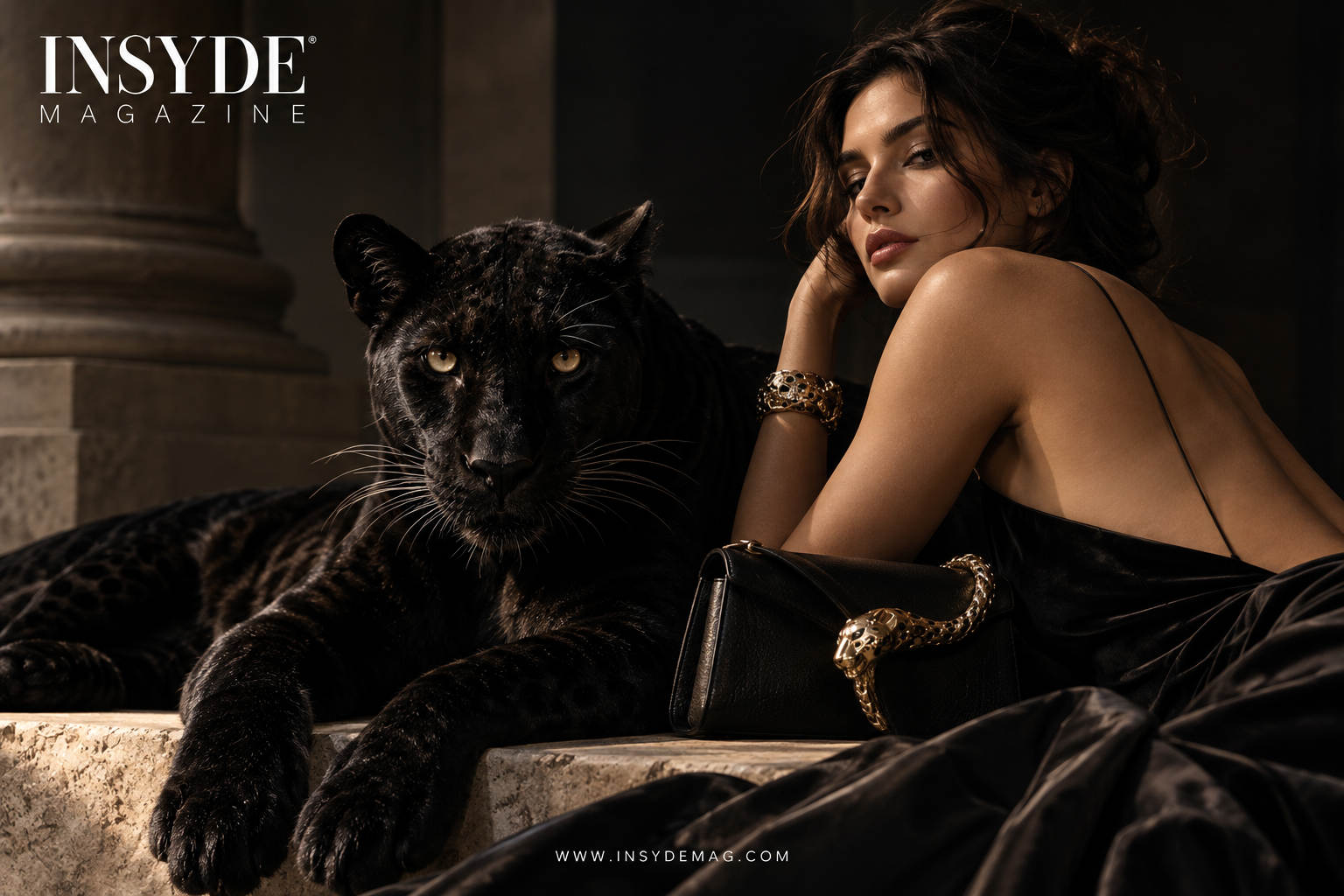
Why the world’s most desirable luxury houses keep turning to the animal kingdom.
By INSYDE
You don’t always need to read the name.
A crocodile can be enough.
A panther can be enough.
A horse and rider can be enough.
Before the word Cartier, Lacoste or Burberry has fully registered, the symbol has already done its work. It has been recognised, interpreted and, in some cases, desired.
That is the peculiar power of the luxury logo.
And perhaps no category of symbol has proved more enduring than the animal.
From Cartier’s panther to Lacoste’s crocodile, from Burberry’s equestrian knight to the many creatures that have appeared throughout fashion and jewellery, luxury has repeatedly looked to the animal kingdom to create some of its most recognisable identities.
But why?
Why does a crocodile become elegance? Why does a panther become jewellery? Why can a horse and rider suggest heritage, aspiration and privilege without a single word?
The answer goes deeper than aesthetics.
Luxury doesn’t simply sell objects. It sells associations.
And animals come with those associations already built in.
THE SYMBOL BEFORE THE BRAND
Long before luxury houses turned animals into brand codes, humans were using them to communicate power, protection, status and identity.
The animal is an unusually efficient symbol because it requires very little explanation.
A lion can suggest strength.
A panther can suggest mystery and power.
A horse can suggest movement, nobility or freedom.
These associations aren’t universal or fixed. They change across cultures and contexts. But that flexibility is precisely what makes animals so useful to luxury.
A brand can take an existing cultural image and give it a new meaning.
Over time, that meaning becomes attached not to the animal itself, but to the house.
The symbol stops being merely a picture.
It becomes part of the brand’s mythology.
THE CROCODILE THAT WAS NEVER MEANT TO BE A LOGO
Perhaps one of the most fascinating examples is Lacoste.
The crocodile wasn’t originally conceived as a branding exercise.
In 1923, tennis player René Lacoste became associated with the nickname “the crocodile” after an American journalist connected his tenacity on court to a bet involving a crocodile-skin suitcase. Lacoste embraced the nickname, and in 1927 his friend Robert George created the crocodile illustration that Lacoste had embroidered onto his jackets.
A few years later, the crocodile appeared on Lacoste’s polo shirt.
The result was remarkable for its time: a recognisable symbol placed visibly on the garment itself. Lacoste identifies itself as the first brand to feature a logo on clothing.
But the important detail isn’t simply that the crocodile became famous.
It’s why it worked.
The animal was already connected to René Lacoste’s character: determination, tenacity and competitive spirit.
The logo therefore wasn’t an arbitrary image attached to a company.
It began as a story about a person.
The brand simply made the story wearable.
THEN CAME THE PANTHER
If Lacoste’s crocodile was born from personality, Cartier’s panther became something closer to mythology.
The panther first appeared in Cartier’s collections in 1914. Cartier identifies it as the Maison’s symbolic animal, with Louis Cartier introducing the motif and Jeanne Toussaint subsequently turning it into one of the house’s defining signatures.
What makes the Cartier panther fascinating is that it was never confined to one interpretation.
It could be fierce.
It could be playful.
It could be elegant.
It could be almost abstract.
Across jewellery and other creations, Cartier has repeatedly reimagined the creature while preserving its recognisable identity.
That is where the relationship between animal and luxury becomes particularly interesting.
Cartier didn’t simply reproduce a panther.
It built a world around one.
The animal became more than an emblem. It became a visual language — one capable of carrying the personality of an entire Maison.
WHEN AN ANIMAL BECOMES A HOUSE CODE
This is perhaps where luxury differs from ordinary branding.
A logo identifies.
A house code evokes.
The distinction is subtle, but enormously important.
Luxury houses spend decades building recognisable visual languages: colours, silhouettes, patterns, materials, motifs and symbols.
Burberry’s Equestrian Knight Design is a revealing example.
Created around 1901 following a public competition to develop a new logo, the emblem brought together a knight, shield, lance and the Latin word Prorsum, meaning “Forward.” Burberry associates the knight with honour, the shield with protection and the lance with reform.
The horse is therefore not simply present because horses look aristocratic.
It exists within a larger narrative.
Movement. Protection. Progress.
The symbol has since been transformed and reinterpreted, while remaining one of Burberry’s enduring brand codes.
The animal survives because the story around it can evolve.
WHY THE ANIMAL IS SO POWERFUL
There is another reason these symbols endure.
An animal gives a brand something a word often cannot:
personality.
Consider the difference between saying:
“We are powerful.”
and showing a panther.
One is a claim.
The other is an image.
The best luxury branding often works through implication. It doesn’t need to announce exclusivity, confidence or sensuality every time. Instead, it allows the consumer to make the connection.
That creates something more valuable than recognition.
It creates interpretation.
And interpretation is central to desire.
THE PSYCHOLOGY OF THE CREATURE
There is a reason the animal kingdom is so useful to fashion.
Animals already carry archetypes.
A horse is not simply a horse.
A bird is not simply a bird.
A snake is not simply a snake.
Centuries of mythology, art, folklore and storytelling have accumulated around these creatures.
Luxury brands can therefore tap into an enormous cultural vocabulary without explaining every reference.
Research into animal motifs in fashion branding has similarly found relationships between animal archetypes, brand personality and the way consumers perceive fashion brands. A study examining 27 established fashion logos found that animal motifs could communicate distinct personality traits and symbolic associations.
But the meaning isn’t fixed.
And that is precisely the point.
Luxury can select the interpretation it wants to amplify.
FROM LOGO TO DESIRE
Something else happens when these symbols become successful.
The consumer begins to participate in the mythology.
You don’t simply own a Cartier creation.
You wear the panther.
You don’t simply wear a Lacoste polo.
You wear the crocodile.
The object becomes a vehicle for the symbol, and the symbol becomes shorthand for belonging to a particular cultural world.
This is one of luxury’s most sophisticated mechanisms.
The brand gives the object a story.
The consumer gives the story a life.
BUT THERE IS A DANGER
The animal symbol is powerful precisely because it is familiar.
And familiarity can become overexposure.
Once a symbol becomes too visible, it can lose some of the mystery that made it desirable in the first place.
That tension sits at the heart of luxury today.
The industry has spent decades making logos instantly recognisable. Yet increasingly, luxury also relies on things that require a closer look: craftsmanship, provenance, materials, construction, heritage and personal meaning.
The question for luxury is therefore no longer simply:
Can we make our symbol recognisable?
It is:
Can we make it meaningful?
THE BEAST BECOMES THE BRAND
Perhaps that is why the most successful animal symbols don’t remain logos for very long.
They evolve.
Lacoste’s crocodile began with a tennis player and became a global house code.
Cartier’s panther moved from a motif in the Maison’s collections into a sculptural and highly recognisable language across its creations.
Burberry’s Equestrian Knight has survived more than a century of changing aesthetics while continuing to be reinterpreted across products, stores and brand activations.
The creatures remain recognisable.
But their meanings keep moving.
And perhaps that is the secret.
A great luxury symbol doesn’t merely represent a brand.
It becomes a character in the brand’s mythology.
Something with a personality.
Something with history.
Something that can be inherited, reinvented and desired by people who may never know the original story behind it.
SO, WHY DO LUXURY BRANDS LOVE ANIMALS?
Because animals give luxury something money alone cannot manufacture:
myth.
They bring instinct to an industry built on craftsmanship.
They bring emotion to objects.
They transform identity into imagery.
And, perhaps most importantly, they allow a brand to say something without saying anything at all.
The next time you see a crocodile embroidered over a heart, a panther wrapped around a wrist or a knight charging across a label, look a little closer.
You’re not just looking at a logo.
You’re looking at a story that has been carefully turned into a symbol.
And eventually, into something people want to wear.
The beast isn’t beside the luxury.
The beast is part of it.