
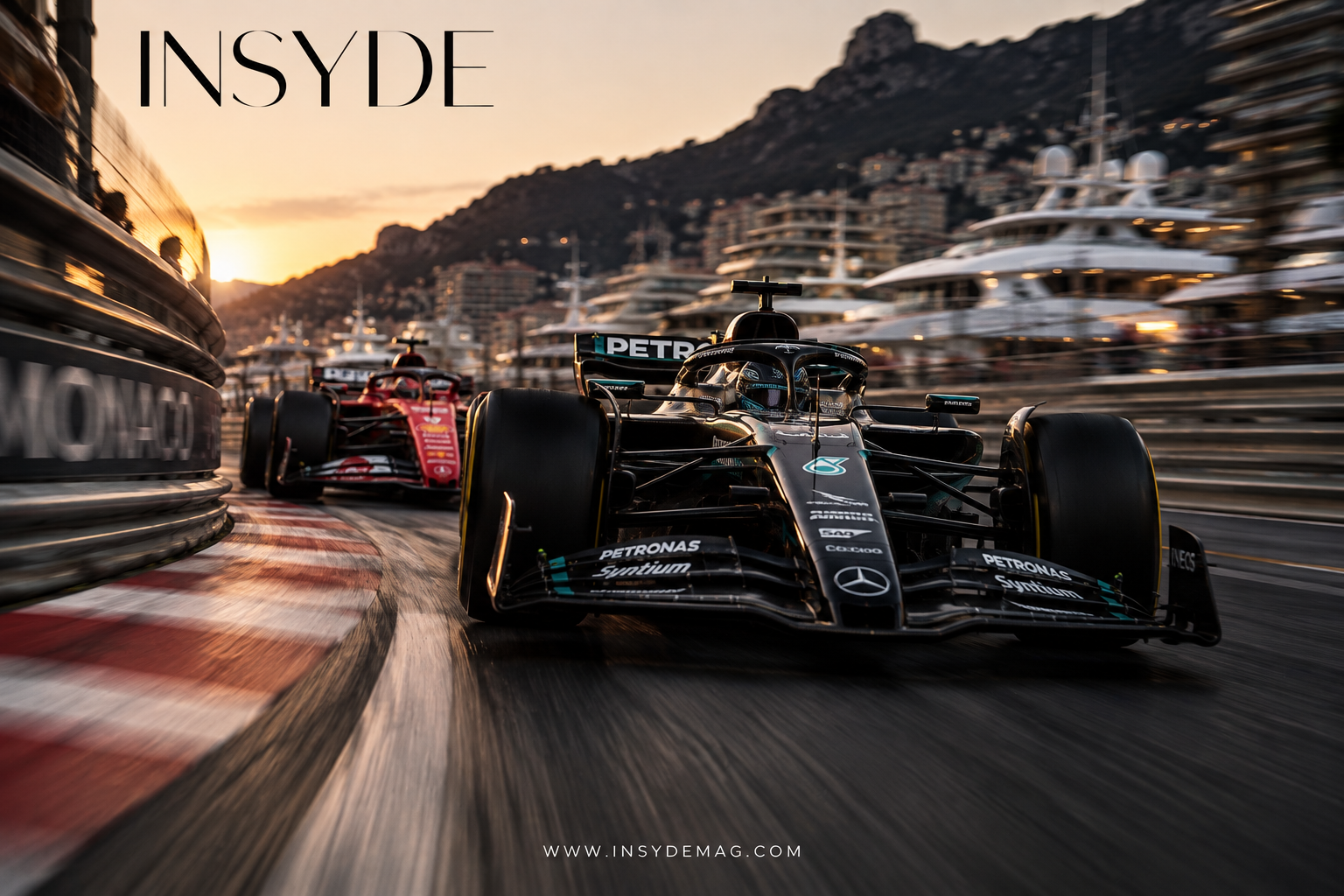
Why the world’s fastest sport has become impossible for luxury to resist.
There is something almost intoxicating about Formula 1.
It begins with the lights.
Five red circles suspended above a grid. Twenty cars waiting in silence. Drivers sealed inside machines engineered to operate at the edge of possibility. Hundreds of thousands of people watching. Millions more waiting around the world.
Then the lights disappear.
Everything becomes noise, movement and instinct.
But the seduction of Formula 1 begins long before the race.
It begins in the paddock.
A watch catches the light beneath a tailored sleeve. A driver steps out of a hospitality suite dressed like he has somewhere more important to be. A Louis Vuitton trophy trunk waits for a moment of victory. A yacht sits beyond the harbour in Monaco. Champagne is poured. Cameras turn toward celebrities. Private jets arrive. Fashion houses take over conversations that once belonged exclusively to engineers and racing teams.
And somewhere beneath all of it, a Formula 1 car is preparing to go faster than almost anything else on four wheels.
This is no longer simply a sport.
It is a world.
And luxury wants a place inside it.
THE SPORT BECAME THE SPECTACLE
Formula 1 has always been glamorous.
Monaco has always had its yachts. Ferrari has always had its mythology. Drivers have always attracted beautiful people, expensive watches and fast cars.
But something has changed.
Formula 1 is no longer merely borrowing from luxury culture.
Luxury culture is actively moving toward Formula 1.
The clearest evidence is difficult to ignore.
In 2025, LVMH became Formula 1’s Global Luxury Partner under a ten-year agreement involving Louis Vuitton, TAG Heuer and Moët Hennessy. The partnership brings together luxury craftsmanship, watchmaking, hospitality, celebration and the world’s highest-profile motorsport championship.
Louis Vuitton creates bespoke trophy trunks for major Grand Prix events.
TAG Heuer serves as Official Timekeeper.
Moët Hennessy brings celebration and hospitality into the paddock.
And in 2027, Gucci will become title partner of Alpine, creating the Gucci Racing Alpine Formula One Team and positioning Gucci Racing as a broader platform at the intersection of luxury and sport.
That is more than sponsorship.
It is a cultural takeover of sorts.
Because Formula 1 has something luxury brands spend enormous amounts of money trying to create:
desire.
THE NEW LUXURY IS ABOUT ACCESS
For decades, luxury was easy to understand.
A watch.
A handbag.
A car.
A piece of jewellery.
A private jet.
A yacht.
The object was the prize.
But luxury has changed.
The new luxury consumer is increasingly interested in what surrounds the object.
Who made it.
Where it takes you.
Who you meet there.
What you experience.
Whether you can enter somewhere others cannot.
Whether the story is worth telling.
Formula 1 understands this instinctively.
You can watch the Monaco Grand Prix from a screen.
Or you can watch it from the harbour.
You can buy a watch inspired by racing.
Or you can wear one while standing inside the paddock.
You can look at photographs of the drivers.
Or you can find yourself standing metres away from them.
The difference is not simply money.
It is proximity.
And proximity has become one of the most valuable currencies in modern luxury.
THE PADDOCK IS NO LONGER JUST A PADDOCK
There was a time when the paddock belonged primarily to teams, engineers, mechanics and journalists.
Now it has become one of the most fascinating social environments in global sport.
It is part workshop.
Part newsroom.
Part fashion week.
Part private club.
Part celebrity ecosystem.
That ambiguity is precisely what makes it seductive.
A driver can walk into a garage wearing a race suit and leave wearing a fashion label.
A watchmaker can talk about precision to people who understand exactly why a tenth of a second matters.
A luxury house can associate itself with performance without ever manufacturing a racing car.
And a young audience can discover Formula 1 through fashion, music, film or social media before ever learning the finer details of tyre strategy.
The boundaries have blurred.
And luxury thrives in blurred boundaries.
WHEN THE DRIVER BECAME THE BRAND
The modern Formula 1 driver is no longer simply an athlete.
He is a personality.
A visual identity.
A cultural figure.
Sometimes, an entire media property.
Lewis Hamilton understood this transformation perhaps more visibly than anyone else.
His career has expanded beyond the racetrack into fashion, music, film, philanthropy and global culture. He demonstrated that a Formula 1 driver could exist simultaneously inside motorsport and outside it.
Charles Leclerc represents another version of the phenomenon.
Ferrari.
Monaco.
Fashion.
Music.
Youth.
A highly recognisable image.
And now a new generation is arriving.
Kimi Antonelli is only 20, yet the 2026 season has already turned him into one of the defining personalities of the championship. By the Spanish Grand Prix in September, Antonelli had won eight of the season’s first 14 races and held a substantial championship lead over his Mercedes teammate George Russell.
The significance isn’t simply that he is winning.
It is that he is becoming an icon while the story is still being written.
And icons are precisely what luxury understands.
A product can be manufactured.
A legend cannot.
LUXURY DOESN’T SELL OBJECTS. IT SELLS MYTHOLOGY.
This is where Formula 1 becomes particularly interesting.
Consider the trophy.
A trophy is already a symbol of victory.
But Louis Vuitton has transformed the object carrying that victory into something with its own visual language.
For the 2026 season, Louis Vuitton is creating bespoke trophy trunks for Grand Prix circuits, handcrafted in its historic Asnières workshops. At Monaco, the sixth consecutive Monaco Grand Prix Trophy Trunk was reimagined in red, drawing on the colours of the Principality and the House’s visual codes.
The trunk doesn’t make the driver faster.
It doesn’t improve the car.
It doesn’t decide the race.
And yet it matters.
Because luxury understands something important:
The way a moment is presented can become part of the moment itself.
The trophy becomes an object.
The object becomes an image.
The image becomes memory.
And memory becomes mythology.
That is luxury’s territory.
TIME WAS ALWAYS GOING TO MATTER
Formula 1 and watchmaking have an almost perfect philosophical relationship.
Both are obsessed with precision.
Both celebrate engineering.
Both transform fractions of time into something meaningful.
In Formula 1, a thousandth of a second can separate victory from defeat.
In mechanical watchmaking, a movement can contain hundreds of components assembled and finished with obsessive attention to detail.
TAG Heuer’s position as Formula 1’s Official Timekeeper therefore feels less like an advertising arrangement and more like a meeting of two worlds that were always going to find each other.
But the watch has evolved beyond measurement.
It has become identity.
A driver’s watch is no longer merely an instrument.
It is part of the mythology surrounding him.
And that distinction matters.
Because luxury is rarely about what an object does.
It is about what the object means.
MONACO IS THE DREAM
If Formula 1 has a fantasy, it is Monaco.
The circuit runs through one of the world’s most recognisable luxury destinations.
The Mediterranean sits beside the track.
Yachts fill the harbour.
Hotels become temporary headquarters.
Terraces become viewing platforms.
Supercars occupy the streets.
And the boundary between sport and lifestyle almost disappears.
Monaco does something fascinating to Formula 1.
It turns the race into a destination.
You are not simply watching cars compete.
You are entering a world.
And that is one of the fundamental shifts happening in luxury.
The object is no longer enough.
The world around the object matters.
A Ferrari is desirable.
But Ferrari at Monaco is mythology.
A watch is desirable.
A watch on a driver inside the Monaco paddock becomes a story.
Champagne is a product.
Champagne on the podium becomes ritual.
Formula 1 understands the power of context.
Luxury understands it even better.
THE F1 FAN DOESN’T HAVE TO LOOK LIKE AN F1 FAN
Perhaps the most interesting development is the audience.
The new Formula 1 consumer is not necessarily the traditional motorsport enthusiast.
They may have discovered the sport through a driver.
A fashion campaign.
A streaming series.
A celebrity.
A meme.
A watch.
A Grand Prix weekend in Miami.
A photograph from Monaco.
Or simply the fascination of watching beautiful machines move impossibly fast.
That matters.
Because culture is increasingly built through intersections.
Fashion enters music.
Music enters film.
Film enters luxury.
Luxury enters sport.
Sport enters social media.
And Formula 1 sits almost perfectly in the middle of all of it.
It has become a meeting point for several different forms of aspiration.
That makes its audience unusually valuable.
Not necessarily because every fan can afford luxury.
But because luxury is built on aspiration long before it is built on ownership.
THEN GUCCI WANTED IN
If LVMH’s partnership represented the arrival of luxury at the highest level, Gucci’s next move represents something even more revealing.
From 2027, Gucci will become title partner of Alpine, with the team competing as the Gucci Racing Alpine Formula One Team. Gucci has described Gucci Racing as a new business and experiential platform built around performance, precision, discipline and excellence at the intersection of luxury and sport.
Look closely at that language.
Not advertising.
Not merely sponsorship.
Platform.
That word tells us where the relationship is heading.
Luxury brands increasingly want to build worlds rather than place logos inside them.
Gucci doesn’t simply want its name near Formula 1.
It wants Formula 1 to become part of Gucci’s cultural universe.
That is a much more ambitious proposition.
The team becomes a stage.
The car becomes a moving expression of the brand.
The drivers become cultural figures.
The paddock becomes an experiential environment.
And the Grand Prix becomes a global moment around which an entire luxury narrative can be built.
This is how modern luxury behaves.
It doesn’t ask:
Where can we put our logo?
It asks:
Where can we create desire?
WHY DOES LUXURY WANT SPEED?
There is an apparent contradiction here.
Luxury is traditionally associated with slowness.
Hand-finishing.
Craftsmanship.
Patience.
Haute couture.
Mechanical watchmaking.
Objects that take months or years to perfect.
Formula 1 is the opposite.
Everything happens at extraordinary speed.
Cars are designed around fractions of a second.
Pit stops happen in moments.
Drivers operate at the edge of human reaction.
Engineers make decisions in real time.
And yet the two worlds share a deeper obsession.
Precision.
A watchmaker might spend years perfecting a movement because one fraction of a millimetre matters.
A Formula 1 team might spend millions pursuing a fraction of a second.
Different industries.
Same mentality.
Make it lighter.
Make it faster.
Make it more precise.
Make it better than it needs to be.
That is the language of excellence.
And luxury speaks it fluently.
THE MOST EXPENSIVE THING IN F1 MAY BE ACCESS
There is a particular reason the paddock has become so seductive.
You cannot simply walk into it.
That matters.
Luxury has always been fascinated by controlled access.
Private clubs.
Private rooms.
Private aviation.
Private islands.
Private shopping appointments.
The fewer people who can enter, the more valuable the experience becomes.
Formula 1 has created an extraordinarily powerful version of the same idea.
Millions can watch.
Thousands can attend.
Far fewer can experience the sport from its most intimate spaces.
That hierarchy creates desire.
And desire creates value.
The paddock isn’t merely somewhere you go to watch racing.
It is somewhere you go to be close to the thing everyone else is watching.
In an age of unlimited digital access, physical proximity has become a luxury.
Formula 1 is selling it beautifully.
THE SPORT BECAME SOCIAL CURRENCY
There is another transformation taking place.
Formula 1 has become something people use to communicate who they are.
Supporting Ferrari says something.
Following a particular driver says something.
Wearing a team cap says something.
Knowing the best place to watch Monaco says something.
Being photographed inside the paddock says something.
Even understanding the language of the sport can become a form of cultural capital.
This is why F1 increasingly behaves like fashion.
Fashion isn’t simply about clothes.
It is about identity.
Formula 1 isn’t simply about racing.
It is increasingly about belonging to a particular world.
That is an extraordinarily powerful position for a luxury brand.
BUT THE MACHINES STILL HAVE TO DELIVER
There is one thing Formula 1 cannot afford to lose.
The racing.
Because without the performance, the fantasy collapses.
The luxury around Formula 1 works because the underlying machinery is extraordinary.
The cars are real.
The danger is real.
The engineering is real.
The competition is real.
The pressure is real.
A fashion house can borrow the language of speed.
Formula 1 actually lives it.
A watch can talk about precision.
Formula 1 is governed by it.
A luxury brand can sell exclusivity.
Formula 1 can create a physical line between those who are inside and those who are watching from outside.
That authenticity is everything.
The fantasy works because the machine is real.
THE REAL PRODUCT IS DESIRE
Perhaps that is the secret behind the entire phenomenon.
Formula 1 is not simply selling racing.
It is selling a feeling.
The feeling of speed.
The feeling of danger.
The feeling of being close to something extraordinary.
The feeling of entering a world most people can only see through a screen.
Luxury understands that feeling intimately.
A luxury object is rarely valuable simply because of its materials.
Its value comes from the story surrounding it.
The craftsmanship.
The heritage.
The scarcity.
The people associated with it.
The places it takes you.
The version of yourself you imagine becoming when you possess it.
Formula 1 now operates in exactly the same emotional territory.
It doesn’t simply ask you to watch.
It asks you to want.
THE NEW LUXURY ISN’T OWNERSHIP
For years, the luxury conversation was dominated by ownership.
Who owns the Ferrari?
Who owns the yacht?
Who owns the watch?
Who owns the house?
But the next generation of luxury is becoming increasingly experiential.
Who gets access?
Who gets invited?
Who gets there first?
Who gets to see behind the curtain?
Who gets to stand close enough to feel the vibration?
Who gets to say:
I was there.
Formula 1 is extraordinarily good at producing those moments.
And that may be why its relationship with luxury feels so natural.
The sport gives luxury something that a product launch cannot:
a living spectacle.
Luxury gives the sport something equally valuable:
a language of aspiration.
Together, they create an ecosystem much larger than either.
FORMULA 1 IS BECOMING A LUXURY LANGUAGE
This is ultimately why the relationship matters.
It isn’t really about logos.
It isn’t even really about sponsorship.
It is about language.
Formula 1 speaks in the language of:
Performance.
Precision.
Risk.
Craftsmanship.
Exclusivity.
Speed.
Competition.
Emotion.
Luxury speaks in remarkably similar terms.
The difference is that Formula 1 makes those ideas move.
It puts them on a circuit.
It gives them sound.
It gives them faces.
It gives them consequences.
And then luxury arrives to frame the experience.
A watch measures the moment.
A trophy preserves it.
A fashion house dresses it.
A hospitality suite packages it.
A camera turns it into an image.
A driver turns it into mythology.
And millions of people watch.
THE SEDUCTION OF FORMULA 1
Formula 1 didn’t become desirable because luxury brands decided to make it desirable.
They came because it was already desirable.
The sport had built something money cannot easily manufacture:
authentic obsession.
People care about these cars.
They care about the drivers.
They care about the teams.
They care about victory.
They care about defeat.
They care about the smallest details.
And when something has that kind of emotional gravity, luxury knows what to do with it.
It creates worlds around it.
That is why Louis Vuitton is building trunks around trophies.
Why TAG Heuer is measuring the sport.
Why LVMH is building experiences inside the paddock.
Why Gucci is preparing to put its name on an F1 team.
Why drivers are becoming fashion figures.
Why Monaco continues to feel less like a race weekend and more like a dream.
The seduction isn’t simply speed.
It is proximity to speed.
It is the watch on the wrist.
The champagne after the victory.
The sound of the engine disappearing down the straight.
The flash of a camera in the paddock.
The yacht beyond the circuit.
The person beside you.
The feeling that, for one weekend, you have entered a world that usually exists behind glass.
And perhaps that is what modern luxury increasingly means.
Not simply owning something extraordinary.
But getting close enough to feel it.
Formula 1 has become one of the world’s most powerful machines for creating that feeling.
The cars may be built to win.
The drivers may race for championships.
The brands may come for relevance.
But the audience?
We come for the fantasy.
And the fantasy is getting harder to resist.
That is the seduction of Formula 1.
INSYDE TAKE
Formula 1 is no longer simply where the world’s fastest drivers compete.
It is where performance meets culture.
Where engineering meets fashion.
Where precision meets desire.
Where sport meets luxury.
And where access itself becomes part of the experience.
The race remains the heartbeat.
Everything around it has become the world.
Luxury, Through a Different Lens.
Beyond the Spotlight.
INSYDE – No.1 Luxury Magazine In Bengalore