
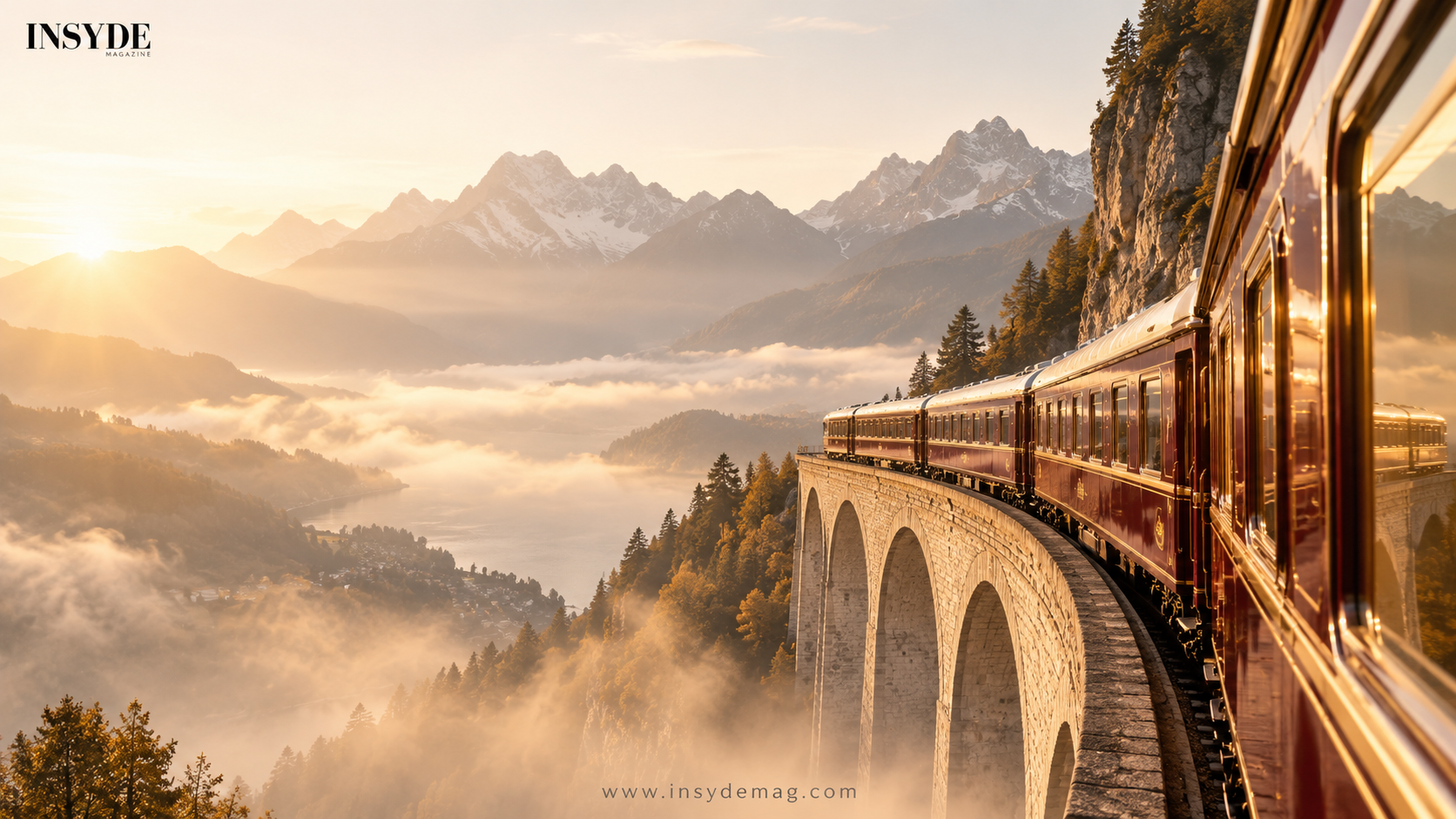
From restored Art Deco carriages in Europe to palace-inspired suites in India and grand expeditions across Africa, luxury rail travel is transforming the journey itself into the ultimate indulgence.
There are faster ways to cross continents. There are more private ways to travel. And there are certainly more direct ways to reach a destination.
Yet few experiences capture the imagination quite like stepping aboard a beautifully restored railway carriage, settling into a private suite and watching the world unfold through the window. Outside, landscapes shift from mountain passes to historic cities and vast open plains. Inside, the pace changes. Dinner becomes an occasion, the journey becomes the destination, and time itself becomes part of the luxury.
Luxury rail travel occupies a distinctive place in the world of high-end hospitality. It combines the romance of historic railway journeys with the comforts of contemporary service: beautifully appointed accommodation, considered cuisine, attentive staff and itineraries that connect passengers with places worth experiencing slowly.
The economics are equally fascinating. Depending on the route, accommodation and duration, a luxury train journey can cost several thousand pounds per person or reach tens of thousands for a single booking. These fares are not directly comparable: a one-night cabin, a multi-night private suite and an expedition with extensive excursions represent very different products.
What unites them is a philosophy of travel that places the experience itself at the centre.
That philosophy resonates with the wider luxury travel market. Virtuoso’s 2026 Luxe Report, drawing on insights from more than 2,400 travel advisers across over 50 countries, identifies cultural immersion, authenticity, food and wine, and meaningful travel experiences among the priorities shaping affluent travel. The report also finds that travellers remain willing to spend more when the experience justifies the cost.
Luxury trains offer a compelling expression of these priorities. They transform the space between destinations into something worth paying for.
From the legendary carriages of the Venice Simplon-Orient-Express to the palace-inspired suites of India’s Maharajas’ Express, these five journeys demonstrate the many ways luxury can be experienced on the rails.
01. Venice Simplon-Orient-Express, Europe
Few names in luxury travel possess the cultural resonance of the Venice Simplon-Orient-Express. Its midnight-blue carriages, polished woodwork, intricate marquetry and Art Deco interiors evoke an era when railway travel was an expression of elegance in its own right.
Operated by Belmond, the train has built its reputation around the restoration of historic carriages and an experience shaped by craftsmanship, gastronomy and personal service. Its restaurant cars turn dinner into an event, while dedicated stewards and carefully appointed cabins preserve the intimacy of traditional railway travel.
The celebrated Paris–Istanbul itinerary offers a particularly evocative example. The five-night journey connects Paris with Istanbul through a route that includes Budapest and Bucharest, with excursions and hotel stays forming part of the broader experience. It draws on the mythology of the original Orient Express tradition while operating as a distinct contemporary luxury service.
The price of admission
Belmond’s official listings show the five-night Paris–Istanbul journey in 2026 from £19,900 per adult in a Historic Cabin. For comparison, its one-night Paris–Venice journey starts from £4,275 per adult in the same cabin category. These are published starting fares, not guaranteed prices for every departure; availability and cabin selection affect the final cost.
The distinction matters. The longer itinerary is not simply a more expensive version of the same night aboard. It incorporates a broader journey, additional destinations and a different scale of experience.
Why it matters
The Venice Simplon-Orient-Express demonstrates how heritage can become a contemporary luxury asset. In a market where new hotels and experiences appear constantly, its appeal rests partly on the sense of stepping into a world that has deliberately resisted the ordinary rhythms of modern travel.
Its most valuable feature may not be any single amenity. It is the coherence of the experience: the carriage design, service, dining and route all contribute to the same idea of glamour.
02. Maharajas’ Express, India
India’s luxury hospitality industry has long drawn on its palaces, historic residences and traditions of elaborate service. The Maharajas’ Express brings those influences together in a journey designed around the country’s architectural, cultural and royal heritage.
Its itineraries connect destinations associated with monumental architecture, historic cities and India’s diverse regional identities. The train becomes a travelling base from which guests can explore the country without repeatedly checking into and out of conventional hotels.
The accommodation ranges from Deluxe Cabins to the Presidential Suite. At the highest level, the proposition extends beyond interior design to include personalised service, guided sightseeing and private vehicles for excursions. The operator’s published inclusions vary by category, making it important to examine the details rather than treating every fare as equivalent.
The price of admission
For the 2026–27 season, the official fare table lists the Presidential Suite on the seven-day, six-night Indian Splendour itinerary at ₹26.13 lakh per person, based on twin-sharing occupancy, before an additional 5% GST. The same listed Presidential Suite fare applies to the Heritage of India itinerary. The operator notes that Indian-rupee tariffs are subject to revision every two months, so the published amount should be reconfirmed before booking.
At this price, the train occupies a distinctive position in India’s premium travel market. Its value proposition is a curated journey combining accommodation, dining, guided excursions and a service model built around the experience of travelling in comfort.
Why it matters
The Maharajas’ Express shows how Indian heritage can be translated into a contemporary luxury product for domestic and international audiences. It is not simply a train with lavish interiors; it is an example of destination-led hospitality, where architecture, history and service contribute to the overall value.
For India, that distinction is significant. Luxury travel need not depend on importing an international aesthetic. It can draw its appeal from the country’s own cultural depth and traditions of hospitality.
03. Royal Scotsman, Scotland
In Scotland, luxury often finds expression in historic estates, natural materials, regional cuisine and a close relationship with the landscape. The Royal Scotsman brings these qualities together in a travelling environment that feels closer to an intimate country retreat than conventional transport.
Its itineraries pass through the Scottish Highlands and other regions of the country, combining scenic rail travel with excursions, cultural experiences and food-led programmes. Selected journeys also explore Scotland’s whisky heritage, giving passengers a deeper connection with the places they visit.
The accommodation is central to the experience, but the surrounding landscape is equally important. Mountains, lochs, villages and historic sites provide a changing backdrop that no fixed hotel could reproduce in quite the same way.
The price of admission
Belmond’s official listings include the five-night Clans, Castles & Isles journey from £73,500 per Grand Suite, quoted per cabin. A separate four-night The Highlands journey is listed from £21,000 per cabin in a Double Cabin. These are different accommodation categories and itineraries, not directly comparable per-person fares.
The figures illustrate why luxury train prices require careful interpretation. A quoted cabin price is not the same as a per-person rate, and the cost of a journey depends on the selected accommodation, itinerary and booking conditions.
Why it matters
The Royal Scotsman represents a quieter form of exclusivity. Rather than relying on spectacle alone, it combines privacy, landscape, food and heritage in a relatively intimate setting.
Its appeal lies in the feeling of being looked after while remaining connected to the destination. For travellers who value atmosphere over display, that may be precisely the point.
04. Rovos Rail, Southern Africa
The appeal of Rovos Rail is rooted in distance. Its journeys offer an alternative to the short flight and quick transfer, inviting passengers to experience southern Africa through the changing landscapes between destinations.
The Cape Town route provides a compelling example. Covering approximately 1,600 kilometres over three nights, it travels through the Cape Winelands and the Great Karoo, with excursions including the historic village of Matjiesfontein and Kimberley’s Diamond Mine Museum.
The train’s suites retain the character of classic railway accommodation while providing private bathrooms, seating areas and practical comforts. The Royal Suite, in particular, is designed around a private lounge and an en-suite bathroom with a bath and separate shower.
The experience is less about reaching a single famous destination than about seeing a vast region unfold over several days.
The price of admission
Rovos Rail publishes fares according to itinerary, travel period and suite category. Its official Cape Town journey page provides separate rate tables for 2026, 2027 and 2028, reflecting the importance of checking the correct travel season before quoting a fare.
The appropriate approach is to consult the operator’s current rate table for the intended departure rather than attach an unverified price to the journey. Rates for an earlier season should not be presented as current 2026–27 prices.
Why it matters
Rovos Rail illustrates a different expression of luxury: exploration without sacrificing comfort. Its appeal comes from the combination of long-distance travel, heritage railway design and access to landscapes that reveal themselves gradually.
In this setting, the journey is not an interruption between experiences. It is the experience.
05. La Dolce Vita Orient Express, Italy
If the Venice Simplon-Orient-Express evokes historic European glamour, the La Dolce Vita Orient Express offers a more contemporary interpretation of luxury rail travel.
Its concept draws on Italian design, regional cuisine and the appeal of exploring the country through carefully planned itineraries. Rather than relying exclusively on nostalgia, it presents the train as a contemporary setting for experiencing Italian culture, food and landscapes.
The programme includes journeys through Italy as well as a longer Rome–Istanbul itinerary. Its offering spans shorter regional experiences and multi-night international travel, each with a different price and itinerary.
The price of admission
The official booking listings show the four-night Rome–Istanbul journey scheduled for 22–27 October 2026 at €20,000, including taxes. The same listings show the one-night Tastes of Tuscan Vineyards experience from €3,060, including taxes, for a November 2026 departure. These are specific published offerings, and availability and prices may change.
The comparison reveals two distinct interpretations of luxury. One is a short, destination-focused escape; the other is an extended journey across borders. Both use the train as a setting for hospitality and discovery, but their durations and experiences differ considerably.
Why it matters
La Dolce Vita Orient Express demonstrates that luxury rail travel is not confined to reproducing the past. It can reinterpret the format through contemporary design and a strong connection with regional culture.
Its proposition is particularly relevant to travellers who see gastronomy, architecture and a sense of place as essential parts of a premium experience.
The Economics of Exclusivity
The published fares make one point clear: luxury rail travel is not a single category of product. It ranges from overnight journeys in historic cabins to multi-night experiences involving premium suites, curated excursions and extended itineraries.
The following comparison uses published operator listings available in October 2026. It is not a ranking of the five most expensive trains in the world.
| Journey | Published price reference | What the price represents |
|---|---|---|
| Venice Simplon-Orient-Express | From £19,900 per adult | Five-night Paris–Istanbul, Historic Cabin, 2026 |
| Maharajas’ Express | ₹26.13 lakh per person, plus 5% GST | Six-night Indian Splendour, Presidential Suite, twin-sharing basis, 2026–27 |
| Royal Scotsman | From £73,500 per cabin | Five-night Clans, Castles & Isles, Grand Suite |
| Rovos Rail | Varies by journey and season | Check the current official rate table for the selected departure |
| La Dolce Vita Orient Express | €20,000 including taxes | Four-night Rome–Istanbul journey listed for October 2026 |
These figures should not be compared as if they were equivalent tickets. Some are per person, others per cabin; some include taxes, while the Maharajas’ Express fare explicitly excludes GST. Journey duration and inclusions also differ.
A fair comparison must consider what is included in each fare: accommodation, meals, beverages, guided excursions, transfers and any hotel stays away from the train. It must also distinguish the advertised starting price from the amount a traveller would pay for a specific departure.
The broader lesson is that the price of luxury rail is determined by more than distance. Accommodation, service, itinerary design and the overall experience all contribute to the final fare.
Why the Journey Matters More Than the Destination
The appeal of luxury rail travel becomes clearer when viewed against the wider direction of affluent tourism. Virtuoso’s 2026 Luxe Report highlights cultural immersion, authenticity, food and wine, and meaningful travel among the interests shaping the market. It also reports that 55% of surveyed advisers expect spending per trip to increase modestly, while 28% anticipate spending to remain stable. These are adviser expectations, not measured growth in train bookings, but they provide useful context for the premium experiences market.
Luxury trains align with these priorities in several ways.
They make time part of the experience. A journey lasting several nights encourages passengers to settle into a rhythm rather than treat travel as an inconvenience.
They combine several forms of hospitality. Accommodation, dining, scenery, excursions and personal service are brought together in a single itinerary.
They give heritage a contemporary purpose. Historic railway design and regional traditions become part of a modern premium product.
They create a sense of occasion. The act of boarding, dressing for dinner, watching the landscape change and arriving somewhere new becomes a sequence of experiences in its own right.
This does not mean luxury trains are replacing private aviation, superyachts or five-star hotels. Each serves a different purpose. A private jet prioritises flexibility and speed; a luxury train asks passengers to value the time spent travelling.
That distinction is central to understanding the market. The appeal is not that a train can do what an aircraft does, only more slowly. It is that the experience of travelling by rail can offer something an aircraft cannot easily replicate.
The Future of Luxury on Rails
Luxury rail travel occupies a distinctive position between transportation and hospitality. Its strongest operators understand that beautiful interiors alone are not enough. The route must be compelling, the service consistent, the excursions worthwhile and the experience coherent from departure to arrival.
India’s Maharajas’ Express demonstrates how heritage-led hospitality can attract international attention. The Venice Simplon-Orient-Express shows how historic design can retain its cultural and commercial appeal. The Royal Scotsman and Rovos Rail present different interpretations of landscape-led exploration, while La Dolce Vita Orient Express offers a contemporary approach to Italian design and regional culture.
Their differences matter. There is no single definition of luxury, and the most expensive option is not automatically the most rewarding. For one traveller, it may be a private suite and a formal dinner; for another, it may be the opportunity to cross a remarkable landscape without rushing through it.
What these journeys share is a belief that travel can be more than the movement between two points.
In a world increasingly organised around speed and convenience, that belief has become a luxury of its own.
Perhaps that is the enduring attraction of travelling by rail at its most exceptional. The destination still matters, but it no longer has to justify every moment spent getting there.
Sometimes, the journey is the privilege.
INSYDE MAGAZINE – no.1 Luxury Magazine in Bengaluru