Author: insyde

  • Inside Bengaluru’s New Luxury Real Estate

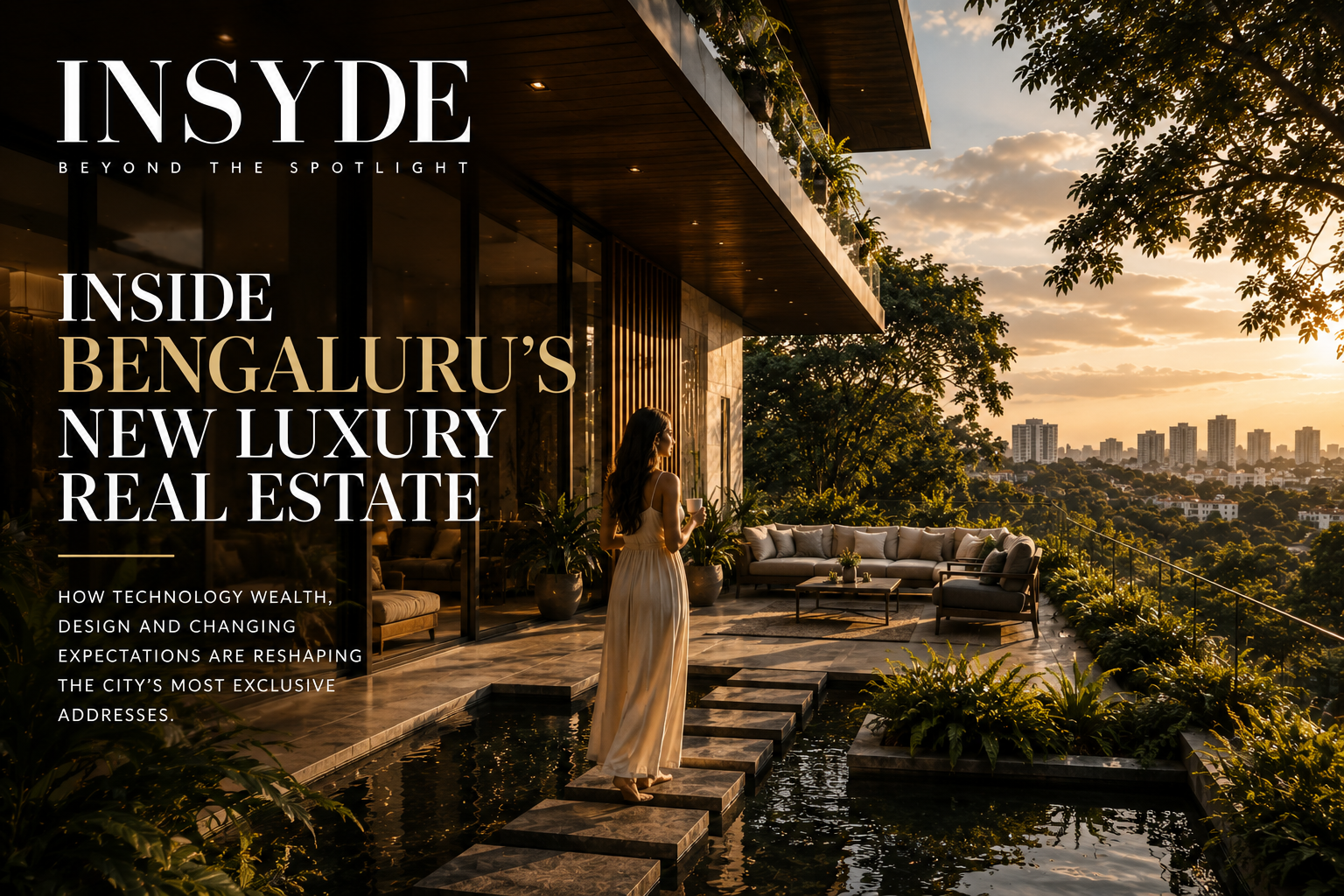
    Inside Bengaluru’s New Luxury Real Estate

    Technology wealth, changing consumer expectations and a new appetite for design are reshaping Bengaluru’s high-end housing market. At the top end, a home is no longer simply a property—it is becoming an expression of how the city wants to live.

    Bengaluru has always understood the language of growth.

    For decades, the city built its reputation on technology, entrepreneurship and the companies that transformed India’s relationship with the global economy. But as that wealth has matured, another transformation is becoming increasingly visible.

    The city is beginning to spend its wealth differently.

    Nowhere is that more apparent than in luxury real estate.

    Bengaluru’s most expensive homes are no longer being defined simply by their size or their address. Increasingly, buyers are paying for privacy, architecture, wellness, technology, service and the experience of living well.

    The numbers suggest that this is no longer a niche phenomenon.

    It is becoming a market of its own.

    When ₹10 Crore Became a Market

    In FY2025, Bengaluru’s residential market for homes priced at ₹10 crore and above crossed ₹1,000 crore in annual sales for the first time. Seventy-eight homes in the segment were sold that year, compared with 51 in the previous financial year.

    The momentum continued into FY2026.

    Data from CRE Matrix and India Sotheby’s International Realty recorded 128 Bengaluru homes priced at ₹10 crore and above sold during FY2026, representing ₹1,957 crore in transaction value. Unit sales increased 52% year on year, making Bengaluru the fastest-growing southern market covered in their report.

    The significance of those numbers is not simply that more expensive homes are being sold.

    It is that Bengaluru now has a sufficiently deep pool of affluent buyers for ultra-premium residential property to behave like a distinct consumer market.

    The ₹10 crore threshold is no longer merely a marker of exceptional wealth.

    It is becoming part of the city’s expanding luxury economy.

    The New Bengaluru Buyer

    Bengaluru’s luxury consumer is different from the traditional image of the Indian high-net-worth buyer.

    The city’s wealth has been shaped heavily by technology, entrepreneurship, global businesses and the startup ecosystem. Its affluent population includes founders, CXOs, senior technology executives, entrepreneurs, HNIs and globally mobile Indians.

    That background influences what they expect from a home.

    The FY2025 luxury housing data identified startup founders, CXOs, HNIs and global Indians among the key buyers in the ₹10 crore-plus segment.

    For this consumer, luxury is increasingly about what the price enables.

    More privacy.

    More space.

    Better design.

    Better security.

    Better amenities.

    Better access.

    And, perhaps most importantly, a home that feels aligned with the life they have built.

    That distinction matters.

    Because when buyers begin choosing residences based on experience rather than square footage alone, real estate starts behaving like luxury.

    When a Home Becomes an Experience

    The traditional luxury residence was often defined by scale.

    The larger the home, the greater the sense of status.

    That equation is changing.

    Today’s premium developments increasingly compete through what surrounds the residence: architecture, landscape, wellness facilities, private amenities, smart-home technology, hospitality-style services and carefully designed communal spaces.

    The home is becoming an ecosystem.

    This reflects a broader transformation in luxury consumption. Across India, affluent consumers are increasingly placing value on experiences, personalisation, hospitality and environments rather than visible symbols of wealth.

    Bengaluru is particularly suited to this evolution.

    A city accustomed to paying a premium for technology, convenience and efficiency is beginning to apply the same logic to where it lives.

    The Rise of the Design-Led Residence

    At the upper end of the market, architecture is no longer background.

    It is part of the product.

    Natural materials. Generous proportions. Landscape design. Light. Privacy. Technology. Wellness.

    These details are increasingly becoming part of the value proposition.

    Knight Frank’s H1 2026 research recorded a 9% year-on-year increase in Bengaluru’s average weighted residential price, reaching ₹9,354 per square foot. The research also found continued momentum in premium housing, with the ₹2–5 crore segment recording a 50% year-on-year increase in new launches.

    The figures point to a broader premiumisation of the market.

    But at the very top end, the competition is less about simply adding square footage.

    It is about creating differentiation.

    A luxury residence needs to feel considered.

    Bengaluru’s Luxury Map Is Moving

    Luxury has traditionally been associated with Bengaluru’s established central neighbourhoods.

    But the geography of premium living is expanding.

    Hebbal has emerged as one of the city’s strongest luxury markets. In FY2025, it accounted for 22% of Bengaluru’s ₹10 crore-plus luxury apartment sales value, while markets including Domlur, Sudhamnagar and Bommanahalli also featured among emerging high-end locations.

    North Bengaluru is particularly significant.

    Knight Frank identified North Bengaluru as the city’s fastest-growing residential corridor in H1 2026, with launches increasing 10% and sales rising 11% year on year. Infrastructure development, expanding commercial activity, employment growth and airport connectivity are helping reshape the area’s residential appeal.

    This matters beyond property.

    When the geography of wealth changes, the geography of the city changes with it.

    Restaurants follow affluent neighbourhoods.

    Retail follows.

    Hospitality follows.

    Wellness, design and premium services follow.

    Real estate is therefore not simply responding to Bengaluru’s growth.

    It is helping create the next version of the city.

    The Space Equation

    One of the clearest indicators of changing expectations is the demand for larger residences.

    In FY2025, luxury apartments in the 5,000–7,000 square-foot range attracted particularly strong buyer interest.

    But space itself is becoming more nuanced.

    The value of a large residence increasingly lies in what that space allows.

    A private office.

    A library.

    A home gym.

    A guest suite.

    A larger kitchen designed for entertaining.

    A terrace that functions as an outdoor room.

    A private garden.

    A space for art.

    The modern luxury residence is beginning to resemble a private hospitality environment—one designed around the rituals of its occupants.

    That is a very different proposition from simply buying a bigger apartment.

    The Business of Premiumisation

    For developers and luxury brands, this shift has significant implications.

    A growing affluent consumer base creates opportunities well beyond residential property. Architecture, interiors, furniture, fashion, jewellery, automobiles, hospitality, wellness and premium entertainment increasingly occupy the same ecosystem.

    India’s luxury retail market is expanding alongside this affluent consumer base, while brands are increasing their presence in major metropolitan markets and experimenting with more experience-led physical spaces.

    Bengaluru is becoming an important part of that story.

    The city’s luxury real estate market can therefore be understood as more than a property segment.

    It is a gateway into a broader premium economy.

    A high-value residence can create demand for interior design.

    A new luxury neighbourhood can create demand for restaurants and hospitality.

    A concentration of affluent households can attract international brands.

    And a sophisticated consumer base can raise expectations across the entire market.

    The luxury home becomes the starting point rather than the end product.

    The Limits of Luxury

    There is another side to Bengaluru’s premiumisation.

    Prices are rising, but buyers are also becoming more selective.

    Knight Frank reported that Bengaluru’s residential sales moderated sequentially in H1 2026, even as year-on-year demand remained positive. The report also identified affordability pressures and elevated property prices as factors influencing buyer and developer behaviour.

    For the luxury segment, that selectivity may ultimately be healthy.

    When buyers have more choices and higher expectations, developers cannot rely solely on a prestigious address or a large floor plan.

    They have to create a reason for the premium.

    That means better architecture.

    Better service.

    Better design.

    Better experiences.

    Luxury, after all, only works when the buyer believes there is something genuinely rare about what is being offered.

    What Bengaluru Is Building

    The most interesting part of Bengaluru’s luxury real estate story is not the price of its homes.

    It is what those homes represent.

    For a technology entrepreneur, a residence can be a private retreat from an intensely connected professional life.

    For a global Indian, it can be a return to Bengaluru with expectations shaped by international cities.

    For a young founder or CXO, it can be both an asset and an expression of identity.

    For developers, it represents an opportunity to move beyond conventional residential construction and create complete lifestyle environments.

    And for Bengaluru itself, it signals something larger:

    A city that once built its identity around creating wealth is becoming increasingly comfortable with living it.

    The Next Address

    Bengaluru’s luxury real estate market is entering a more sophisticated phase.

    The first chapter was about accumulation.

    The next is about curation.

    As affluent buyers become more discerning, the winning residences will not necessarily be the largest or the most conspicuous.

    They will be the ones that understand what luxury increasingly means:

    Privacy without isolation. Technology without intrusion. Architecture without excess. Comfort without compromise.

    Bengaluru’s luxury real estate story is ultimately not about houses.

    It is about what the city’s wealth wants its future to look like.

    And increasingly, that future has an address.

    — INSYDE Editorial

    Sources: CRE Matrix & India Sotheby’s International Realty; Knight Frank India; Fortune India; Business Standard.

  • Sadie Sink: The Next Chapter

    Sadie Sink: The Next Chapter

    From Stranger Things to the MCU, the actress is entering a new era of stardom — one that could define the next chapter of her career.

    Some careers are defined by a single role.

    Others begin to change the moment that role ends.

    For Sadie Sink, that transition has arrived at an unusually significant moment.

    For years, audiences knew her as Max Mayfield in Stranger Things — a character who became one of the defining young faces of Netflix’s global phenomenon. Now, with Spider-Man: Brand New Day, Sink has stepped into a very different cultural landscape.

    She is Jean Grey.

    But the significance of the role isn’t simply that she has joined Marvel.

    It is what comes with it.

    Jean Grey is one of the most recognisable figures in X-Men mythology, and Sink’s introduction arrives as Marvel begins building a new generation of mutants. The upcoming X-Men film is currently scheduled for 2028, with Sink returning as Jean Grey.

    That makes Brand New Day less interesting as a destination than as a beginning.

    For Sadie Sink, this is the next chapter.

    Leaving Max Behind

    There is a particular difficulty in becoming famous through a character audiences genuinely love.

    Eventually, the actor has to leave that character behind.

    Sink joined Stranger Things in its second season as Max Mayfield and quickly became one of the show’s most recognisable performers.

    Max was complicated, independent and emotionally guarded — qualities Sink played with a restraint that made the character feel considerably more human than a conventional teenage television role.

    The performance became part of the cultural identity of a generation of viewers.

    But there is a point when familiarity becomes a limitation.

    An actor can spend years being associated with the same face, the same costume and the same character.

    The next challenge is proving that the audience can believe in someone else.

    For Sink, Jean Grey is an unusually ambitious answer.

    Enter Jean Grey

    Spider-Man: Brand New Day introduces Sink’s Jean Grey through a story that is considerably more intimate than the scale of her abilities might suggest.

    She is powerful, but she is also isolated, angry and shaped by trauma.

    Her abilities are not presented simply as an advantage. They are part of the burden she carries.

    Sink has discussed approaching Jean through that emotional complexity, rather than treating her powers as the entire performance. She has also spoken about the challenge of communicating telepathy and psychic abilities visually without relying entirely on spectacle.

    That distinction matters.

    The most interesting superhero performances are rarely about the abilities themselves.

    They are about the person underneath them.

    A Different Kind of Marvel Introduction

    Marvel could have introduced Jean Grey through spectacle.

    Instead, Brand New Day gives her a more personal entry point.

    Her powers are extraordinary, but the emotional centre of the character is loneliness.

    That creates an intriguing contrast with Peter Parker.

    Both characters exist in a world where their abilities separate them from ordinary life.

    Both carry grief.

    Both have been shaped by loss.

    And both are forced to confront what extraordinary power means when placed against ordinary human vulnerability.

    Director Destin Daniel Cretton has discussed Jean’s role in the film’s themes of isolation and escapism, helping explain why she belongs in Peter Parker’s story rather than simply being inserted as a preview of the X-Men.

    That makes Sink’s casting feel less like franchise mathematics and more like a creative decision.

    The Performance Beneath the Powers

    Playing a character with telepathic and telekinetic abilities presents an unusual challenge.

    Much of what Jean does cannot be physically seen.

    There is no conventional object to hold.

    No obvious physical movement to communicate every thought.

    The audience has to believe that something is happening inside her mind.

    Sink has spoken about the challenge of visually communicating Jean’s abilities and about approaching the character through her internal struggle rather than treating her powers as pure spectacle.

    That restraint becomes important.

    The performance cannot depend entirely on effects.

    It depends on expression.

    Stillness.

    Control.

    The moments between words.

    And this is where Sink’s previous work becomes relevant.

    She has spent much of her career playing characters whose strongest emotions are often communicated without excessive explanation.

    Jean simply gives that ability a much larger canvas.

    The Luxury of Reinvention

    There is an interesting parallel between acting and luxury.

    At the highest level, luxury is rarely about having more.

    It is about having the freedom to choose differently.

    The same can be true of a career.

    Once an actor becomes strongly identified with one successful role, repeating it can be the safest option.

    Reinvention is riskier.

    Sink’s move from Stranger Things into the MCU therefore represents more than another major franchise credit.

    It is a decision to enter a new visual and cultural language.

    From Hawkins to New York.

    From Netflix’s ensemble drama to Marvel’s cinematic universe.

    From a character defined by adolescence to one whose mythology could extend for years.

    That transition requires a different kind of confidence.

    The New Marvel Generation

    Sink’s timing may be as important as the role itself.

    Marvel is entering another transition.

    The upcoming X-Men film is currently scheduled for May 2028, with Sink’s Jean Grey positioned within a new generation of mutant characters.

    This means Sink isn’t simply joining an established franchise.

    She is becoming part of the generation expected to shape what comes next.

    That distinction matters.

    Playing a legacy character inside an established universe is one thing.

    Helping establish the identity of a new era is another.

    The pressure is greater.

    So is the opportunity.

    Why Jean Grey Matters

    Jean Grey is not simply another superhero.

    She occupies a particularly important place in X-Men mythology because her story has long been connected to questions of identity, power, fear and control.

    Her abilities are extraordinary.

    Her emotional life is complicated.

    And her relationship with those abilities has historically been central to her character.

    That gives Sink considerable dramatic territory to explore.

    Rather than arriving as a fully formed icon, this version of Jean has been introduced as a young woman still trying to understand what her abilities mean and where she belongs. Sink has described the character as emotionally complicated and has expressed excitement about continuing to develop her in the MCU’s future X-Men story.

    That may ultimately be the smarter way to approach a character with such a long history.

    Let the audience meet the person before asking them to embrace the mythology.

    The End of One Era

    There is something symbolic about Sink’s transition happening alongside the conclusion of Stranger Things.

    For a generation of audiences, Max Mayfield will always be part of the cultural memory of the series.

    But an actor cannot remain frozen inside the role that made them famous.

    The most interesting careers are often defined by what happens afterward.

    The moment when an actor stops being associated with one character and begins building an identity beyond it is rarely immediate.

    It happens gradually.

    One role at a time.

    One decision at a time.

    That is the stage Sink is entering now.

    The question is no longer:

    Can she play Max?

    We already know the answer.

    The question is:

    Who is Sadie Sink when Max is no longer the centre of the conversation?

    Beyond the Franchise

    There is another reason this moment matters.

    Sink’s career is beginning to extend beyond a single franchise ecosystem.

    Her work is expanding into projects outside Marvel, including The Marriage Plot, an FX/A24 series in development.

    That suggests a broader trajectory.

    The goal isn’t simply to become another recognisable franchise face.

    It is to develop a career with enough range to exist outside any one studio, character or genre.

    That distinction is increasingly important as Hollywood’s most recognisable young actors navigate an entertainment landscape dominated by intellectual property.

    Franchises can create global visibility.

    Range creates longevity.

    The Importance of Restraint

    There is something distinctive about Sink’s rise because it has not depended entirely on the loudest version of celebrity.

    Her appeal has largely come through performance.

    The characters.

    The work.

    The moments on screen.

    That becomes particularly valuable in an era when celebrity can be manufactured through constant visibility.

    Audiences see actors everywhere — interviews, campaigns, social platforms, premieres and brand collaborations.

    But visibility is not the same as mystique.

    Sometimes the most compelling performers are the ones who allow the work to remain larger than the personality.

    Sink has the opportunity to build precisely that kind of career.

    The Next Face of a New Era?

    It would be premature to describe Sadie Sink as the definitive face of Marvel’s next generation.

    That story is still being written.

    But the ingredients are there.

    A recognisable global audience from Stranger Things.

    A major new role in the MCU.

    A character with decades of cultural history.

    A place inside the developing X-Men universe.

    And, perhaps most importantly, enough career ahead of her to define what comes next.

    The interesting part is that she doesn’t need to become the next version of anyone.

    Not the next Marvel superstar.

    Not the next franchise actress.

    Not another performer permanently defined by the role that made her famous.

    Her opportunity is more interesting than that.

    To become Sadie Sink on her own terms.

    The Next Chapter

    The arrival of Jean Grey could easily have been treated as another Marvel casting story.

    But viewed from a distance, it represents something more significant.

    A young actor is moving from one defining cultural phenomenon into another.

    One character is becoming part of her history.

    Another is beginning to shape her future.

    And somewhere between those two identities lies the most interesting part of her career.

    Not the moment she became famous.

    Not even the moment she joined Marvel.

    But the period in which she decides what to do with both.

    Because the most valuable thing an actor can carry from one era into another isn’t a franchise.

    It is credibility.

    And Sadie Sink has reached the point where the question is no longer whether audiences know her.

    They do.

    The question is what they will remember her for next.

    Jean Grey may be the next chapter.

    It doesn’t have to be the final definition.

    INSYDE — Beyond the Spotlight.

  • THE BILLIONAIRES BEHIND THE WORLD’S MOST LUXURIOUS HOTELS

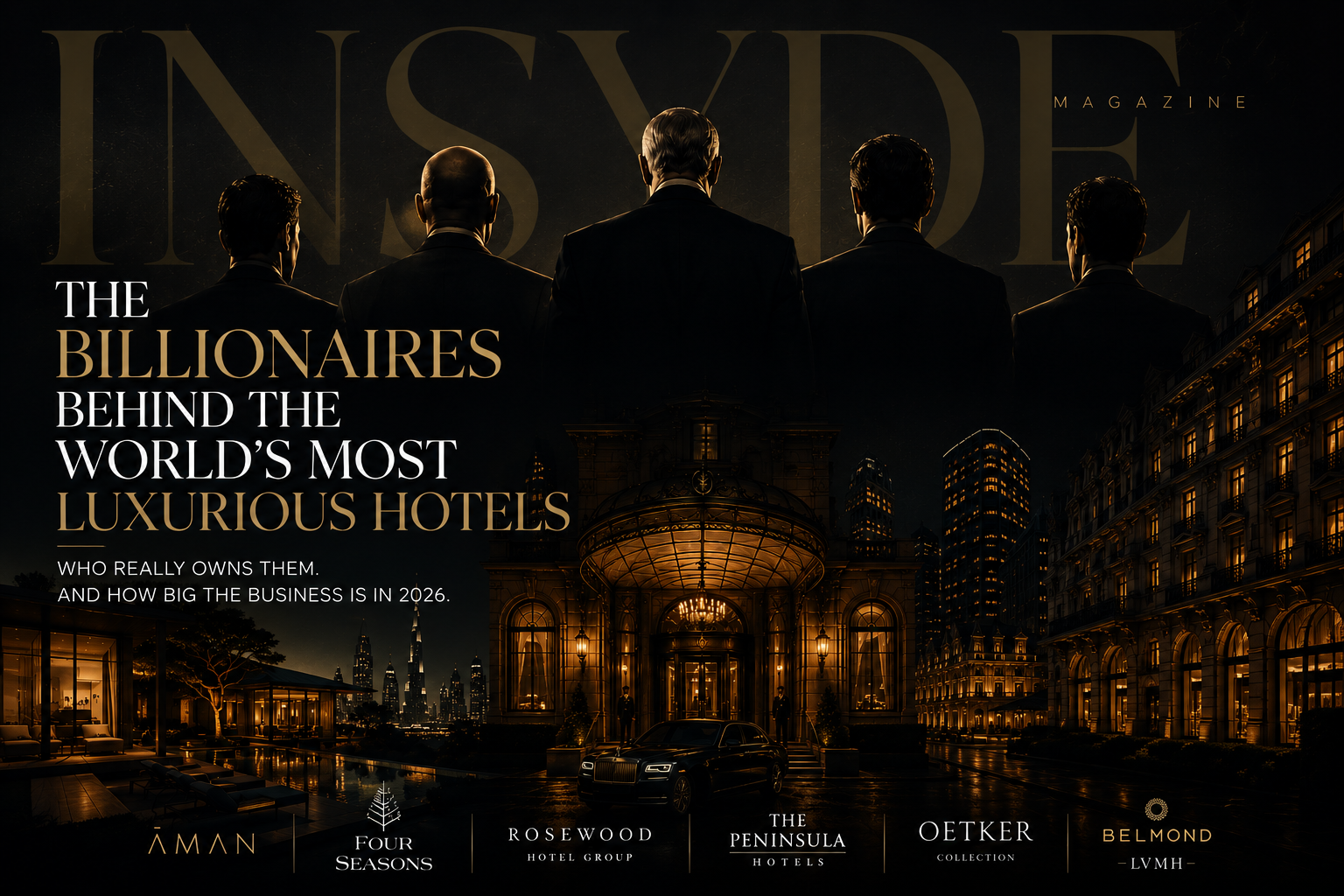
    THE BILLIONAIRES BEHIND THE WORLD’S MOST LUXURIOUS HOTELS

    You know the hotel. You know the name. But do you know who actually owns the world behind it?

    Walk into one of the world’s great luxury hotels and you see the same things.

    Marble.

    Chandeliers.

    Immaculate suites.

    Private entrances.

    Restaurants where reservations can feel harder to secure than flights.

    Service so polished that almost everything appears effortless.

    But behind that effortless experience is a business most guests never think about.

    Who owns it?

    The answer is rarely as simple as the name above the entrance.

    A billionaire might own the hotel company.

    A family office might own the building.

    An investment fund might own the land.

    Another company might operate the property.

    And a global luxury group might own the brand and manage the experience.

    That complexity is not a technical footnote.

    It is the story.

    Because in 2026, some of the world’s most powerful fortunes are increasingly connected to the business of luxury hospitality.

    And the money involved is enormous.

    A $10 billion valuation for Four Seasons.

    A $3.2 billion enterprise-value acquisition of Belmond by LVMH.

    A $500 million new investment vehicle targeting Aman and Janu hotels, residences and mixed-use developments.

    A $230 million acquisition of Rosewood that helped turn it into a global luxury-hospitality group.

    These aren’t simply hotel deals.

    They are bets on the future of luxury itself.


    THE HOTEL YOU SEE IS ONLY THE FRONT END

    The first thing to understand about luxury hotels is that the brand and the building are not necessarily the same business.

    This is where the industry becomes fascinating.

    A hotel group can create the brand, design the service standards and manage the property without owning the real estate.

    A property company can own the building and hire a hotel company to operate it.

    An investment group can finance the development.

    And a billionaire can ultimately control the company sitting somewhere above all of them.

    So when someone says a billionaire “owns a hotel”, that can mean several different things.

    They may own:

    The hotel brand.

    The operating company.

    The property.

    The development company.

    Or simply a controlling stake in the company that controls the brand.

    At the top end of hospitality, understanding that distinction is essential.

    Because sometimes the most valuable thing in the building isn’t the building at all.

    It’s the name.


    AMAN: THE BILLIONAIRE WHO TURNED PRIVACY INTO AN EMPIRE

    Few names represent ultra-luxury quite like Aman.

    The brand began in 1988 with Amanpuri in Phuket and built its reputation around something that was almost the opposite of conventional luxury-hotel expansion:

    scarcity.

    Then came Vlad Doronin.

    The billionaire real-estate entrepreneur acquired Aman in 2014, after having been a long-time Aman guest himself. Since then, he has expanded the brand from secluded resorts into city hotels, residences, private clubs, interiors and new forms of travel.

    Aman has now grown into a global portfolio of hotels and resorts, while its ecosystem has expanded far beyond traditional hospitality.

    And then came the number that reveals where Aman is really heading.

    In July 2026, Doronin’s OKO Group announced a $500 million joint venture with Shinsegae Property to develop Aman and Janu hotels, branded residences and mixed-use properties.

    But the most striking part may be the residential business.

    Doronin told Bloomberg that Aman had sold close to $9 billion in branded residences over the previous four years, according to Forbes.

    Suddenly, Aman looks very different.

    It isn’t simply a company selling extraordinarily expensive hotel rooms.

    It is building a world where the same customer can stay at Aman, live at Aman, join Aman and eventually travel with Aman.

    The hotel becomes the entry point.

    The brand becomes the real asset.


    FOUR SEASONS: THE $10 BILLION BET

    If Aman represents scarcity, Four Seasons represents something else:

    global scale without abandoning luxury.

    Four Seasons is backed by Cascade Investment, associated with Bill Gates, alongside Kingdom Holding Company and founder Isadore Sharp.

    In 2021, Cascade agreed to acquire an additional 23.75% stake for $2.21 billion, taking its ownership to 71.25% and valuing Four Seasons at approximately $10 billion in enterprise value.

    That wasn’t a bet on one hotel.

    It was a bet on a global luxury machine.

    Four Seasons has continued expanding and says it has 135 hotels and resorts and 61 residential properties across 47 countries.

    And this is what makes the Four Seasons strategy so interesting.

    Aman tells the customer:

    You are entering a world very few people can access.

    Four Seasons tells the customer:

    You can expect an extraordinary standard wherever in the world you go.

    Two completely different interpretations of luxury.

    Both extraordinarily valuable.


    ROSEWOOD: THE $230 MILLION ACQUISITION

    Rosewood’s story demonstrates another way fortunes enter luxury.

    In 2011, Chow Tai Fook Enterprises, the Hong Kong company behind the Cheng family’s business empire, acquired Rosewood for roughly $230 million.

    The interesting part isn’t simply what they paid.

    It is what happened afterwards.

    Rosewood Hotel Group has expanded into a global hospitality platform, with 60 properties across 26 countries and territories and more than 30 additional properties in development.

    The group also operates other hospitality and lifestyle businesses.

    That makes Rosewood an important example of a larger trend:

    wealthy owners aren’t necessarily buying hotels to collect hotels.

    They’re buying brands that can be expanded across multiple categories.

    Hotels.

    Residences.

    Wellness.

    Private clubs.

    Experiences.

    And eventually, entire lifestyles.


    THE PENINSULA: WHEN LUXURY BECOMES A FAMILY LEGACY

    Then there is The Peninsula.

    Its story feels almost completely different.

    The Peninsula Hotels are part of Hongkong and Shanghai Hotels, a business with roots going back to 1866 and long associated with the Kadoorie family.

    Its chairman, Sir Michael Kadoorie, represents a very different model of luxury ownership: generational wealth.

    The Peninsula portfolio remains deliberately selective, with properties across major cities and destinations including Hong Kong, Shanghai, Tokyo, New York, London and Paris.

    This is not the story of a billionaire buying a trendy hospitality brand and rapidly multiplying its properties.

    It is something much older:

    generational ownership.

    That distinction matters.

    Because luxury isn’t always built through growth.

    Sometimes it is built through continuity.

    The Peninsula doesn’t need to be everywhere.

    Its power comes partly from the fact that it isn’t.


    OETKER: THE FAMILY BUSINESS BEHIND EUROPEAN HOTEL ROYALTY

    If there is one group that demonstrates the relationship between family wealth and luxury heritage, it is Oetker.

    Oetker Collection sits within the family-owned Oetker business, whose interests extend well beyond hotels.

    The group identifies Dr. Alfred Oetker and Ferdinand Oetker among its shareholders, while the wider family business spans multiple industries, including real estate and luxury hospitality.

    Its hotel portfolio includes names such as Le Bristol Paris and Hotel du Cap-Eden-Roc.

    And this is where luxury hospitality becomes different from almost every other industry.

    You can spend billions building a new hotel.

    But you cannot spend billions and instantly purchase a century of history.

    A historic address has something money alone cannot manufacture:

    memory.

    That is why heritage itself has become a luxury asset.

    You can construct a spectacular hotel in three years.

    You cannot manufacture decades of mythology.


    LVMH: WHEN THE LUXURY CONGLOMERATE ENTERS THE HOTEL BUSINESS

    Then there is the world’s ultimate luxury conglomerate.

    LVMH.

    The group already controlled brands across fashion, jewellery, watches, beauty and wine and spirits.

    Then it went deeper into hospitality.

    In 2018, LVMH agreed to acquire Belmond for $2.6 billion in equity value and $3.2 billion in enterprise value. The transaction was completed in 2019.

    Belmond brought with it hotels, restaurants, luxury trains and river cruises.

    That acquisition was important because it revealed a larger strategy.

    Luxury doesn’t have to mean selling a handbag.

    It can mean selling the entire journey surrounding the customer.

    A hotel.

    A train.

    A yacht.

    A destination.

    A restaurant.

    A fashion house.

    A piece of jewellery.

    Different products.

    One customer.

    One ecosystem.

    And in 2026, that strategy is becoming even more relevant as luxury groups push further into travel and experiential hospitality.


    THE BILLIONAIRE DOESN’T ALWAYS OWN THE HOTEL

    This is perhaps the most important part of the entire story.

    Imagine a luxury hotel carrying one of the world’s most famous names.

    The guest assumes the company behind that name owns everything.

    Not necessarily.

    The brand could belong to one company.

    The real estate could belong to another.

    The hotel operator could be a third.

    The financing could come from a fourth.

    And the ultimate investor could sit several layers above them.

    That structure is extremely common in modern hospitality.

    It allows hotel companies to expand without buying every building themselves.

    And it allows property investors to use powerful luxury brands to make their real estate more valuable.

    Which leads to perhaps the biggest transformation happening in luxury right now.


    THE REAL GOLDMINE: BRANDED RESIDENCES

    The hotel room is no longer necessarily the biggest prize.

    The residence might be.

    Luxury hotel brands are increasingly attaching their names to private residences.

    Why?

    Because selling a hotel room generates revenue from a stay.

    Selling a branded residence can create an enormous property transaction — while allowing the hotel company to earn branding, management and service fees without necessarily owning the entire building.

    Aman is one of the clearest examples.

    According to Forbes’ 2026 reporting, Aman has sold close to $9 billion in branded residences in four years, while Savills data cited in the same report indicated that buyers globally were willing to pay an average 33% premium for branded residences over comparable unbranded homes.

    That is a staggering proposition.

    Imagine buying an apartment.

    Now put a globally recognised luxury hotel brand on the front.

    Add hotel-level service.

    Concierge.

    Housekeeping.

    Wellness.

    Restaurants.

    Private clubs.

    Then charge a premium for the privilege.

    Suddenly the hotel brand is no longer just selling hospitality.

    It is selling real estate at a premium.


    WHY BILLIONAIRES WANT INTO HOSPITALITY

    So why would someone who already has billions want to own hotels?

    The obvious answer is money.

    But it isn’t the only answer.

    Luxury hospitality sits at an unusual intersection of industries.

    Real estate.

    Travel.

    Food.

    Fashion.

    Entertainment.

    Culture.

    Private wealth.

    A luxury hotel can become a meeting place for CEOs.

    A destination for celebrities.

    A home-away-from-home for billionaires.

    A platform for restaurants and chefs.

    A gateway into a city.

    A launchpad for branded residences.

    A private club.

    And a physical expression of a luxury brand.

    That makes the hotel much more powerful than a simple accommodation business.

    It becomes a social and commercial ecosystem.


    FROM ROOMS TO WORLDS

    This is where the luxury-hospitality business is ultimately heading.

    A hotel room was once the product.

    Then came the suite.

    Then the villa.

    Then the residence.

    Then the private club.

    Then the yacht.

    Then the private travel experience.

    The customer doesn’t necessarily want to buy one thing anymore.

    They want an entire world that feels consistent with their lifestyle.

    Aman understands this.

    Four Seasons understands this.

    LVMH understands this.

    Rosewood understands this.

    And the investors behind these companies understand something even more important:

    The luxury customer doesn’t stop being a luxury customer when they leave the hotel.

    So why should the brand stop selling to them?


    THE NEW LUXURY POWER PLAY

    This changes the economics of luxury.

    The most valuable hospitality brands aren’t necessarily the ones with the most rooms.

    They may be the ones that can convince customers to spend across the greatest number of categories.

    Stay at the hotel.

    Buy the residence.

    Join the club.

    Book the experience.

    Take the yacht.

    Return to another property.

    Bring the same brand into your lifestyle.

    That is a much bigger business than hotel occupancy.

    And it explains why billionaires, family fortunes and luxury conglomerates continue to look at hospitality as more than a place to park capital.

    They are buying access to a customer.


    SO, WHO REALLY OWNS LUXURY?

    There is no single answer.

    Vlad Doronin controls Aman.

    Cascade Investment is the controlling shareholder behind Four Seasons.

    The Cheng family’s Chow Tai Fook Enterprises controls Rosewood.

    The Kadoorie family sits behind The Peninsula’s long-running ownership structure.

    The Oetker family controls its luxury hospitality and wider family business.

    LVMH controls Belmond and has built a growing luxury-hospitality ecosystem around it.

    Different fortunes.

    Different generations.

    Different strategies.

    But they are all betting on the same fundamental idea:

    Luxury is becoming less about a product and more about an ecosystem.


    THE PEOPLE YOU NEVER SEE

    The guests are visible.

    The hotel is visible.

    The logo is visible.

    The billionaire behind the business usually isn’t.

    You won’t see them standing in the lobby.

    You probably won’t know which investment vehicle owns the building.

    You may never know which company controls the brand.

    And you certainly won’t see the spreadsheets behind the marble.

    But those decisions determine where the next hotel opens.

    Which neighbourhood becomes fashionable.

    Which destination receives billions in development.

    Which brands remain exclusive.

    Which become global.

    And which luxury experiences become available only to those who can afford them.

    That is the hidden side of hospitality.

    Not the room.

    Not the restaurant.

    Not the view.

    The ownership.

    Because the next time you walk into one of the world’s most luxurious hotels, look beyond the chandelier.

    Ask who owns the building.

    Who owns the brand.

    Who operates it.

    Who financed it.

    And who stands to benefit when the world’s wealthiest people decide they want to stay there.

    Because sometimes, the most interesting person in the hotel…

    is the one you never see.

    INSYDE — Beyond the Spotlight.

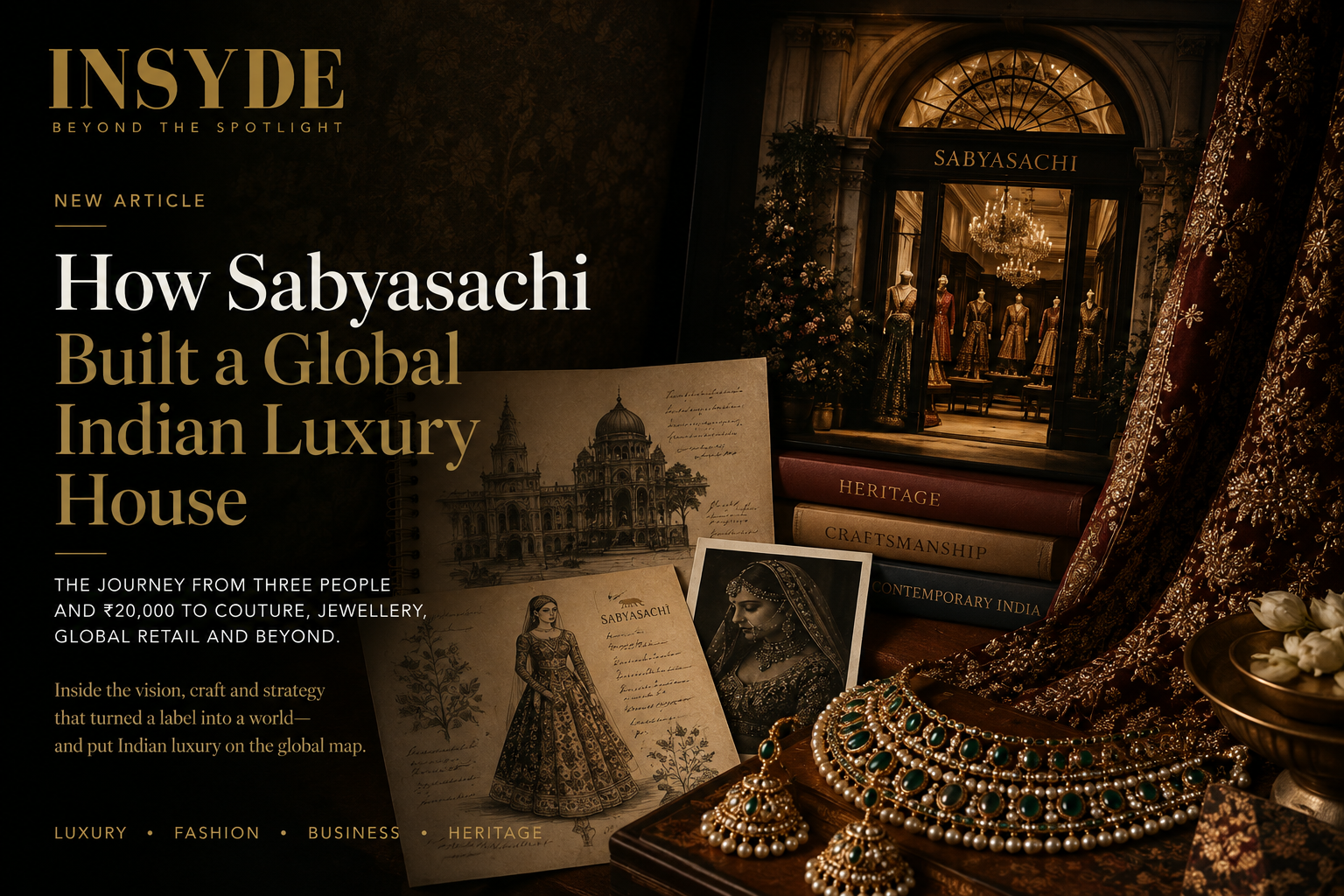
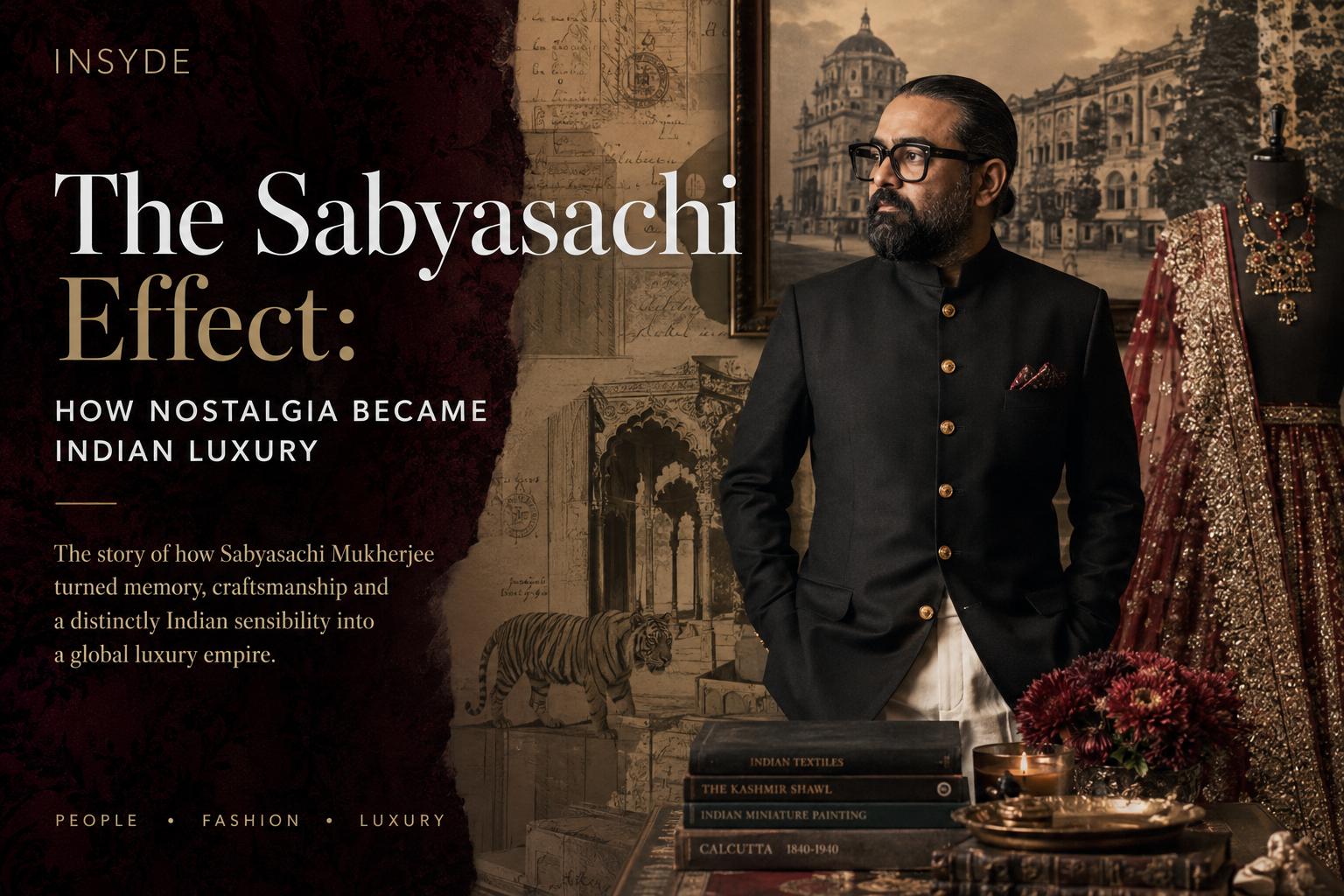
  • How Sabyasachi Built a Global Indian Luxury House | INSYDE

    How Sabyasachi Built a Global Indian Luxury House | INSYDE

    The Sabyasachi label began with three people and ₹20,000. Today, it spans couture, jewellery, retail, beauty, art and international markets. The real story is how a designer turned an aesthetic into an entire luxury ecosystem.

    A fashion label sells clothes.

    A luxury house sells something much harder to manufacture:

    a world.

    Sabyasachi has spent more than two decades building one.

    The clothes came first.

    Then came bridalwear.

    Then jewellery.

    Then accessories.

    Then stores that looked more like museums.

    Then international expansion.

    Then beauty.

    Then art.

    Then collaborations with global companies.

    At some point, calling Sabyasachi simply a fashion label stopped being enough.

    The more interesting question became:

    How did one designer turn a very specific idea of India into a global luxury business?

    The original ambition was never small

    The Sabyasachi story starts with an unusually clear ambition.

    After graduating from NIFT Kolkata in 1999, Sabyasachi rejected job offers from established designers and started his own label. His official history says he borrowed ₹20,000 from his family and began with a workforce of three.

    The ambition, according to the brand, was to create India’s biggest luxury house.

    That is important because it changes how we read everything that followed.

    The jewellery wasn’t a random extension.

    The stores weren’t simply retail expansion.

    The beauty collaboration wasn’t just another licensing opportunity.

    They were pieces of a larger plan.

    The goal was never only to design clothes.

    It was to build a house.

    The luxury proposition was craft

    The foundation of the business is not celebrity.

    It is craftsmanship.

    Sabyasachi’s official history describes work with weavers, block printers, embroiderers, dyers, goldsmiths, furniture artisans and other craftspeople across India. It currently says the house employs around 1,000 craftspeople and works regularly with more than 3,000 craftspeople and master weavers.

    That network gives the brand something modern luxury increasingly values:

    provenance.

    Where was it made?

    Who made it?

    How long did it take?

    What technique was used?

    What region does it come from?

    These questions turn an object into a story.

    And luxury has always been very good at selling stories.

    Sabyasachi’s innovation was to argue that India’s enormous craft tradition could be the foundation of a luxury proposition rather than simply a source of inspiration.

    The house explicitly describes the future of artisanal crafts and handwoven textiles as lying in luxury.

    That is not just a design philosophy.

    It is a business philosophy.

    The bridal business created the ecosystem

    Couture created prestige.

    Bridalwear created demand.

    Jewellery expanded the relationship.

    The wedding became the perfect environment for a luxury house because the customer often needs multiple categories at once.

    Clothing.

    Jewellery.

    Accessories.

    Beauty.

    Sometimes even décor and hospitality.

    Sabyasachi’s first bridal collection, Chand Bibi, marked a major turning point in the brand’s growth and helped establish what became known as the “Sabyasachi bride.”

    But the important business insight was broader.

    A bride doesn’t necessarily want a single product.

    She wants a world around the occasion.

    Sabyasachi was well positioned to provide it.

    Then jewellery became its own business

    The launch of Sabyasachi Jewellery was a significant step because jewellery is not simply another category of fashion.

    It changes the economics and lifespan of the relationship with the customer.

    A couture garment may be purchased for an occasion.

    Jewellery can become an heirloom.

    The house developed its jewellery language around Indian heritage, North Calcutta references and Byzantine influences. It also introduced a branded mangalsutra, presenting the traditional wedding necklace through a contemporary luxury lens.

    The jewellery business expanded internationally, including retail at Bergdorf Goodman and dedicated spaces in the brand’s New York and Mumbai stores.

    This was an important evolution.

    The customer no longer had to leave the Sabyasachi universe to complete the look.

    The house could increasingly provide the look itself.

    The store became the advertisement

    Then came retail.

    But Sabyasachi did not treat the store as somewhere to put clothes.

    The brand describes its retail spaces as “living museums.”

    The Mumbai flagship, opened in the city’s heritage district in 2023, expanded the idea dramatically. The brand describes the 25,862-square-foot space as its largest flagship, bringing together bridal and couture, ready-to-wear, jewellery, archival pieces and other elements of the Sabyasachi world.

    The New York flagship had already opened in 2022.

    The current official store network includes Kolkata, Mumbai, Delhi, Hyderabad, Bengaluru and New York.

    This is more than expansion.

    It is brand theatre.

    A luxury customer isn’t simply entering a shop.

    They are entering the story.

    And once the physical environment becomes distinctive enough, the store itself becomes marketing.

    People photograph it.

    Publications cover it.

    Visitors remember it.

    The building becomes part of the brand.

    New York wasn’t just another store

    The New York expansion carried a specific ambition.

    The brand described the goal as changing perceptions of Indian luxury—from “made in India” to “designed and made in India.”

    That distinction goes to the heart of Sabyasachi’s global strategy.

    The brand did not want India to be viewed simply as a production location.

    It wanted India to be understood as a source of design authority.

    That is a much bigger proposition.

    It changes the relationship between Indian luxury and the rest of the world.

    India is no longer merely where the artisan sits.

    India is where the luxury story begins.

    Collaboration without losing the identity

    Sabyasachi has also used collaborations as a way of extending the brand without abandoning its visual language.

    The house has worked with names including Christian Louboutin, H&M, Pottery Barn, Starbucks and Estée Lauder.

    The H&M collaboration is particularly interesting.

    It brought Sabyasachi into a mass global retail environment and included the retailer’s first sari. The collection was made available across approximately 50 countries, and the brand’s own history says the Indian online launch saw Myntra crash shortly after release, with the collection selling out rapidly.

    That kind of collaboration can easily dilute a luxury brand.

    Instead, it demonstrated something useful:

    recognition can travel across price points.

    People who could not access couture could still encounter the Sabyasachi universe.

    The brand remained aspirational.

    Then came beauty

    Beauty was a more significant move than it might initially appear.

    In its 25th year, Sabyasachi became the first Indian brand to collaborate with Estée Lauder on a global collection, launched across more than 20 countries.

    Why beauty?

    Because luxury houses don’t only sell what people wear.

    They sell codes.

    Colours.

    Textures.

    Packaging.

    Objects.

    Rituals.

    Beauty allowed Sabyasachi to take its visual identity into a category with a different price structure and a much wider global audience.

    The product changed.

    The world did not.

    That’s the real power of a luxury house.

    The corporate engine

    Behind the romance is another reality.

    Scaling a luxury business requires capital and infrastructure.

    In 2021, Aditya Birla Fashion and Retail acquired a 51% stake in Sabyasachi Calcutta LLP. ABFRL continues to include Sabyasachi within its designer-led ethnic portfolio.

    This relationship matters because it gives the house access to a larger corporate platform while the Sabyasachi identity remains the creative centre.

    And there is a larger lesson here.

    A designer can create desire.

    But a business has to deliver it.

    Supply chains.

    Retail.

    Inventory.

    International distribution.

    People.

    Technology.

    Capital.

    A global luxury house needs all of them.

    The glamour is the visible part.

    The infrastructure is the reason the glamour can exist at scale.

    The art foundation changes the definition again

    Another recent development pushes Sabyasachi beyond conventional fashion.

    The Sabyasachi Art Foundation opened its first gallery at Nilaya Anthology, with an inaugural exhibition by artist Atish Mukherjee. The brand describes the initiative as part of its commitment to cultural stewardship and to creating a permanent home where art can be nurtured and exhibited.

    This is strategically interesting.

    Because once a fashion brand begins collecting, exhibiting and supporting art, its cultural authority starts to change.

    It is no longer only making products.

    It is participating in cultural preservation.

    That is a much more ambitious position.

    Twenty-five years later, the house looks back

    The 25th-anniversary show in Mumbai in 2025 made the evolution visible.

    More than 150 looks revisited the Sabyasachi vocabulary while mixing traditional Indian craft with international references. Vogue described the show as a return to Calcutta and to the designer’s foundational aesthetic.

    The timing was significant.

    The house had spent years expanding outward.

    Now it was looking backward.

    But not nostalgically for nostalgia’s sake.

    The past had become an asset.

    The archive had become a resource.

    The signature had become a business advantage.

    And now the house is going back to New York

    The next chapter is already taking shape.

    The CFDA’s official preliminary September 2026 schedule lists Sabyasachi by Sabyasachi Mukherjee for New York Fashion Week on September 15, 2026.

    The return matters because the house is no longer arriving in New York as an ambitious young Indian label.

    It arrives with:

    A mature couture business.

    A global jewellery operation.

    International retail.

    A recognised visual identity.

    A craft ecosystem.

    Corporate backing.

    And a much larger understanding of what an Indian luxury house can be.

    The runway is almost the least interesting part.

    The interesting part is everything that had to be built before the runway could matter.

    So, what actually makes Sabyasachi a luxury house?

    It isn’t the price.

    It isn’t the celebrity list.

    It isn’t even the craftsmanship on its own.

    It is consistency.

    The same world appears across clothing.

    Jewellery.

    Stores.

    Beauty.

    Art.

    Packaging.

    Photography.

    Collaborations.

    The customer knows what Sabyasachi means before seeing the product.

    That is one of the hardest things to build in luxury.

    A recognisable world.

    The real Sabyasachi business

    There is a reason Sabyasachi has become such an interesting case study for Indian luxury.

    He didn’t build the business by abandoning India.

    He built it by making India itself part of the brand proposition.

    The craft is Indian.

    The references are Indian.

    The nostalgia is Indian.

    The jewellery is Indian.

    The wedding is Indian.

    But the ambition is global.

    That combination is what makes the house interesting.

    Because the real product isn’t a lehenga.

    It isn’t a necklace.

    It isn’t a store in New York.

    The product is the belief that all of these things belong together.

    That they can form one coherent world.

    And perhaps that is what separates a successful designer from a luxury house.

    A designer creates beautiful things.

    A luxury house creates meaning around those things.

    Sabyasachi has spent twenty-five years building that meaning.

    Now the question is no longer whether Indian luxury can travel.

    It already has.

    The question is how far the Sabyasachi idea of India can travel with it.

    — INSYDE

  • THE ₹1 CRORE WEEKEND

    THE ₹1 CRORE WEEKEND

    What happens when luxury stops being about where you stay — and becomes about having the entire world arranged around you.

    Imagine arriving at an airport where there is no queue, no waiting lounge and no schedule to follow.

    A private aircraft is waiting.

    You land somewhere remote. A villa has been prepared exclusively for you. A chef is cooking exactly what you want. A yacht is waiting offshore. A therapist arrives for a treatment in your suite. Your itinerary changes whenever you feel like it.

    There are no crowds.

    No strangers.

    No compromises.

    And by the time the weekend is over, the bill could reach ₹1 crore.

    Not because the room costs ₹1 crore.

    Because the room is only the beginning.

    This is where luxury hospitality is heading.

    WHEN THE HOTEL ROOM STOPPED BEING THE PRODUCT

    For decades, luxury hospitality was relatively easy to understand.

    The better the suite, the better the hotel.

    More space. Better views. Better restaurants. Better service. Better design.

    But at the very top of the market, the definition of luxury is changing.

    The wealthiest traveller may already have access to beautiful homes, private cars, first-class cabins, personal staff and extraordinary restaurants.

    So what can a hotel actually offer that money hasn’t already made available?

    Privacy.

    And increasingly, control.

    The ability to arrive without being noticed. Eat without sharing a restaurant. Move without following a timetable. Spend an entire day without encountering another guest.

    Luxury is becoming less about adding things to an experience and more about removing everything that gets in the way of it.

    THE RISE OF THE PRIVATE WORLD

    Across the luxury-travel industry, private villas and exclusive-use properties are becoming increasingly important.

    The shift is simple.

    Instead of booking the best room in a resort, some ultra-high-net-worth travellers are booking the resort itself.

    In 2026, Mint reported growing interest among wealthy Indian travellers in buying out entire resorts, highlighting a Mumbai business family’s private booking of all 13 villas at Soneva Secret in the Maldives.

    The experience went far beyond accommodation, incorporating private aviation, butlers, chefs, yachts and spa services.

    At that level, you are no longer really buying a hotel stay.

    You are buying a temporary private world.

    And that distinction matters.

    Because the next generation of luxury hospitality isn’t necessarily competing to build the biggest hotel.

    It is competing to create the most personalised version of one.

    ₹1 CRORE ISN’T REALLY ABOUT THE ROOM

    A ₹1 crore weekend sounds outrageous.

    And it should.

    But the number is useful because it illustrates how quickly luxury can compound when every element of a journey becomes bespoke.

    Consider what can sit behind a single weekend:

    A private aircraft.

    A secluded villa.

    Dedicated staff.

    A personal chef.

    A yacht or private boat.

    Wellness treatments.

    Exclusive dining.

    Helicopter transfers.

    Rare experiences arranged around the guest.

    Security and privacy.

    A completely customised itinerary.

    None of these things individually has to cost ₹1 crore.

    Together, at the extreme end of the market, they can create an experience where the accommodation becomes almost incidental.

    The luxury isn’t the villa.

    It’s everything that happens around it.

    INDIA’S LUXURY TRAVELLER IS CHANGING TOO

    India’s luxury market is becoming increasingly sophisticated.

    The country’s wealth creation has produced a larger population of travellers who are not discovering luxury for the first time.

    They are choosing between versions of it.

    That changes the conversation.

    A traveller who has stayed at the world’s most recognisable hotels may no longer be impressed simply because a property has five stars.

    They want something harder to replicate.

    Privacy.

    Space.

    Personalisation.

    Access.

    And increasingly, experiences that don’t feel mass-produced.

    This helps explain the growing appeal of private villas, destination celebrations, exclusive resorts and highly customised itineraries among India’s affluent travellers.

    For someone flying out of Bengaluru, Mumbai or Delhi, the question is no longer simply:

    “Where should we stay?”

    It can become:

    “What do we want the entire trip to feel like?”

    That is a very different luxury proposition.

    THE HOTEL IS BECOMING A LIFESTYLE

    Luxury hospitality is also moving beyond the traditional hotel.

    Branded residences are becoming a major part of the premium property market, combining private ownership with services traditionally associated with five-star hotels.

    Housekeeping.

    Concierge.

    Private dining.

    Wellness.

    Hospitality management.

    Personalised services.

    The boundary between home and hotel is becoming increasingly blurred.

    The same thing is happening with resort design.

    The emphasis is shifting toward villas, private pools, secluded landscapes, wellness spaces and low-density environments.

    The message is clear:

    Luxury doesn’t always need to look bigger.

    Sometimes it needs to feel more personal.

    THE NEW STATUS SYMBOL IS PRIVACY

    There was a time when luxury was designed to be seen.

    The enormous logo.

    The front-row seat.

    The most recognisable suite.

    The car everyone noticed.

    But luxury culture is changing.

    The most valuable experience may now be the one nobody else knows you had.

    A private dining room instead of a crowded restaurant.

    A villa instead of a hotel floor.

    A secluded beach instead of a famous beach club.

    A private jet instead of an airport lounge.

    This is the paradox of modern luxury:

    The more exclusive it becomes, the less it needs to announce itself.

    Quiet luxury was never just about neutral colours and understated clothing.

    In travel, it can mean something much more literal.

    Quiet.

    EXPERIENCE HAS BECOME THE REAL PRODUCT

    The wealthiest traveller isn’t necessarily buying a bed.

    They are buying time.

    They are buying convenience.

    They are buying access.

    They are buying the ability to say, “I want this,” and have someone figure out how to make it happen.

    That might mean arranging a dinner that isn’t normally available.

    Finding a particular ingredient.

    Opening an experience outside normal hours.

    Organising a yacht around a sunset.

    Bringing a specialist wellness practitioner to a remote property.

    Or simply changing tomorrow’s plans because the guest woke up and decided they wanted to go somewhere else.

    That is the real evolution of luxury hospitality.

    The itinerary is no longer fixed.

    The service adapts to the person.

    AND THEN THERE IS THE PSYCHOLOGY OF IT

    Luxury has always been about scarcity.

    But the most powerful scarcity isn’t necessarily a rare object.

    It is access.

    You can buy another handbag.

    Another watch.

    Another car.

    But you cannot always buy a private moment in a place where almost nobody else can go.

    That makes privacy one of the most powerful luxury currencies of the next decade.

    And it explains why the world’s most sophisticated hospitality brands are investing heavily in secluded villas, private residences, bespoke experiences and exclusive-use offerings.

    They aren’t simply selling accommodation.

    They are selling distance from the ordinary.

    THE ₹1 CRORE WEEKEND IS A PREVIEW, NOT THE POINT

    Most luxury travellers will never spend ₹1 crore on a weekend.

    They don’t need to.

    The significance of the number is what it reveals about the upper edge of the market.

    At a certain level of wealth, the question changes from:

    “How much does this cost?”

    to:

    “How completely can this be customised?”

    That is a very different definition of luxury.

    And it is one that hospitality companies are beginning to understand.

    The future may belong to properties that can give guests not simply beautiful surroundings, but the feeling that those surroundings have temporarily been designed around them.

    THE FUTURE OF LUXURY MAY BE SMALLER

    For years, luxury was associated with excess.

    Bigger suites.

    Bigger resorts.

    Bigger lobbies.

    Bigger experiences.

    But the next era could move in the opposite direction.

    Fewer rooms.

    More space.

    Fewer guests.

    More privacy.

    Less spectacle.

    More personalisation.

    The luxury traveller doesn’t necessarily want more of everything.

    They want more of what matters to them.

    And that is a much harder product to create.

    Because it requires hospitality to understand the individual rather than simply impress the customer.

    SO, WHAT IS THE ₹1 CRORE WEEKEND REALLY BUYING?

    Not a hotel room.

    Not a villa.

    Not a yacht.

    Not even a destination.

    It is buying something much more difficult to put a price on:

    Control over your own time.

    The ability to disappear.

    To change the plan.

    To have the world move around you instead of moving around the world.

    That may be the ultimate evolution of luxury hospitality.

    Because when money stops being the measure of what you can buy, privacy, access and personalisation become the new currency.

    The ₹1 crore weekend isn’t really about spending ₹1 crore.

    It’s about what happens when luxury stops asking,

    “How much can we give you?”

    and starts asking,

    “How much of the world can we arrange around you?”

    INSYDE — Beyond the Spotlight.

  • FROM KGF TO TOXIC

    FROM KGF TO TOXIC

    HOW KANNADA CINEMA CHANGED THE GAME

    The story of how Karnataka’s film industry stopped asking for a national audience — and started building one.

    For years, Indian cinema had an unspoken hierarchy.

    There was Bollywood.

    There were the major South Indian industries.

    And then there was Kannada cinema — an industry with its own stars, filmmakers, audiences and extraordinary creative history, but one that rarely received the same national attention.

    Then something changed.

    Not overnight.

    Not because one film suddenly transformed an entire industry.

    But because a generation of Kannada filmmakers began asking a different question:

    What if Kannada cinema didn’t have to look like anyone else’s cinema to be seen by everyone else?

    What if the language stayed?

    What if the stories stayed rooted?

    What if Karnataka itself became part of the spectacle?

    And what if the rest of India came to watch?

    That question helped create a new chapter.

    KGF changed the scale.

    Kantara changed the conversation.

    And now, with Toxic: A Fairy Tale for Grown-Ups, Kannada cinema is entering another fascinating phase — one where the ambition is no longer simply to make a successful Kannada film, but to create films capable of travelling across languages, markets and cultures.

    But the real story isn’t Toxic.

    It is the industry that made a film like Toxic possible.


    BEFORE THE PAN-INDIA ERA

    Kannada cinema did not suddenly arrive when KGF did.

    Long before Rocky entered the Kolar Gold Fields, Karnataka had a film culture with its own stars, writers, musicians, filmmakers and fiercely loyal audiences.

    The problem wasn’t a lack of cinema.

    It was the scale of visibility.

    A successful Kannada film could dominate Karnataka without necessarily becoming a national cultural event.

    That distinction matters.

    An industry can be commercially healthy within its home market and still remain relatively invisible outside it.

    For years, Kannada cinema operated within that contradiction.

    It had the talent.

    It had the audience.

    It had the stories.

    But the national conversation was often happening somewhere else.

    Then the economics of Indian cinema began changing.

    Streaming made regional films easier to discover.

    Social media allowed films and stars to travel before audiences ever entered theatres.

    Digital distribution reduced some of the barriers created by language.

    And filmmakers began realising that the word “regional” did not necessarily have to mean “limited.”


    THEN CAME KGF

    When KGF: Chapter 1 arrived in 2018, it did not feel like a conventional regional release.

    It felt bigger.

    Darker.

    More aggressive.

    More theatrical.

    More deliberately designed as an event.

    Yash wasn’t presented merely as another Kannada star.

    He was introduced to a much wider audience as a larger-than-life cinematic figure.

    The filmmaking was unapologetically grand.

    The world was stylised.

    The music was designed to travel.

    And the marketing understood something crucial:

    People don’t need to understand every cultural reference to understand ambition.

    KGF demonstrated that a Kannada-language production could be conceived, marketed and distributed as a major Indian theatrical product without abandoning its regional identity.

    Its sequel expanded that commercial scale dramatically.

    But the most important number wasn’t the box office.

    It was the number of people who suddenly began looking at Kannada cinema differently.

    The industry had demonstrated that its commercial ceiling did not necessarily end at Karnataka’s borders.

    And that changed expectations.

    For producers.

    For distributors.

    For actors.

    For filmmakers.

    And, perhaps most importantly, for audiences.


    THE REAL CHANGE WASN’T LANGUAGE

    This is where the phrase “pan-India” can become misleading.

    A film doesn’t become pan-India simply because it is dubbed into several languages.

    Distribution can put a movie in front of millions of people.

    It cannot make those people care.

    That requires something else.

    A character they connect with.

    A world they want to enter.

    A story that feels emotionally accessible.

    A visual language powerful enough to cross linguistic boundaries.

    That distinction has become particularly relevant to Kannada cinema’s current conversation.

    The industry’s own filmmakers and actors have increasingly emphasised that simply labelling a film “pan-India” isn’t enough. Connection, relatability and strong storytelling matter more than the label itself.

    That may be one of the most important lessons from Kannada cinema’s recent rise.

    Pan-India isn’t a language strategy.

    It’s a connection strategy.


    THEN KANTARA CHANGED THE CONVERSATION

    If KGF demonstrated that Kannada cinema could compete at scale, Kantara demonstrated something even more interesting.

    You didn’t necessarily have to make Karnataka less visible to make a film nationally successful.

    You could make the story more local.

    More rooted.

    More specific.

    And somehow, that specificity could make it more universal.

    That is an important shift in the psychology of Indian cinema.

    For years, there was an assumption that a film seeking national attention needed to become more accessible by becoming more generic.

    Kantara offered another possibility:

    What if authenticity itself was the attraction?

    Rishab Shetty’s film drew deeply from the cultural landscape of coastal Karnataka and turned local traditions, folklore and questions of land and identity into a cinematic language that travelled far beyond the state.

    The lesson wasn’t simply that regional stories could succeed.

    It was more powerful:

    Regional identity could become a competitive advantage.


    KARNATAKA STOPPED BEING THE BACKGROUND

    And this is where the transformation becomes bigger than movies.

    Look at what successful Kannada cinema has begun exporting.

    Not only actors.

    Not only films.

    But Karnataka itself.

    Its landscapes.

    Its mythology.

    Its music.

    Its language.

    Its architecture.

    Its visual identity.

    Its people.

    Cinema is one of the world’s most powerful cultural export machines because audiences don’t simply watch stories.

    They absorb worlds.

    A successful film can make someone curious about a place they’ve never visited.

    It can make an unfamiliar language sound interesting.

    It can turn an actor into a national face.

    It can make a local aesthetic aspirational.

    And that is where entertainment begins becoming culture.


    THE RISE OF THE KANNADA STAR

    The new generation of Kannada stars is operating in a very different environment.

    An actor is no longer defined only by the films they make.

    Their identity exists across:

    Cinema.

    Social media.

    Fashion.

    Brand partnerships.

    Interviews.

    Premieres.

    Music.

    Advertising.

    Fan communities.

    The star is now a media ecosystem.

    Yash is perhaps the clearest example of this transformation.

    After KGF, his identity expanded beyond Karnataka’s traditional star system.

    He became one of the faces through which audiences outside the state encountered Kannada cinema.

    And Toxic represents an interesting next step because its ambition is visibly larger in scale while remaining rooted in a Kannada production ecosystem.

    Its multilingual release and national marketing demonstrate how dramatically the commercial ambitions surrounding major Kannada productions have expanded.

    That would have been much harder to imagine in the same way a generation ago.


    BUT BIGGER DOESN’T ALWAYS MEAN BETTER

    This is where the conversation gets uncomfortable.

    The moment a regional industry becomes successful nationally, a new pressure appears.

    Scale.

    Bigger stars.

    Bigger budgets.

    Bigger sets.

    More languages.

    More screens.

    More expectations.

    More comparisons.

    Suddenly, every film risks being judged against the biggest success that came before it.

    And that can become dangerous.

    Because one of the things that made Kannada cinema interesting was its willingness to tell stories that didn’t feel manufactured for everyone.

    The industry now has to balance two competing ambitions:

    How do you become bigger without becoming less yourself?

    That may be Kannada cinema’s most important question over the next decade.


    TOXIC IS THE NEXT TEST

    Toxic arrives at exactly that intersection.

    It follows Yash’s KGF era and comes from director Geetu Mohandas, with an ensemble that includes major names from different parts of Indian cinema.

    Its scale, multilingual release strategy and expectations around Yash make it an important moment for the industry’s evolving business model.

    But its importance goes beyond whether it becomes a blockbuster.

    It represents a question.

    Can Kannada cinema continue expanding its ambition without losing the creative identity that made the industry worth watching in the first place?

    That is a much harder challenge than simply making a bigger movie.


    THE BUSINESS OF GOING PAN-INDIA

    There is another side to this transformation that audiences rarely see.

    Making a film for multiple markets changes the economics.

    Distribution becomes more complicated.

    Marketing becomes more expensive.

    Dubbing and localisation matter.

    Release strategies become more sophisticated.

    Star power becomes a financial asset.

    And suddenly, a film is no longer being designed only for the audience sitting in Bengaluru on Friday night.

    It is being designed for multiple markets simultaneously.

    That changes risk.

    It also changes opportunity.

    A successful Kannada film can potentially earn from audiences far beyond Karnataka.

    But a film designed for a much larger market also carries much larger expectations.

    Recent industry discussions have highlighted this tension: the success of KGF and Kantara has encouraged bigger pan-India ambitions, but there are also concerns that chasing the scale of past blockbusters can lead to excessive budgets and formulaic filmmaking.

    Pan-India is not just an artistic ambition.

    It’s a business model.

    And Kannada cinema is still learning how to operate inside it.


    THE FASHION OF A NEW INDUSTRY

    There is another element of this transformation that is easy to overlook:

    fashion.

    As Kannada stars become nationally visible, their public image becomes increasingly important.

    Film promotions aren’t simply about posters anymore.

    They are fashion moments.

    Red carpets become editorial moments.

    Press tours become visual campaigns.

    Celebrity styling becomes part of the marketing.

    And the actor’s appearance becomes another way of selling the world around the film.

    This matters because entertainment and luxury increasingly overlap.

    A successful film can create demand for a look.

    A celebrity can influence fashion.

    A designer can become part of a film’s cultural conversation.

    A star can become a brand ambassador.

    The movie becomes content.

    The actor becomes a personality.

    And the personality becomes a commercial ecosystem.

    That is modern entertainment.


    FROM BENGALURU TO THE WORLD

    There is something particularly fascinating about Karnataka’s cultural transformation.

    For decades, Bengaluru’s global identity was dominated by technology.

    Software.

    Startups.

    Engineering.

    Global companies.

    Innovation.

    Now another part of Karnataka is travelling with it:

    culture.

    And the two ecosystems are not necessarily as separate as they appear.

    A city that produces global technology companies also produces audiences with global cultural exposure.

    It produces entrepreneurs.

    Designers.

    Musicians.

    Creators.

    Filmmakers.

    And a new generation of consumers who move comfortably between international culture and local identity.

    That creates an unusually interesting environment for entertainment.

    The technology capital and the film industry are increasingly part of the same broader cultural economy.


    THE INDUSTRY IS GETTING BIGGER. BUT WHAT WILL IT BECOME?

    This is where the story stops being about KGF.

    And Kantara.

    And Toxic.

    Because individual films come and go.

    The bigger question is what kind of industry Kannada cinema wants to build.

    Does it want to compete purely on scale?

    Does it want to become another large commercial film industry?

    Does it want to preserve a stronger regional identity?

    Can it do both?

    Can a Kannada film become global without becoming culturally diluted?

    Can a filmmaker make an intensely local story and still find an audience in Tokyo, London, Dubai or Los Angeles?

    And perhaps most importantly:

    Can Kannada cinema build a global reputation that belongs to the industry itself, rather than being dependent on a handful of superstar films?

    That is the next frontier.


    KANNADA CINEMA DOESN’T NEED TO BECOME BOLLYWOOD

    This may be the biggest lesson of the last decade.

    Kannada cinema doesn’t need to imitate Bollywood.

    It doesn’t need to imitate Tamil cinema.

    It doesn’t need to imitate Telugu cinema.

    And it certainly doesn’t need to imitate Hollywood.

    Its greatest opportunity may be to become more unmistakably Kannada.

    Because the global audience doesn’t need another version of something it already knows.

    It needs something it hasn’t seen.

    That is the advantage of cultural specificity.

    The more confident an industry becomes in its own identity, the more interesting it can become to everyone else.


    FROM REGIONAL INDUSTRY TO CULTURAL EXPORT

    The transformation can now be seen in a simple sequence.

    KGF changed the scale.

    Kantara changed the conversation.

    A new generation of actors changed the faces.

    Streaming changed discovery.

    Social media changed fandom.

    Pan-India distribution changed the business.

    And now films like Toxic are testing the next stage.

    Not:

    Can Kannada cinema become successful outside Karnataka?

    That question has already been answered.

    The new question is:

    How far can it go without losing itself?

    Because the most exciting thing about Kannada cinema right now isn’t simply that the rest of India has started watching.

    It’s that Karnataka has started to understand the power of what it has been creating all along.

    Stories.

    Stars.

    Music.

    Style.

    Identity.

    Culture.

    And eventually, influence.


    KARNATAKA’S NEXT EXPORT

    For years, when the world thought about Karnataka, it often thought about technology.

    The code.

    The companies.

    The startups.

    The engineers.

    Now another export is gaining momentum.

    Culture.

    Kannada cinema doesn’t need permission to enter the national conversation anymore.

    It has already entered.

    The challenge now is far more ambitious.

    To build a cinematic identity strong enough that audiences don’t simply recognise a successful Kannada film when they see one.

    They recognise where it came from.

    They recognise the language.

    The visual language.

    The people.

    The stories.

    The feeling.

    And perhaps that is the real change.

    KGF didn’t just make Kannada cinema bigger.

    Kantara didn’t just make Karnataka visible.

    And Toxic isn’t simply another attempt to go bigger.

    Together, they represent an industry learning how to turn regional identity into cultural power.

    For years, Karnataka’s greatest global export may have been technology.

    But cinema is beginning to export something technology cannot:

    a way of seeing the world.

    And the next chapter of Kannada cinema may not be about proving that Karnataka belongs on the global stage.

    It may be about deciding what Karnataka wants the world to see when it gets there.

    INSYDE — Beyond the Spotlight.

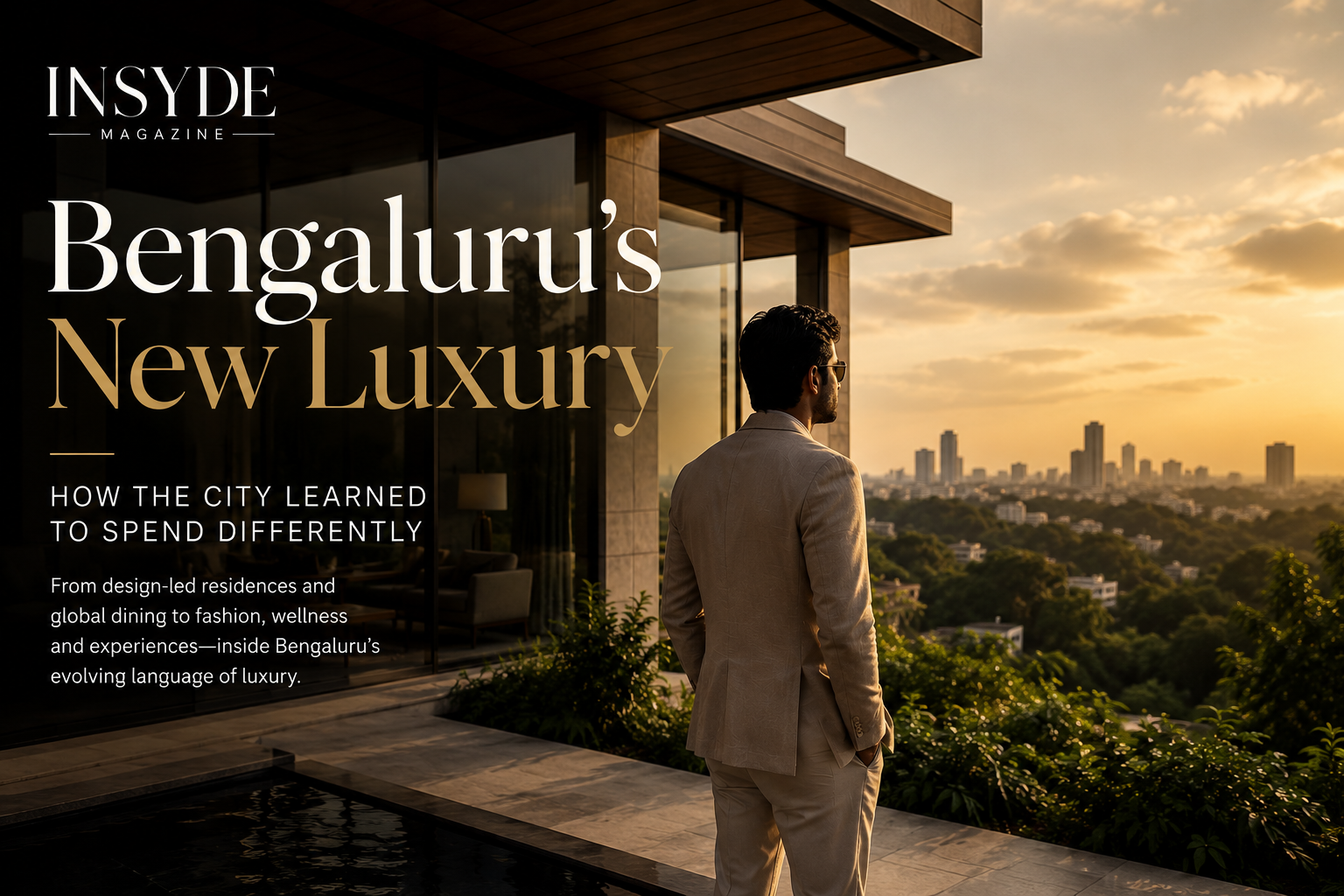
  • Bengaluru’s New Luxury: How the City Learned to Spend Differently

    Bengaluru’s New Luxury: How the City Learned to Spend Differently

    The city’s relationship with luxury is changing. Beyond logos and excess, Bengaluru is building a more considered culture of premium living—shaped by design, privacy, experience and a new generation of affluent consumers.

    There was a time when Bengaluru’s idea of success was relatively straightforward.

    A good career. A successful company. A home in a desirable neighbourhood. Perhaps a luxury car parked outside it.

    But the city has become wealthier, more global and considerably more sophisticated—and its relationship with luxury is evolving with it.

    Today, luxury in Bengaluru is increasingly less about simply owning something expensive and more about how one lives.

    A beautifully designed residence. A restaurant where the experience matters as much as the plate. A private club. A watch chosen for its craftsmanship rather than its recognisability. A fashion label that feels personal rather than obvious.

    It is a subtle shift, but an important one.

    Bengaluru is developing its own language of luxury.

    From Technology Wealth to Lifestyle Wealth

    For years, Bengaluru’s economic identity was dominated by technology.

    The city became synonymous with startups, software, multinational corporations and a generation of entrepreneurs who accumulated wealth differently from the traditional industrial and business families of older Indian metros.

    That wealth is now influencing the city’s consumption patterns.

    Bengaluru’s luxury market is no longer restricted to a small group of established families. Startup founders, CXOs, entrepreneurs, global Indians and high-net-worth professionals are becoming an increasingly visible part of the premium consumer landscape.

    The transformation is particularly clear in real estate.

    In FY2025, Bengaluru’s market for homes priced at ₹10 crore and above crossed ₹1,000 crore in annual sales for the first time. According to data from India Sotheby’s International Realty and CRE Matrix, 78 such homes were sold during the year, compared with 51 the previous year, while 42% of the city’s ₹10 crore-plus sales over the preceding four years occurred in FY2025 alone.

    The numbers are significant. But what matters more is what they reveal about the consumer behind them.

    The purchase of a luxury home is increasingly being framed around more than an address or an investment. Space, privacy, design, amenities and quality of life are becoming part of the proposition.

    Bengaluru is, in other words, becoming a city where wealth increasingly seeks quality of life.

    The New Luxury Is More Private

    Luxury has traditionally relied on visibility.

    The logo. The statement piece. The grand entrance.

    But contemporary luxury is moving in another direction.

    For an increasingly sophisticated consumer, exclusivity can mean something much quieter: an address with limited access, architecture that does not need to announce itself, personalised service, rare materials, thoughtful interiors or simply the freedom to enjoy something without an audience.

    This shift is particularly visible in Bengaluru’s premium residential market.

    The city’s high-end housing segment has seen strong price appreciation, while newer developments are increasingly competing through specifications, amenities, sustainability and future-ready design. In H1 2025, under-construction premium homes in Bengaluru recorded capital-value growth of roughly 32–35% year-on-year, according to Fortune India’s reporting on market data.

    The implication is clear.

    Luxury is becoming less about bigger and more about better.

    A City Learning to Buy Experiences

    The same shift extends beyond property.

    Luxury hospitality, fine dining, premium retail, wellness and entertainment are increasingly competing for the same consumer: someone willing to pay more when the experience feels distinctive.

    This matters because modern luxury is rarely confined to a product.

    A luxury restaurant is selling atmosphere, service, design and memory alongside food.

    A premium fashion boutique is selling curation and personal attention alongside clothing.

    A high-end residence is selling privacy, architecture, convenience and community alongside square footage.

    And a luxury hotel is selling a temporary version of a lifestyle.

    The wider Indian luxury market is moving in the same direction. Industry research has identified experiential categories—including fine dining, travel, hospitality and wellness—as increasingly important to affluent consumers, while luxury brands continue expanding their physical presence across India’s major cities.

    Bengaluru is particularly well placed for this evolution.

    It has the wealth, international exposure and young professional population to support it—and a consumer base increasingly comfortable moving between global and Indian ideas of luxury.

    The Bengaluru Consumer Doesn’t Need Everything to Look Expensive

    Perhaps the most interesting part of Bengaluru’s luxury story is that it does not necessarily resemble the traditional image of Indian affluence.

    Mumbai has its unmistakable glamour.

    Delhi has its grander, more visibly opulent side.

    Bengaluru has historically been more understated.

    The city’s relationship with fashion reflects this personality. A consumer might move between a technology office, a contemporary restaurant, an art space and a luxury retail environment in the same week.

    That creates a consumer who is not necessarily looking for one fixed definition of status.

    Instead, there is a growing appetite for curated luxury.

    A well-made garment.

    A beautifully designed home.

    A rare watch.

    A destination dinner.

    A thoughtfully planned weekend.

    A piece of art.

    A car that reflects taste rather than simply price.

    The common thread is discernment.

    And discernment is increasingly becoming one of luxury’s most valuable currencies.

    Bengaluru’s Luxury Map Is Expanding

    The geography of premium Bengaluru is changing too.

    Central Bengaluru remains synonymous with some of the city’s most established luxury addresses, while newer premium developments are expanding the map into emerging and well-connected micro-markets.

    That expansion is visible in the residential market. Bengaluru’s ₹10 crore-plus housing demand is no longer confined to a handful of traditional luxury neighbourhoods; the FY2025 data highlighted markets including Hebbal, Domlur, Sudhamnagar and Bommanahalli, with Hebbal accounting for 22% of luxury sales value among the high-end markets tracked in the report.

    This creates an interesting tension.

    Bengaluru’s old luxury is rooted in location, heritage and scarcity.

    Its new luxury is increasingly built around design, technology, convenience and experience.

    The future will likely be defined by the meeting point between the two.

    The Business of Becoming Luxury

    For brands, this shift matters.

    A growing luxury consumer base creates opportunities well beyond residential real estate. Fashion, jewellery, watches, automobiles, hospitality, restaurants, wellness, interiors and premium entertainment all compete for a consumer whose expectations are becoming more sophisticated.

    India’s luxury retail market is already expanding rapidly. Luxury and bridge-to-luxury brands accounted for a significant increase in retail leasing activity in 2025, reflecting an aggressive push by brands to capture India’s growing affluent consumer base.

    Bengaluru is part of that story—and increasingly, it is becoming an important market within it.

    The city’s retail environment is also evolving. In 2024, Bengaluru led retail space absorption among India’s top eight cities, while the wider retail landscape increasingly shifted towards destinations combining shopping, dining and entertainment.

    That convergence is important.

    The future of luxury may not be a store, a restaurant, a hotel or a residence in isolation.

    It may be the ecosystem around them.

    A neighbourhood where fashion, food, art, hospitality and design exist within the same cultural orbit.

    A place where consumers do not simply purchase products—they participate in a lifestyle.

    What Comes Next

    The most interesting question is no longer whether Bengaluru will become a luxury city.

    It already is.

    The more important question is what kind of luxury city it will become.

    Bengaluru has the economic foundation, entrepreneurial wealth and increasingly sophisticated consumer base to become one of India’s defining premium markets.

    But its opportunity lies in doing luxury differently.

    Not louder.

    Not necessarily bigger.

    Better.

    More personal. More experiential. More design-conscious. More connected to the way people actually want to live.

    For a city built on innovation, perhaps that is the most natural evolution of all.

    Bengaluru’s new luxury is not simply about having more.

    It is about having better—and knowing why it matters.

    — INSYDE Editorial

  • The Sabyasachi Effect: How Nostalgia Became Indian Luxury |INSYDE

    The Sabyasachi Effect: How Nostalgia Became Indian Luxury |INSYDE

    The story of Sabyasachi is not simply about a designer who made Indian fashion famous. It is about how memory, craft and a very particular idea of India became the foundation of a modern luxury business.

    Walk into a Sabyasachi store and the first thing you notice may not be the clothes.

    There are the clothes, of course. The jewellery. The handbags. The shoes. But around them is something else: old-world architecture, art, furniture, objects, colour, photographs and an atmosphere that feels deliberately removed from the speed of contemporary retail.

    It doesn’t quite feel like a shop.

    It feels like a memory.

    That may be the most useful way to understand Sabyasachi Mukherjee.

    Because the designer’s greatest achievement may not be that he made Indian fashion recognisable around the world. It may be that he made a particular version of India’s past feel desirable in the present.

    That distinction is important.

    Luxury has always sold more than products. It sells provenance, scarcity, craftsmanship, identity and belonging. Sabyasachi understood that early—and built a house around them.

    The business of remembering

    The Sabyasachi aesthetic is immediately recognisable.

    Deep colours. Old photographs. Heavy embroidery. Vintage references. Jewellery that looks inherited rather than newly bought. Bengal. Tigers. Colonial-era architecture. Textiles that carry the evidence of the hand.

    Even when the clothes are contemporary, they often seem to have arrived from somewhere else.

    That is not accidental.

    The brand’s own language repeatedly returns to heritage, indigenous craftsmanship and the idea of making the past relevant to the present. Its current collections continue to draw on Calcutta, Bengal, textiles, jewellery and archival references.

    Sabyasachi has effectively made nostalgia into a design system.

    And then he did something much harder:

    he made that nostalgia expensive.

    Before the empire, there were three tailors

    The numbers make the early story almost sound implausible.

    Sabyasachi graduated from NIFT in 1999 and launched his eponymous label soon afterwards. FDCI records that he won three major awards at graduation and, in early 2001, received the Femina British Council award that took him to London for an internship with Georgina von Etzdorf.

    The designer’s own history gives the more personal version: he borrowed ₹20,000 from his family and began with a team of three.

    The important part isn’t the ₹20,000.

    It is what he decided to do with the opportunity.

    At a time when Indian fashion was increasingly looking outward for validation, Sabyasachi’s instincts were unusually inward.

    His early work was interested in India not as a costume, but as a source of references.

    He wasn’t asking:

    How can Indian fashion look international?

    He was asking something closer to:

    What if India itself became the reference?

    The strange power of the hand

    FDCI describes Sabyasachi’s design philosophy through the phrase “personalized imperfection of the human hand.” It is a useful phrase because it gets to the heart of his business.

    In an industry obsessed with speed, scale and perfect replication, the hand offers the opposite.

    It takes time.

    It varies.

    It leaves evidence.

    And Sabyasachi built luxury around that evidence.

    The house says it currently employs, directly or indirectly, more than 3,900 artisans, including master weavers, dyers and printers, and works with textile clusters across numerous Indian states.

    That makes craftsmanship more than a decorative detail in the Sabyasachi story.

    It is infrastructure.

    A sari is not valuable simply because it is a sari. Its value can come from the material, the technique, the person who made it, the time it required and the story attached to it.

    This is where Sabyasachi’s version of luxury becomes particularly Indian.

    The house didn’t need to invent heritage.

    It needed to reframe its value.

    Then came the bride

    If the Sabyasachi aesthetic gave Indian fashion a visual language, the bride gave it a mass cultural stage.

    His bridal work became one of the defining parts of the house, and over time the “Sabyasachi bride” became a recognisable idea in itself: rich textiles, dramatic jewellery, detailed embroidery, saturated colour and a sense of ceremony that felt simultaneously contemporary and inherited.

    Sabyasachi himself later described the house as having created a significant shift in the way people dressed in India, particularly around bridalwear.

    That shift is worth looking at carefully.

    The designer didn’t make Indian weddings less traditional.

    In many ways, he made them more consciously traditional.

    The bride wasn’t trying to escape heritage.

    She was paying a premium to own it.

    And that is a very different proposition from selling fashion.

    Bollywood understood the picture

    Sabyasachi’s relationship with cinema helped the aesthetic travel beyond the runway.

    His work for Black earned him the National Award for Best Costume Design, and his later association with Bollywood and celebrity culture helped establish his clothes as part of a larger visual language.

    This matters because celebrity dressing can do something a runway cannot.

    It gives people a character to imagine themselves becoming.

    The Sabyasachi bride wasn’t simply a consumer wearing a designer lehenga.

    She could see herself in the same visual universe as actors, weddings, films and photographs that circulated far beyond fashion publications.

    The clothes became aspirational because the world around the clothes became aspirational.

    That distinction is one of the reasons the brand has travelled so well.

    The store became part of the product

    Sabyasachi eventually understood that the brand could not live only inside garments.

    The Mumbai flagship was conceived as a “living museum,” bringing together fashion, jewellery, objects, art and interiors. The New York flagship followed in 2022, giving the house a permanent presence in one of the world’s most important luxury markets.

    This is where Sabyasachi starts looking less like a designer and more like the founder of a luxury universe.

    The product is the sari.

    But the experience is the house.

    The furniture, the architecture, the tiger, the packaging, the jewellery, the books, the visual merchandising—all of it reinforces the same idea.

    You don’t just buy Sabyasachi.

    You enter Sabyasachi.

    That is a much more powerful business model.

    From clothes to a house

    The expansion has followed the logic of the universe.

    Jewellery.

    Accessories.

    Fine jewellery.

    Menswear.

    Beauty.

    Collaborations.

    The brand has partnered with names including Christian Louboutin, H&M, Pottery Barn, Starbucks and Estée Lauder.

    The Estée Lauder collaboration is particularly revealing.

    In 2024, the two houses created a global collection of 10 lipsticks. The collaboration translated Sabyasachi’s visual vocabulary—textiles, gemstones, colour and the tiger motif—into beauty packaging and product.

    That is what a mature luxury house does.

    It doesn’t simply put its logo on another product.

    It asks:

    What does our world look like when it enters another category?

    Sabyasachi had an answer.

    It still looked like Sabyasachi.

    The corporate reality behind the romance

    There is, however, a less romantic part of the story.

    Luxury houses need capital.

    In 2021, Aditya Birla Fashion and Retail completed its acquisition of a 51% stake in Sabyasachi Calcutta LLP. ABFRL’s announcement put the transaction into the context of building its position in the fashion and luxury market.

    This matters because the Sabyasachi story isn’t simply one of artistic success.

    It is also a story about what happens when a distinctive creative identity becomes valuable enough to support institutional investment.

    The challenge then changes.

    It is no longer:

    Can I build a brand?

    It becomes:

    Can this brand grow without losing the thing that made it desirable?

    So far, the strategy has been unusually disciplined.

    The house continues to build around a small number of recognisable codes rather than abandoning them every season.

    Twenty-five years of looking backwards

    The 25th-anniversary show in Mumbai in January 2025 made the philosophy almost impossible to miss.

    The runway was designed as an imagined Calcutta, complete with weathered houses, vintage carpets, verandas, clotheslines and a fountain inspired by the Victoria Memorial. The show featured more than 150 looks, with Deepika Padukone and Christy Turlington among those walking.

    It could have been a retrospective.

    Instead, it became something more interesting.

    A reminder that the past was still the brand’s most useful creative material.

    The clothes themselves mixed Japanese cotton, pashmina, zardozi, gotta-patti, velvet, sequins, tailoring and references ranging from Frida Kahlo to Madonna. Vogue described the show as a homecoming to an identity that had been present since the beginning.

    In other words, Sabyasachi wasn’t presenting heritage as a fixed museum exhibit.

    He was treating it as a working archive.

    That may be the secret.

    The world is watching now

    The international story has become increasingly visible.

    Alia Bhatt’s 2024 Met Gala appearance in Sabyasachi marked another major global fashion moment for the house, while Shah Rukh Khan wore Sabyasachi at the 2025 Met Gala in a look built around the theme of Black dandyism, Indian tailoring and jewellery.

    And now comes another significant step.

    The Council of Fashion Designers of America lists Sabyasachi by Sabyasachi Mukherjee on the official September 2026 New York Fashion Week schedule, with the season running from September 10 to 15.

    For a designer who began in Kolkata with three tailors, that return carries a certain irony.

    New York is no longer the destination.

    It is one of the places where the house now tells its story.

    So what did Sabyasachi actually build?

    Not just a fashion label.

    Not just a bridal business.

    Not even simply an Indian luxury brand.

    He built a point of view.

    And then he spent more than two decades convincing people that the point of view had value.

    That is harder than designing a beautiful collection.

    The genius of the Sabyasachi model is that the individual pieces rarely have to explain the entire brand. The house has already done that work.

    A tiger means something.

    A sari means something.

    A vintage photograph means something.

    A Bengal textile means something.

    A piece of jewellery that looks as though it belonged to someone’s grandmother means something.

    Together, they create a world.

    And in luxury, worlds are what people pay to enter.

    The Sabyasachi Effect

    There is a temptation to describe Sabyasachi’s success as the story of Indian heritage going global.

    That is true, but incomplete.

    The more interesting story is what happened before the global part.

    Heritage became aspiration.

    A craft technique became a luxury technique.

    The sari became a status object.

    The wedding became a fashion platform.

    The store became a cultural space.

    The designer became a house.

    And nostalgia became something that could be packaged, scaled and sold without entirely losing its emotional power.

    That is the Sabyasachi effect.

    He didn’t convince the world that India had a past.

    Everyone already knew that.

    He helped convince a new generation that India’s past could be the future of luxury.

    And as Sabyasachi returns to New York in 2026, that idea is about to be tested on one of fashion’s biggest stages.

    The question now isn’t whether the world will notice Sabyasachi.

    It already has.

    The more interesting question is:

    How much of India’s luxury future will look like the world he built?

    — INSYDE

  • The Director Effect

    The Director Effect

    How cinema’s most successful filmmakers turned their names into a reason to buy the ticket.

    There was a time when the name above a film’s title usually belonged to the star.

    The actor was the attraction. The face was the campaign. The opening weekend belonged to the celebrity whose name appeared largest on the poster.

    The director was often the person behind the curtain.

    That relationship has changed.

    Today, a select group of filmmakers have developed something remarkably powerful: a name that carries its own promise.

    A Nolan film suggests one kind of experience. A Spielberg film another. A Cameron film another. In India, Rajamouli, Bhansali and, increasingly, Aditya Dhar have begun building similarly recognisable creative identities.

    The audience may not know every detail of the story.

    They may not even need to.

    The filmmaker’s name already tells them something about what they are about to experience.

    Scale.

    Craftsmanship.

    Aesthetic.

    Ambition.

    Emotion.

    Spectacle.

    That is when a director stops being simply the person who made the film.

    The director becomes part of the reason to see it.


    When the Name Becomes the Attraction

    The interesting shift isn’t that directors have become famous.

    Great directors have always been famous.

    The shift is that their names increasingly influence the audience’s decision to watch the film itself.

    Christopher Nolan offers perhaps the clearest contemporary example.

    The Odyssey arrived in 2026 with an extraordinary cast including Matt Damon, Tom Holland, Anne Hathaway, Lupita Nyong’o and Zendaya. Yet the conversation surrounding the film was never simply about its cast.

    It was about a Christopher Nolan film.

    The film opened to $264.1 million worldwide and went on to cross $1.4 billion globally, demonstrating the extraordinary theatrical power that can now surround a filmmaker’s name.

    The significance goes beyond the numbers.

    Nolan has reached a point where audiences can recognise the experience before they know the story.

    That is brand recognition.


    Christopher Nolan — The Event Maker

    Nolan’s greatest achievement may not be any individual film.

    It may be that he has transformed the act of going to the cinema into part of his identity as a filmmaker.

    IMAX.

    Large-format film.

    Practical effects.

    Immersive sound.

    Complex narratives.

    Scale.

    Mystery.

    His films arrive with a sense of occasion.

    His relationship with IMAX has become particularly important to that identity. The Odyssey generated an extraordinary opening for the format, reinforcing the idea that Nolan’s films are designed not merely to be watched but to be experienced theatrically.

    Nolan therefore sells something more than a story.

    He sells the experience of cinema itself.

    That is why audiences can become interested in a Nolan film before they know exactly what happens in it.

    The name tells them enough.


    Steven Spielberg — The Pioneer

    Long before directors were discussed as personal brands, Steven Spielberg had already established the model.

    Jaws didn’t simply become a hit.

    It helped define the modern blockbuster.

    Spielberg’s name eventually came to represent something unusually broad:

    Adventure.

    Emotion.

    Spectacle.

    Humanity.

    Family.

    History.

    Science fiction.

    The remarkable part is the range.

    A Spielberg film doesn’t have to belong to one genre to feel like a Spielberg film.

    That is one of the defining characteristics of a mature creative brand.

    The identity survives the category.

    His name became associated with a particular standard of mainstream cinematic storytelling, helping establish the idea that the filmmaker could become part of the commercial identity of a movie.

    Decades later, the name still carries that accumulated trust.

    And that is perhaps the purest form of brand equity:

    recognition built over time.


    James Cameron — The Spectacle

    If Spielberg helped build the modern blockbuster, James Cameron pushed the idea of spectacle into technological territory.

    Titanic, Avatar and Avatar: The Way of Water place Cameron in an extraordinarily rare commercial category.

    But the more interesting part isn’t simply their box-office performance.

    It is the way Cameron approaches technology.

    He doesn’t merely use new tools.

    He frequently pushes the industry to develop them.

    For Avatar, his production team developed new approaches to performance capture, virtual environments and 3D filmmaking to realise the world he had imagined.

    The technology became part of the storytelling.

    That has become part of the Cameron promise.

    When a Cameron film arrives, audiences expect something that stretches the boundaries of what cinema can physically display.

    The technology becomes part of the spectacle.

    And the director becomes the guarantee.


    India’s Director-Brand Era

    The phenomenon isn’t uniquely American.

    In fact, some of the most interesting examples are emerging from India.

    Indian cinema has always had powerful stars, but a new generation of filmmakers has demonstrated that a director’s name can carry an increasingly independent form of commercial and cultural value.

    The difference is subtle.

    The audience isn’t simply asking who is acting in the film.

    It is beginning to ask:

    Who is creating this world?


    S. S. Rajamouli — The Global Phenomenon

    S. S. Rajamouli may be the clearest contemporary example of an Indian filmmaker whose name has become associated with a global theatrical proposition.

    Baahubali established the scale.

    RRR expanded the international audience.

    His cinema carries a recognisable promise:

    Mythology.

    Emotion.

    Heroism.

    Music.

    Large-scale action.

    World-building.

    Spectacle.

    But Rajamouli’s influence has increasingly travelled beyond the traditional boundaries of Indian cinema.

    His international reception and the global ambitions surrounding his upcoming projects demonstrate how far that directorial identity has travelled.

    The important shift is that Rajamouli is no longer simply exporting individual films.

    He is exporting a cinematic language.

    Audiences increasingly understand what a Rajamouli experience promises before the opening frame.

    That is a powerful form of authorship.


    Sanjay Leela Bhansali — The Aesthetic

    If Rajamouli’s name promises spectacle, Sanjay Leela Bhansali’s promises something more intimate:

    a world.

    Mention Bhansali and an audience can almost imagine the frame before seeing it.

    Architecture.

    Jewellery.

    Textiles.

    Music.

    Choreography.

    Romance.

    Colour.

    Light.

    Grandeur.

    His films have developed such a distinctive visual vocabulary that the director’s name itself functions almost like an aesthetic category.

    That is a particularly sophisticated form of brand recognition.

    A luxury house can communicate through a silhouette.

    An architect can communicate through proportion.

    A watchmaker can communicate through a movement.

    Bhansali communicates through the frame.

    His films feel authored down to the smallest detail.

    The sets, costumes, musical sequences and compositions all belong to the same universe.

    And that consistency creates expectation.

    The audience knows what kind of world it is entering.

    The question isn’t whether it will be beautiful.

    The question is how Bhansali will make beauty feel this time.


    Aditya Dhar — The New Force

    Aditya Dhar represents a different stage of director-brand power.

    His career is considerably younger than those of Spielberg, Cameron, Nolan, Rajamouli or Bhansali, but that is precisely what makes his rise interesting.

    Uri: The Surgical Strike established his directorial identity through political tension, action and a grounded sense of scale.

    The Dhurandhar films expanded that identity dramatically.

    The commercial response has demonstrated that Dhar is increasingly associated with a particular cinematic proposition: political narratives, high-stakes action, technical ambition and large-scale world-building.

    That matters because a director does not necessarily need decades to build a recognisable identity anymore.

    In an environment where audiences are exposed to more content than ever, a distinctive creative voice can become recognisable remarkably quickly.

    Dhar represents the newer model of the director as a commercial force.

    His story is still being written.

    But the audience is beginning to recognise the promise.


    The Director as a Luxury Brand

    This is where cinema begins to resemble luxury.

    A luxury house doesn’t simply sell an object.

    It sells an expectation.

    You don’t choose a watch only because it tells time.

    You choose its history, craftsmanship, design language and reputation.

    You don’t choose a fashion house merely because it produces clothing.

    You choose its interpretation of clothing.

    The same principle increasingly applies to filmmakers.

    A Nolan film promises one kind of experience.

    A Cameron film another.

    A Rajamouli film another.

    A Bhansali film another.

    The audience is not simply purchasing a ticket.

    It is purchasing an expectation of authorship.

    That is the real shift.


    From Star Power to Auteur Power

    For decades, cinema was built around the star system.

    The actor was the brand.

    The actor’s face sold the poster.

    The actor’s name drove the opening.

    That power hasn’t disappeared.

    But audiences now have another way of choosing.

    Franchises have multiplied.

    Streaming has expanded the amount of content available.

    The number of films competing for attention has become enormous.

    In that environment, a recognisable creative voice becomes valuable.

    A filmmaker with a distinct identity provides something a new concept otherwise lacks:

    trust.

    The audience may not know the entire story.

    But they know the person telling it.

    And sometimes that is enough.


    The New Currency Is Expectation

    Perhaps the most valuable thing a filmmaker can build is not fame.

    It is expectation.

    When a director reaches that level, a new project becomes news before the trailer arrives.

    A new Nolan project becomes an event.

    A new Cameron project becomes an event.

    A new Rajamouli project becomes an event.

    A new Bhansali project becomes an event.

    The filmmaker’s previous work has already performed part of the marketing.

    The reputation precedes the film.

    That is exactly how powerful luxury brands operate.

    The name creates anticipation before the object is experienced.


    The Risk of Becoming a Brand

    There is, however, a paradox.

    A brand creates expectations.

    And expectations can become a prison.

    The more recognisable a filmmaker becomes, the more audiences expect the next film to resemble the last.

    Nolan must remain Nolan.

    Bhansali must remain Bhansali.

    Rajamouli must remain Rajamouli.

    But if a signature becomes too predictable, it can become formula.

    The strongest creative brands therefore face the same challenge as the strongest luxury houses:

    How do you remain recognisable without becoming predictable?

    The answer is evolution.

    Preserve the philosophy.

    Change the expression.

    A signature should be a foundation, not a cage.


    The Future Belongs to the Signature

    The future of theatrical cinema will not belong entirely to actors.

    Nor will it belong exclusively to franchises.

    Both will remain powerful.

    But as audiences become more selective about which films deserve their time, money and attention, authorship becomes increasingly valuable.

    A filmmaker with a recognisable voice offers something a generic production cannot.

    A reason to anticipate.

    A reason to care.

    A reason to believe the experience will be different.

    That may explain why the modern director is becoming something more than the person who makes the film.

    The director is becoming part of the reason the film exists in the audience’s imagination before it arrives.


    The Director Is the Brand

    The most interesting evolution in cinema may therefore be happening above the title.

    Not in the cast list.

    Not in the franchise logo.

    But in the name of the person who imagined the world.

    Spielberg built the modern blockbuster.

    Cameron turned technology into spectacle.

    Nolan turned theatrical cinema into an event.

    Rajamouli transformed scale into a global Indian cinematic language.

    Bhansali turned visual beauty into authorship.

    Dhar is demonstrating how quickly a contemporary filmmaker can build a commercial identity around a distinct worldview.

    Six directors.

    Six different forms of influence.

    But one underlying shift.

    The audience isn’t always asking:

    “What is this film about?”

    Increasingly, it is asking:

    “Who made it?”

    And when the answer itself is enough to make someone buy a ticket, the filmmaker has crossed an important line.

    They are no longer simply making the brand.

    They have become the brand.

    INSYDE — Beyond the Spotlight.

  • The New Bengaluru: Where Creativity, Culture & Ambition Collide| INSYDE

    The New Bengaluru: Where Creativity, Culture & Ambition Collide| INSYDE

    Bengaluru has always been a city of ideas. But something is changing.

    For decades, the city has been defined by technology.

    Startups. Software. Engineers. Global companies. Venture capital. The familiar image of Bengaluru as India’s technology capital has become so powerful that it can sometimes feel like the entire city has been reduced to one identity.

    But spend enough time here and another Bengaluru begins to appear.

    It exists in small studios and independent cafés. In rehearsal rooms, galleries, design offices, music venues and photography collectives. It exists in the people building brands from their bedrooms, artists experimenting with new mediums, musicians creating without waiting for a record label, designers turning ideas into businesses and young people trying to build careers that don’t fit neatly into traditional job titles.

    This is the Bengaluru we want to look at.

    This is INSYDE.

    A city built on what comes next

    Bengaluru has a long relationship with experimentation.

    Its reputation as India’s technology and startup capital didn’t happen overnight. The city developed an ecosystem where engineers, entrepreneurs, researchers and investors could collide and create something new. More recently, that appetite for experimentation has extended well beyond technology.

    The city’s cultural ecosystem has grown alongside its economic one. Museums, independent cultural spaces, festivals, theatres, music communities and creative institutions have created more places for ideas to meet. The World Cities Culture Forum describes Bengaluru as a city with a varied cultural offering, a growing nightlife scene, a large reading community and a diverse population.

    Recent cultural initiatives have also attempted to position Bengaluru not only as a technology capital, but as a cultural force. UnboxingBLR, for example, has focused on understanding and strengthening the city’s cultural identity through data, events and citywide initiatives.

    And perhaps that’s the interesting part.

    Bengaluru doesn’t have to choose between technology and culture.

    It can be both.

    The people behind the city

    Cities aren’t really defined by their buildings.

    They’re defined by the people who give those buildings a reason to exist.

    The founder working from a tiny office.

    The illustrator taking commissions between two jobs.

    The designer launching a label with five pieces.

    The musician playing a small venue before anyone knows their name.

    The filmmaker making something with a handful of friends.

    The photographer documenting a neighbourhood before it becomes fashionable.

    The chef experimenting with what Indian food can become.

    The architect thinking about what an Indian city should look like.

    The creator turning a phone, an idea and an internet connection into a career.

    These people may not have millions of followers.

    They may not appear on magazine covers.

    They may not have investors, publicists or blue ticks.

    But they are often the people who make a city interesting.

    And that’s where we think the story begins.

    Beyond the startup narrative

    There is nothing wrong with Bengaluru being India’s technology capital.

    In fact, it’s an extraordinary part of the city’s story.

    But the technology narrative can sometimes overshadow everything else.

    Ask someone about Bengaluru and you’ll probably hear about startups, traffic, weather, cafés, IT parks and the tech industry.

    Ask someone who actually spends time inside the city’s creative communities, however, and you’ll hear a much longer story.

    You’ll hear about independent artists.

    About theatre.

    About fashion.

    About music.

    About food.

    About design.

    About photography.

    About architecture.

    About books.

    About communities.

    About people building things simply because they believe they should exist.

    That is a different version of Bengaluru.

    And perhaps it deserves more attention.

    The new ambition

    There is also something changing about ambition itself.

    For an earlier generation, success could be easier to define.

    Get a good degree.

    Get a good job.

    Build a career.

    Buy a house.

    Move up.

    Today, the definition is messier.

    A young person might work in technology during the day and make music at night.

    Someone might have a full-time job while building a fashion label.

    An artist might sell work through Instagram.

    A creator might build a business without ever having an office.

    A designer might become an entrepreneur.

    An entrepreneur might become a content creator.

    The boundaries between professions are disappearing.

    And Bengaluru is a particularly interesting place to watch this happen because technology, entrepreneurship and creative culture already exist side by side.

    The British Council’s research into arts and technology in India highlights Bengaluru as one of the places where practitioners are exploring how technology can become a creative medium, while artists use their work to question and reinterpret technology itself.

    The interesting question isn’t simply:

    “What job do you have?”

    It’s becoming:

    “What are you building?”

    A city that keeps reinventing itself

    Bengaluru has changed dramatically over the years.

    The city of today is not the city of twenty years ago.

    And the city that exists ten years from now probably won’t resemble today’s Bengaluru either.

    That’s what makes it worth documenting.

    Every generation leaves something behind.

    New businesses.

    New music.

    New aesthetics.

    New neighbourhoods.

    New communities.

    New ideas.

    New problems.

    New solutions.

    New definitions of what it means to belong to the city.

    Technology may have helped Bengaluru become globally important.

    But culture is what helps a city develop a personality.

    And Bengaluru has plenty of personality.

    So, what is INSYDE?

    INSYDE is an independent media platform starting in Bengaluru.

    We’re interested in the people, ideas, places and movements shaping what comes next.

    Not only the famous.

    Not only the successful.

    Not only the people who already have an audience.

    We’re interested in the ones building quietly.

    The ones experimenting.

    The ones taking risks.

    The ones creating something from nothing.

    The ones who might be unknown today and impossible to ignore tomorrow.

    We’ll talk to artists, designers, founders, musicians, filmmakers, architects, creators, chefs, photographers and anyone else who is pushing culture forward.

    We’ll look at the places where new ideas are emerging.

    We’ll explore the city’s changing relationship with fashion, technology, art, music, food and identity.

    And we’ll try to ask better questions along the way.

    Because we don’t want INSYDE to simply tell you who is already important.

    We want to help you discover who might become important next.

    Bengaluru is only the beginning

    We’re starting here because this city gives us something special.

    A collision of technology and tradition.

    Ambition and creativity.

    Local culture and global influence.

    Old neighbourhoods and new ideas.

    People from across India and around the world.

    Bengaluru is complicated.

    It’s exciting.

    It’s frustrating.

    It’s constantly changing.

    And sometimes it feels like five different cities occupying the same space.

    That’s exactly why we’re interested.

    Because somewhere between the traffic, the startups, the cafés, the apartments, the studios, the stages and the streets is a generation quietly creating a new version of the city.

    We want to meet them.

    We want to understand them.

    And we want to tell their stories.

    This is the beginning.

    Welcome to INSYDE.