

Where acoustic precision meets Italian design and the aesthetics of modern living.
INSYDE EXCLUSIVE
In contemporary luxury, the objects that occupy our homes are increasingly expected to do more than serve a function. They are considered through the language of material, proportion, craftsmanship and personal expression. Sound, once largely the domain of technical specifications and dedicated listening rooms, is becoming part of this wider conversation about how we design and experience the spaces in which we live.
For Italian high-end audio house UBSOUND, this intersection is central to its approach. Founded in Milan in 2011, the company has developed a philosophy around two connected ambitions: the pursuit of natural sound reproduction and the creation of loudspeakers treated with the care of an artisanal object.
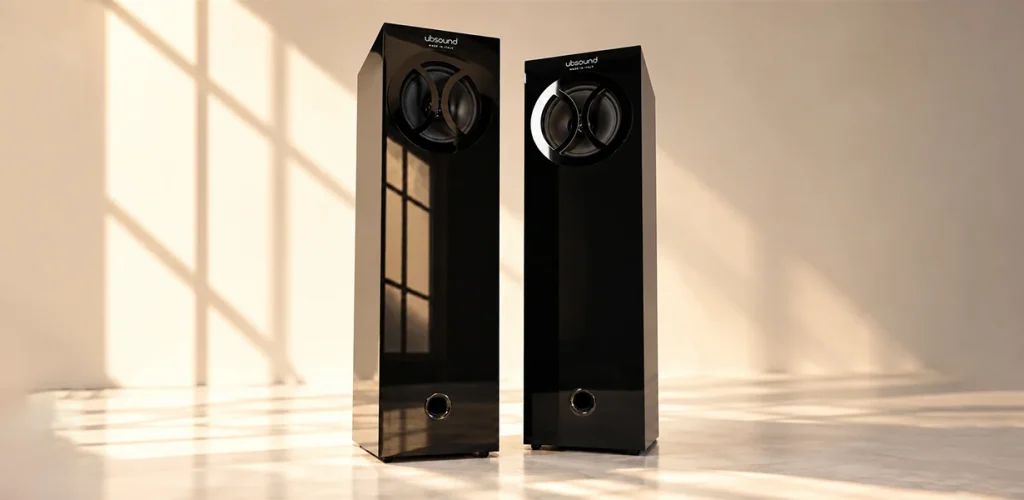
Its F85 floorstanding loudspeaker brings those ambitions into focus. Built around a single full-range driver, supported by the company’s proprietary HDNSS technology and presented in a carefully finished cabinet, the F85 is conceived not only as an audio component but also as an object with a considered architectural presence.
Yet the more interesting story lies beyond the product itself. Through the perspectives of UBSOUND CEO Marzio Gasparro and Italian architect Flora Profeta, the F85 becomes a study in how sound, engineering and interior design can be approached as parts of the same experience.
THE PURSUIT OF A MORE NATURAL SOUND
At the heart of UBSOUND’s philosophy is a particular idea of fidelity: music should be reproduced without unnecessary intervention, preserving the character of the original recording rather than imposing an artificial signature upon it.
For Marzio Gasparro, the company’s founder and CEO, this pursuit has always been accompanied by a commitment to craftsmanship. He describes the original philosophy as resting on two principles: creating a loudspeaker capable of delivering authentic, natural sound, and producing it with the dedication associated with an artisanal musical instrument.
“The first is a constant pursuit of creating a loudspeaker capable of delivering an authentic and truly natural sound, free from filtering or unnecessary emphasis on specific sound frequencies,” Gasparro explains.
The second principle is equally important. UBSOUND’s approach, he says, is centred on crafting a product that is “entirely handmade with the same passion one would dedicate to creating an artisanal music instrument.”
It is a position that places the listening experience ahead of spectacle. Rather than treating sound as an opportunity for exaggerated bass, heightened treble or a deliberately coloured presentation, the company’s stated objective is to preserve tonal coherence and the emotional character of music.
That philosophy informs the F85’s central acoustic architecture.
A DIFFERENT APPROACH TO LOUDSPEAKER DESIGN
The F85 uses a single, independent 21-centimetre full-range dynamic driver, operating without a crossover or filter between the loudspeaker and the amplifier. In conventional multi-driver loudspeaker designs, crossovers divide the audio signal into frequency ranges and direct them to different drivers. UBSOUND has chosen a different route, placing the emphasis on a single driver reproducing the full frequency range.
For Gasparro, this architecture is fundamental to the company’s pursuit of natural reproduction.
“It took more than 3 years of engineering design and many prototypes to create the F85s,” he says, describing the development process behind the loudspeaker.
The design is paired with UBSOUND’s proprietary HDNSS — High Definition Natural Sound Signature technology, integrated within the wooden cabinet. According to the company, the system is designed to manage internal resonances, control passive sound waves and absorb unwanted vibrations through its engineering approach.
The intention is to support a coherent soundstage while reducing unwanted cabinet-related interference. These are UBSOUND’s stated design objectives rather than independently verified performance conclusions, but they help explain the thinking behind the product’s construction.
The F85’s published specifications include a frequency response of 26 Hz–22 kHz, sensitivity of 90 dB and nominal impedance of 8 ohms. Together, these figures provide a technical starting point for understanding the loudspeaker’s operating range and amplifier compatibility. As with any high-end audio system, however, real-world performance also depends on the amplifier, room acoustics, speaker placement and listening environment.
For UBSOUND, arriving at the intended sound was not a matter of a single engineering breakthrough. It required a prolonged process of development and listening.
Gasparro reports that the F85 underwent more than 600 listening sessions across anechoic, semi-anechoic and domestic environments. Dozens of prototypes were modified throughout the process, with the company refining the design until it reached the tonal character it had set out to achieve.
The number is significant not simply for its scale, but for what it suggests about the development philosophy: a loudspeaker is not finished when its technical architecture is established. It must also be evaluated in the conditions in which people will actually listen to it.
THE FINISHING TOUCH: ITALIAN CRAFT AND AUTOMOTIVE INFLUENCE
A loudspeaker’s acoustic architecture may determine how it performs, but its physical presence determines how it lives within a room. UBSOUND’s treatment of the F85 cabinet reflects an awareness that, in considered residential environments, finish and material are not incidental details.
Gasparro draws a connection between the company’s approach to surface finishing and Italy’s relationship with luxury automotive design. The influence is visible in the production process, which uses techniques associated with professional automotive painting.
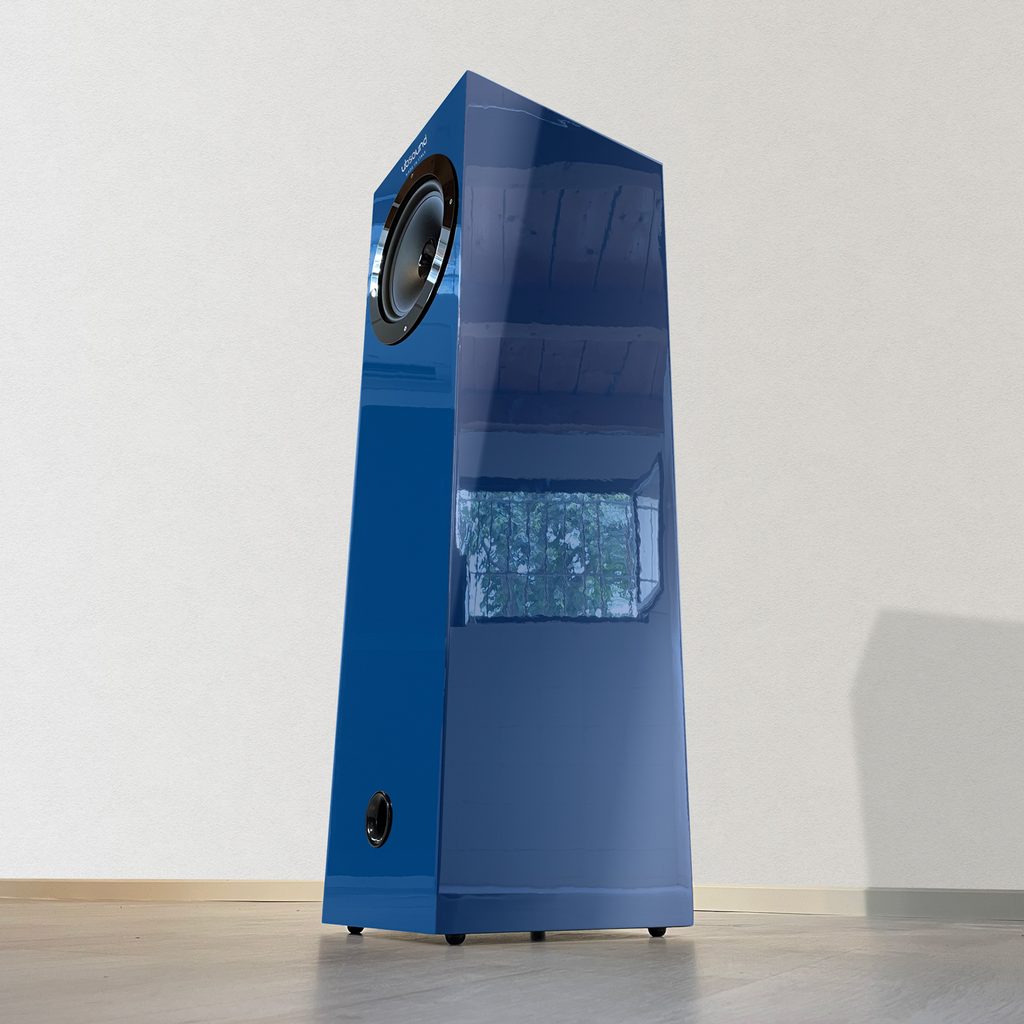
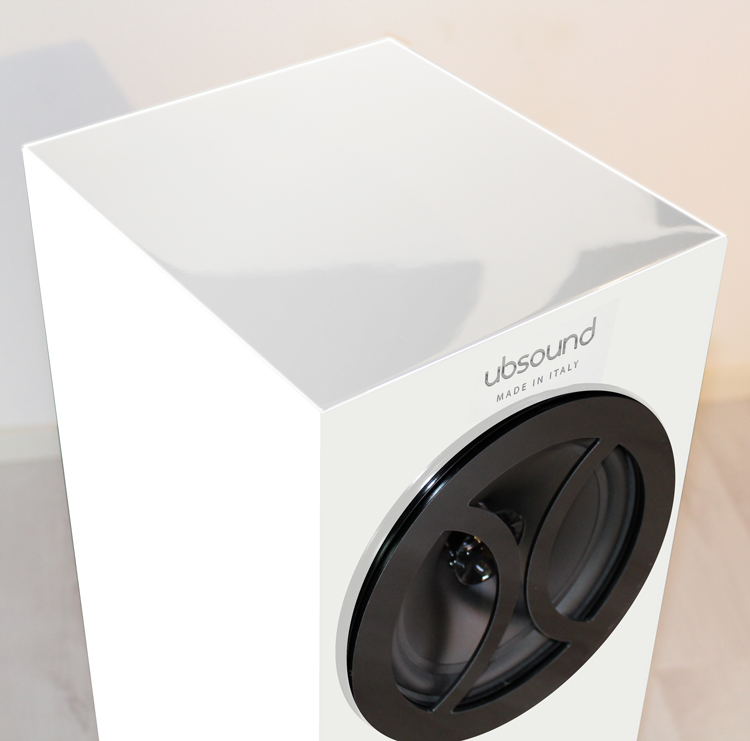
According to Gasparro, each cabinet receives two coats of primer, followed by five coats of paint applied in a professional automotive spray oven. Two coats of high-gloss clear finish are then applied before the surface is manually polished.
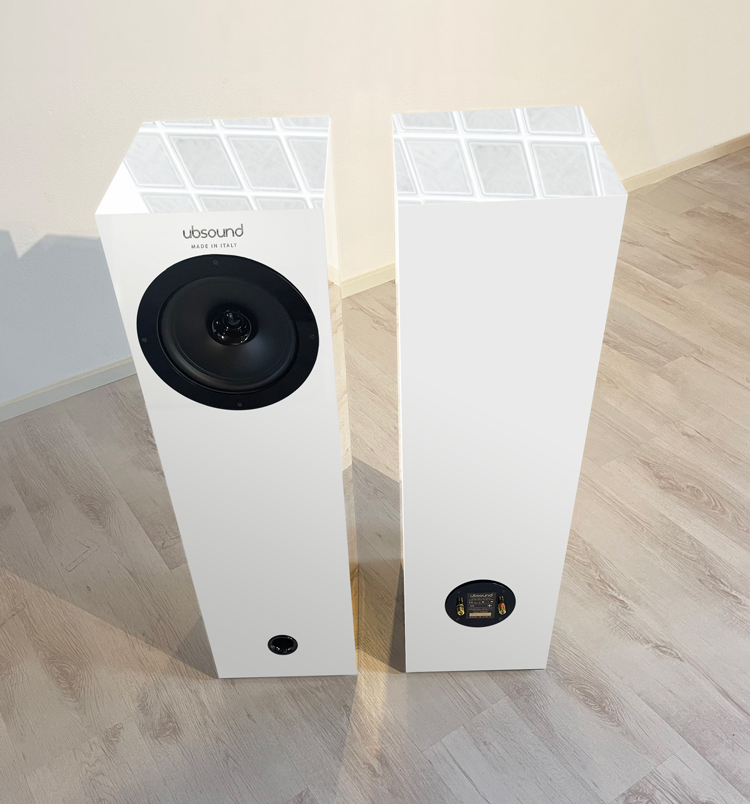
The process is intended to create a refined, durable finish while allowing a high degree of personalisation. Alongside glossy black and white, UBSOUND offers the possibility of bespoke colours selected through automotive paint codes. A client can therefore choose a shade that relates to a particular vehicle, material palette or interior scheme.
“By finishing our loudspeaker cabinets using an automotive painting process, we offer the consumers the freedom to choose any color they desire,” Gasparro says.
It is a detail that moves customisation beyond a conventional choice between a small number of standard finishes. Colour becomes part of the relationship between the object and its surroundings.
The same attention extends to the F85’s supporting details. A front bass-reflex port, anti-vibration feet, removable magnetic grille and dedicated protective covers form part of the overall design. Gasparro views these components as elements of the ownership experience rather than accessories to be considered separately.
“When creating a loudspeaker — viewing it also as a piece of luxury interior decor — every single detail, from design to materials, makes a huge difference in the final result,” he explains.
The distinction matters. In a product intended to occupy a prominent position in a living space, the quality of the finish, the usability of its components and the coherence of its design all contribute to how it is experienced over time.
WHEN A LOUDSPEAKER BECOMES AN ARCHITECTURAL OBJECT
The F85’s visual identity is perhaps best understood through the perspective of Flora Profeta, the Italian architect whose contribution brings a spatial and compositional dimension to the story.
Where Gasparro approaches the loudspeaker through sound reproduction and engineering, Profeta considers its relationship with the room. Her perspective begins with a broader shift in residential design: technology is no longer necessarily something to conceal. It can become an integral part of the architectural composition, provided its form, dimensions, materials and placement are considered carefully.
“In recent years, technology has increasingly become an integral part of residential interior design, rather than something to be concealed,” Profeta observes.
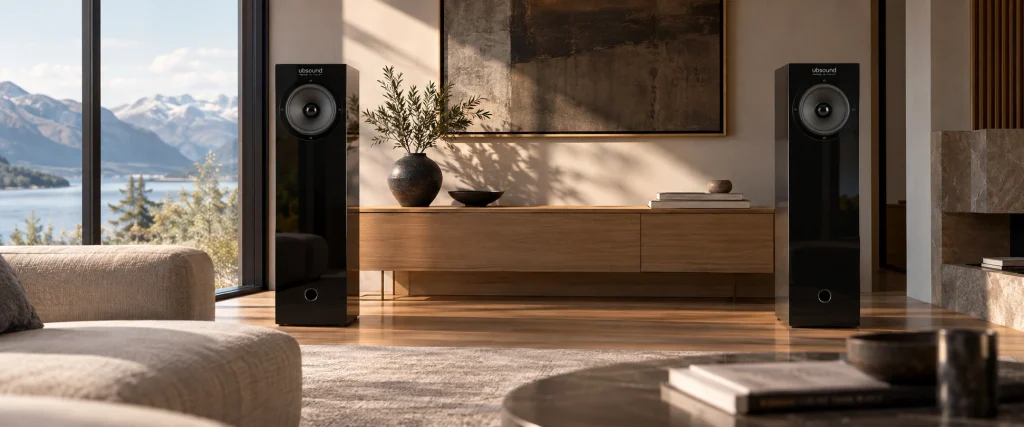
For her, the F85 is interesting because of its geometry. Its form is built around a relationship between two simple visual elements: a strong vertical line and a circle.
The cabinet establishes the vertical axis, drawing the eye upwards and giving the object a sense of height. The circular driver creates a focal point within that composition. Their relationship, Profeta explains, gives the loudspeaker a visual identity that is clear without depending on decorative complexity.
Rather than treating the F85 as a technical object placed into an already completed interior, she sees it as an element capable of contributing to the room’s overall character.
Its finish plays an important role in that relationship. A bespoke colour can make the loudspeaker a deliberate visual feature, or allow it to sit more quietly alongside the furniture, materials and surrounding palette. The object’s presence is therefore not fixed; it can be shaped by the architectural environment in which it is placed.
This is where the title of the story finds its meaning. Architecture is not simply an aesthetic reference for the F85. It is a way of thinking about the relationship between an object, its proportions and the space around it.
THE ROOM IS PART OF THE SOUND
There is, however, a distinction between designing a loudspeaker that looks at home in an interior and designing an interior that supports the loudspeaker’s performance.
Profeta is clear that the latter cannot be treated as an afterthought. A room is an active part of the listening experience. Furniture, surfaces and materials can influence sound reflections and reverberation, affecting how audio is perceived.
For architects and interior designers, this means that the position of a loudspeaker is only one part of a much larger consideration. The materials surrounding it, the arrangement of furniture and the acoustic character of the room all deserve attention.
“Acoustic considerations should never be treated as secondary to the architectural design,” she says.
Her argument is that sound and spatial planning should develop together, rather than being addressed in separate stages. A listening environment should be considered as a complete composition in which acoustic performance, functionality and visual harmony are given equal importance.
This perspective also helps explain why UBSOUND collaborates with architecture studios on residential projects and hospitality environments. Gasparro says the company’s work extends to luxury homes, hotel suites and yacht interiors — settings where audio equipment must satisfy both performance expectations and the demands of a carefully considered design scheme.
The relationship is increasingly relevant to contemporary homes, where clients have access to a wider range of architectural references and design ideas than ever before. Profeta believes this exposure has made homeowners more informed and selective, with greater attention paid to an object’s quality, functionality and suitability for its environment.
The result is a more integrated understanding of luxury living. Technology is expected to perform, but it is also expected to belong.
THE PEOPLE BEHIND THE PHILOSOPHY
The perspectives behind the F85 come from two different professional backgrounds, brought together by a shared interest in the relationship between performance and design.

Marzio Gasparro — Founder and CEO, UBSOUND
Born in 1974, Marzio Gasparro brings more than 25 years of experience in sales, marketing and business management across advertising, consumer electronics and audio. Before founding UBSOUND in Milan in 2011, he held senior management positions in international companies, including serving as Country Manager and Managing Director of Parrot Italy, a technology company specialising in wireless communication and drone systems.
Driven by a longstanding interest in music and high-fidelity audio, he established UBSOUND with the ambition of developing loudspeakers focused on natural sound reproduction, acoustic coherence and Italian craftsmanship. Today, he leads the strategic development of the UBSOUND Group and the evolution of its HDNSS technology and international presence.
Flora Profeta — Italian Architect
Flora Profeta is an Italian architect and graduate of Politecnico di Milano. She holds a bachelor’s degree in Architectural Sciences and a master’s degree in Architectural Design, specialising in Interior Architecture, which she completed with honours. A licensed architect, her work focuses on the relationship between architectural composition, materials, proportions and the integration of design elements within residential spaces.
Her approach emphasises visual harmony and the consideration of individual objects as part of a coherent architectural environment. In the context of the F85, this perspective offers a design-led reading of how high-end audio can contribute to the character of a contemporary interior.

UBSOUND AND THE INDIAN MARKET
UBSOUND’s next chapter includes a more direct presence in India, a market the company identifies as important to its international ambitions.
Through its partnership with IIT – Innovative Information Technology Pvt. Ltd., the F85 is expected to become available in India around February 2027. The company has indicated an expected retail price of ₹30 lakh–₹35 lakh, depending on the selected colour finish.
The loudspeakers are expected to be offered through IIT’s distribution network, including showrooms in Mumbai and Bengaluru, alongside specialist Hi-Fi retailers. Availability, pricing and listening-session arrangements should be confirmed directly with the distributor as the launch approaches.
For Gasparro, India represents more than another distribution destination. He describes the market as being of fundamental importance to UBSOUND and says the company is laying the groundwork to develop greater brand awareness. He also points towards further projects in the pipeline, with future innovation expected across both sound and design.
For a brand whose identity is built around the relationship between engineering and aesthetics, the Indian market offers an opportunity to engage not only with audio enthusiasts but also with architects, interior designers and clients interested in the role technology plays within contemporary living spaces.
A MORE CONSIDERED WAY TO LISTEN
The F85 is an expression of a particular ambition: to bring acoustic engineering and design sensibility into a single object. Its full-range driver and HDNSS technology reflect UBSOUND’s pursuit of natural sound, while its automotive-inspired finishes and geometric form position it within a broader conversation about the design of contemporary interiors.
Whether that ambition is ultimately realised in a listening room is something that can only be judged through an actual listening experience, in the context of a carefully matched system and environment. But the thinking behind the product offers a compelling perspective on how high-end audio is being approached by a new generation of design-conscious homeowners and specialists.
For Gasparro, the loudspeaker remains an instrument dedicated to music. For Profeta, it is also an architectural element, defined by proportion, material and its relationship with space.
Between those perspectives sits the idea that gives the F85 its identity: sound need not be separated from the environment in which it is experienced. It can be engineered, shaped and considered as part of the architecture of living.
And perhaps that is where the next conversation about luxury audio begins — not only with what we hear, but with how thoughtfully the experience is designed.
UBSOUND F85 — AT A GLANCE
- Brand: UBSOUND
- Founded: 2011, Milan, Italy
- Product: F85 high-end full-range floorstanding loudspeaker
- Driver architecture: Single 21 cm full-range dynamic driver, without a crossover
- Technology: HDNSS — High Definition Natural Sound Signature
- Frequency response: 26 Hz–22 kHz
- Sensitivity: 90 dB
- Nominal impedance: 8 ohms
- Finishes: Glossy black and white, with bespoke colour options
- India availability: Expected around February 2027
- Indicative India retail price: ₹30 lakh–₹35 lakh, depending on finish
- Indian distribution: IIT – Innovative Information Technology Pvt. Ltd.
- Official website: www.ubsound.com
- India distributor: www.iitav.com
Product specifications, development figures, technology descriptions and India market information in this feature are based on information supplied by UBSOUND. The F85’s performance claims have not been independently tested by INSYDE. India pricing and availability are indicative and subject to confirmation by the distributor.
INSYDE EXCLUSIVE
An original conversation with Marzio Gasparro, Founder and CEO of UBSOUND, and Flora Profeta, Italian Architect.
Editorial and photography materials supplied by UBSOUND.
INSYDE MAGAZINE – The Leading Luxury Magazine In Bengaluru
Leave a Reply