
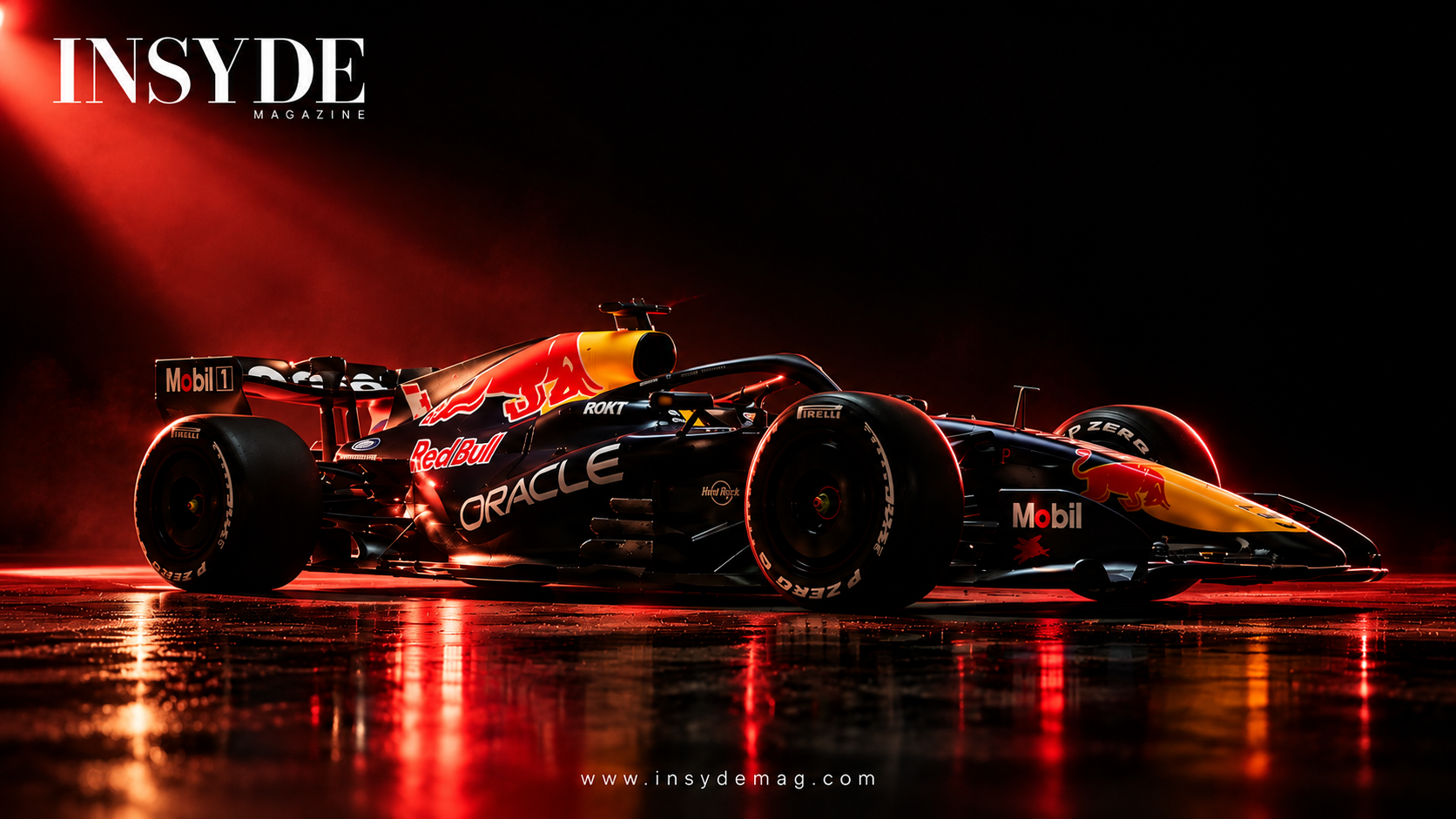
Inside the billions, billionaires and global spectacle powering Formula 1
Formula 1 has become far more than a motorsport championship. With billions in annual revenue, a reported global fanbase of 827 million and a growing presence in luxury, entertainment and premium experiences, F1 is building one of the most commercially powerful brands in world sport.
INSYDE Magazine | Business, Luxury & Culture
The Billion-Dollar Race
Every Formula 1 race is decided by fractions of a second. The business behind it, however, is built over years of contracts, commercial partnerships, technological investment and global audience development.
A car crosses the finish line. A championship is decided. But behind the spectacle sits a much larger operation—one that sells broadcasting rights, secures sponsorship agreements, licenses races to host cities and turns a sporting calendar into a global entertainment property.
The financial scale is substantial. In its 2025 financial results, Liberty Media reported that Formula 1 generated US$3.873 billion in revenue in 2025, up from US$3.411 billion in 2024. Operating income rose to US$632 million, while adjusted operating income before depreciation and amortisation—known as adjusted OIBDA—reached US$946 million.
That represents revenue growth of approximately 13.5 per cent year on year, alongside a 28 per cent increase in operating income.
These are not small numbers for a sport built around a limited number of live events each year. They reflect the strength of a business model in which the same championship can generate income from broadcasters, sponsors, race promoters, digital services and premium experiences across multiple markets.
And the momentum has continued into 2026. Formula 1’s mid-season review, published in July 2026, reported nearly 3.7 million race-weekend attendances across the first 11 events, approximately 6 per cent above the same events in 2025. All 11 events had sold out at the time of the review.
The financial results for the full 2026 season are not yet available. But the mid-season numbers provide a current indication of demand.
The bigger question is what makes this business so valuable—and how much of the global economy surrounding Formula 1 is actually captured by its headline revenue.
First, Understand What the $3.87 Billion Actually Means
Formula 1’s US$3.873 billion figure represents revenue reported by the championship’s commercial business. It is not the combined turnover of every team, sponsor, circuit, broadcaster, hospitality provider and supplier connected to the sport.
That distinction is essential.
The wider F1 ecosystem includes independently operated teams, manufacturers, race promoters, television networks, sponsors, travel companies, hospitality businesses and numerous suppliers. Their revenues overlap in different ways, and there is no single, comprehensive figure that captures the entire ecosystem without risking double-counting.
Formula 1’s own financial disclosures provide the clearest starting point.
According to Liberty Media’s 2025 annual report, the championship generated US$3.086 billion in primary revenue and US$787 million in other revenue during 2025.
Primary revenue grew from US$2.757 billion in 2024, while other revenue increased from US$654 million. Together, they brought total reported revenue to US$3.873 billion.
The difference between revenue and profit also matters. Formula 1 reported US$632 million in operating income, not US$3.873 billion in profit. Its reported operating expenses, administrative costs, depreciation and other items sit between the revenue figure and the operating result.
For investors and business analysts, the distinction is fundamental: revenue measures the money a business earns from its operations, while operating income reflects what remains after relevant operating costs and expenses.
Formula 1 is not simply large. It is a rights-based business with a substantial cost structure and a globally distributed commercial model.
Where Does Formula 1 Make Its Money?
Formula 1’s commercial structure is built around three principal revenue engines: race promotion, media rights and sponsorship. Its additional revenue streams include hospitality, logistics, support championships, digital activities and licensing.
The categories are described in detail in Liberty Media’s annual filing.
1. Media Rights: Selling the Race to the World
Formula 1 does not need every fan to attend a Grand Prix to monetise their interest in the championship.
Through media-rights agreements, broadcasters and streaming platforms pay for the right to show races and associated programming in their respective markets. These agreements allow Formula 1 to reach audiences across countries while creating recurring commercial relationships.
For broadcasters, the attraction is live sport, dramatic competition, recognisable personalities and programming that can draw viewers throughout a season. For Formula 1, media distribution expands the audience beyond the physical limits of a circuit.
The business is particularly powerful because a single season produces a continuing schedule of events. Each race creates fresh content, new narratives and further opportunities for advertisers and partners.
Formula 1 also operates its own digital subscription service, F1 TV, and earns revenue from licensing footage and other media-related activities.
The financial importance of media rights is not just the size of an individual contract. It is the ability to build a portfolio of agreements across markets, with contract terms that can extend across multiple years.
That gives the business a degree of commercial continuity even as individual races, teams and championship outcomes change.
2. Race Hosting: Why Cities Pay to Join the Calendar
A Grand Prix can deliver a city something that conventional advertising rarely offers: several days of international attention tied to a live event.
Formula 1 earns race-promotion revenue by granting promoters the rights to host, stage and promote events. These arrangements are generally governed by contracts, and the fees differ according to the event, market and commercial terms.
In its 2025 annual report, Liberty Media disclosed that race-promotion revenue accounted for 26.7 per cent of Formula 1’s total revenue in 2025.
Applying that reported share to total revenue puts race-promotion revenue at approximately US$1.03 billion for the year. This is an arithmetic estimate based on the disclosed percentage, rather than a separately quoted exact revenue figure.
That makes hosting agreements a major pillar of the business.
For a host destination, the attraction may include tourism, hotel occupancy, international media exposure, corporate networking and the chance to position the city as a centre for business and entertainment.
But a Grand Prix is not automatically profitable for its host. Staging costs can be high, and the economic benefits depend on factors such as ticket sales, sponsorship, visitor spending, public investment and the terms of the hosting agreement.
A race can create enormous visibility without necessarily delivering the same financial return to every stakeholder.
The commercial question is whether the event’s long-term benefits justify its cost.
3. Sponsorship: The Value of Being Associated With F1
Formula 1 is an attractive platform for brands because it combines global reach with associations that are difficult to manufacture through traditional advertising alone.
Performance. Precision. Engineering. Speed. Innovation. Exclusivity.
Sponsors can integrate themselves into the championship through team partnerships, car liveries, driver apparel, trackside advertising, branded content, digital campaigns and hospitality experiences.
The relationship can be especially valuable when a partnership goes beyond logo placement. A technology company may use Formula 1 to demonstrate engineering expertise. A financial institution may connect the sport with performance and international business. A luxury brand may use the paddock to communicate craftsmanship, prestige and access.
Formula 1’s 2025 results included a new multi-year sponsorship agreement with Standard Chartered, alongside continuing commercial partnerships and broadcast arrangements. The announcement is documented in Liberty Media’s year-end results.
For sponsors, the commercial opportunity extends across the season. A brand can appear in race coverage, social content, driver interviews, event activations and premium hospitality environments.
For Formula 1, those relationships help monetise its audience and brand beyond the ticket-buying spectator.
827 Million Fans: The Audience Behind the Business
A global sports business becomes more valuable when its audience expands. In Formula 1’s case, the audience is also changing.
According to Formula 1’s official 2025 season review, the sport’s reported global fanbase reached 827 million people in 2025—up 12 per cent year on year and 63 per cent compared with 2018.
Formula 1 also reported that 43 per cent of its global fanbase was under 35, while women accounted for 42 per cent. The proportion of female fans had risen from 37 per cent in 2018.
These are Formula 1’s own published fanbase estimates, not a census of unique people who watched every race. Even with that qualification, the figures point to a championship expanding its reach beyond its traditional audience.
This matters because younger and more diverse audiences can open doors to new categories of advertisers, sponsors and entertainment partners.
A fan might first discover Formula 1 through a driver on social media, a documentary, a video game, a fashion collaboration or a clip from a dramatic race. The route into the sport no longer begins and ends with watching a full Grand Prix broadcast.
That creates more opportunities for Formula 1 to convert attention into participation—and, ultimately, commercial value.
India: A Market Worth Watching
For an Indian publication, the global fanbase figures are particularly relevant.
Formula 1’s published 2025 season review put its Indian fanbase at 78.8 million. The same report listed China at 221.1 million, demonstrating the scale of the sport’s Asian audience.
These are estimates published by Formula 1 and should be attributed accordingly. They do not mean that every person counted watches every race or represents an active paying customer.
Nevertheless, the scale is significant for brands seeking to reach Indian audiences interested in technology, cars, fashion, entertainment and premium experiences.
India has a large digital audience and a growing market for international entertainment and premium consumer brands. Formula 1’s commercial opportunity lies in connecting that audience with accessible digital content, broadcast distribution, sponsorships and experiences that are relevant to the market.
The challenge is converting interest into sustained engagement and spending. A large fanbase is an asset, but it is not the same as a large paying customer base.
The Digital Economy: Formula 1 Never Really Leaves the Track
The business of Formula 1 continues between race weekends.
Its drivers and teams produce a steady stream of interviews, behind-the-scenes footage, technical explanations, short-form videos and social media moments. That content gives the championship a presence long after the cars return to the garages.
Formula 1’s 2025 season review reported more than 2.3 billion social media engagements across its platforms during the year.
Engagement is not the same as unique viewers, and it should not be treated as direct revenue. But it demonstrates how the sport can extend a live event into a much wider digital conversation.
A dramatic overtake may become a short video. A driver’s radio message may turn into a meme. A team launch may generate weeks of discussion before the first race. Each moment gives the championship another opportunity to reach fans and commercial partners.
This is particularly important for a sport whose events take place across different time zones. Social media allows fans to follow the championship even when they cannot watch a race live.
The business implication is clear: Formula 1 is selling more than the broadcast of a sporting event. It is building a year-round entertainment ecosystem around the event.
That ecosystem creates additional inventory for sponsors, new ways to engage fans and a stronger relationship between the championship and its audience.
Luxury, Monaco and the Business of Access
Formula 1’s relationship with luxury is not incidental. The sport brings together high-performance engineering, international travel, premium hospitality and a clientele that includes business leaders, celebrities, investors and brand executives.
Monaco is the clearest illustration. The Grand Prix unfolds in a destination already associated with superyachts, luxury hotels, high-end retail and international wealth. The race becomes a sporting event and a social setting at the same time.
Yet the luxury economy around Formula 1 extends beyond one location.
Premium hospitality offerings can include trackside suites, curated dining, exclusive viewing areas and access to parts of the race-weekend environment that are not available to ordinary ticket holders. Formula 1’s own Paddock Club offering sits within this broader market for premium race experiences.
The appeal is not simply watching cars go by. It is proximity—to the teams, the drivers, the engineering and the atmosphere surrounding the championship.
For businesses, hospitality can also be a relationship-building tool. Corporate guests can meet clients, entertain partners and participate in an environment that communicates status and exclusivity.
For luxury brands, Formula 1 provides a stage where performance and prestige can coexist. Watchmakers, fashion houses, automotive brands and premium consumer businesses can use partnerships and event activations to connect with an audience already immersed in those values.
The commercial opportunity is to sell not just a seat, but an experience.
The Real Cost of Going to a Grand Prix
The premium nature of Formula 1 creates opportunities, but it also introduces a clear divide between different ways of experiencing the sport.
At one end, fans watch through television, streaming and social media. At the other, spectators can pay for premium grandstand locations, hospitality packages, travel and accommodation in some of the world’s most expensive destinations.
The total cost of attending varies considerably by race, ticket category, travel arrangements and accommodation. There is no single price that accurately represents a Formula 1 weekend.
For a destination such as Monaco, hotel and travel costs can be a major part of the overall expenditure. Other races may offer different price points, although flights, accommodation and local transport can still make attendance expensive.
This tiered model is commercially useful. Formula 1 can reach millions of fans digitally while also selling premium experiences to customers willing to spend significantly more for access.
The business must, however, balance exclusivity with accessibility. If attending a race becomes prohibitively expensive for too many fans, the championship risks limiting one of the most important ways audiences develop a deeper connection with the sport.
The strongest model is one in which mass reach and premium experiences reinforce each other rather than compete.
The Teams: A Different Financial Race
Formula 1’s commercial revenue is only one part of the financial picture. The ten teams operate their own businesses, with separate sponsorships, technical programmes, personnel costs and commercial arrangements.
Their economics are shaped by the expense of designing, developing and operating competitive cars. Teams must invest in engineering, research, manufacturing, logistics and specialist staff, all while competing under the sport’s technical and financial regulations.
The cost cap constrains specified categories of team expenditure, but it should not be mistaken for a universal limit on every cost associated with running a Formula 1 operation. The applicable rules contain defined exclusions and adjustments.
The financial position of one team can also differ substantially from another, depending on sponsorship, ownership, manufacturer support, commercial success and performance.
This is why the championship’s US$3.873 billion revenue should not be presented as the combined revenue of all teams, nor should it be used to infer that every team is equally profitable.
Formula 1’s central commercial business and its competitors have related but distinct economics. One sells the championship’s commercial rights; the others compete within the series while building their own commercial operations.
That distinction is critical to understanding where the money flows—and who ultimately benefits.
2026: A New Era, a New Commercial Test
The 2026 season represents a major technical transition for Formula 1, with new power-unit and chassis regulations changing the engineering challenge for teams and manufacturers.
The regulatory framework has been developed by the FIA, with details available through its official Formula 1 regulations announcements. For manufacturers, regulatory changes can create new opportunities to demonstrate engineering capability. For teams, they introduce technical uncertainty and the need to adapt.
For the commercial business, a new era offers an opportunity to renew audience interest, attract partners and tell a fresh story around the championship. But it also creates risks: fans may react differently to the racing, teams may experience changing competitive fortunes, and manufacturers must judge the value of continued investment.
The latest published 2026 attendance data provides a positive early signal. In its July 2026 mid-season review, Formula 1 reported nearly 3.7 million attendees across the first 11 race weekends, compared with 3.4 million across the corresponding events in 2025. All 11 events had sold out.
That is approximately 6 per cent growth in attendance across the comparable events.
It is a meaningful indicator of live demand, but it is not a complete measure of financial performance. Attendance alone cannot establish whether revenue, operating income or profitability has increased at the same rate.
The full-year financial results will provide a more complete picture once published.
For now, the central test is whether Formula 1 can preserve its audience momentum while continuing to make the championship commercially attractive to broadcasters, sponsors, teams and host destinations.
Is Formula 1 One of the World’s Most Powerful Sports Businesses?
The evidence points to a championship with substantial commercial scale and a diversified revenue model.
Its 2025 financial results show US$3.873 billion in revenue and US$632 million in operating income. Its reported global fanbase reached 827 million, while its season attracted 6.7 million race attendances and generated more than 2.3 billion social media engagements.
The figures measure different things. Revenue captures the commercial income reported by Formula 1’s business. Operating income reflects the result after relevant operating costs. Fanbase estimates describe the championship’s claimed global reach, while attendance and social engagement measure activity in physical and digital environments.
Together, they show how Formula 1 has built a commercial platform that extends far beyond the circuit.
Its model combines recurring media-rights agreements, race-hosting fees, sponsorships, licensing, hospitality and digital distribution. Around that core sits a wider ecosystem of teams, manufacturers, broadcasters, tourism businesses and premium brands.
But the size of the business should not obscure its risks. High operating costs, expensive event infrastructure, dependence on audience demand and the challenge of sustaining interest all matter. Nor should Formula 1’s revenue be confused with the total economic impact of the sport or the profits earned by its individual participants.
The next phase of growth will depend on more than adding fans. It will require the championship to keep those fans engaged, demonstrate value to commercial partners and maintain a compelling sporting product through technical and competitive change.
The Final Lap
Formula 1 may be decided on Sunday, but its business is built all year.
The championship sells broadcasters access to live competition, gives sponsors a global stage, offers cities a high-profile event and provides fans with experiences ranging from a mobile screen to a premium hospitality suite.
Its cars are the most visible part of the product. The real commercial engine is the world built around them: the rivalries, the technology, the drivers, the destinations and the audience that returns for every race.
For INSYDE, Formula 1 is a revealing case study in the convergence of business, luxury and culture. It shows how a sport can turn performance into a brand, attention into commercial opportunity and a calendar of races into a global entertainment property.
The fastest car may win the race. The bigger business is the one that keeps the world watching.
INSYDE | Luxury, Through a Different Lens
Sources & Reporting
- Liberty Media — 2025 Financial and Operating Results
- Liberty Media — 2025 Annual Report / Form 10-K
- Formula 1 — 2025 Season in Numbers
- Formula 1 — 2025 Season Review
- Formula 1 — 2026 Mid-Season Review
Data note: Full-year financial figures in this article refer to the 2025 reporting year. 2026 attendance figures are from Formula 1’s July 2026 mid-season review and should not be interpreted as full-season totals. Fanbase and engagement figures are attributed to Formula 1’s own published reporting. The estimated race-promotion revenue is calculated from the share disclosed in Liberty Media’s annual filing.
INSYDE MAGAZINE
Bengaluru’s No. 1 Luxury Magazine
Luxury, Through a Different Lens
www.insydemag.com