
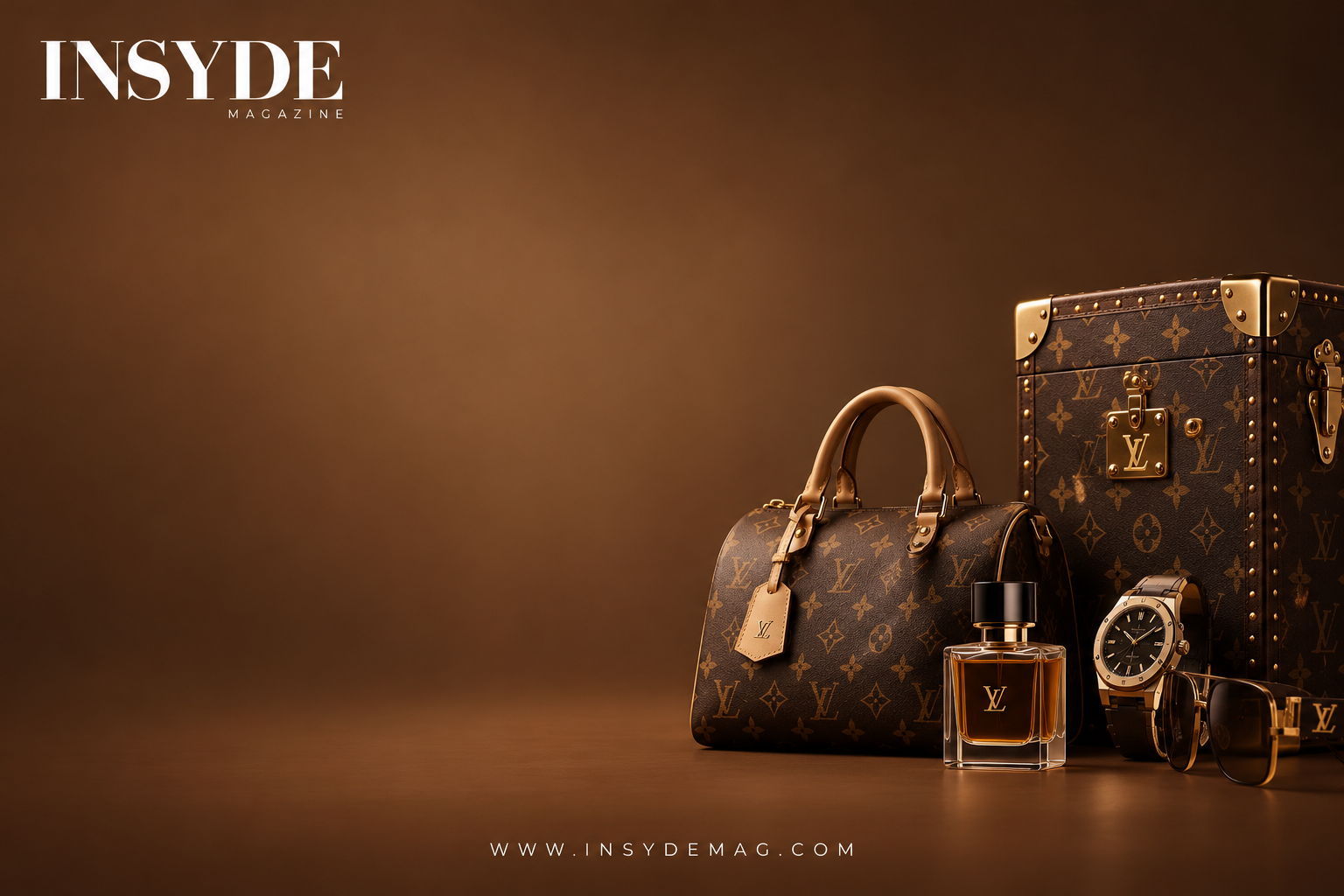
Inside the Global Slowdown Reshaping the World’s Most Coveted Brands
From weakening fashion sales and rising consumer selectivity to the shifting economics of exclusivity, the world’s luxury giants are confronting a difficult question: what happens when the desire to own luxury begins to fade?
INSYDE Magazine | Luxury & Business |
Luxury has always sold a fantasy.
A handbag is never just a handbag. A watch is never simply a mechanism for measuring time. A hotel suite, a couture gown or a piece of fine jewellery promises something beyond its physical form: status, craftsmanship, heritage, belonging and the rare feeling of possessing something exceptional.
For decades, the world’s most powerful luxury houses have built extraordinary businesses around that promise. Their names became cultural shorthand for success. Their boutiques became destinations. Their products became objects of desire, often commanding prices far removed from the cost of the materials used to make them.
But in October 2026, the global luxury industry finds itself confronting a less glamorous reality.
Growth has become harder to secure. Some of the world’s largest fashion businesses are struggling to regain momentum. Consumer behaviour is changing, demand is shifting between regions, and the industry’s most influential companies are facing renewed scrutiny over their ability to justify premium prices.
The numbers tell a complicated story. This is not the collapse of luxury, nor the disappearance of wealthy consumers. It is a market undergoing a reset — one that is exposing the differences between brands that continue to inspire desire and those finding it increasingly difficult to sustain it.
At the centre of the debate is a question that goes beyond quarterly earnings.
Has luxury become so expensive, so ubiquitous and so dependent on its own prestige that parts of the industry are beginning to lose the very charm that made them desirable?
THE NUMBERS BEHIND THE GLAMOUR
The global luxury economy remains enormous. Yet its scale can obscure the pressure emerging within individual categories.
According to Bain & Company and Altagamma’s June 2026 luxury market update, worldwide luxury spending reached approximately €1.443 trillion in 2025. This figure covers a broad range of luxury markets, including personal goods and experiences; it should not be confused with spending on designer fashion and accessories alone.
The personal luxury goods market — covering categories such as fashion, leather goods, jewellery, watches and beauty — was estimated at approximately €358 billion in 2025. At current exchange rates, that represented a 2% decline from 2024, although the market grew by 1% at constant exchange rates.
For 2026, Bain and Altagamma’s base-case forecast anticipates growth of 2% to 4%, potentially bringing personal luxury goods spending to between €365 billion and €373 billion.
That is a forecast, not a confirmed year-end result. It suggests that the market could return to modest growth, but it does not imply that every luxury company will benefit equally.
The distinction is crucial. An industry can remain worth hundreds of billions of euros while major brands experience falling sales, pressure on profitability and increasingly selective consumers.
The latest results from LVMH, the luxury group behind Louis Vuitton, Dior, Tiffany & Co., Bulgari and other major names, illustrate the challenge.
On 12 October 2026, LVMH reported €18.5 billion in third-quarter revenue, with organic revenue growth of just 1% compared with the same period a year earlier. For the first nine months of 2026, group revenue reached €57.1 billion, representing 2% organic growth.
The more revealing figure came from its core fashion and leather goods division. Organic revenue in that business fell 5% in the third quarter. Across the first nine months of 2026, the division’s reported revenue declined 4% year on year, while organic revenue fell 2%.
These are not interchangeable measurements: reported revenue reflects factors including currency movements, while organic growth attempts to assess underlying business performance.
Nevertheless, the direction is clear. One of the world’s most influential luxury groups is finding that its largest fashion businesses cannot rely on the industry’s historic momentum.
The company’s results also showed that performance differed by region. LVMH described a less buoyant environment in China, while the United States, Europe and Japan recorded growth during the quarter.
The lesson is not that luxury has stopped selling. It is that the industry can no longer assume that prestige alone will guarantee growth.
Source: LVMH, third-quarter 2026 results.
WHEN EXCLUSIVITY BECOMES A PRICE TAG
Luxury has always depended on pricing power. A product that commands a premium can signal rarity, superior craftsmanship, design excellence and the authority of a recognised house.
But pricing power is not limitless.
For years, price increases have been an important part of the commercial strategies pursued across luxury. When demand is strong and customers remain willing to pay, raising prices can support revenue and reinforce a brand’s positioning.
The difficulty emerges when the price rises faster than the customer’s perception of value.
A customer purchasing a luxury handbag is not paying only for leather, stitching or hardware. They are paying for the design, the name, the service, the experience and the emotional satisfaction attached to the purchase.
When prices rise substantially, the brand must continue to justify the entire proposition.
Is the craftsmanship exceptional? Is the design distinctive? Does the product feel special enough to deserve its price? Will it remain desirable beyond the current season? Does the experience justify the expense?
For some consumers, the answer remains an emphatic yes. For others, the calculation is becoming more difficult.
This is particularly relevant for aspirational buyers: consumers who can afford selected luxury products but cannot treat every purchase as financially insignificant.
For them, a handbag, watch or pair of shoes is a considered decision. When the price increases, they may postpone the purchase, choose a pre-owned alternative or redirect their money towards travel, dining and other experiences.
Luxury brands therefore face a delicate balancing act. Lowering prices indiscriminately could undermine exclusivity, but continuing to raise them without strengthening perceived value risks making the customer feel that the brand is asking for more while offering less in return.
The problem is not the existence of high prices. Luxury is supposed to be expensive.
The problem arises when expensive becomes the most convincing thing a product has to offer.
THE CUSTOMER LUXURY CANNOT AFFORD TO FORGET
The wealthiest customers remain important to luxury. They support high jewellery, couture, rare watches, bespoke services and limited-edition creations.
But the global luxury market was never built exclusively on the spending of billionaires.
Aspirational consumers have helped turn luxury houses into cultural institutions. They buy fragrances, beauty products, accessories and entry-level leather goods. They follow fashion campaigns, recognise creative directors, discuss collections and introduce brands to new audiences.
Their individual spending may be lower, but their collective influence is significant.
That is why the shrinking or weakening of this customer base deserves attention.
In June 2026, Reuters reported on Bain’s estimate that the luxury industry had lost approximately 70 million consumers since 2022. The figure reflects a reported industry estimate; it should not be interpreted as proof that every one of those consumers has permanently abandoned luxury.
It does, however, highlight the challenge facing brands that have increasingly concentrated on their highest-spending clients.
A company can become more exclusive in its advertising while simultaneously reducing the number of people who feel connected to it.
That strategy may improve the economics of individual transactions in the short term, but it can also narrow the audience that sustains cultural relevance over time.
Younger consumers, in particular, encounter luxury differently from previous generations. They can compare prices, research craftsmanship, follow independent designers, browse resale platforms and question a brand’s claims before entering a boutique.
They are not necessarily rejecting luxury. They are becoming more selective about what deserves their money.
For the industry, the challenge is to preserve exclusivity without allowing it to become indifference.
CHINA AND THE FRAGILE GEOGRAPHY OF LUXURY
Luxury is a global business, but its fortunes have long been influenced by a handful of powerful consumer markets.
China became one of the industry’s most important growth engines, supported by rising wealth, international travel and strong demand for European fashion, jewellery and watches.
That made the Chinese consumer central to the expansion strategies of many international luxury houses.
But demand does not move in a straight line.
LVMH’s October 2026 results pointed to a less buoyant environment in China, helping explain the pressure on its fashion and leather goods division. The company reported growth in the United States, Europe and Japan, but that strength did not remove the overall weakness in its core fashion business.
The wider significance is that global luxury brands must manage different economic conditions, consumer expectations and cultural dynamics simultaneously.
When demand weakens in one major region, companies with concentrated exposure can face immediate pressure. When several markets become less predictable at once, the challenge becomes more complicated.
This is not an argument for abandoning China or replacing it with another single growth engine. It is an argument for a more balanced global strategy.
The United States can offer opportunities, but it is not a guaranteed substitute for every lost sale elsewhere. Europe remains important, particularly for local consumers and international visitors. Japan has its own demand patterns, while other Asian markets continue to evolve.
The strongest brands will be those that understand their customers market by market rather than assuming that a global reputation automatically translates into uniform demand.
In luxury, geography is no longer simply a question of where a brand opens its next boutique. It is a question of where desire is growing, where it is weakening and why.
NOT EVERY LUXURY EMPIRE IS LOSING ITS CHARM
A slowdown story becomes misleading when it treats every category as though it were experiencing the same problems.
Luxury fashion, jewellery, watches, beauty, hospitality and other premium experiences operate with different economics. Their customers buy for different reasons, and their products follow different purchase cycles.
Richemont provides an important counterexample.
The Swiss group, whose jewellery maisons include Cartier, Van Cleef & Arpels, Buccellati and Vhernier, reported €6.329 billion in sales for the quarter ended 30 June 2026, an increase of 20% at constant exchange rates and 17% at actual exchange rates.
Its jewellery maisons recorded a 24% increase at constant exchange rates, while its specialist watchmakers grew by 8%.
The figures cover Richemont’s first fiscal quarter, which ended in June. They are not directly comparable with LVMH’s July–September third-quarter results because the reporting periods and business portfolios differ.
Even with that qualification, Richemont’s performance demonstrates an essential point: demand remains strong in parts of luxury, particularly where products continue to attract customers through recognisable design, craftsmanship and enduring desirability.
Jewellery also serves different purposes from seasonal fashion. It can mark significant life events, function as a gift, become a collectible or be passed between generations. Established jewellery houses have built long histories around signature designs and a distinctive visual language.
That does not make jewellery immune to economic pressure. Nor does one strong quarter guarantee future growth.
It does show why the industry should not be described as a single market moving in one direction.
The more useful question is which brands and categories are sustaining their appeal — and what they are doing differently.
Source: Richemont, first-quarter results for the period ended 30 June 2026.
FROM OWNING LUXURY TO EXPERIENCING IT
A different idea of luxury is gaining ground: one in which the most desirable purchase is not necessarily an object.
High-end hospitality, fine dining, private travel, wellness retreats and cultural experiences offer something physical products cannot always replicate — a memory, a sense of access, personal attention or time spent outside ordinary life.
Bain and Altagamma’s June 2026 update identifies experiences as an area of relative strength, with luxury experiences such as hospitality and restaurants, alongside selected high-value assets, expected to grow by around 4%.
That forecast should be read as an industry outlook, not a final result for every experience-led business.
Nevertheless, the direction is important.
A handbag can be photographed and compared. A watch can be researched on the secondary market. But a private journey, an exceptional meal or a carefully designed hospitality experience depends on the quality of its execution, the people involved and the atmosphere created.
For some consumers, these experiences are becoming a more compelling use of discretionary spending than another recognisable product.
This does not mean that physical luxury is disappearing. Fashion, jewellery and watches remain central to the industry. Instead, the definition of luxury is expanding, and brands must decide how they fit into a consumer’s wider idea of a desirable life.
The opportunity extends beyond hotels and restaurants. A fashion house can build a cultural world around its products. A jewellery brand can deepen its connection to craftsmanship and heritage. A luxury retailer can turn a store visit into a personalised experience rather than a simple transaction.
The brands that understand the emotional value of an experience may discover new ways to sustain the desirability of their products.
Luxury has always sold more than objects. The market is increasingly asking brands to prove it.
Source: Bain & Company and Altagamma’s 2026 market update.
THE SECOND-HAND MARKET IS CHANGING THE CONVERSATION
The rise of pre-owned luxury has introduced another variable into the industry’s relationship with value.
The secondary market gives consumers access to established brands at different price points. It also allows collectors to buy, sell and trade products beyond their original retail environment.
For a buyer considering a new luxury item, the decision is no longer limited to comparing it with other new products. The buyer can examine pre-owned alternatives, investigate resale prices and consider whether the purchase is likely to retain its appeal.
Bain and Altagamma’s 2026 research found that around half of luxury shoppers consult the second-hand market before buying new, while approximately half already use AI during their purchase journey.
These findings suggest that technology and resale are no longer peripheral to luxury shopping. They are becoming part of how consumers discover products, compare options and evaluate value.
For brands, the implications are mixed.
A strong secondary market can reinforce a product’s reputation for longevity, desirability and collectability. It can also introduce new consumers to a brand who may later purchase directly from the company.
But resale makes it easier for shoppers to question the relationship between a product’s original price and its perceived value. A consumer may decide that a pre-owned piece from a more prestigious house offers a better proposition than a new product from a less established competitor.
That places greater importance on quality, durability, authenticity and timeless design.
Luxury houses cannot control every transaction in the secondary market, but they can influence the qualities that make their products desirable long after the first sale.
The real test is whether a product remains compelling when the customer has more information, more alternatives and fewer reasons to buy impulsively.
Source: Bain & Company and Altagamma, 2026 luxury market research.
INDIA: A PROMISING MARKET WITH REAL CONSTRAINTS
India presents an important opportunity for global luxury, but it should not be treated as an automatic solution to the industry’s challenges elsewhere.
The country’s expanding affluent population, entrepreneurial wealth and growing appetite for premium products have attracted international brands. Yet translating that interest into a mature luxury market requires more than consumer aspiration.
A March 2026 Reuters report on India’s luxury retail-space shortage highlighted a major constraint: the limited availability of high-quality luxury retail destinations.
The report described a market in which global brands were competing for a relatively small number of suitable locations, while new retail developments would take time to deliver.
This creates a structural challenge. A growing customer base cannot be fully served without the right stores, trained staff, reliable service, appropriate locations and the broader retail infrastructure that supports a premium shopping experience.
Import duties and differences in pricing can also influence where affluent Indian consumers choose to shop.
For international luxury houses, India therefore represents a long-term strategic opportunity rather than an immediate substitute for weaker demand elsewhere.
The opportunity is also relevant to Indian luxury businesses. Brands that understand local craftsmanship, cultural heritage and changing consumer expectations can develop propositions that are distinctive rather than simply imported.
But growth will depend on execution. Strong demand must translate into repeat purchases, trusted customer relationships and retail experiences that meet the expectations attached to a premium price.
India may become a more significant force in the global luxury landscape. Its potential, however, should be assessed through market evidence rather than optimism alone.
THE NEXT ERA OF LUXURY WILL BE WON ON VALUE
The industry’s next chapter will not be decided by price increases alone.
Luxury houses still possess formidable advantages: heritage, craftsmanship, design, distribution, cultural influence and relationships with wealthy customers. The current slowdown does not erase those strengths.
It does make the quality of their execution more important.
First, brands must make their prices mean something. A premium must be supported by product quality, distinctive design, materials, service and a credible story. Price alone cannot create enduring desire.
Second, customer relationships must extend beyond the wealthiest buyers. High-spending clients remain essential, but younger and aspirational consumers represent a potential future audience. Brands must find ways to remain relevant without abandoning the exclusivity that defines them.
Third, creativity must do more than generate attention. Campaigns, celebrity partnerships and cultural visibility can make a brand famous, but fame does not automatically create loyalty. Products must still be desirable when the campaign ends.
Fourth, companies must understand the new shopping journey. Consumers increasingly compare products, explore resale platforms and use digital tools before making decisions. A brand’s proposition must remain convincing beyond its own advertising and retail environment.
Finally, luxury businesses must understand what customers are actually buying. Sometimes it is craftsmanship. Sometimes it is status, rarity, personal expression or access to a particular world. The strongest brands understand these motivations and deliver them consistently.
The winners will not necessarily be the brands that become the most expensive. They may be the brands that give consumers the clearest reason to believe their products are exceptional.
THE LAST WORD
Luxury is not dead. But the old assumption that prestige can sustain growth indefinitely is being tested.
The global market remains vast, and the latest industry forecasts point towards modest growth in personal luxury goods during 2026. Yet the recovery is uneven. LVMH’s fashion and leather goods division is under pressure, while Richemont’s jewellery maisons have reported strong growth. Experiences and the secondary market are reshaping how consumers think about luxury, and brands are being forced to compete for attention in a more informed and selective marketplace.
Together, these developments point towards a more demanding luxury economy — one in which recognition alone may not be enough, price increases require stronger justification, and loyalty must be earned rather than assumed.
For decades, luxury sold the promise of something beyond the ordinary. The next era will depend on whether that promise still feels extraordinary.
Because the greatest threat to a luxury empire is not simply a weaker quarter or a slower market.
It is the moment a customer looks at something once considered irresistible — and decides they can live without it.
INSYDE MAGAZINE
Luxury. Culture. The People Shaping What Comes Next.
No.1 Luxury Magazine In Bengaluru
www.insydemag.com