
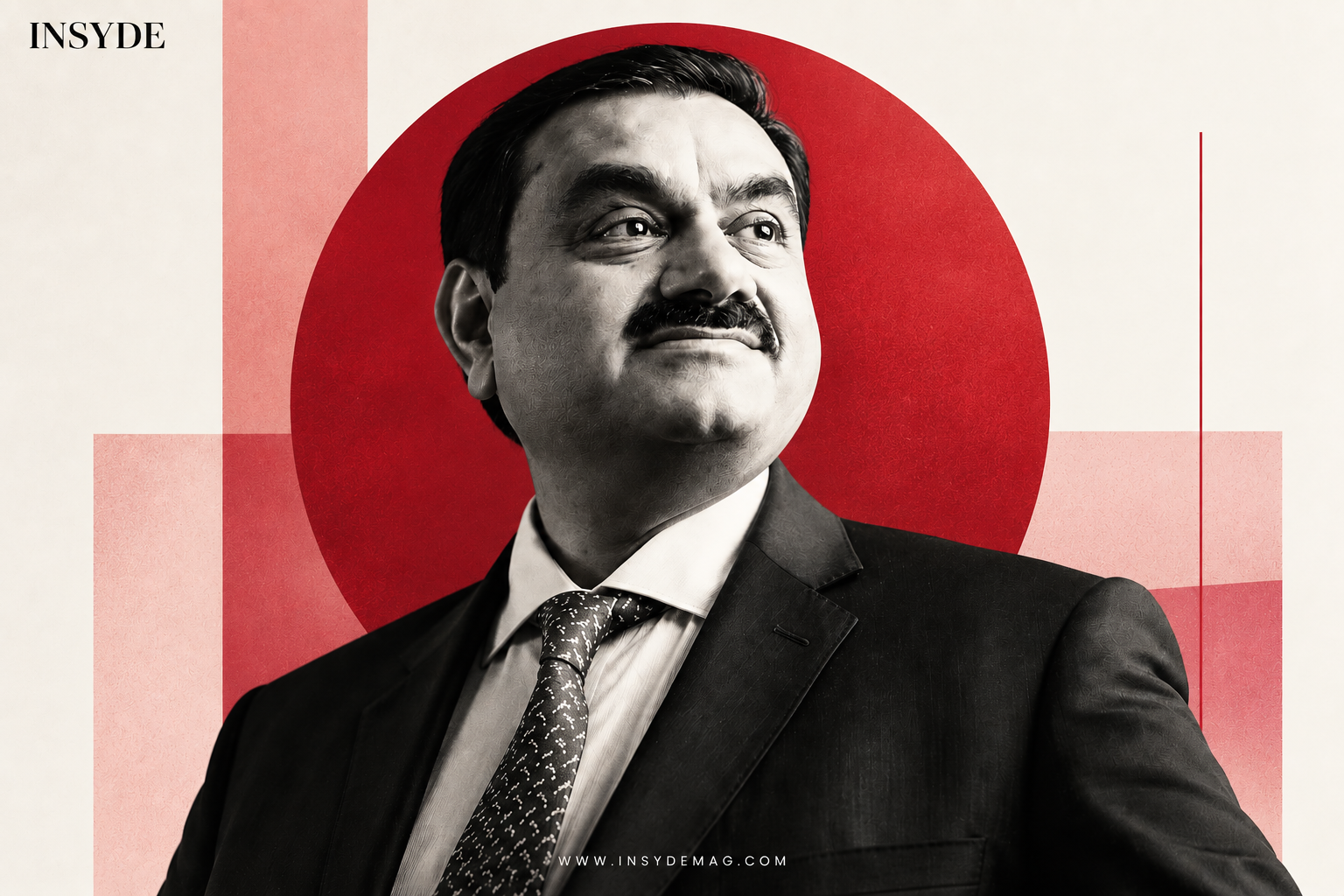
How Gautam Adani returned to the top of India’s wealth rankings — and why the bigger story is the infrastructure empire being built for what comes next.
BY INSYDE | BUSINESS & POWER
There are different ways to become extraordinarily wealthy.
You can build something people desperately want.
You can create a brand people dream about owning.
Or you can build the infrastructure that an entire economy depends on.
Gautam Adani belongs largely to the third category.
In September 2026, Forbes’ latest India’s 100 Richest list placed Adani at No. 1 with an estimated $112.7 billion fortune, marking his return to the top after three years at No. 2. Forbes said his wealth had increased by $20.7 billion over the previous year.
The M3M Hurun India Rich List 2026 also placed Adani and his family first, valuing their wealth at approximately ₹9.23 lakh crore. Hurun’s wealth calculations, however, were a snapshot as of August 24, 2026, illustrating why billionaire rankings can produce different numbers at different points in time.
That distinction matters.
Because the most interesting part of the Adani story isn’t simply who occupies the first line of a rich list.
It is what kind of empire can create wealth on this scale.
Ports.
Airports.
Power.
Renewables.
Logistics.
Infrastructure.
And increasingly:
Artificial intelligence.
The Adani comeback is therefore about more than a number.
It is about the changing architecture of Indian wealth.
01 — THE RETURN
The headline is irresistible:
Adani is back on top.
Forbes’ 2026 India rich list estimates Gautam Adani’s fortune at $112.7 billion, making him India’s richest person on that ranking. The publication says he has reclaimed the position after three years at No. 2.
Hurun tells a similar story. Its 2026 list puts Adani and his family at approximately ₹9.23 lakh crore, ahead of Mukesh Ambani and family at ₹8.63 lakh crore.
But billionaire rankings are snapshots, not permanent titles.
Their numbers change with listed-company valuations, exchange rates, ownership stakes and the date on which wealth is measured. Forbes and Hurun themselves use different methodologies and valuation dates, which explains why their figures are not identical.
The ranking is therefore the hook.
The empire is the story.
02 — BEFORE THE BILLIONS, THERE WAS TRADE
The Adani Group did not begin as an airport empire.
It began in 1988 as a commodities trading business.
Over the following decades, Gautam Adani expanded into ports, logistics, energy, transmission, airports, renewables and other infrastructure businesses.
That history explains something fundamental about the Adani model.
The group has generally built around large physical systems rather than a single consumer-facing product.
A luxury brand might sell a handbag.
A technology company might sell software.
Adani’s businesses operate closer to the foundations underneath those economies.
They move goods.
They move people.
They generate electricity.
They transmit power.
They connect supply chains.
And increasingly, they are positioning themselves around the infrastructure required for computing.
The result is a very different kind of business empire.
Less visible.
More physical.
And built around assets designed to operate at enormous scale.
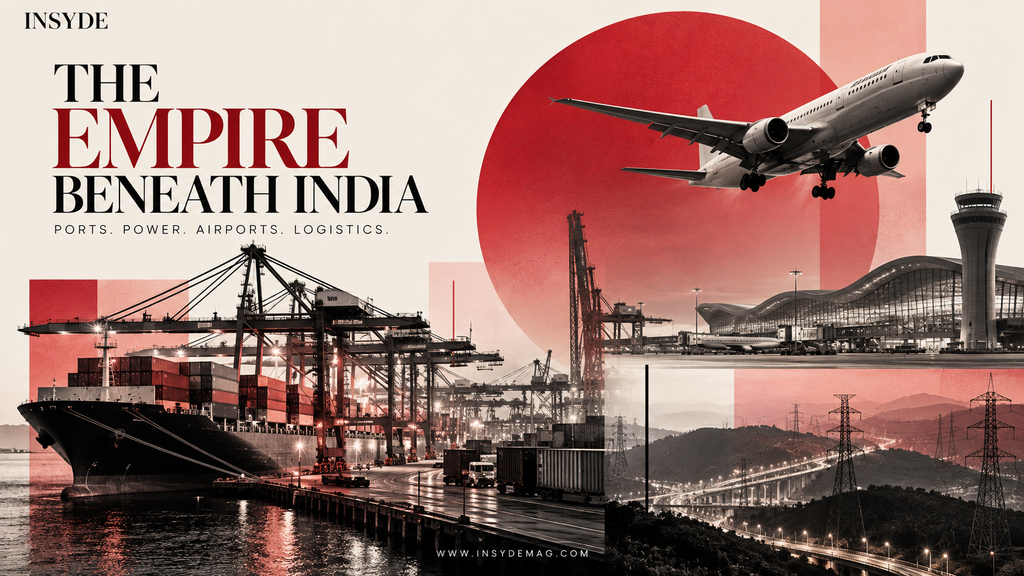
03 — THE EMPIRE BENEATH INDIA
Look at the port business and the scale becomes clearer.
Adani Ports and Special Economic Zone, or APSEZ, reported 500.8 million tonnes of cargo handled in FY26, an 11% increase from the previous year. The company reported a 27.1% share of India’s total port cargo and a 45.5% share of India’s container market.
Mundra is particularly significant.
The port handles nearly 35% of India’s container trade, according to APSEZ.
This isn’t simply a story about owning a port.
It is about occupying a critical position inside India’s relationship with global trade.
Then there is aviation.
Adani Airport Holdings reported 94.44 million passengers across its seven operational airports in FY2024–25, according to the company’s reporting.
The network now stretches across major Indian aviation markets, while Navi Mumbai International Airport began international operations in July 2026, adding another significant asset to the group’s aviation portfolio.
These aren’t abstract assets.
They are places through which millions of people and enormous volumes of goods physically move.
And that is the defining characteristic of the Adani empire:
scale becomes tangible.
04 — THE ₹1.53-LAKH-CRORE STATEMENT
Perhaps the clearest indication of where the group is heading isn’t Adani’s personal net worth.
It is how aggressively the businesses are investing.
The Adani portfolio reported ₹1,52,967 crore in capital expenditure during FY26, describing it as the highest annual capex in its history. Its gross asset base reached ₹7,85,098 crore, while EBITDA reached an all-time high of ₹94,834 crore, up 5.6% year on year. The group said core infrastructure contributed 87% of EBITDA.
The numbers reveal something important.
Adani’s wealth story isn’t simply about assets becoming more valuable.
It is also about continually building more assets.
During FY26, the group reported commissioning major projects including 5.1 GW of renewable capacity, 3.37 GWh of battery-energy storage, the Ganga Expressway and Navi Mumbai International Airport.
Infrastructure requires enormous amounts of capital.
But it also requires something else:
time.
A port is not a five-year trend.
An airport is not a seasonal fashion cycle.
A transmission network is not a consumer fad.
These are assets designed to operate for decades.
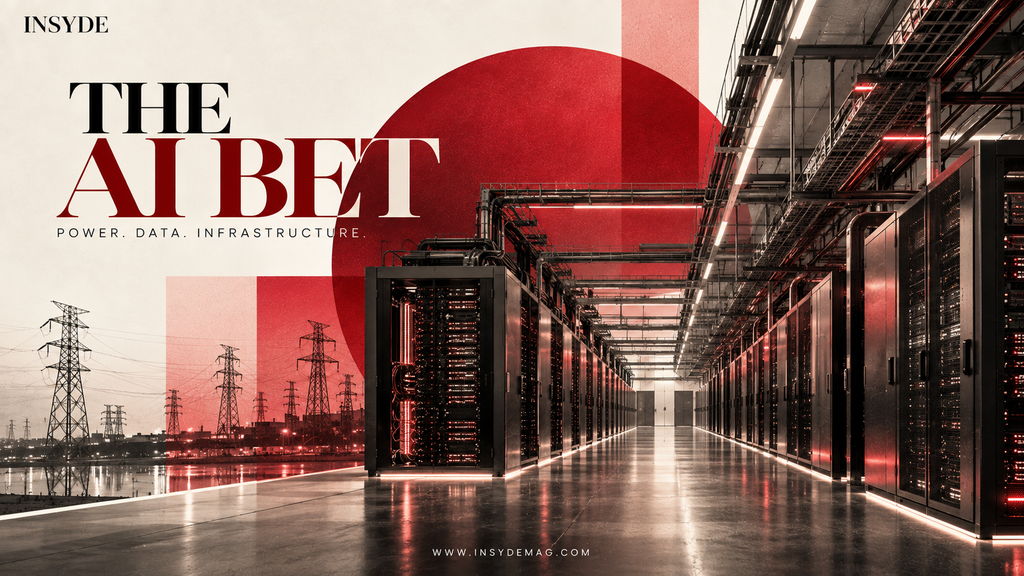
05 — THEN CAME AI
This is where the Adani story becomes considerably more interesting.
In February 2026, the Adani Group announced a proposed $100 billion direct investment through 2035 to develop renewable-energy-powered, hyperscale, AI-ready data centres.
The plan targets 5 GW of integrated data-centre capacity and is expected by the group to catalyse an additional $150 billion across areas including server manufacturing, advanced electrical infrastructure and sovereign cloud services — creating what Adani describes as a potential $250 billion AI infrastructure ecosystem in India.
The significance isn’t simply the size of the headline number.
It is the logic behind it.
AI may look like a software revolution.
But software needs hardware.
Hardware needs data centres.
Data centres need electricity.
Electricity requires generation and transmission.
And all of that requires land, construction, cooling, logistics, networks and capital.
Suddenly, the traditional Adani portfolio — energy, infrastructure, logistics and utilities — has a direct relationship with one of the defining technological shifts of the decade.
The group isn’t simply betting on AI applications.
It is betting on the physical infrastructure underneath AI.
06 — FROM PORTS TO COMPUTE
This may ultimately be one of the most interesting evolutions in the Adani story.
The first version of the empire was built around commodities.
The next expanded into infrastructure and energy.
The emerging version is positioning itself around the infrastructure required by a more digital economy.
It is an evolution from moving physical goods to supporting the systems that move information and computation.
In April 2026, Google broke ground on a gigawatt-scale AI hub in Visakhapatnam in partnership with AdaniConneX and Nxtra by Airtel, adding another major development to India’s emerging AI infrastructure ecosystem.
Then, in June, Adani Enterprises and Jabil announced plans for a strategic alliance aimed at building a vertically integrated AI and data-centre infrastructure manufacturing platform in India, including high-density AI racks, servers, storage, networking systems, power-distribution equipment and thermal-management infrastructure.
The glamour of AI tends to belong to the companies building models, applications and consumer products.
But underneath the interface is an industrial ecosystem:
Power.
Cooling.
Data centres.
Servers.
Transmission.
Connectivity.
Land.
Construction.
Logistics.
That is the infrastructure opportunity Adani is pursuing.
07 — TWO MODELS OF INDIAN SCALE
For years, India’s billionaire story has been framed around a single question:
Ambani or Adani?
But the more revealing comparison isn’t personal.
It is structural.
Reliance under Mukesh Ambani has evolved from its traditional energy and petrochemicals base into a broader ecosystem spanning telecommunications, digital services, retail, financial services and energy.
Adani’s centre of gravity is different.
Its portfolio remains heavily concentrated around infrastructure, transport, logistics, energy, utilities and industrial development, while newer ambitions extend into areas such as AI infrastructure and advanced manufacturing.
The distinction tells us something about India’s economic transformation.
The country’s largest business empires are increasingly not built around one product.
They are built around ecosystems.
One can be closer to the consumer.
Another can be closer to the infrastructure underneath the consumer economy.
Both reflect the increasing scale and complexity of Indian capital.
08 — THE COMEBACK HAS A HISTORY
No serious account of Adani’s rise can ignore the scrutiny surrounding the group in recent years.
In January 2023, Hindenburg Research published allegations concerning the Adani Group, including claims involving stock manipulation and financial wrongdoing. The Adani Group denied the allegations. The episode was followed by substantial market scrutiny and a sharp decline in the group’s listed-company valuations.
The story has since moved through multiple regulatory and legal developments.
Most recently, on September 28, 2026, India’s market regulator SEBI allowed Gautam Adani and four Adani Group companies to settle proceedings concerning alleged minimum-public-shareholding violations.
Reuters reported that the settlement involved a payment of ₹1.482 crore ($154,403) without admission or denial of SEBI’s findings. Proceedings against the Adani entities were disposed of without penalties, while two individuals were separately fined ₹20 lakh each for incomplete or incorrect disclosures.
For INSYDE, this isn’t a footnote.
It is part of understanding what happens when a private business empire becomes large enough to attract sustained regulatory, market and public scrutiny.
Scale creates opportunity.
Scale also creates scrutiny.
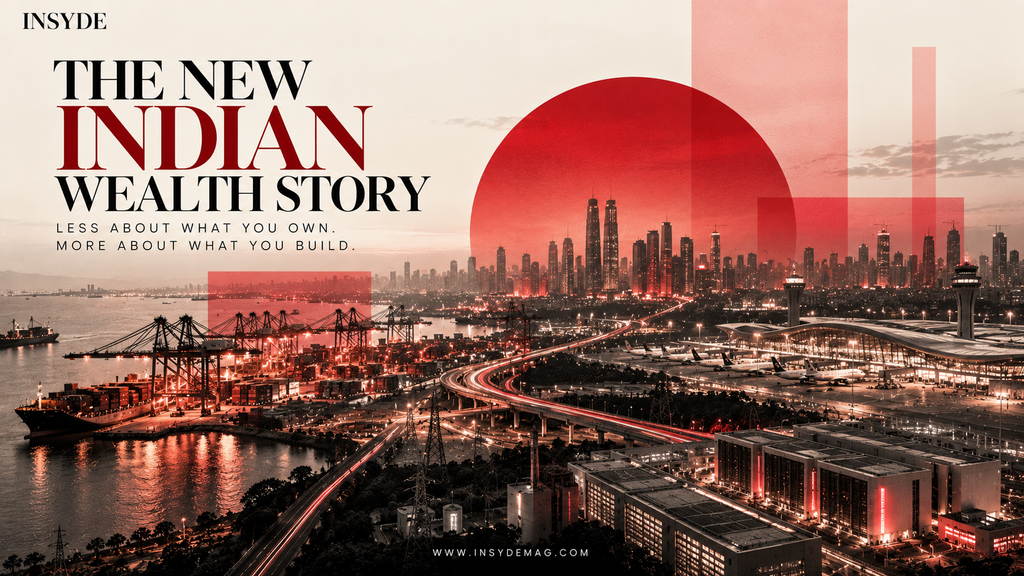
09 — THE NEW INDIAN BILLIONAIRE
There was a time when India’s wealth hierarchy was dominated by industrial categories that were relatively easy to define.
Steel.
Cement.
Textiles.
Pharmaceuticals.
Petrochemicals.
Today’s landscape is more complicated.
Technology.
Telecom.
Digital platforms.
Renewable energy.
Infrastructure.
Healthcare.
Financial services.
Data centres.
AI.
Logistics.
The latest Hurun list puts that transformation into perspective: 1,810 individuals with wealth of at least ₹1,000 crore made its 2026 list, with their combined wealth reaching approximately ₹187.5 lakh crore, or $1.96 trillion. Hurun also counted a record 391 dollar billionaires.
The modern billionaire is increasingly not simply a person with an enormous collection of assets.
It is an individual whose ownership can span networks of businesses that interact with one another.
A port connects to logistics.
Logistics connects to manufacturing.
Energy connects to data centres.
Data centres connect to AI.
Airports connect to retail, hospitality and urban development.
The empire becomes the ecosystem.
10 — THE LUXURY OF SCALE
Luxury is usually presented through objects.
A watch.
A car.
A yacht.
A private jet.
A penthouse.
But there is another form of luxury that rarely appears in glossy advertising:
scale.
The ability to commit billions of dollars to an industry before its full potential becomes obvious.
The ability to build assets that may take years to mature.
The ability to think in decades rather than seasons.
Infrastructure requires exactly that kind of patience.
It is capital-intensive, operationally complex and dependent on long-term demand.
That makes the Adani story relevant to INSYDE for a different reason.
It expands the definition of what extreme wealth looks like.
Sometimes luxury is owning the object everyone recognizes.
Sometimes it is having the resources to build the system nobody notices until it stops working.
11 — WHAT INDIA NEEDS NEXT
The real test of an infrastructure empire is not how impressive its balance sheet looks today.
It is whether the assets being built remain relevant tomorrow.
India’s next phase of growth will require enormous amounts of:
Energy.
Transportation.
Logistics.
Urban infrastructure.
Digital connectivity.
Computing capacity.
Manufacturing.
Adani’s recent capital deployment reflects that ambition.
During FY26, the group reported commissioning major assets across renewable energy, battery storage, airports, roads and other infrastructure platforms. Adani Green Energy separately reported adding more than 5 GW of renewable capacity in FY26, taking its operational renewable portfolio to 19.3 GW.
The strategy is therefore not simply about becoming larger.
It is about positioning the portfolio around the physical requirements of India’s next economic phase.
Whether every investment ultimately delivers the returns projected is a question that only time and markets can answer.
But the direction of capital is clear.
12 — THE SECOND ACT
The easiest way to describe this moment is as a comeback.
And there is truth in that.
Adani has returned to the top of Forbes’ 2026 Indian wealth ranking after three years at No. 2.
But the second act is more interesting than the first.
Because this isn’t simply about rebuilding what existed before.
The group is simultaneously expanding its infrastructure portfolio while placing major new bets on renewable energy, energy storage, data centres and AI infrastructure.
That makes the current moment less about reclaiming a title and more about what happens after the title is reclaimed.
The next decade will determine whether the group’s enormous capital cycle translates into equally significant long-term value.
For now, the direction is unmistakable.
The empire is building.
THE INSYDE TAKE
The most interesting thing about Gautam Adani’s return to the top isn’t the number beside his name.
It is what that number represents.
A fortune built largely around the physical architecture of a rapidly changing economy.
Ports.
Airports.
Power.
Energy.
Logistics.
Renewables.
And now, increasingly, artificial intelligence.
Forbes and Hurun currently place Adani at the top of their respective 2026 Indian wealth rankings, while their figures differ because their methodologies and valuation dates differ.
But beyond the ranking, the larger story is difficult to miss.
India is building.
It is building airports.
Ports.
Energy systems.
Digital infrastructure.
Manufacturing capacity.
And increasingly, the physical foundations of artificial intelligence.
The fortunes being created at the highest levels of Indian wealth are therefore becoming increasingly connected not simply to what India buys, but to what India will need next.
That may be the real Adani comeback.
Not simply returning to No. 1.
But building for what comes after it.
THE ADANI COMEBACK
The billionaire is back at the top.
The empire is building for what comes next.
Ports. Power. Airports. AI.
The new Indian wealth story may be less about what you own — and more about what you build.
INSYDE