
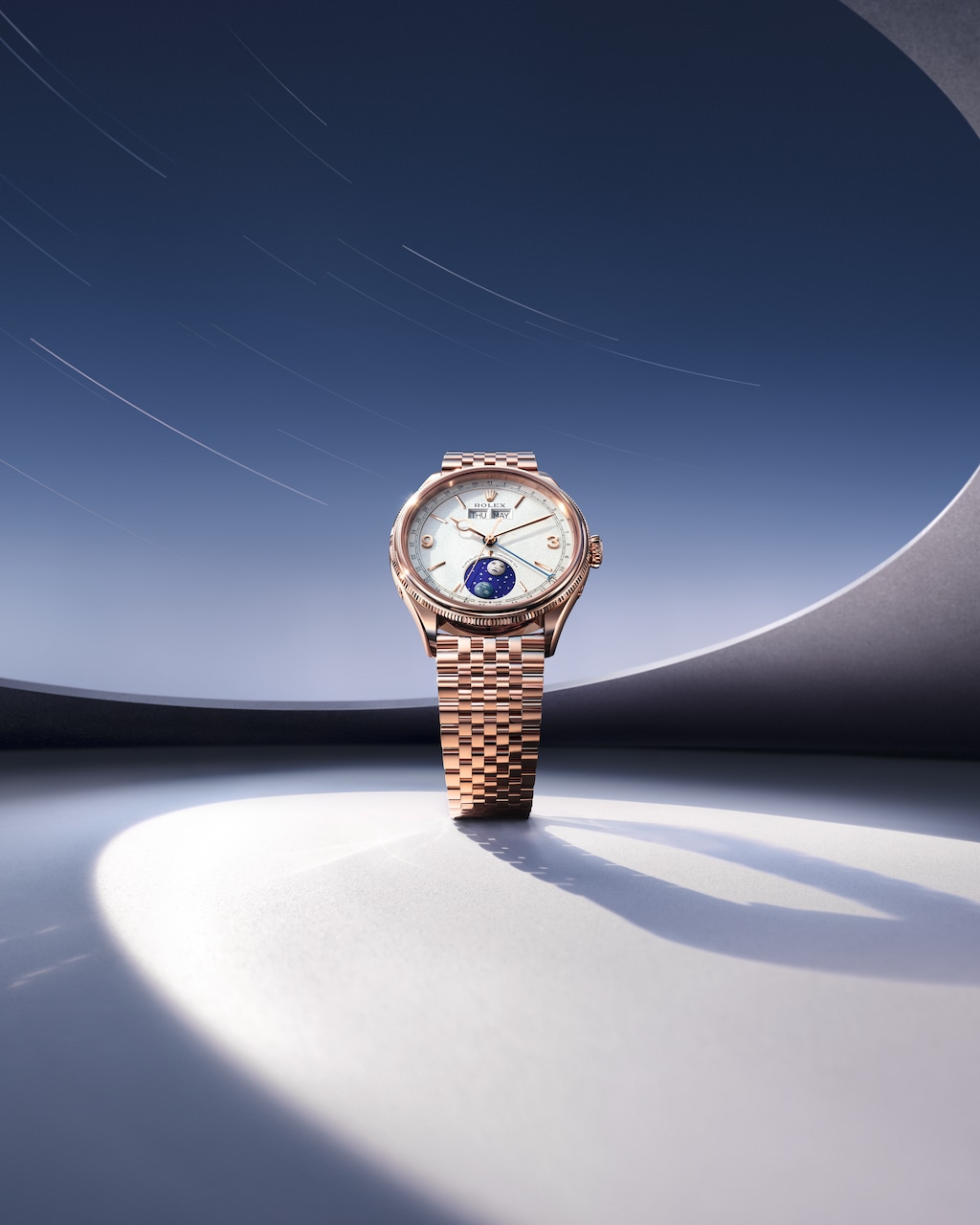
A historic Rolex name returns in a 39mm creation that brings together an instantaneous complete annual calendar, a meteorite moonphase and a new movement built around some of the brand’s latest technical developments.
A smartphone knows the date.
It knows the day, the month and, with a quick glance, the phase of the moon.
So why would anyone still build a mechanical watch that does all of this through gears, levers, springs and a movement beating five times every second?
Because mechanical watchmaking has never really been about necessity.
It is about turning something as ordinary as the passage of time into an object worth looking at.
That idea sits at the heart of the Rolex Perpetual Padellone, the latest addition to Rolex’s Perpetual collection. Introduced in September 2026, the watch brings together an instantaneous complete annual calendar, a moonphase display and a new self-winding movement, combining traditional watchmaking ideas with contemporary Rolex engineering.
Its name, however, comes from much further back.
The Padellone takes its identity from Rolex reference 8171, an earlier Rolex timepiece with a complete calendar that became known to collectors as the “Padellone.” Rolex describes the new watch as a natural continuation of that heritage.
But this is not simply an exercise in recreating the past.
The historical name provides the starting point.
The engineering is entirely of its time.
THE RETURN OF THE PADELLONE
There is something fascinating about the way Rolex uses its history.
Reference 8171 established the Padellone name within the brand’s story of complete-calendar watches. Decades later, Rolex has taken that name and attached it to a watch built around an entirely new movement and a considerably more sophisticated calendar mechanism.
The connection is therefore not about reproducing an old design piece by piece.
It is about continuing an idea.
The calendar remains central.
But now it sits alongside a moonphase display, an instantaneous calendar change and calibre 7190, a movement developed specifically for the new watch.
The result is a conversation between two eras of Rolex watchmaking.
One provides the name.
The other provides the mechanics.
WHAT EXACTLY IS THE PERPETUAL PADELLONE?
At its most basic, the Perpetual Padellone displays:
Hours. Minutes. Seconds. Date. Day. Month. Moonphase.
But the way it handles the calendar is what makes the watch particularly interesting.
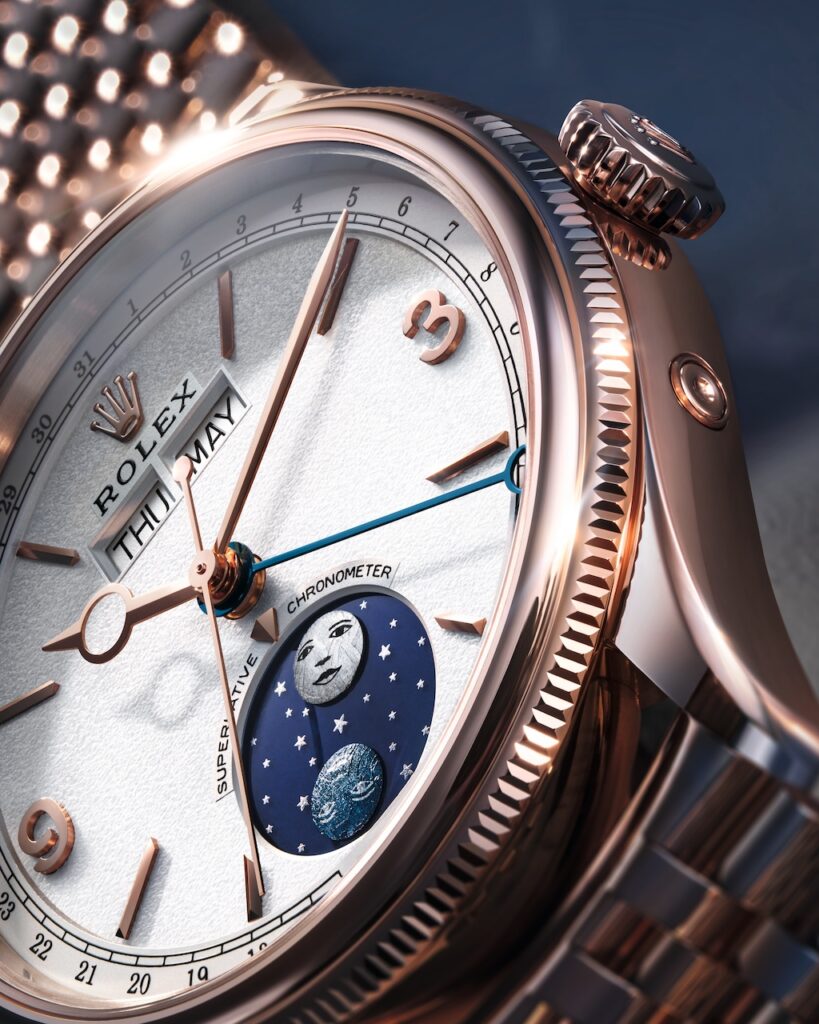
Rolex calls it an instantaneous complete annual calendar.
The first important word is annual.
Through Rolex’s patented Haplos system, the mechanism differentiates between months containing 30 days and those containing 31 days.
That means the wearer only needs to make one calendar adjustment each year: when February turns to March.
Then comes instantaneous.
At midnight, the day, date and month change simultaneously in a fraction of a second.
Rather than having the three indications transition independently, Rolex has engineered them to jump together, maintaining their alignment. A patent application has also been filed for this mechanism.
On the dial, the day and month appear in two apertures at 12 o’clock, while a blue central hand with a crescent moon at its tip points towards the date around the circumference.
It is an impressive amount of information presented with remarkably little visual noise.
THE HAPLOS SYSTEM
The mechanism behind the annual calendar is called Haplos.
Rolex says the system consists of only two components coupled to the date mechanism: an additional carrier finger and an annual lever.
The programming of the annual calendar is incorporated into the reverse side of the month disc.
That information tells the annual lever which month is currently being displayed, allowing the mechanism to distinguish between 30-day and 31-day months.
The result is remarkably simple from the wearer’s perspective.
The watch understands the difference between the months.
The wearer doesn’t have to.
Only February requires intervention.
And when the calendar reaches midnight, the three indications change together.
The sophistication is hidden exactly where it should be: inside the movement.
THEN THERE IS THE MOON
At six o’clock, the Padellone introduces another rhythm entirely.
A blue enamelled moonphase disc completes one rotation every 29.53 days, corresponding to the lunar month.
But the moonphase isn’t simply a decorative complication.
The full moon and new moon displayed on the disc are made from meteorite.
The new moon is treated with a dark-blue PVD coating, while the silver stars are pad printed onto the disc.
It gives the watch an unusual relationship with the natural world.
The calendar follows the structure of the year.
The moonphase follows the lunar cycle.
And both are being translated into mechanical motion on the wrist.
Rolex itself describes the moonphase as a link between the rhythm of the Moon and that of the Earth—a small window onto the night sky.
A DIAL BUILT AROUND RESTRAINT
The dial of the Perpetual Padellone is finished with a grained texture across most of its surface, while the outer edge receives a fine satin finish.
The date scale is inscribed in black around the periphery.
A blue central hand, finished with its crescent-moon tip, indicates the date.
At 12 o’clock, the day and month appear through two apertures, both displayed in English.
At six, the blue moonphase disc provides the visual counterpoint.
There is a lot happening here.
But the dial doesn’t look crowded.
That is perhaps one of the watch’s more understated achievements.
The complication is visible without becoming the aesthetic.
THE 39MM CASE
The Perpetual Padellone measures 39mm in diameter.
Its case combines graceful lines with a bezel that is both domed and subtly fluted. The middle case incorporates correctors on its sides for the calendar functions, while the upper edges of the lugs receive gentle chamfering.
The domed sapphire crystal and transparent sapphire caseback both receive anti-reflective coating.
The watch is waterproof to 50 metres / 165 feet.
The case is offered in 18 ct Everose gold or 950 platinum.
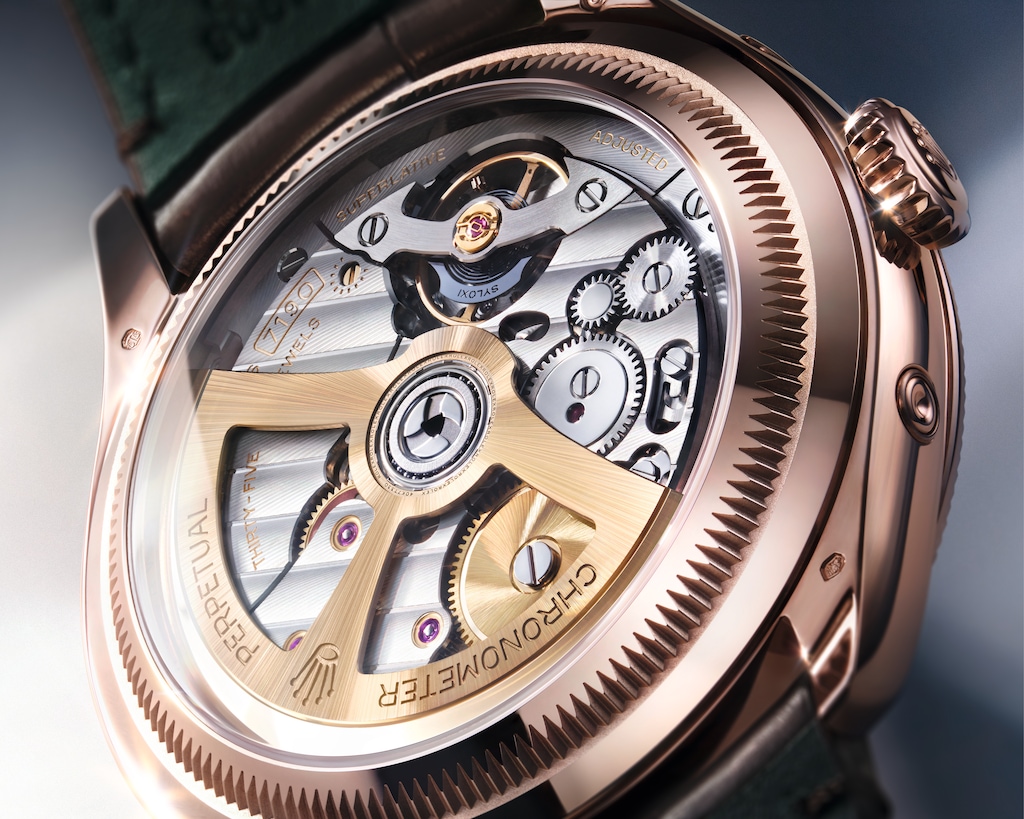
The transparent caseback is particularly important to the character of the watch.
It allows the movement to become part of the visual experience rather than remaining entirely hidden.
Through it, Rolex’s finishing can be seen, including bridges decorated with Rolex Côtes de Genève and a cut-out oscillating weight in yellow gold.
THREE EXPRESSIONS OF THE PADELLONE
Rolex presents the Perpetual Padellone in three configurations.
EVEROSE GOLD WITH SETTIMO BRACELET
The first combines an 18 ct Everose gold case with a grained-finish intense white dial and a Settimo bracelet fitted with a concealed Crownclasp.
PLATINUM WITH ICE-BLUE DIAL
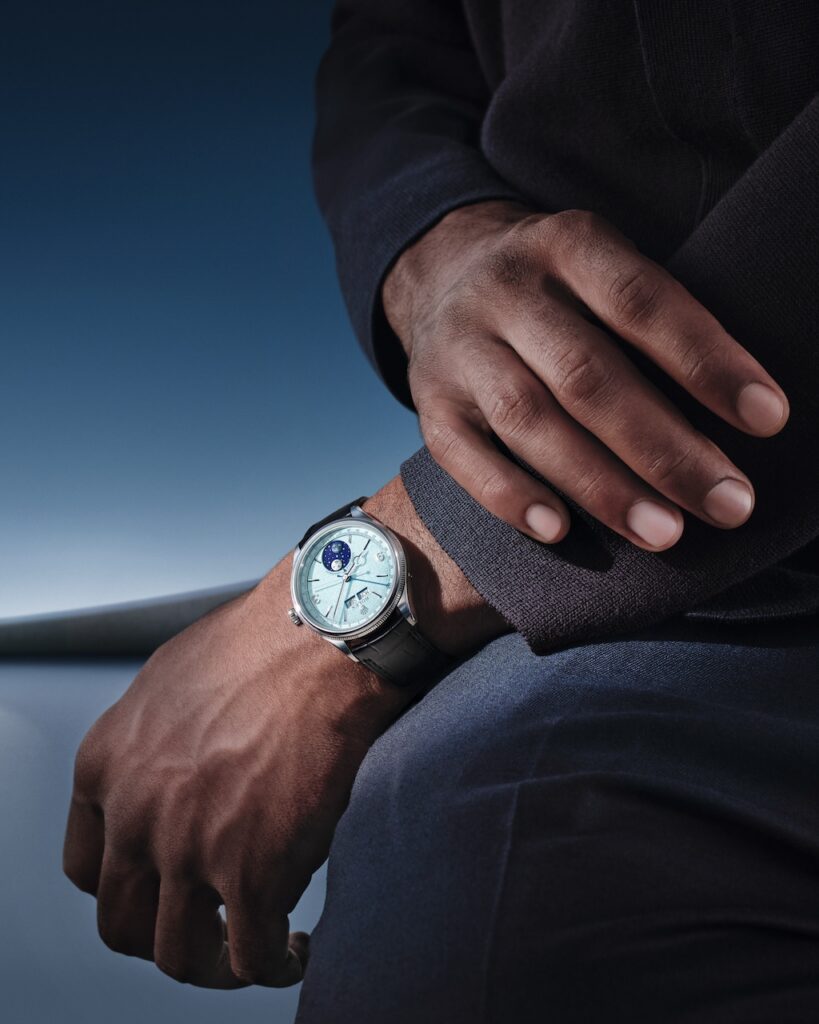
The second features a 950 platinum case, a grained-finish ice-blue dial and a matt black alligator leather strap with a Dualclasp.
EVEROSE GOLD WITH BROWN ALLIGATOR
The third returns to 18 ct Everose gold and an intense white grained-finish dial, this time paired with a matt brown alligator leather strap and Dualclasp.
The mechanical foundation remains the same.
The material and strap combinations simply give the watch different expressions.
THE SETTIMO BRACELET
The Everose gold version with the bracelet introduces Rolex’s Settimo bracelet.
Its links are made from seven very small, slightly contoured elements, polished on every surface. Rolex says this construction allows the bracelet to follow the shape of the wrist while remaining particularly lightweight.
The bracelet uses a special attachment system to the middle case for which a patent application has been filed.
A concealed folding Crownclasp completes the design, maintaining the visual continuity of the bracelet.
The leather versions take a different approach.
The matt brown and matt black alligator straps feature green calfskin lining, tone-on-tone stitching and a Dualclasp, a double folding clasp designed to sit centred on the wrist.
The details are subtle.
That is exactly the point.
CALIBRE 7190: THE ENGINE INSIDE
If the dial is where the Padellone tells its story, calibre 7190 is where that story becomes mechanical.
The movement is entirely developed and manufactured by Rolex and is exclusive to the Perpetual Padellone.
It is a self-winding mechanical movement operating at 5 hertz and delivering an approximately 66-hour power reserve. Rolex places it within the 71XX family and notes that it is thinner than the majority of its movements.
The movement is protected by 30 patent applications, two of which are exclusive to the watch.
Calibre 7190 is based on the design of calibre 7135, unveiled with the Land-Dweller in 2025, and incorporates the same regulating system built around the Dynapulse escapement and advanced oscillator.
But the movement has been developed around the Padellone’s annual-calendar architecture.
This is where the watch’s various ideas converge.
Calendar.
Moonphase.
Precision.
Energy.
All of them have to work together inside a single movement.
DYNAPULSE
The Dynapulse escapement is a sequential-distribution escapement made from silicon.
Rolex says it combines excellent energy efficiency with dependability and resistance to strong magnetic fields.
The technology is the subject of seven patent applications. It was inaugurated with calibre 7135 in the Land-Dweller in 2025.
For calibre 7190, Dynapulse becomes part of a movement that has to manage the additional demands of an instantaneous annual calendar.
It is another example of how the Padellone combines a traditional complication with more recent Rolex movement technology.
THE SYLOXI HAIRSPRING
Calibre 7190 also uses a Syloxi hairspring made from silicon.
Rolex highlights its resistance to strong magnetic fields, thermal stability and high shock resistance.
The geometry of the hairspring is patented and designed to help maintain the calibre’s regularity in different positions.
For calibre 7190, the Syloxi coils are particularly thick, providing greater rigidity. Rolex identifies this as an essential factor in allowing the movement to beat at 5 hertz.
The specification therefore isn’t just a number on a technical sheet.
The movement has been engineered around it.
THE OSCILLATOR
The oscillator of calibre 7190 contains a balance staff made from high-technology ceramic, a material Rolex describes as patented and exclusive to the brand.
It is paired with a balance wheel made from optimized brass.
The oscillator is mounted on Paraflex shock absorbers, which further enhance the movement’s resistance to shocks and help reposition the balance staff after impact. Rolex also says the system allows the balance to pivot smoothly and regularly in different positions.
Once again, the philosophy is cumulative.
Precision is not one component.
It is the result of many components behaving correctly together.
APPROXIMATELY 66 HOURS OF POWER
The movement uses a self-winding system through a Perpetual rotor.
Rolex attributes the approximately 66-hour power reserve to the architecture of the barrel and the efficiency of the escapement.
For the wearer, that means the watch can continue running for almost three days when fully wound and left off the wrist.
For Rolex, the more interesting story is how that autonomy is achieved while maintaining the performance expected from a movement operating at 5 hertz and carrying a sophisticated calendar mechanism.
THE SUPERLATIVE CHRONOMETER
The Perpetual Padellone carries Rolex’s Superlative Chronometer certification.
Since 2026, the certification includes three additional testing criteria:
Resistance to magnetism.
Reliability.
Sustainability.
These supplement the existing criteria governing precision, waterproofness, self-winding and autonomy.
Rolex’s precision requirement for the finished watch is particularly stringent.
After the movement has been cased, the watch must achieve an accuracy of between −2 and +2 seconds per day.
The distinction matters.
Rolex is not talking only about the movement before it becomes a watch.
The test applies to the finished object.
The certification is represented by the Rolex green seal and is accompanied by an international five-year guarantee.
HERITAGE WITHOUT REPRODUCTION
This may be the most interesting thing about the Padellone.
Rolex could have simply recreated the visual identity of reference 8171.
Instead, the brand has taken the historical idea behind the Padellone and placed it inside an entirely contemporary technical framework.
The name comes from the past.
The annual-calendar concept connects it to traditional watchmaking.
The moonphase gives the watch an astronomical dimension.
Calibre 7190 brings in the latest generation of Rolex movement technology used in the watch.
And Haplos introduces a new approach to the annual-calendar mechanism itself.
The result is not a vintage watch wearing modern clothes.
It is a modern watch carrying a historical name.
That is a very different proposition.
WHY DOES A MECHANICAL WATCH NEED TO KNOW THE MOON?
This is perhaps the question that sits underneath the entire Padellone.
We no longer need a mechanical watch to tell us what day it is.
Our phones do it.
Our computers do it.
Our cars do it.
Our calendars correct themselves.
The moonphase is available with a search.
Information has become almost frictionless.
Mechanical watchmaking moves in the opposite direction.
It takes something simple and makes it physical.
A date becomes a system of wheels and levers.
A change of month becomes an instantaneous mechanical event.
The moon becomes a disc completing one revolution every 29.53 days.
A movement becomes something that can be seen through sapphire.
That is the paradox at the heart of modern mechanical luxury.
Technology has made time easier to access.
Watchmaking makes time more tangible.
And perhaps that is why complications still matter.
Not because we need them.
Because we want to understand them.
THE PADELLONE, RECONSIDERED
The Perpetual Padellone is ultimately less about adding more information to a watch than about making information meaningful again.
The calendar tells us where we are in the year.
The moonphase reminds us that time does not move according to a single rhythm.
The movement turns those rhythms into something physical.
And the case brings the entire system into an object designed to be worn, handled and looked at.
That is where the Padellone becomes particularly interesting within Rolex’s broader approach to watchmaking.
It does not abandon tradition in favour of technology.
Nor does it rely on tradition alone.
Instead, the two are made to work together.
The historical Padellone provides the name.
Haplos provides a new approach to the calendar.
Calibre 7190 provides the mechanical architecture.
The moonphase gives the watch its poetry.
And the transparent caseback lets the wearer see some of the work behind the result.
WHEN TIMES ALIGN
The Perpetual Padellone is an unusual kind of Rolex.
It is not trying to make time louder.
It is making time more interesting.
At 39mm, it remains relatively restrained in proportion. Its dial is carefully balanced. Its calendar information is integrated rather than shouted. Its moonphase introduces a quiet sense of astronomy.
And underneath it all is a movement designed specifically for the watch, operating at 5 hertz, with approximately 66 hours of power reserve and protected by 30 patent applications.
The name may belong to Rolex’s past.
The engineering does not.
That is ultimately what makes the Perpetual Padellone worth paying attention to.
It is not simply a return.
It is a continuation.
A historical idea has been taken apart, reconsidered and rebuilt with the tools of contemporary watchmaking.
And perhaps the most beautiful irony is that Rolex has created such a complicated way to remind us of something incredibly simple:
Time passes.
We can measure it.
We can display it.
We can engineer it.
But we can also make something beautiful enough to make us stop and look at it.
That is the Perpetual Padellone.
And that is when times align.
INSYDE MAGAZINE
Luxury, Through a Different Lens.