
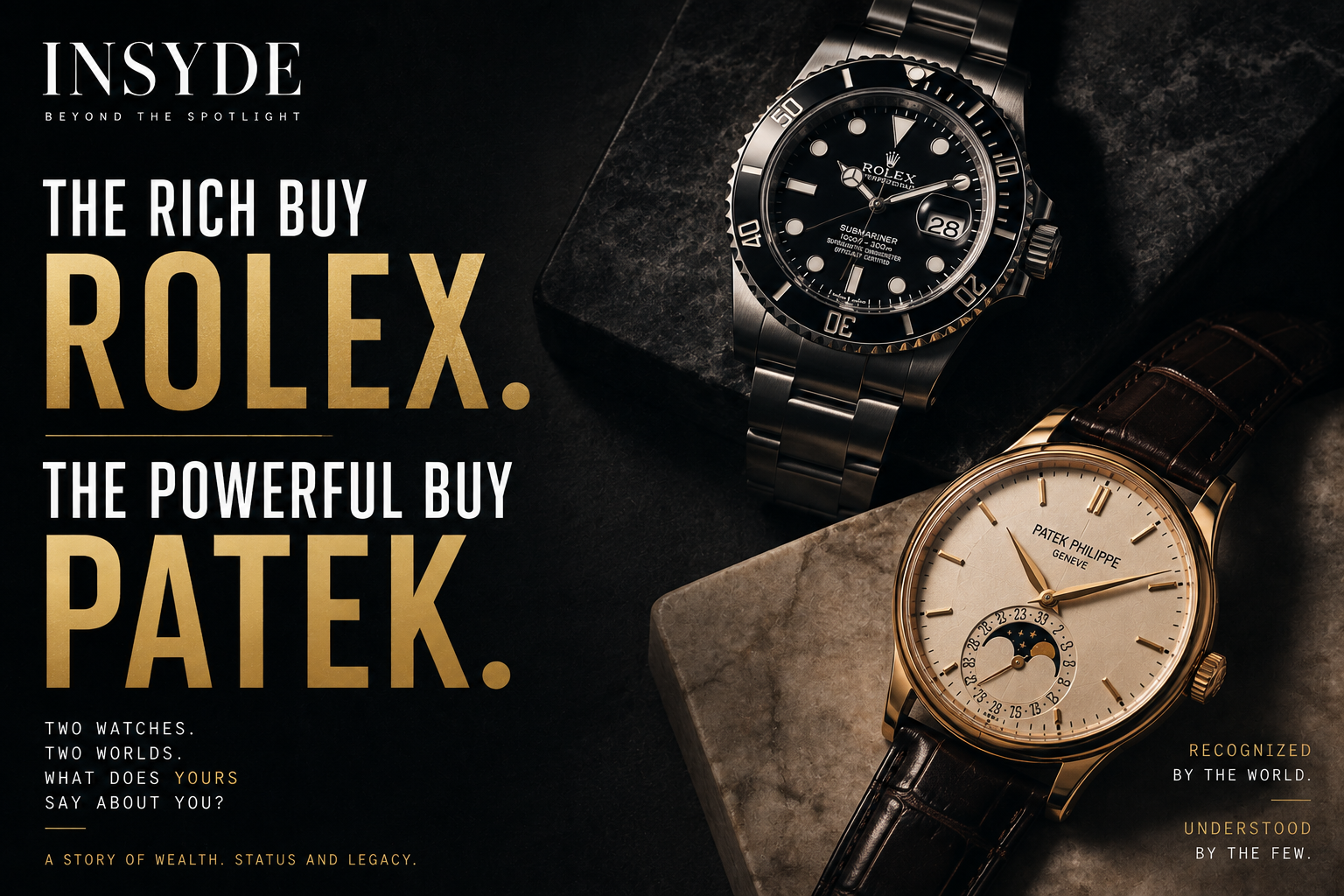
Two watches. Two worlds. And a question luxury has been asking for generations: what does the watch on your wrist say about you?
There is a saying in the world of luxury watches:
The rich buy Rolex. The powerful buy Patek.
It is provocative. It is memorable. And, taken literally, it is wrong.
There are billionaires who wear Rolex. Collectors who own both. Watch enthusiasts who choose neither. And a Patek Philippe on a wrist does not make its wearer powerful any more than a Rolex makes someone rich.
But the saying survives because it captures something far more interesting than a simple comparison.
It captures the psychology of luxury.
Because at a certain level of wealth, a watch stops being about telling time.
It becomes about what you want the world to know — and what you no longer need it to know.
Rolex and Patek Philippe sit at the summit of Swiss watchmaking, yet they communicate remarkably different ideas of success.
One mastered global recognition.
The other mastered the power of discretion.
One became a symbol of achievement.
The other became a symbol of legacy.
And somewhere between the two lies a fascinating question:
When you can afford almost anything, why does the thing you choose to wear still matter so much?
ROLEX: THE SYMBOL OF ARRIVAL
Few luxury brands are as instantly recognisable as Rolex.
You don’t have to be a watch collector to know the crown.
You don’t need to understand mechanical movements.
You don’t need to know the reference number.
You simply see it.
And you understand.
That is one of the greatest achievements in luxury branding.
Rolex began with Hans Wilsdorf, who believed the wristwatch could become both technically dependable and commercially desirable. The company’s history was built around precision, water resistance, reliability and performance in demanding environments.
But Rolex eventually became much more than a technical watchmaker.
It became a cultural symbol.
Explorers wore it.
Athletes wore it.
Leaders wore it.
Entrepreneurs wore it.
Actors wore it.
People who had achieved something wore it.
Over generations, the association became almost automatic.
Rolex became a shorthand for having made it.
THE POWER OF BEING RECOGNISED
This is where Rolex is extraordinary.
Patek Philippe may be revered by serious collectors, but Rolex possesses something almost impossible to manufacture:
mass cultural recognition without losing luxury status.
A Rolex can be appreciated by a lifelong horologist and recognised by someone who has never opened a watch case.
That duality is extraordinarily powerful.
It means the watch can operate on two levels simultaneously.
For the enthusiast, it can be about engineering, history and design.
For the wider world, it can simply mean:
success.
That is not superficial.
It is branding at its highest level.
Rolex didn’t merely create watches people wanted.
It created a symbol people wanted to be associated with.
THEN THERE IS PATEK PHILIPPE
If Rolex is the language of recognition, Patek Philippe is closer to the language of connoisseurship.
Founded in Geneva in 1839, Patek Philippe has spent generations developing complicated mechanical watches and preserving an unusually independent identity. The Stern family acquired the company in 1932, and Patek Philippe remains family-owned today.
That independence is significant.
Patek Philippe does not need to become everything to everyone.
Its appeal has always been rooted in high watchmaking, craftsmanship, technical expertise and continuity.
Its watches can be extraordinarily complicated.
Its production remains deliberately limited.
And the company itself emphasises the rarity and time involved in creating its pieces.
This creates a different kind of desirability.
You don’t necessarily buy Patek Philippe so everyone notices.
You buy it because you understand what you’re looking at.
WHEN STATUS BECOMES A SECRET LANGUAGE
Imagine two people entering the same room.
One is wearing a Rolex.
Almost everyone recognises it.
Another is wearing a complicated Patek Philippe.
Most people don’t notice.
Then someone across the room looks at the wrist.
They pause.
They understand.
That tiny moment captures one of the most fascinating changes in modern luxury.
Status doesn’t always become more powerful by becoming more visible.
Sometimes it becomes more powerful by becoming selective.
The person wearing the watch isn’t necessarily asking:
Do you know how much this costs?
They may be asking something much quieter:
Do you know what this is?
And if the answer is yes, nothing else needs to be said.
TWO BRANDS. TWO DEFINITIONS OF SUCCESS.
This is where the famous saying begins to make sense.
Not literally.
Culturally.
Rolex has become associated with achievement.
Patek Philippe has become associated with legacy.
Rolex can communicate:
I made it.
Patek Philippe can communicate:
I understand why this matters.
The difference is subtle.
But in luxury, subtlety is often where the interesting stories begin.
THE OWNERSHIP STORY IS EVEN MORE INTERESTING
There is another reason these two brands deserve attention.
Neither is simply another luxury label sitting inside a massive publicly traded conglomerate.
Rolex is owned by the Hans Wilsdorf Foundation, established by its founder. The structure allows Rolex to remain independently controlled.
Patek Philippe remains controlled by the Stern family, which has owned the company since 1932.
Think about that.
Two of the world’s most powerful names in luxury watchmaking have retained extraordinary independence while building global influence.
In an industry where brands can become pieces of enormous luxury portfolios, that independence is part of the story.
They aren’t simply selling products.
They are protecting legacies.
THE BUSINESS OF SAYING NO
Luxury has always depended on an interesting contradiction.
A brand needs people to want its products.
But if everyone can have them immediately, desire changes.
Too much availability weakens scarcity.
Too much visibility can weaken mystery.
Too much production can weaken exclusivity.
Rolex and Patek Philippe approach this challenge differently, but both understand the fundamental principle:
Desire needs distance.
Rolex has achieved enormous global recognition while maintaining a powerful perception of exclusivity.
Patek Philippe operates at a different scale, with a stronger emphasis on complicated watchmaking, limited production and craftsmanship.
Neither needs to convince consumers that the product is luxurious.
The reputation arrived long before the customer.
PATEK AND THE IDEA OF TIME BEYOND YOURSELF
Perhaps the most powerful distinction comes from Patek Philippe’s philosophy.
The brand’s famous campaign tells the owner:
“You never actually own a Patek Philippe. You merely look after it for the next generation.”
It is one of the most effective ideas in luxury advertising because it changes the meaning of ownership.
You are not the final owner.
You are a temporary custodian.
The watch existed before you.
Someone may inherit it after you.
Suddenly, the product isn’t simply about wealth.
It is about continuity.
That is an extraordinarily sophisticated proposition.
BUT ROLEX HAS ITS OWN KIND OF POWER
It would be easy — and wrong — to turn this into a story where Patek Philippe is the sophisticated choice and Rolex is simply the more recognisable one.
Rolex’s achievement may actually be more difficult.
How do you become one of the world’s most recognised luxury brands without becoming ordinary?
How do you reach millions of people while preserving the perception of exclusivity?
How do you become recognisable across continents, generations and cultures?
Rolex answered those questions better than almost anyone.
Its strength is not secrecy.
Its strength is universal recognition.
That is a different form of power.
And it is enormous.
THE WATCH IS NO LONGER ABOUT TIME
This is where luxury becomes fascinating.
A watch costing thousands, tens of thousands or hundreds of thousands of dollars does not provide proportionally more accurate time.
That isn’t why people buy it.
They buy craftsmanship.
History.
Design.
Scarcity.
Identity.
Emotion.
And sometimes, status.
The watch becomes a piece of personal storytelling.
A Rolex might tell the story of ambition.
A Patek might tell the story of appreciation.
A vintage piece might tell the story of heritage.
A rare complication might tell the story of obsession.
The object becomes a reflection of the person.
Time is merely the mechanism.
SO, WHICH ONE IS FOR THE POWERFUL?
Perhaps the question itself is flawed.
Power isn’t measured by the logo on someone’s wrist.
And wealth certainly isn’t.
The real distinction is what the wearer wants from the object.
If recognition matters, Rolex possesses extraordinary power.
If craftsmanship, rarity and horological depth matter, Patek Philippe occupies a remarkable position.
If legacy matters, Patek’s philosophy becomes particularly compelling.
If achievement matters, Rolex’s cultural history speaks loudly.
And if none of those things matter?
Then perhaps the most luxurious choice is simply wearing what you genuinely love.
WHEN YOU NO LONGER NEED TO PROVE IT
There is a point in the journey of luxury where the conversation changes.
At first, luxury can be about being seen.
Then it can become about being recognised.
Eventually, it can become about being understood.
That is where Patek Philippe’s world becomes especially fascinating.
Not because Patek is inherently “better” than Rolex.
But because it represents a different relationship with status.
A Rolex can enter a room and announce achievement.
A Patek can sit beneath a cuff and wait.
Someone who understands will notice.
Everyone else doesn’t need to.
That is perhaps the purest form of discreet luxury.
THE RICH BUY ROLEX. THE POWERFUL BUY PATEK.
So, is the statement true?
Not literally.
It is far too simple for a world as complicated as luxury.
But as a cultural observation, it reveals something important.
Rolex mastered recognition.
Patek Philippe mastered discretion.
Rolex became one of the world’s most powerful symbols of achievement.
Patek Philippe became one of the world’s most powerful symbols of horological legacy.
One tells the world:
I made it.
The other can quietly suggest:
I don’t need to explain it.
And perhaps the difference between the two isn’t actually about wealth.
It is about what you want your wealth to say.
Because at the highest level of luxury, the most expensive thing you can own isn’t necessarily the object.
It is the confidence to let the object speak for itself.
INSYDE — Beyond the Spotlight.