
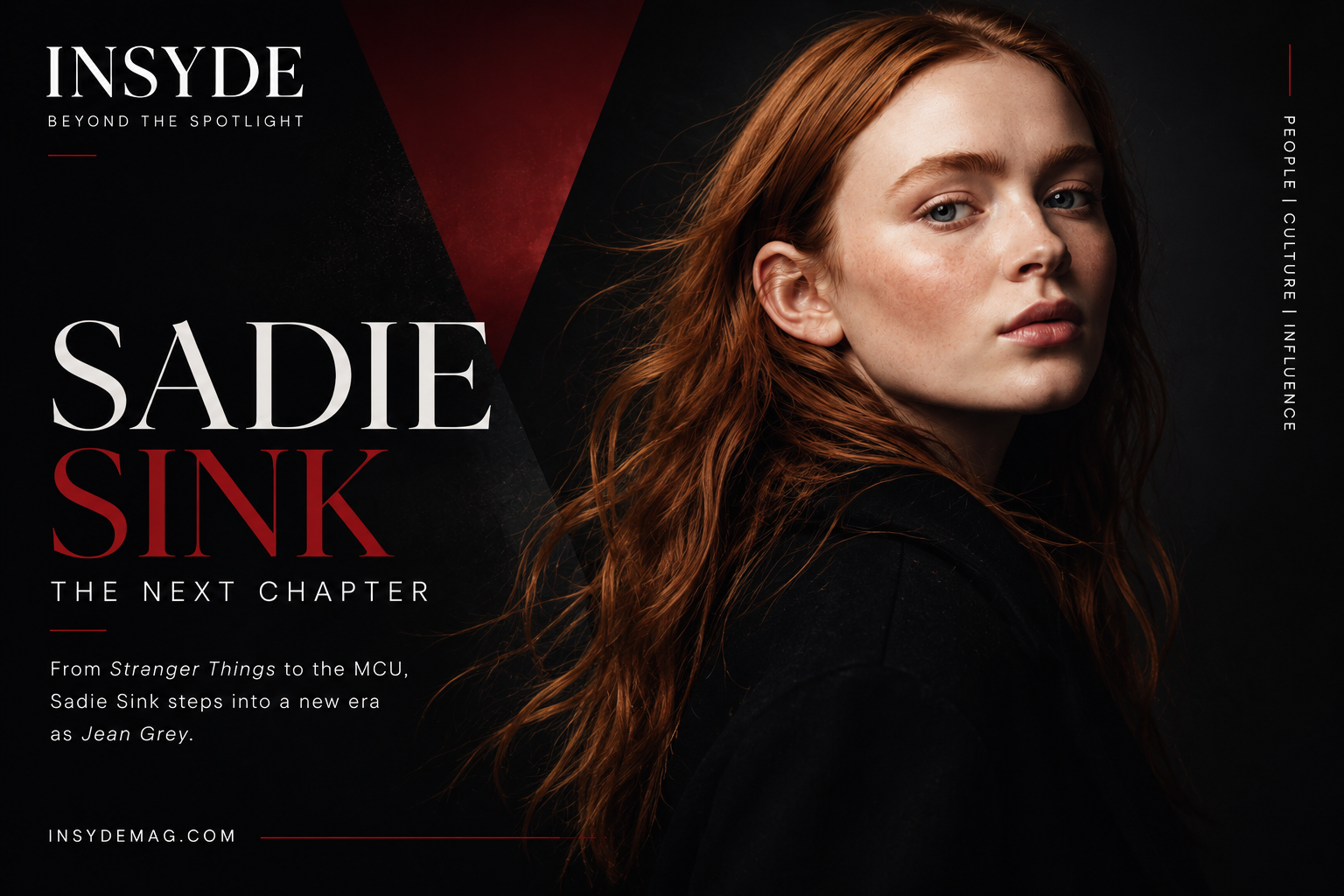
From Stranger Things to the MCU, the actress is entering a new era of stardom — one that could define the next chapter of her career.
Some careers are defined by a single role.
Others begin to change the moment that role ends.
For Sadie Sink, that transition has arrived at an unusually significant moment.
For years, audiences knew her as Max Mayfield in Stranger Things — a character who became one of the defining young faces of Netflix’s global phenomenon. Now, with Spider-Man: Brand New Day, Sink has stepped into a very different cultural landscape.
She is Jean Grey.
But the significance of the role isn’t simply that she has joined Marvel.
It is what comes with it.
Jean Grey is one of the most recognisable figures in X-Men mythology, and Sink’s introduction arrives as Marvel begins building a new generation of mutants. The upcoming X-Men film is currently scheduled for 2028, with Sink returning as Jean Grey.
That makes Brand New Day less interesting as a destination than as a beginning.
For Sadie Sink, this is the next chapter.
Leaving Max Behind
There is a particular difficulty in becoming famous through a character audiences genuinely love.
Eventually, the actor has to leave that character behind.
Sink joined Stranger Things in its second season as Max Mayfield and quickly became one of the show’s most recognisable performers.
Max was complicated, independent and emotionally guarded — qualities Sink played with a restraint that made the character feel considerably more human than a conventional teenage television role.
The performance became part of the cultural identity of a generation of viewers.
But there is a point when familiarity becomes a limitation.
An actor can spend years being associated with the same face, the same costume and the same character.
The next challenge is proving that the audience can believe in someone else.
For Sink, Jean Grey is an unusually ambitious answer.
Enter Jean Grey
Spider-Man: Brand New Day introduces Sink’s Jean Grey through a story that is considerably more intimate than the scale of her abilities might suggest.
She is powerful, but she is also isolated, angry and shaped by trauma.
Her abilities are not presented simply as an advantage. They are part of the burden she carries.
Sink has discussed approaching Jean through that emotional complexity, rather than treating her powers as the entire performance. She has also spoken about the challenge of communicating telepathy and psychic abilities visually without relying entirely on spectacle.
That distinction matters.
The most interesting superhero performances are rarely about the abilities themselves.
They are about the person underneath them.
A Different Kind of Marvel Introduction
Marvel could have introduced Jean Grey through spectacle.
Instead, Brand New Day gives her a more personal entry point.
Her powers are extraordinary, but the emotional centre of the character is loneliness.
That creates an intriguing contrast with Peter Parker.
Both characters exist in a world where their abilities separate them from ordinary life.
Both carry grief.
Both have been shaped by loss.
And both are forced to confront what extraordinary power means when placed against ordinary human vulnerability.
Director Destin Daniel Cretton has discussed Jean’s role in the film’s themes of isolation and escapism, helping explain why she belongs in Peter Parker’s story rather than simply being inserted as a preview of the X-Men.
That makes Sink’s casting feel less like franchise mathematics and more like a creative decision.
The Performance Beneath the Powers
Playing a character with telepathic and telekinetic abilities presents an unusual challenge.
Much of what Jean does cannot be physically seen.
There is no conventional object to hold.
No obvious physical movement to communicate every thought.
The audience has to believe that something is happening inside her mind.
Sink has spoken about the challenge of visually communicating Jean’s abilities and about approaching the character through her internal struggle rather than treating her powers as pure spectacle.
That restraint becomes important.
The performance cannot depend entirely on effects.
It depends on expression.
Stillness.
Control.
The moments between words.
And this is where Sink’s previous work becomes relevant.
She has spent much of her career playing characters whose strongest emotions are often communicated without excessive explanation.
Jean simply gives that ability a much larger canvas.
The Luxury of Reinvention
There is an interesting parallel between acting and luxury.
At the highest level, luxury is rarely about having more.
It is about having the freedom to choose differently.
The same can be true of a career.
Once an actor becomes strongly identified with one successful role, repeating it can be the safest option.
Reinvention is riskier.
Sink’s move from Stranger Things into the MCU therefore represents more than another major franchise credit.
It is a decision to enter a new visual and cultural language.
From Hawkins to New York.
From Netflix’s ensemble drama to Marvel’s cinematic universe.
From a character defined by adolescence to one whose mythology could extend for years.
That transition requires a different kind of confidence.
The New Marvel Generation
Sink’s timing may be as important as the role itself.
Marvel is entering another transition.
The upcoming X-Men film is currently scheduled for May 2028, with Sink’s Jean Grey positioned within a new generation of mutant characters.
This means Sink isn’t simply joining an established franchise.
She is becoming part of the generation expected to shape what comes next.
That distinction matters.
Playing a legacy character inside an established universe is one thing.
Helping establish the identity of a new era is another.
The pressure is greater.
So is the opportunity.
Why Jean Grey Matters
Jean Grey is not simply another superhero.
She occupies a particularly important place in X-Men mythology because her story has long been connected to questions of identity, power, fear and control.
Her abilities are extraordinary.
Her emotional life is complicated.
And her relationship with those abilities has historically been central to her character.
That gives Sink considerable dramatic territory to explore.
Rather than arriving as a fully formed icon, this version of Jean has been introduced as a young woman still trying to understand what her abilities mean and where she belongs. Sink has described the character as emotionally complicated and has expressed excitement about continuing to develop her in the MCU’s future X-Men story.
That may ultimately be the smarter way to approach a character with such a long history.
Let the audience meet the person before asking them to embrace the mythology.
The End of One Era
There is something symbolic about Sink’s transition happening alongside the conclusion of Stranger Things.
For a generation of audiences, Max Mayfield will always be part of the cultural memory of the series.
But an actor cannot remain frozen inside the role that made them famous.
The most interesting careers are often defined by what happens afterward.
The moment when an actor stops being associated with one character and begins building an identity beyond it is rarely immediate.
It happens gradually.
One role at a time.
One decision at a time.
That is the stage Sink is entering now.
The question is no longer:
Can she play Max?
We already know the answer.
The question is:
Who is Sadie Sink when Max is no longer the centre of the conversation?
Beyond the Franchise
There is another reason this moment matters.
Sink’s career is beginning to extend beyond a single franchise ecosystem.
Her work is expanding into projects outside Marvel, including The Marriage Plot, an FX/A24 series in development.
That suggests a broader trajectory.
The goal isn’t simply to become another recognisable franchise face.
It is to develop a career with enough range to exist outside any one studio, character or genre.
That distinction is increasingly important as Hollywood’s most recognisable young actors navigate an entertainment landscape dominated by intellectual property.
Franchises can create global visibility.
Range creates longevity.
The Importance of Restraint
There is something distinctive about Sink’s rise because it has not depended entirely on the loudest version of celebrity.
Her appeal has largely come through performance.
The characters.
The work.
The moments on screen.
That becomes particularly valuable in an era when celebrity can be manufactured through constant visibility.
Audiences see actors everywhere — interviews, campaigns, social platforms, premieres and brand collaborations.
But visibility is not the same as mystique.
Sometimes the most compelling performers are the ones who allow the work to remain larger than the personality.
Sink has the opportunity to build precisely that kind of career.
The Next Face of a New Era?
It would be premature to describe Sadie Sink as the definitive face of Marvel’s next generation.
That story is still being written.
But the ingredients are there.
A recognisable global audience from Stranger Things.
A major new role in the MCU.
A character with decades of cultural history.
A place inside the developing X-Men universe.
And, perhaps most importantly, enough career ahead of her to define what comes next.
The interesting part is that she doesn’t need to become the next version of anyone.
Not the next Marvel superstar.
Not the next franchise actress.
Not another performer permanently defined by the role that made her famous.
Her opportunity is more interesting than that.
To become Sadie Sink on her own terms.
The Next Chapter
The arrival of Jean Grey could easily have been treated as another Marvel casting story.
But viewed from a distance, it represents something more significant.
A young actor is moving from one defining cultural phenomenon into another.
One character is becoming part of her history.
Another is beginning to shape her future.
And somewhere between those two identities lies the most interesting part of her career.
Not the moment she became famous.
Not even the moment she joined Marvel.
But the period in which she decides what to do with both.
Because the most valuable thing an actor can carry from one era into another isn’t a franchise.
It is credibility.
And Sadie Sink has reached the point where the question is no longer whether audiences know her.
They do.
The question is what they will remember her for next.
Jean Grey may be the next chapter.
It doesn’t have to be the final definition.
INSYDE — Beyond the Spotlight.