
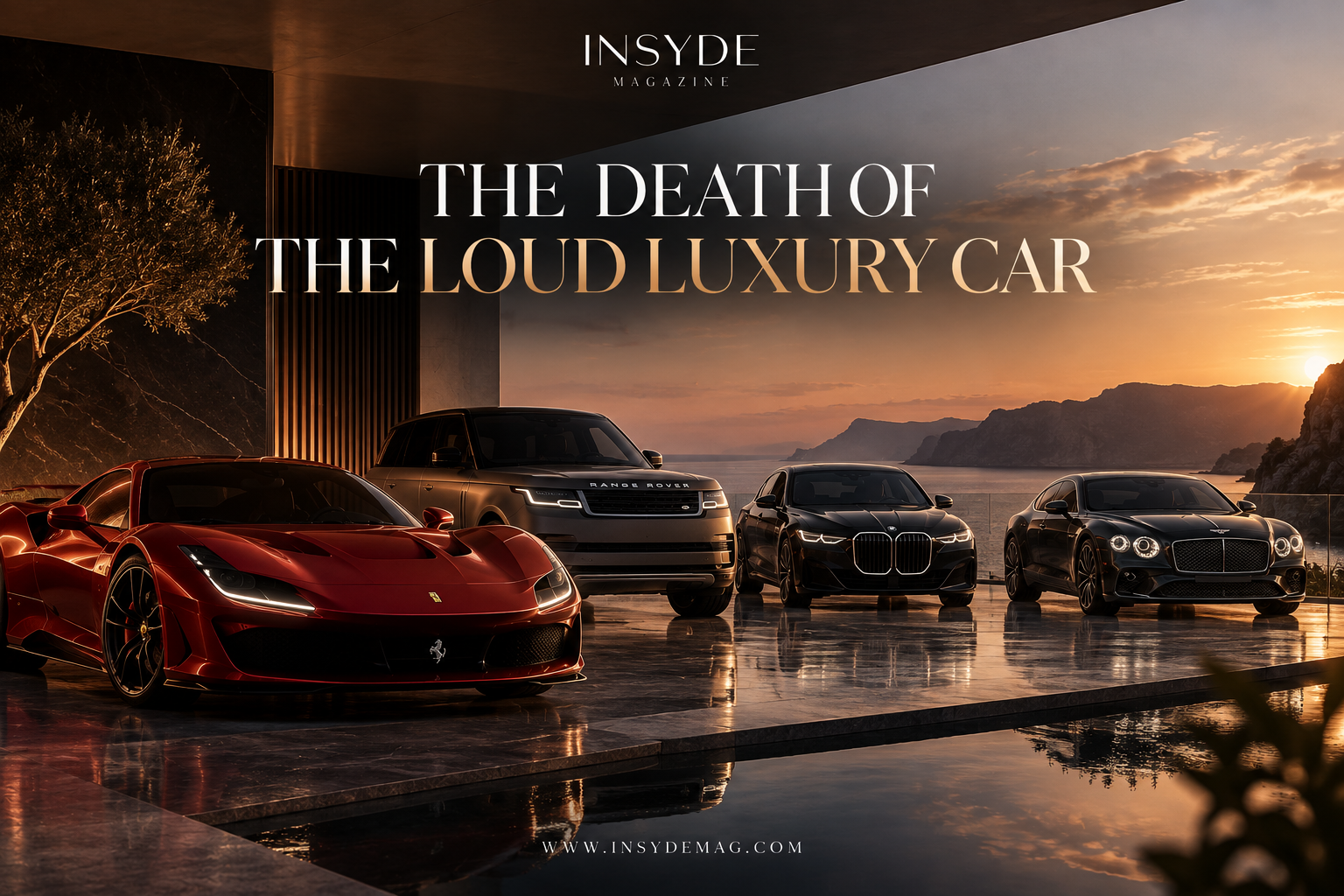
The world’s most desirable cars are entering a quieter, stranger and more personal era. But the roar isn’t disappearing. It is becoming a choice.
Luxury cars used to announce themselves.
You heard them before you saw them.
The engine. The exhaust. The tyres. The arrival.
For decades, automotive luxury was built around a very visible equation: more was more.
More cylinders. More horsepower. More leather. More chrome. More presence.
A luxury car was not simply a machine for moving through the world. It was a machine for making the world notice that you had arrived.
But 2026 has produced a strange contradiction.
Some of the world’s most desirable cars are becoming quieter.
Others are becoming impossibly faster.
Some are turning the cabin into a private sanctuary.
Others are recreating the emotional theatre of the combustion engine even after removing the engine itself.
The new Range Rover Electric calls itself the quietest Range Rover yet. Ferrari has created a 1,050-cv plug-in hybrid in the 849 Testarossa. BMW has brought a new 7 Series and i7 to India, with the electric flagship now locally produced in Chennai. Bentley is designing an entirely new sound for its electric Torcal using real musical instruments.
So what exactly is happening to the luxury car?
The answer is not that cars are becoming quieter.
Luxury is becoming more intentional about what it makes you feel.
WHEN MORE STOPPED BEING ENOUGH
For years, horsepower was one of the simplest ways to communicate automotive status.
600 horsepower was extraordinary.
Then 700 became extraordinary.
Then 800.
Then 1,000.
Now four-digit horsepower is entering the territory of production luxury cars.
Ferrari’s 849 Testarossa combines a twin-turbo V8 with three electric motors to produce a total 1,050 cv. Its V8 alone produces 830 cv, while the hybrid system contributes another 220 cv. Ferrari quotes a 0–100 km/h time of less than 2.3 seconds and a top speed above 330 km/h.
It is an extraordinary engineering achievement.
But it also raises an uncomfortable question.
How much performance can a person actually use?
You don’t need 1,050 horsepower to cross a city.
You don’t need 330 km/h to drive to dinner.
You don’t even need 500.
And that is where the luxury conversation begins to change.
When performance becomes almost absurdly abundant, the specification sheet stops being enough.
The question moves from:
What can the car do?
to:
What does the car make you feel?
That is a much more interesting question.
And considerably harder to engineer.
RANGE ROVER IS SELLING SILENCE
Few brands illustrate this transformation better than Range Rover.
The first fully electric Range Rover does not try to abandon the visual language that made the name a luxury icon.
It still looks unmistakably like a Range Rover.
But underneath that familiar silhouette is a very different interpretation of power.
Range Rover describes it as its “quietest Range Rover yet”, with near-silent propulsion, advanced drivetrain isolation, acoustic laminated glass and active noise cancellation designed to create individual quiet zones for occupants. The cabin also incorporates air purification, CO₂ management and an ambient fragrance diffuser.
The numbers are impressive too.
Up to 600 km of claimed range.
Up to 550PS and 850Nm from its electric powertrain.
And charging from 10 to 80 percent in approximately 22 minutes using a suitable 350kW DC charger.
But the most interesting specification may be the one that doesn’t appear on the performance sheet.
Silence.
Imagine sitting inside a Range Rover in Mumbai.
The horns are still outside.
The motorcycles are still outside.
The construction is still outside.
The city has not become quieter.
Your experience of it has.
That is a distinctly modern interpretation of luxury.
Not necessarily showing the world what you have.
Controlling how much of the world reaches you.
THE CAR IS BECOMING A PRIVATE WORLD
This may be the biggest transformation happening in luxury automobiles.
And it isn’t happening underneath the bonnet.
It is happening after the door closes.
For decades, automotive luxury was heavily exterior-facing.
The grille.
The wheels.
The badge.
The exhaust.
The engine.
The car was designed to be seen.
But increasingly, the most sophisticated luxury happens inside.
Materials become tactile.
Seats become architecture.
Lighting becomes atmosphere.
Sound becomes design.
Climate becomes personal.
Technology becomes invisible.
And silence becomes a feature.
The luxury car is slowly becoming less like a machine you sit inside and more like a private environment that happens to move.
That changes the meaning of performance.
A car can now be incredibly powerful without feeling aggressive.
It can be technologically complex without making the cabin feel complicated.
It can accelerate violently while making the passenger experience feel completely calm.
The real achievement is no longer simply making the machine work harder.
It is making the machine feel like it isn’t working at all.
That is what effortless luxury has always promised.
The automobile is simply discovering how to deliver it at a much higher level.
THEN FERRARI MADE THE FUTURE LOUD AGAIN
And just when the future starts looking peaceful, Ferrari arrives with a completely different answer.
The 849 Testarossa is almost a rebuttal to the idea that luxury performance must become subdued.
It is outrageous by design.
Its twin-turbo V8 produces 830 cv.
Three electric motors bring total output to 1,050 cv.
An electric motor sits at the rear, while two more sit on the front axle, creating an all-wheel-drive system with torque vectoring.
Ferrari has also introduced new electronic controls and an active aerodynamic package derived from its racing experience.
It is excessive.
And that is precisely why it matters.
Ferrari understands that some customers do not want serenity.
They want theatre.
They want acceleration.
They want mechanical drama.
They want the sensation of a machine doing something extraordinary underneath them.
But Ferrari’s response to electrification is not to reject it.
It is to use electrification to make the combustion engine more extreme.
That distinction is important.
The future of luxury is not simply:
electric versus petrol.
It is:
What can each technology make you feel?
THE STRANGE THING ABOUT ELECTRIC LUXURY
Electric power has created an interesting problem for luxury-car designers.
It can make a car incredibly fast.
But speed alone isn’t new anymore.
It can make a car incredibly quiet.
But silence alone isn’t enough either.
So brands are being forced to think about something they have always understood but rarely had to articulate:
emotion.
What should acceleration feel like?
What should silence feel like?
What should the cabin sound like?
How should the car communicate power when the engine no longer needs to announce itself?
What should replace the rituals we’ve associated with performance for generations?
These aren’t engineering questions alone.
They are questions about culture.
And that is why the most interesting developments in luxury cars right now aren’t necessarily happening in the horsepower tables.
They are happening in the spaces between technology and emotion.
BMW IS TURNING THE CABIN INTO THE DESTINATION
BMW’s new 7 Series and i7, launched in India on September 11, offer another version of the future.
And it is a particularly important one for India.
The new range arrives with petrol and all-electric powertrains, including the i7 M70 — described by BMW as the most powerful 7 Series ever.
The electric range now reaches up to 728 km WLTP, while the flagship i7 M70 brings BMW’s performance philosophy into the electric era. The cabin introduces BMW Panoramic Head-Up Display, BMW Operating System X, a passenger screen and an enhanced Theatre Screen, alongside Executive Lounge seating and increased ambient lighting.
But the bigger story is happening behind the scenes.
The i7 is now being locally produced at BMW Group Plant Chennai, making India the only country outside Germany where BMW produces this electric flagship.
That is not simply a manufacturing footnote.
It tells us something about where India sits in the luxury-car industry now.
India is not merely waiting for global luxury brands to arrive.
India is becoming part of the next chapter of their product strategy.
INDIA ISN’T WAITING FOR THE FUTURE
The timing is important.
During the first six months of 2026, India’s luxury passenger-vehicle market grew 4 percent year-on-year. BMW delivered 9,075 cars in the period, up 17 percent, while its EV sales reached 2,359 units — a 78 percent increase over the same period a year earlier.
But one number tells an even more interesting story.
Long-wheelbase BMW models accounted for 52 percent of its H1 sales.
SUVs accounted for 65 percent.
This is important because it tells us that India’s luxury consumer is not abandoning traditional ideas of luxury.
Quite the opposite.
They still want space.
They still want presence.
They still want the elevated driving position.
They still want to be driven.
They simply increasingly want those things wrapped in newer technology.
The same market is also seeing a rapid expansion in luxury electric vehicles.
Luxury EV sales in India reached 5,404 units in FY2026, a 61 percent year-on-year increase and more than five times the FY2023 level. BMW alone accounted for 3,537 of those vehicles.
The shift is no longer theoretical.
It is happening in showrooms.
It is happening on Indian roads.
And increasingly, it is happening at the very top of the market.
THE NEW LUXURY ISN’T SMALLER. IT’S SMARTER.
There is a lazy assumption that electrification will make luxury cars less extravagant.
The opposite may be happening.
Electric power gives designers different freedoms.
Instant torque.
Different packaging possibilities.
Near-silent propulsion.
Software-defined features.
New cabin architectures.
New approaches to sound.
New approaches to personalisation.
The luxury car doesn’t necessarily need to become smaller or more austere.
It can become more immersive.
BMW’s new 7 Series makes that obvious.
The car can be a performance machine.
A chauffeur-driven lounge.
A cinema.
A connected digital environment.
A quiet office.
A private space.
The point isn’t that one function replaces another.
The point is that the car is becoming capable of being whatever the occupant needs it to be.
That is a different form of luxury.
THEN BENTLEY ASKED: WHAT HAPPENS TO THE SOUND?
Perhaps no brand has framed the emotional problem of electrification more beautifully than Bentley.
Its upcoming electric Torcal has a soundtrack created using real instruments — including drums, viola and bass guitar.
Bentley’s designers studied the character of its V8 and discovered that the emotional quality wasn’t simply the sound of combustion.
It was rhythm.
So instead of attempting to reproduce an engine literally, the team worked with musicians to create a new sonic identity for the electric car. Bentley describes the result as something designed not to imitate an engine, but to evoke the same emotional response.
That is fascinating.
Because it reveals a truth about luxury that specifications can’t explain.
People don’t necessarily become attached to objects because of what they do.
They become attached to how those objects make them feel.
The sound of a V8 can become memory.
A steering wheel can become ritual.
The sensation of a particular engine can become identity.
A brand can spend decades creating an emotional language — and electrification suddenly forces it to translate that language into another medium.
Bentley isn’t trying to preserve the past exactly.
It is trying to translate it.
That may be the most important creative challenge facing luxury automotive design.
THE V12 MAY BECOME THE MECHANICAL WATCH OF THE AUTOMOBILE
There is another possibility.
Perhaps combustion engines won’t disappear from luxury.
Perhaps they will become rarer — and therefore more meaningful.
Think about mechanical watches.
Quartz made accurate time cheap, precise and almost invisible.
It didn’t kill mechanical watchmaking.
It changed its purpose.
Once technology made accuracy effortless, mechanical watches became increasingly about craftsmanship, complexity, heritage and human intervention.
Something similar could happen to the combustion engine.
Electric power can make speed effortless.
It can make torque immediate.
It can make silence possible.
And that could leave the combustion engine with something different to offer:
character.
The mechanical theatre.
The imperfections.
The vibration.
The sound.
The ritual.
The knowledge that hundreds of moving parts are physically working together to create something that no longer needs to exist in quite the same way.
In that world, a V12 isn’t merely an engine.
It becomes heritage in motion.
THE DEATH OF THE LOUD LUXURY CAR
So is the loud luxury car actually dying?
Not quite.
Ferrari is still making extraordinary noise.
Performance cars are still chasing impossible numbers.
Brands still understand the power of visual presence.
The V8 is not suddenly irrelevant.
The V12 hasn’t become culturally meaningless.
And there will always be customers who want their arrival heard from half a street away.
That isn’t the point.
The real change is subtler.
Loudness is losing its monopoly on luxury.
For decades, the expensive car had to prove itself.
The engine announced it.
The exhaust announced it.
The grille announced it.
The badge announced it.
Now some of the most sophisticated forms of automotive luxury are almost invisible.
The quality of the silence.
The precision of the ride.
The temperature of the cabin.
The feel of the leather.
The privacy of the rear seat.
The absence of vibration.
The intelligence of the software.
The way the car anticipates what you want before you ask.
These aren’t always things you can photograph.
They aren’t always things you can post.
But they may be much closer to what luxury has always promised:
control over your experience.
THE NEW STATUS SYMBOL IS CONTROL
This may be where the luxury car is heading.
Not simply more.
More control.
Control over speed.
Control over sound.
Control over privacy.
Control over comfort.
Control over technology.
Control over personalisation.
Control over how much of the outside world reaches you.
The traditional luxury car said:
Look at me.
The new luxury car can say:
Leave me alone.
That difference is enormous.
Because as luxury becomes more accessible visually — as almost every new car can have enormous screens, ambient lighting, premium materials and impressive performance — true differentiation becomes harder to see.
So the next luxury frontier becomes less about what is visible from the street.
It becomes about what happens when you close the door.
THE FUTURE ISN’T QUIET. IT’S PERSONAL.
That is why 2026 is such an interesting moment.
The industry isn’t moving in one direction.
It is splitting into different interpretations of desire.
Range Rover is exploring serenity.
Ferrari is pushing performance into almost absurd territory.
BMW is turning electric technology into flagship luxury.
Bentley is translating mechanical emotion into a new electric language.
And India is becoming one of the markets where these competing ideas of luxury are increasingly visible at the same time.
None of these approaches cancels the others.
They coexist.
And perhaps that is the real evolution.
The future of luxury isn’t about choosing between loud and quiet.
Petrol and electric.
Old and new.
Technology and emotion.
It is about giving the customer the ability to choose exactly how luxury should feel.
INSYDE TAKE
For decades, the luxury automobile taught us to measure desire.
Horsepower.
Top speed.
Acceleration.
Engine size.
Cylinder count.
But the next era of automotive luxury may be much harder to quantify.
Silence.
Space.
Privacy.
Craftsmanship.
Emotion.
Effortlessness.
The most desirable car of the future may not be the one that makes the most noise.
It may be the one that understands exactly when you want to hear nothing at all.
And perhaps that is the real death of the loud luxury car.
Not that the roar disappears.
Not that the engine becomes irrelevant.
Not that performance stops mattering.
But that, finally,
the roar becomes optional.
INSYDE
Luxury, Through a Different Lens.
Beyond the Spotlight.