Category: Entertainment

The people, stories and cultural forces shaping Indian entertainment, from cinema and music to celebrity culture, events and nightlife.

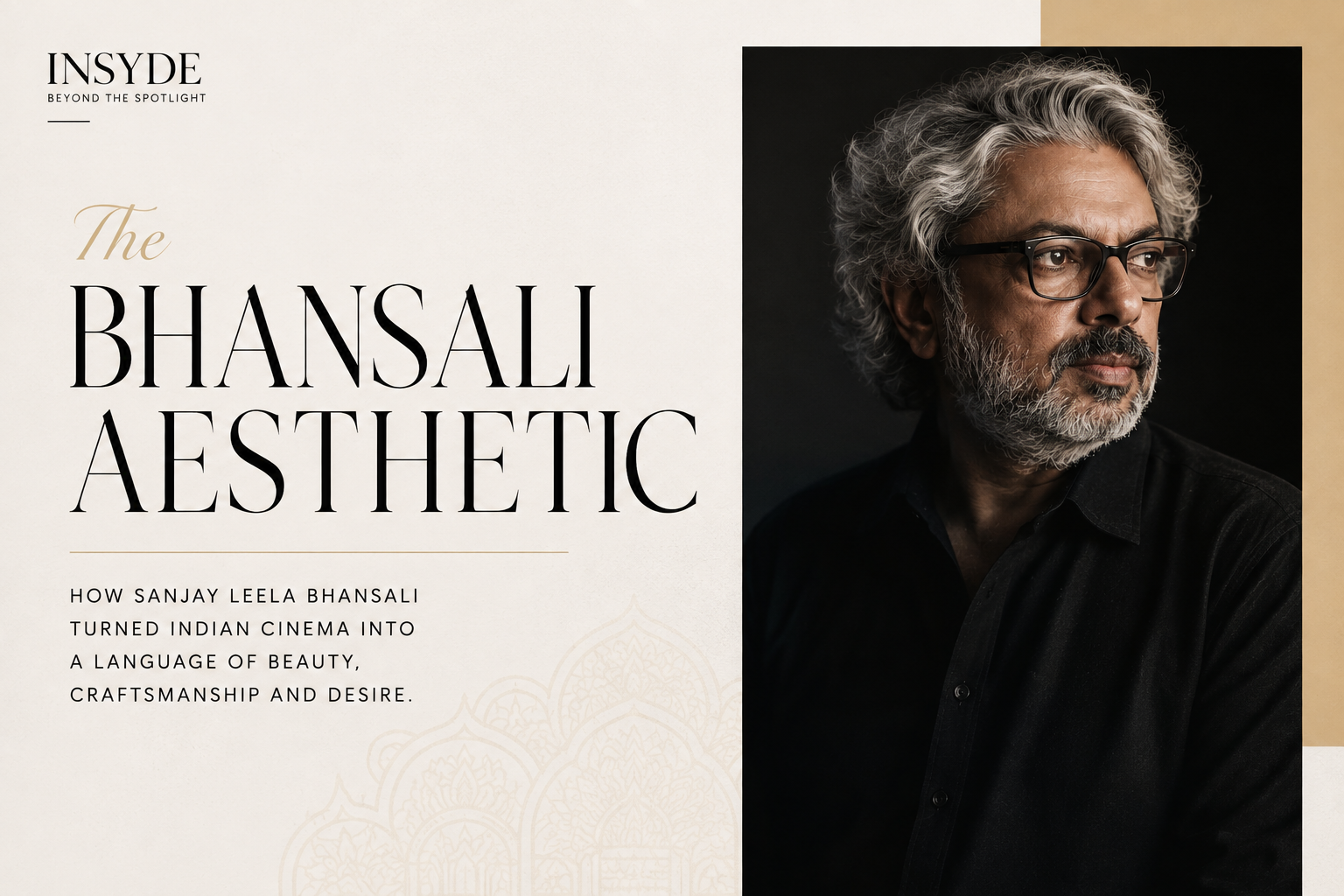
  • The Bhansali Aesthetic

    The Bhansali Aesthetic

    How Sanjay Leela Bhansali turned Indian cinema into a language of beauty, craftsmanship and desire.

    Some filmmakers tell stories.

    Sanjay Leela Bhansali builds worlds.

    Before a character speaks, there may already be a chandelier glowing above her, silk moving through the frame, jewellery catching the light, music rising somewhere beyond the room.

    In his cinema, beauty is rarely background.

    Beauty is part of the narrative.

    That is what makes Bhansali particularly interesting to INSYDE.

    His work sits at an intersection of cinema, fashion, architecture, music, craftsmanship and desire — a place where visual richness becomes storytelling and detail becomes identity.

    Over more than three decades, he has developed an aesthetic so recognisable that a frame can sometimes feel like a Bhansali frame before the audience consciously understands why.

    And perhaps that is the real achievement.

    He didn’t simply create films with a distinctive look. He created a visual language.

    When Cinema Becomes a World

    There is a difference between designing a beautiful frame and constructing an entire universe.

    Bhansali has consistently pursued the latter.

    His films are populated by elaborate interiors, dramatic architecture, intricate costumes, jewellery, carefully choreographed movement and compositions in which even the smallest visual element can feel deliberate.

    Those details do not exist independently.

    They speak to one another.

    Architecture establishes scale.

    Costume establishes character.

    Lighting establishes mood.

    Music establishes emotion.

    Movement establishes rhythm.

    Together, they create something closer to an immersive environment than a conventional film set.

    That precision has become part of the Bhansali method. On Heeramandi, Architectural Digest India documented his insistence on repeatedly adjusting elements of the set — from furniture and wall textures to seemingly minor decorative details — and quoted Bhansali explaining that architecture plays an important role in how he constructs a frame. (Architectural Digest)

    The point is not simply to make a set look expensive.

    The environment has to belong to the story.

    The Luxury of Detail

    Luxury has always depended on detail.

    The difference between something expensive and something exceptional is often invisible from a distance.

    A stitch.

    A setting.

    A finish.

    A proportion.

    A material chosen because of how it responds to light.

    Bhansali approaches cinema with a similar sensitivity.

    A costume isn’t simply clothing.

    A room isn’t simply a set.

    A chandelier isn’t simply decoration.

    A colour isn’t simply a colour.

    Everything contributes to the emotional architecture of the scene.

    The result is a cinema that can feel almost tactile.

    You sense the weight of the fabric.

    The warmth of the light.

    The scale of the room.

    The movement of jewellery.

    The silence before the music begins.

    The effect is extravagant, but the underlying principle is surprisingly disciplined:

    nothing is there without intention.

    Where the Obsession With Beauty Began

    The grandeur of Bhansali’s cinema has a deeply personal origin.

    He has spoken about growing up in a chawl in Mumbai and about the lack of space and visual beauty around him during his childhood. His mother, a dancer, performed in a small space, while Bhansali imagined larger, more ordered environments. He has connected those experiences directly to the expansive sets, central framing and visual symmetry that later became signatures of his filmmaking. (Indian Express)

    It is an important detail because it changes the way his aesthetic can be understood.

    The grandeur is not simply extravagance for its own sake.

    It is a response to limitation.

    Small spaces became expansive ones.

    Plain walls became elaborate environments.

    Disorder became symmetry.

    Limited movement became choreography.

    The absence of beauty became an obsession with creating it.

    And perhaps that is why his sets rarely feel merely expensive.

    They feel imagined.

    The Architecture of Desire

    Bhansali understands something that luxury brands have understood for generations:

    objects become more powerful when placed inside a world.

    A necklace is one thing.

    A necklace worn with a particular fabric, under a particular light, inside a particular room, accompanied by music and movement, becomes something else.

    The object acquires context.

    That is one of the reasons his cinema has such a strong relationship with fashion and jewellery.

    The visual elements do not sit around the characters.

    They help construct them.

    Jewellery as Storytelling

    There may be no better example than jewellery.

    In Bhansali’s worlds, jewellery rarely feels incidental.

    It can establish hierarchy.

    It can indicate wealth.

    It can communicate tradition.

    It can transform the silhouette of a character.

    And, importantly, it interacts with light.

    A necklace catching the light during a close-up is doing more than displaying craftsmanship.

    It is participating in the image.

    This is where Bhansali’s cinema naturally intersects with the language of luxury.

    The finest luxury objects are designed to reward attention.

    So are his frames.

    The closer you look, the more there is to discover.

    Fashion Without the Fashion Show

    Bhansali’s relationship with fashion is more sophisticated than simply dressing actors beautifully.

    His costumes establish an entire visual vocabulary.

    Silhouette, fabric, colour, ornamentation and movement work together.

    The clothes have to survive choreography.

    They have to respond to lighting.

    They have to communicate period and cultural context.

    And they have to remain emotionally connected to the character.

    That requires something closer to design than conventional styling.

    The result is fashion that belongs to the world of the film rather than being placed on top of it.

    The costume doesn’t interrupt the story. It becomes part of the story.

    The Women at the Centre

    Bhansali’s cinema has repeatedly placed women at the centre of its visual and emotional worlds.

    From Devdas and Black to Ram-Leela, Bajirao Mastani, Padmaavat, Gangubai Kathiawadi and Heeramandi, his women are rarely treated as background figures.

    Their clothes, jewellery, movement and environments often become extensions of their emotional and social position.

    The scale of the world around them can communicate power.

    A crowded room can become a stage.

    A palace can become a prison.

    A costume can become armour.

    A jewel can become status.

    A dance can become defiance.

    That visual treatment has become one of the recognisable elements of his cinema. Actors from Heeramandi have also described his approach to presenting women as central to his filmmaking language. (Indian Express)

    The important point is not simply that Bhansali makes beautiful images of women.

    It is that he uses beauty as part of the language through which their stories are told.

    Music Is Architecture

    There is another defining element of the Bhansali aesthetic: music.

    For Bhansali, music has long been central to the construction of his films rather than something added after the visual world is complete.

    A song can become a room.

    A room can become choreography.

    Choreography can become emotion.

    Emotion becomes narrative.

    This is why some of his most memorable sequences can communicate enormous amounts without conventional dialogue.

    The music carries the architecture of the scene.

    The performers move through it.

    The camera becomes part of the choreography.

    The result is closer to a fully composed theatrical experience than a conventional musical interlude.

    The Discipline Beneath the Spectacle

    The word “grand” is often used to describe Bhansali.

    It is accurate, but incomplete.

    What is more interesting is the discipline underneath it.

    He has spoken about his fascination with central framing and the desire to create order from the disorder he experienced growing up. (Indian Express)

    Architectural Digest India has similarly documented his attention to the smallest details of his sets, including furniture placement, textures, colours and architectural elements. (Architectural Digest)

    That reveals the secret beneath the spectacle.

    The image may be extravagant.

    The composition is controlled.

    That is why his frames can feel so immediately recognisable.

    Grandeur With a Purpose

    Bhansali’s films are often described using words such as lavish, opulent and larger-than-life.

    But spectacle alone would not explain their longevity.

    The real fascination lies in what the grandeur communicates.

    A palace can represent power.

    A crowded courtyard can represent society.

    A vast stage can make an individual appear small.

    An empty room can make an emotion feel enormous.

    A chandelier can suggest wealth, desire or decay.

    A costume can tell you where a character belongs before the dialogue does.

    The visual scale is therefore not simply decoration.

    It is emotional scale.

    India Through a More Cinematic Lens

    There is also something distinctly Indian about Bhansali’s understanding of grandeur.

    India has never treated beauty as purely architectural.

    It exists in textiles.

    Jewellery.

    Music.

    Dance.

    Wedding traditions.

    Craftsmanship.

    Palaces.

    Festivals.

    Theatre.

    Ceremony.

    Bhansali understands that instinctively.

    His cinema draws from a cultural memory in which colour, ornamentation, music and movement can coexist without apology.

    The result is not simply an expensive-looking version of Indian cinema.

    It is an attempt to transform elements of Indian visual culture into a cinematic language of their own.

    And that distinction matters.

    He doesn’t simply decorate Indian stories. He builds worlds around them.

    From Cinema to a Wider Cultural Language

    With Heeramandi: The Diamond Bazaar, Bhansali extended this visual vocabulary into streaming.

    The series brought together his familiar concerns — music, performance, elaborate environments, costumes, historical atmosphere and female characters — for a global streaming audience. Netflix describes the series as a story of love, power, betrayal and freedom centred on the courtesans of pre-independence Lahore. (Indian Express)

    The significance goes beyond the move from cinema to television.

    It demonstrated that the Bhansali aesthetic could exist as a broader cultural world.

    The sets became part of the conversation.

    The costumes became part of the conversation.

    The jewellery became part of the conversation.

    The music became part of the conversation.

    The visual identity became almost as recognisable as the title itself.

    That is a powerful position for any filmmaker to reach.

    The Influence of the Past

    Bhansali’s visual references are not limited to cinema.

    Architectural Digest India has documented how his reference library has drawn from places and objects he encountered growing up, as well as artists, photographers and musicians including S. H. Raza, V. S. Gaitonde, Raghu Rai and Kishori Amonkar. (Architectural Digest)

    That is revealing.

    His aesthetic isn’t built from one source.

    It is accumulated.

    Painting.

    Photography.

    Music.

    Architecture.

    Theatre.

    Textiles.

    Indian history.

    Street life.

    Memory.

    The resulting world may look fantastical, but its ingredients are deeply rooted in observation.

    When Excess Becomes Restraint

    There is an irony in Bhansali’s work.

    The images can be enormous.

    The sets can be enormous.

    The costumes can be elaborate.

    The music can be overwhelming.

    Yet the composition is often highly controlled.

    Symmetry.

    Central framing.

    Colour relationships.

    Movement.

    Light.

    Negative space.

    Everything is competing for attention, yet everything is carefully placed.

    That tension is part of what makes the aesthetic work.

    The spectacle is large. The intention is precise.

    A Filmmaker With a Signature

    The ultimate achievement for an auteur is recognisability.

    Not fame.

    Not scale.

    Not even box-office success.

    A signature.

    Something that makes an audience recognise the creator before seeing the name.

    Bhansali has achieved that.

    The grand interiors.

    The controlled colour.

    The elaborate costumes.

    The music.

    The choreography.

    The central compositions.

    The emotional intensity.

    The women framed against enormous spaces.

    The sense that every object has been placed with intention.

    Together, they form a vocabulary.

    And once a filmmaker develops a vocabulary of that strength, individual films become chapters inside a much larger artistic language.

    What Comes Next

    Bhansali’s next chapter is already taking shape.

    His much-anticipated Love & War, starring Ranbir Kapoor, Alia Bhatt and Vicky Kaushal, is nearing completion, with reports now pointing toward his next major project, a Madhubala biopic. (The Times of India)

    For a filmmaker whose aesthetic is already so established, the interesting question is not whether the next project will be visually ambitious.

    We know the answer.

    The more compelling question is:

    What will he do with that language next?

    Can grandeur evolve without becoming repetition?

    Can spectacle remain emotionally intimate?

    Can a recognisable aesthetic continue to surprise?

    Those are the questions that matter when an artist has spent decades refining a signature.

    The Bhansali Aesthetic

    Perhaps the easiest way to misunderstand Sanjay Leela Bhansali is to think his cinema is simply about luxury.

    It isn’t.

    Luxury is the surface.

    The deeper obsession is craft.

    The craft of composition.

    The craft of music.

    The craft of costume.

    The craft of movement.

    The craft of light.

    The craft of architecture.

    The craft of creating an environment that feels larger than reality.

    That is why his images remain so persistent.

    Long after a film’s plot has been discussed, individual frames remain.

    A room.

    A colour.

    A piece of jewellery.

    A costume.

    A song.

    A gesture beneath a chandelier.

    A character standing alone in an enormous space.

    These are not simply beautiful moments.

    They are fragments of a language.

    And perhaps that is Bhansali’s most enduring contribution to Indian cinema.

    He has shown that grandeur, when treated with enough discipline and imagination, can become more than spectacle.

    It can become storytelling.

    In a culture increasingly consumed through fleeting images, there is something almost radical about a filmmaker who still believes a frame deserves to be constructed, considered and remembered.

    That may be the real Bhansali aesthetic.

    Not simply the luxury of seeing more — but the discipline of making every detail matter.

    INSYDE — Beyond the Spotlight.

  • SADIE SINK FITS THE MOMENT

    SADIE SINK FITS THE MOMENT

    Inside Calvin Klein’s latest campaign—and why the brand’s newest fashion move is less about jeans than the generation wearing them.

    There is a particular kind of fashion moment that doesn’t announce itself as a revolution.

    No dramatic runway. No impossible silhouette. No attempt to reinvent the entire wardrobe.

    Sometimes, it is simply a pair of jeans.

    And the person wearing them.

    For Calvin Klein, that has always been enough.

    On September 1, Calvin Klein unveiled the second chapter of its Fall 2026 “Feel the Fit” campaign, this time with Sadie Sink at its centre. Directed and photographed by Aidan Zamiri, the campaign follows Sink through a series of everyday moments where changing into Calvin Klein denim changes the energy around her.

    At first glance, it is exactly what you would expect from Calvin Klein: denim, minimal styling, confidence and an unmistakable sense of attitude.

    Look closer, though, and there is something more interesting happening.

    Calvin Klein isn’t simply dressing Sadie Sink.

    It is using her to speak to a generation that already knows how to dress itself.

    THE FIT ISN’T REALLY THE POINT

    The premise behind “Feel the Fit” is almost deceptively simple.

    The right pair of jeans can change how you feel.

    Sink has described denim as a constant in her wardrobe and the right pair of jeans as something that can change the way you carry yourself.

    That sounds like advertising language.

    But it also explains why the campaign works.

    Fashion has spent decades promising transformation: wear this and become someone else.

    Calvin Klein’s proposition is quieter.

    You don’t need to become someone else.

    You just need to find the version of yourself that feels right.

    That distinction feels particularly relevant now, when personal style has become less about following one definitive trend and more about knowing what belongs to you.

    WHY SADIE?

    Sink arrives at Calvin Klein at an interesting point in her career.

    For audiences who discovered her through Stranger Things, she is already a familiar face. But her identity is no longer tied to one role or one screen.

    Her career has continued to move across theatre, film and increasingly fashion.

    That makes her particularly useful to a brand like Calvin Klein.

    She doesn’t arrive with the polished distance of a traditional fashion model. She arrives with an existing cultural identity.

    And Calvin Klein has historically understood the power of that.

    The brand’s identity has long been built around minimalism, individuality and the ability to turn familiar clothing into something culturally significant.

    Sink doesn’t have to disappear into the Calvin Klein aesthetic.

    The campaign works because she can bring her own energy into it.

    THE CALVIN KLEIN FORMULA

    There is a reason Calvin Klein can put so much attention on something as familiar as denim.

    The brand has spent decades making the ordinary feel culturally significant.

    A white T-shirt.

    Underwear.

    A pair of jeans.

    Nothing about these pieces is particularly complicated.

    The image surrounding them is.

    Calvin Klein’s strength has always been its ability to make simplicity feel desirable. Rather than overwhelming its clothes with unnecessary detail, the brand has repeatedly allowed attitude, image and personality to do the work.

    That philosophy remains visible in “Feel the Fit.”

    For Fall 2026, the campaign focuses on three key denim silhouettes: the returning ’90s Straight Jean, the relaxed Low Rise Baggy Jean and the High Rise Loose Jean.

    The clothes are recognisable.

    The attitude is what changes.

    THE RETURN OF THE EVERYDAY ICON

    There is something almost contradictory about the current denim conversation.

    Fashion is obsessed with novelty, yet some of its strongest moments come from clothes people already know.

    The ’90s are back.

    Low-rise silhouettes are back.

    Relaxed denim is back.

    But this isn’t simply a replay of an old decade.

    The current generation has taken those references and stripped them of their original context.

    A ’90s jean doesn’t necessarily mean dressing like the ’90s anymore.

    It means borrowing the proportions, the attitude and the freedom of the silhouette—and making them your own.

    Calvin Klein understands that distinction.

    Its Fall 2026 denim collection uses nostalgic shapes while presenting them through a distinctly contemporary campaign.

    And Sink becomes the bridge between the two.

    WHEN A CELEBRITY BECOMES A CULTURAL MIRROR

    This is where the campaign becomes more interesting than another celebrity fashion collaboration.

    The most valuable fashion faces today aren’t necessarily the ones who look the most like models.

    They’re the ones whose audiences already care about how they live, dress, move and present themselves.

    That changes the relationship between celebrity and fashion.

    A campaign no longer simply says:

    “This person wears our clothes.”

    It says:

    “This is the world our clothes belong in.”

    Sink brings an audience that exists at the intersection of entertainment, youth culture and fashion.

    Calvin Klein brings a visual language that has already survived multiple generations.

    Put the two together, and the campaign isn’t really selling a new identity.

    It is giving an existing one a new uniform.

    THE NEW COOL DOESN’T TRY SO HARD

    Perhaps that’s what makes the campaign feel so contemporary.

    There is no obvious attempt to make Sink look unreachable.

    The campaign moves through everyday settings and moments of spontaneous energy. The clothes remain central without overwhelming the person wearing them.

    That ease is important.

    Because contemporary cool has become suspicious of effort.

    The perfectly constructed outfit can feel less interesting than something that looks instinctive.

    The most desirable wardrobe isn’t necessarily the one filled with the most expensive pieces.

    It is the one where everything looks like it belongs.

    Calvin Klein has been speaking that language for decades.

    Sadie Sink happens to speak it fluently.

    SADIE SINK FITS THE MOMENT

    Perhaps the smartest thing about this campaign is that it doesn’t ask us to believe Sadie Sink has suddenly become a fashion icon.

    It doesn’t need to.

    She’s already becoming one.

    Calvin Klein simply gives that evolution a frame.

    And perhaps that’s where the real “Feel the Fit” idea exists—not in the jeans themselves, but in the feeling of finding something that makes sense.

    A performer finding her next chapter.

    A generation rediscovering denim.

    A fashion house returning to one of its most recognisable languages.

    None of it feels particularly forced.

    And maybe that’s the point.

    The best fashion moments don’t always announce that they’re happening.

    Sometimes, they just fit.

    INSYDE — Beyond the Spotlight

  • Sadie Sink: The Next Chapter

    Sadie Sink: The Next Chapter

    From Stranger Things to the MCU, the actress is entering a new era of stardom — one that could define the next chapter of her career.

    Some careers are defined by a single role.

    Others begin to change the moment that role ends.

    For Sadie Sink, that transition has arrived at an unusually significant moment.

    For years, audiences knew her as Max Mayfield in Stranger Things — a character who became one of the defining young faces of Netflix’s global phenomenon. Now, with Spider-Man: Brand New Day, Sink has stepped into a very different cultural landscape.

    She is Jean Grey.

    But the significance of the role isn’t simply that she has joined Marvel.

    It is what comes with it.

    Jean Grey is one of the most recognisable figures in X-Men mythology, and Sink’s introduction arrives as Marvel begins building a new generation of mutants. The upcoming X-Men film is currently scheduled for 2028, with Sink returning as Jean Grey.

    That makes Brand New Day less interesting as a destination than as a beginning.

    For Sadie Sink, this is the next chapter.

    Leaving Max Behind

    There is a particular difficulty in becoming famous through a character audiences genuinely love.

    Eventually, the actor has to leave that character behind.

    Sink joined Stranger Things in its second season as Max Mayfield and quickly became one of the show’s most recognisable performers.

    Max was complicated, independent and emotionally guarded — qualities Sink played with a restraint that made the character feel considerably more human than a conventional teenage television role.

    The performance became part of the cultural identity of a generation of viewers.

    But there is a point when familiarity becomes a limitation.

    An actor can spend years being associated with the same face, the same costume and the same character.

    The next challenge is proving that the audience can believe in someone else.

    For Sink, Jean Grey is an unusually ambitious answer.

    Enter Jean Grey

    Spider-Man: Brand New Day introduces Sink’s Jean Grey through a story that is considerably more intimate than the scale of her abilities might suggest.

    She is powerful, but she is also isolated, angry and shaped by trauma.

    Her abilities are not presented simply as an advantage. They are part of the burden she carries.

    Sink has discussed approaching Jean through that emotional complexity, rather than treating her powers as the entire performance. She has also spoken about the challenge of communicating telepathy and psychic abilities visually without relying entirely on spectacle.

    That distinction matters.

    The most interesting superhero performances are rarely about the abilities themselves.

    They are about the person underneath them.

    A Different Kind of Marvel Introduction

    Marvel could have introduced Jean Grey through spectacle.

    Instead, Brand New Day gives her a more personal entry point.

    Her powers are extraordinary, but the emotional centre of the character is loneliness.

    That creates an intriguing contrast with Peter Parker.

    Both characters exist in a world where their abilities separate them from ordinary life.

    Both carry grief.

    Both have been shaped by loss.

    And both are forced to confront what extraordinary power means when placed against ordinary human vulnerability.

    Director Destin Daniel Cretton has discussed Jean’s role in the film’s themes of isolation and escapism, helping explain why she belongs in Peter Parker’s story rather than simply being inserted as a preview of the X-Men.

    That makes Sink’s casting feel less like franchise mathematics and more like a creative decision.

    The Performance Beneath the Powers

    Playing a character with telepathic and telekinetic abilities presents an unusual challenge.

    Much of what Jean does cannot be physically seen.

    There is no conventional object to hold.

    No obvious physical movement to communicate every thought.

    The audience has to believe that something is happening inside her mind.

    Sink has spoken about the challenge of visually communicating Jean’s abilities and about approaching the character through her internal struggle rather than treating her powers as pure spectacle.

    That restraint becomes important.

    The performance cannot depend entirely on effects.

    It depends on expression.

    Stillness.

    Control.

    The moments between words.

    And this is where Sink’s previous work becomes relevant.

    She has spent much of her career playing characters whose strongest emotions are often communicated without excessive explanation.

    Jean simply gives that ability a much larger canvas.

    The Luxury of Reinvention

    There is an interesting parallel between acting and luxury.

    At the highest level, luxury is rarely about having more.

    It is about having the freedom to choose differently.

    The same can be true of a career.

    Once an actor becomes strongly identified with one successful role, repeating it can be the safest option.

    Reinvention is riskier.

    Sink’s move from Stranger Things into the MCU therefore represents more than another major franchise credit.

    It is a decision to enter a new visual and cultural language.

    From Hawkins to New York.

    From Netflix’s ensemble drama to Marvel’s cinematic universe.

    From a character defined by adolescence to one whose mythology could extend for years.

    That transition requires a different kind of confidence.

    The New Marvel Generation

    Sink’s timing may be as important as the role itself.

    Marvel is entering another transition.

    The upcoming X-Men film is currently scheduled for May 2028, with Sink’s Jean Grey positioned within a new generation of mutant characters.

    This means Sink isn’t simply joining an established franchise.

    She is becoming part of the generation expected to shape what comes next.

    That distinction matters.

    Playing a legacy character inside an established universe is one thing.

    Helping establish the identity of a new era is another.

    The pressure is greater.

    So is the opportunity.

    Why Jean Grey Matters

    Jean Grey is not simply another superhero.

    She occupies a particularly important place in X-Men mythology because her story has long been connected to questions of identity, power, fear and control.

    Her abilities are extraordinary.

    Her emotional life is complicated.

    And her relationship with those abilities has historically been central to her character.

    That gives Sink considerable dramatic territory to explore.

    Rather than arriving as a fully formed icon, this version of Jean has been introduced as a young woman still trying to understand what her abilities mean and where she belongs. Sink has described the character as emotionally complicated and has expressed excitement about continuing to develop her in the MCU’s future X-Men story.

    That may ultimately be the smarter way to approach a character with such a long history.

    Let the audience meet the person before asking them to embrace the mythology.

    The End of One Era

    There is something symbolic about Sink’s transition happening alongside the conclusion of Stranger Things.

    For a generation of audiences, Max Mayfield will always be part of the cultural memory of the series.

    But an actor cannot remain frozen inside the role that made them famous.

    The most interesting careers are often defined by what happens afterward.

    The moment when an actor stops being associated with one character and begins building an identity beyond it is rarely immediate.

    It happens gradually.

    One role at a time.

    One decision at a time.

    That is the stage Sink is entering now.

    The question is no longer:

    Can she play Max?

    We already know the answer.

    The question is:

    Who is Sadie Sink when Max is no longer the centre of the conversation?

    Beyond the Franchise

    There is another reason this moment matters.

    Sink’s career is beginning to extend beyond a single franchise ecosystem.

    Her work is expanding into projects outside Marvel, including The Marriage Plot, an FX/A24 series in development.

    That suggests a broader trajectory.

    The goal isn’t simply to become another recognisable franchise face.

    It is to develop a career with enough range to exist outside any one studio, character or genre.

    That distinction is increasingly important as Hollywood’s most recognisable young actors navigate an entertainment landscape dominated by intellectual property.

    Franchises can create global visibility.

    Range creates longevity.

    The Importance of Restraint

    There is something distinctive about Sink’s rise because it has not depended entirely on the loudest version of celebrity.

    Her appeal has largely come through performance.

    The characters.

    The work.

    The moments on screen.

    That becomes particularly valuable in an era when celebrity can be manufactured through constant visibility.

    Audiences see actors everywhere — interviews, campaigns, social platforms, premieres and brand collaborations.

    But visibility is not the same as mystique.

    Sometimes the most compelling performers are the ones who allow the work to remain larger than the personality.

    Sink has the opportunity to build precisely that kind of career.

    The Next Face of a New Era?

    It would be premature to describe Sadie Sink as the definitive face of Marvel’s next generation.

    That story is still being written.

    But the ingredients are there.

    A recognisable global audience from Stranger Things.

    A major new role in the MCU.

    A character with decades of cultural history.

    A place inside the developing X-Men universe.

    And, perhaps most importantly, enough career ahead of her to define what comes next.

    The interesting part is that she doesn’t need to become the next version of anyone.

    Not the next Marvel superstar.

    Not the next franchise actress.

    Not another performer permanently defined by the role that made her famous.

    Her opportunity is more interesting than that.

    To become Sadie Sink on her own terms.

    The Next Chapter

    The arrival of Jean Grey could easily have been treated as another Marvel casting story.

    But viewed from a distance, it represents something more significant.

    A young actor is moving from one defining cultural phenomenon into another.

    One character is becoming part of her history.

    Another is beginning to shape her future.

    And somewhere between those two identities lies the most interesting part of her career.

    Not the moment she became famous.

    Not even the moment she joined Marvel.

    But the period in which she decides what to do with both.

    Because the most valuable thing an actor can carry from one era into another isn’t a franchise.

    It is credibility.

    And Sadie Sink has reached the point where the question is no longer whether audiences know her.

    They do.

    The question is what they will remember her for next.

    Jean Grey may be the next chapter.

    It doesn’t have to be the final definition.

    INSYDE — Beyond the Spotlight.

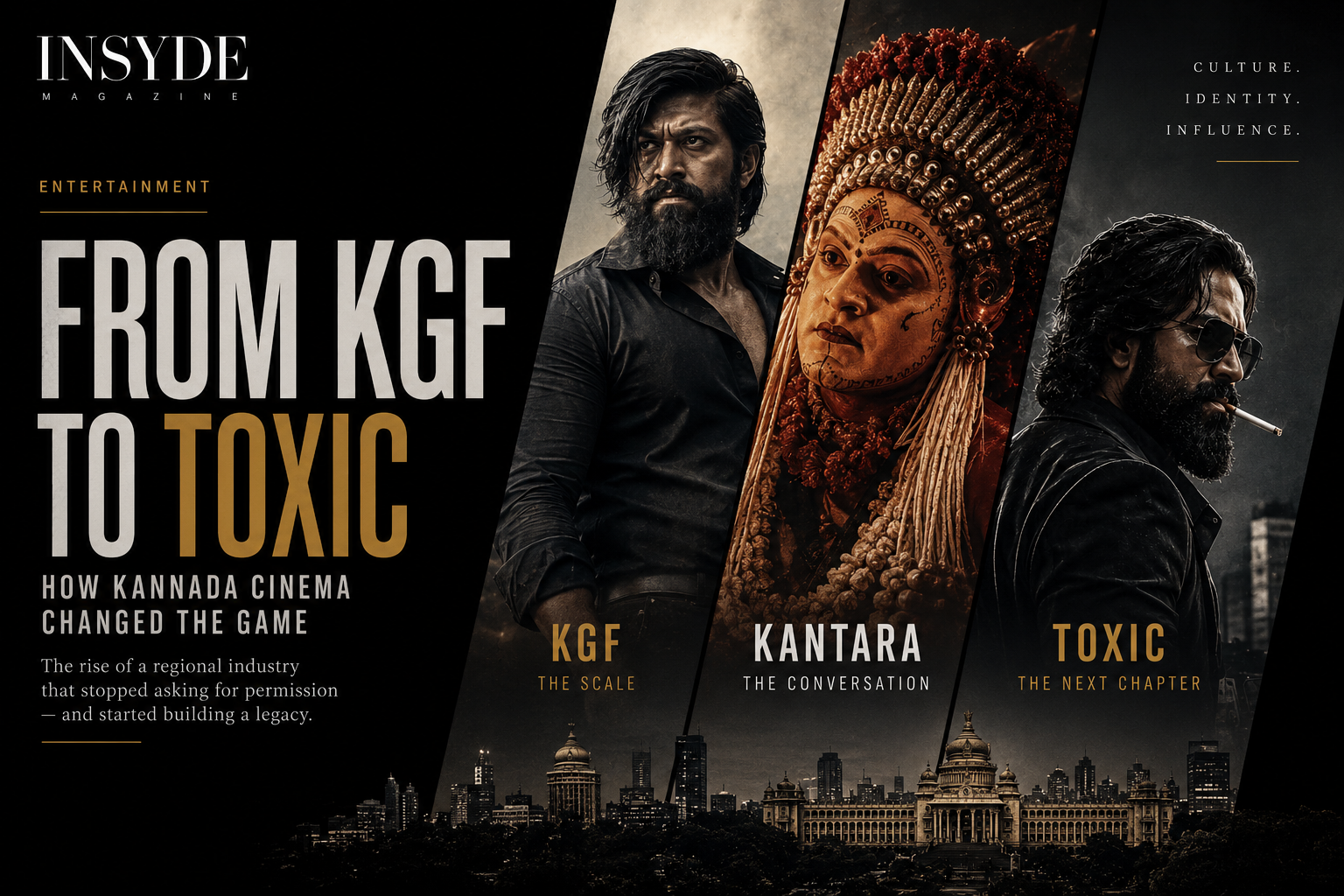
  • FROM KGF TO TOXIC

    FROM KGF TO TOXIC

    HOW KANNADA CINEMA CHANGED THE GAME

    The story of how Karnataka’s film industry stopped asking for a national audience — and started building one.

    For years, Indian cinema had an unspoken hierarchy.

    There was Bollywood.

    There were the major South Indian industries.

    And then there was Kannada cinema — an industry with its own stars, filmmakers, audiences and extraordinary creative history, but one that rarely received the same national attention.

    Then something changed.

    Not overnight.

    Not because one film suddenly transformed an entire industry.

    But because a generation of Kannada filmmakers began asking a different question:

    What if Kannada cinema didn’t have to look like anyone else’s cinema to be seen by everyone else?

    What if the language stayed?

    What if the stories stayed rooted?

    What if Karnataka itself became part of the spectacle?

    And what if the rest of India came to watch?

    That question helped create a new chapter.

    KGF changed the scale.

    Kantara changed the conversation.

    And now, with Toxic: A Fairy Tale for Grown-Ups, Kannada cinema is entering another fascinating phase — one where the ambition is no longer simply to make a successful Kannada film, but to create films capable of travelling across languages, markets and cultures.

    But the real story isn’t Toxic.

    It is the industry that made a film like Toxic possible.


    BEFORE THE PAN-INDIA ERA

    Kannada cinema did not suddenly arrive when KGF did.

    Long before Rocky entered the Kolar Gold Fields, Karnataka had a film culture with its own stars, writers, musicians, filmmakers and fiercely loyal audiences.

    The problem wasn’t a lack of cinema.

    It was the scale of visibility.

    A successful Kannada film could dominate Karnataka without necessarily becoming a national cultural event.

    That distinction matters.

    An industry can be commercially healthy within its home market and still remain relatively invisible outside it.

    For years, Kannada cinema operated within that contradiction.

    It had the talent.

    It had the audience.

    It had the stories.

    But the national conversation was often happening somewhere else.

    Then the economics of Indian cinema began changing.

    Streaming made regional films easier to discover.

    Social media allowed films and stars to travel before audiences ever entered theatres.

    Digital distribution reduced some of the barriers created by language.

    And filmmakers began realising that the word “regional” did not necessarily have to mean “limited.”


    THEN CAME KGF

    When KGF: Chapter 1 arrived in 2018, it did not feel like a conventional regional release.

    It felt bigger.

    Darker.

    More aggressive.

    More theatrical.

    More deliberately designed as an event.

    Yash wasn’t presented merely as another Kannada star.

    He was introduced to a much wider audience as a larger-than-life cinematic figure.

    The filmmaking was unapologetically grand.

    The world was stylised.

    The music was designed to travel.

    And the marketing understood something crucial:

    People don’t need to understand every cultural reference to understand ambition.

    KGF demonstrated that a Kannada-language production could be conceived, marketed and distributed as a major Indian theatrical product without abandoning its regional identity.

    Its sequel expanded that commercial scale dramatically.

    But the most important number wasn’t the box office.

    It was the number of people who suddenly began looking at Kannada cinema differently.

    The industry had demonstrated that its commercial ceiling did not necessarily end at Karnataka’s borders.

    And that changed expectations.

    For producers.

    For distributors.

    For actors.

    For filmmakers.

    And, perhaps most importantly, for audiences.


    THE REAL CHANGE WASN’T LANGUAGE

    This is where the phrase “pan-India” can become misleading.

    A film doesn’t become pan-India simply because it is dubbed into several languages.

    Distribution can put a movie in front of millions of people.

    It cannot make those people care.

    That requires something else.

    A character they connect with.

    A world they want to enter.

    A story that feels emotionally accessible.

    A visual language powerful enough to cross linguistic boundaries.

    That distinction has become particularly relevant to Kannada cinema’s current conversation.

    The industry’s own filmmakers and actors have increasingly emphasised that simply labelling a film “pan-India” isn’t enough. Connection, relatability and strong storytelling matter more than the label itself.

    That may be one of the most important lessons from Kannada cinema’s recent rise.

    Pan-India isn’t a language strategy.

    It’s a connection strategy.


    THEN KANTARA CHANGED THE CONVERSATION

    If KGF demonstrated that Kannada cinema could compete at scale, Kantara demonstrated something even more interesting.

    You didn’t necessarily have to make Karnataka less visible to make a film nationally successful.

    You could make the story more local.

    More rooted.

    More specific.

    And somehow, that specificity could make it more universal.

    That is an important shift in the psychology of Indian cinema.

    For years, there was an assumption that a film seeking national attention needed to become more accessible by becoming more generic.

    Kantara offered another possibility:

    What if authenticity itself was the attraction?

    Rishab Shetty’s film drew deeply from the cultural landscape of coastal Karnataka and turned local traditions, folklore and questions of land and identity into a cinematic language that travelled far beyond the state.

    The lesson wasn’t simply that regional stories could succeed.

    It was more powerful:

    Regional identity could become a competitive advantage.


    KARNATAKA STOPPED BEING THE BACKGROUND

    And this is where the transformation becomes bigger than movies.

    Look at what successful Kannada cinema has begun exporting.

    Not only actors.

    Not only films.

    But Karnataka itself.

    Its landscapes.

    Its mythology.

    Its music.

    Its language.

    Its architecture.

    Its visual identity.

    Its people.

    Cinema is one of the world’s most powerful cultural export machines because audiences don’t simply watch stories.

    They absorb worlds.

    A successful film can make someone curious about a place they’ve never visited.

    It can make an unfamiliar language sound interesting.

    It can turn an actor into a national face.

    It can make a local aesthetic aspirational.

    And that is where entertainment begins becoming culture.


    THE RISE OF THE KANNADA STAR

    The new generation of Kannada stars is operating in a very different environment.

    An actor is no longer defined only by the films they make.

    Their identity exists across:

    Cinema.

    Social media.

    Fashion.

    Brand partnerships.

    Interviews.

    Premieres.

    Music.

    Advertising.

    Fan communities.

    The star is now a media ecosystem.

    Yash is perhaps the clearest example of this transformation.

    After KGF, his identity expanded beyond Karnataka’s traditional star system.

    He became one of the faces through which audiences outside the state encountered Kannada cinema.

    And Toxic represents an interesting next step because its ambition is visibly larger in scale while remaining rooted in a Kannada production ecosystem.

    Its multilingual release and national marketing demonstrate how dramatically the commercial ambitions surrounding major Kannada productions have expanded.

    That would have been much harder to imagine in the same way a generation ago.


    BUT BIGGER DOESN’T ALWAYS MEAN BETTER

    This is where the conversation gets uncomfortable.

    The moment a regional industry becomes successful nationally, a new pressure appears.

    Scale.

    Bigger stars.

    Bigger budgets.

    Bigger sets.

    More languages.

    More screens.

    More expectations.

    More comparisons.

    Suddenly, every film risks being judged against the biggest success that came before it.

    And that can become dangerous.

    Because one of the things that made Kannada cinema interesting was its willingness to tell stories that didn’t feel manufactured for everyone.

    The industry now has to balance two competing ambitions:

    How do you become bigger without becoming less yourself?

    That may be Kannada cinema’s most important question over the next decade.


    TOXIC IS THE NEXT TEST

    Toxic arrives at exactly that intersection.

    It follows Yash’s KGF era and comes from director Geetu Mohandas, with an ensemble that includes major names from different parts of Indian cinema.

    Its scale, multilingual release strategy and expectations around Yash make it an important moment for the industry’s evolving business model.

    But its importance goes beyond whether it becomes a blockbuster.

    It represents a question.

    Can Kannada cinema continue expanding its ambition without losing the creative identity that made the industry worth watching in the first place?

    That is a much harder challenge than simply making a bigger movie.


    THE BUSINESS OF GOING PAN-INDIA

    There is another side to this transformation that audiences rarely see.

    Making a film for multiple markets changes the economics.

    Distribution becomes more complicated.

    Marketing becomes more expensive.

    Dubbing and localisation matter.

    Release strategies become more sophisticated.

    Star power becomes a financial asset.

    And suddenly, a film is no longer being designed only for the audience sitting in Bengaluru on Friday night.

    It is being designed for multiple markets simultaneously.

    That changes risk.

    It also changes opportunity.

    A successful Kannada film can potentially earn from audiences far beyond Karnataka.

    But a film designed for a much larger market also carries much larger expectations.

    Recent industry discussions have highlighted this tension: the success of KGF and Kantara has encouraged bigger pan-India ambitions, but there are also concerns that chasing the scale of past blockbusters can lead to excessive budgets and formulaic filmmaking.

    Pan-India is not just an artistic ambition.

    It’s a business model.

    And Kannada cinema is still learning how to operate inside it.


    THE FASHION OF A NEW INDUSTRY

    There is another element of this transformation that is easy to overlook:

    fashion.

    As Kannada stars become nationally visible, their public image becomes increasingly important.

    Film promotions aren’t simply about posters anymore.

    They are fashion moments.

    Red carpets become editorial moments.

    Press tours become visual campaigns.

    Celebrity styling becomes part of the marketing.

    And the actor’s appearance becomes another way of selling the world around the film.

    This matters because entertainment and luxury increasingly overlap.

    A successful film can create demand for a look.

    A celebrity can influence fashion.

    A designer can become part of a film’s cultural conversation.

    A star can become a brand ambassador.

    The movie becomes content.

    The actor becomes a personality.

    And the personality becomes a commercial ecosystem.

    That is modern entertainment.


    FROM BENGALURU TO THE WORLD

    There is something particularly fascinating about Karnataka’s cultural transformation.

    For decades, Bengaluru’s global identity was dominated by technology.

    Software.

    Startups.

    Engineering.

    Global companies.

    Innovation.

    Now another part of Karnataka is travelling with it:

    culture.

    And the two ecosystems are not necessarily as separate as they appear.

    A city that produces global technology companies also produces audiences with global cultural exposure.

    It produces entrepreneurs.

    Designers.

    Musicians.

    Creators.

    Filmmakers.

    And a new generation of consumers who move comfortably between international culture and local identity.

    That creates an unusually interesting environment for entertainment.

    The technology capital and the film industry are increasingly part of the same broader cultural economy.


    THE INDUSTRY IS GETTING BIGGER. BUT WHAT WILL IT BECOME?

    This is where the story stops being about KGF.

    And Kantara.

    And Toxic.

    Because individual films come and go.

    The bigger question is what kind of industry Kannada cinema wants to build.

    Does it want to compete purely on scale?

    Does it want to become another large commercial film industry?

    Does it want to preserve a stronger regional identity?

    Can it do both?

    Can a Kannada film become global without becoming culturally diluted?

    Can a filmmaker make an intensely local story and still find an audience in Tokyo, London, Dubai or Los Angeles?

    And perhaps most importantly:

    Can Kannada cinema build a global reputation that belongs to the industry itself, rather than being dependent on a handful of superstar films?

    That is the next frontier.


    KANNADA CINEMA DOESN’T NEED TO BECOME BOLLYWOOD

    This may be the biggest lesson of the last decade.

    Kannada cinema doesn’t need to imitate Bollywood.

    It doesn’t need to imitate Tamil cinema.

    It doesn’t need to imitate Telugu cinema.

    And it certainly doesn’t need to imitate Hollywood.

    Its greatest opportunity may be to become more unmistakably Kannada.

    Because the global audience doesn’t need another version of something it already knows.

    It needs something it hasn’t seen.

    That is the advantage of cultural specificity.

    The more confident an industry becomes in its own identity, the more interesting it can become to everyone else.


    FROM REGIONAL INDUSTRY TO CULTURAL EXPORT

    The transformation can now be seen in a simple sequence.

    KGF changed the scale.

    Kantara changed the conversation.

    A new generation of actors changed the faces.

    Streaming changed discovery.

    Social media changed fandom.

    Pan-India distribution changed the business.

    And now films like Toxic are testing the next stage.

    Not:

    Can Kannada cinema become successful outside Karnataka?

    That question has already been answered.

    The new question is:

    How far can it go without losing itself?

    Because the most exciting thing about Kannada cinema right now isn’t simply that the rest of India has started watching.

    It’s that Karnataka has started to understand the power of what it has been creating all along.

    Stories.

    Stars.

    Music.

    Style.

    Identity.

    Culture.

    And eventually, influence.


    KARNATAKA’S NEXT EXPORT

    For years, when the world thought about Karnataka, it often thought about technology.

    The code.

    The companies.

    The startups.

    The engineers.

    Now another export is gaining momentum.

    Culture.

    Kannada cinema doesn’t need permission to enter the national conversation anymore.

    It has already entered.

    The challenge now is far more ambitious.

    To build a cinematic identity strong enough that audiences don’t simply recognise a successful Kannada film when they see one.

    They recognise where it came from.

    They recognise the language.

    The visual language.

    The people.

    The stories.

    The feeling.

    And perhaps that is the real change.

    KGF didn’t just make Kannada cinema bigger.

    Kantara didn’t just make Karnataka visible.

    And Toxic isn’t simply another attempt to go bigger.

    Together, they represent an industry learning how to turn regional identity into cultural power.

    For years, Karnataka’s greatest global export may have been technology.

    But cinema is beginning to export something technology cannot:

    a way of seeing the world.

    And the next chapter of Kannada cinema may not be about proving that Karnataka belongs on the global stage.

    It may be about deciding what Karnataka wants the world to see when it gets there.

    INSYDE — Beyond the Spotlight.

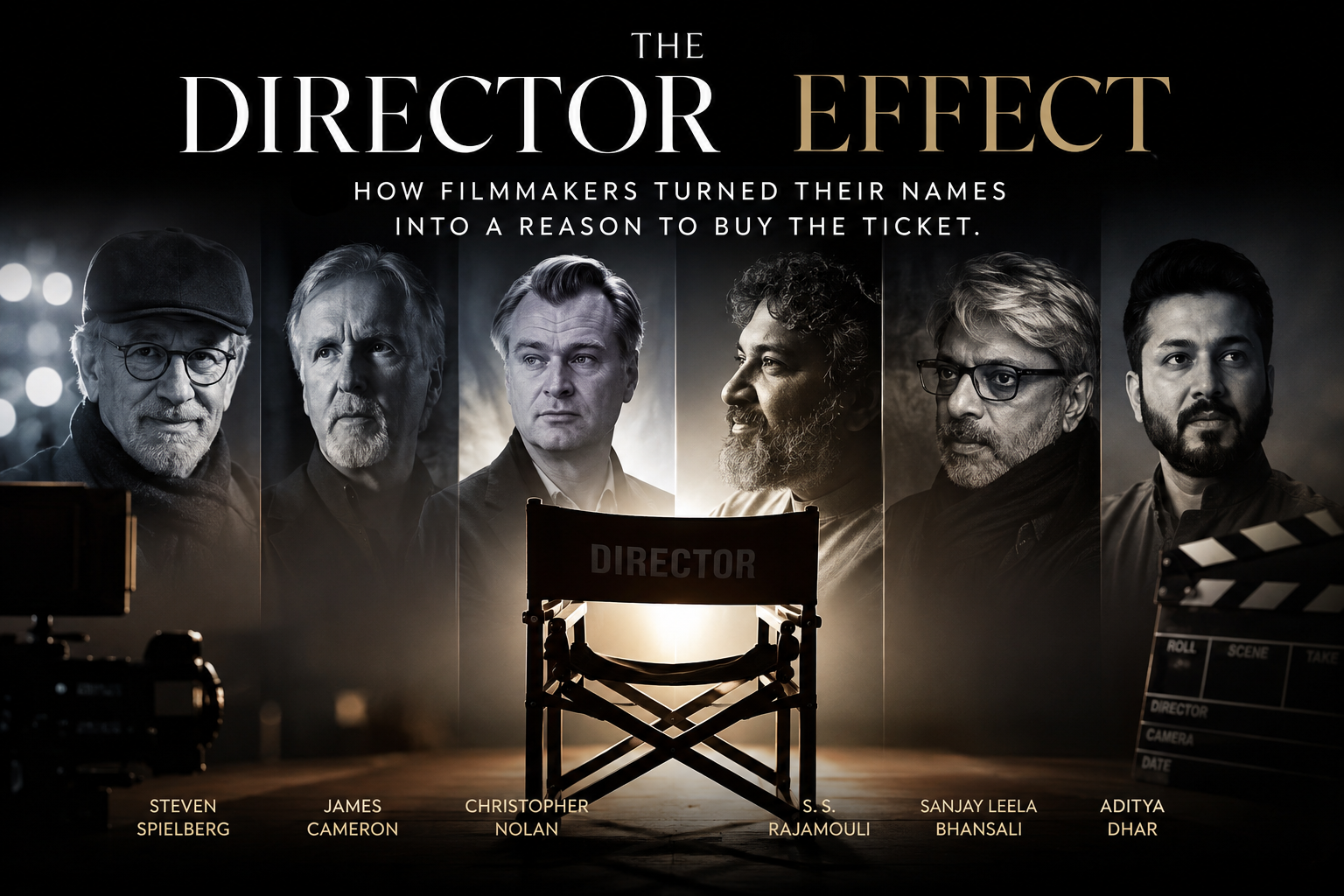
  • The Director Effect

    The Director Effect

    How cinema’s most successful filmmakers turned their names into a reason to buy the ticket.

    There was a time when the name above a film’s title usually belonged to the star.

    The actor was the attraction. The face was the campaign. The opening weekend belonged to the celebrity whose name appeared largest on the poster.

    The director was often the person behind the curtain.

    That relationship has changed.

    Today, a select group of filmmakers have developed something remarkably powerful: a name that carries its own promise.

    A Nolan film suggests one kind of experience. A Spielberg film another. A Cameron film another. In India, Rajamouli, Bhansali and, increasingly, Aditya Dhar have begun building similarly recognisable creative identities.

    The audience may not know every detail of the story.

    They may not even need to.

    The filmmaker’s name already tells them something about what they are about to experience.

    Scale.

    Craftsmanship.

    Aesthetic.

    Ambition.

    Emotion.

    Spectacle.

    That is when a director stops being simply the person who made the film.

    The director becomes part of the reason to see it.


    When the Name Becomes the Attraction

    The interesting shift isn’t that directors have become famous.

    Great directors have always been famous.

    The shift is that their names increasingly influence the audience’s decision to watch the film itself.

    Christopher Nolan offers perhaps the clearest contemporary example.

    The Odyssey arrived in 2026 with an extraordinary cast including Matt Damon, Tom Holland, Anne Hathaway, Lupita Nyong’o and Zendaya. Yet the conversation surrounding the film was never simply about its cast.

    It was about a Christopher Nolan film.

    The film opened to $264.1 million worldwide and went on to cross $1.4 billion globally, demonstrating the extraordinary theatrical power that can now surround a filmmaker’s name.

    The significance goes beyond the numbers.

    Nolan has reached a point where audiences can recognise the experience before they know the story.

    That is brand recognition.


    Christopher Nolan — The Event Maker

    Nolan’s greatest achievement may not be any individual film.

    It may be that he has transformed the act of going to the cinema into part of his identity as a filmmaker.

    IMAX.

    Large-format film.

    Practical effects.

    Immersive sound.

    Complex narratives.

    Scale.

    Mystery.

    His films arrive with a sense of occasion.

    His relationship with IMAX has become particularly important to that identity. The Odyssey generated an extraordinary opening for the format, reinforcing the idea that Nolan’s films are designed not merely to be watched but to be experienced theatrically.

    Nolan therefore sells something more than a story.

    He sells the experience of cinema itself.

    That is why audiences can become interested in a Nolan film before they know exactly what happens in it.

    The name tells them enough.


    Steven Spielberg — The Pioneer

    Long before directors were discussed as personal brands, Steven Spielberg had already established the model.

    Jaws didn’t simply become a hit.

    It helped define the modern blockbuster.

    Spielberg’s name eventually came to represent something unusually broad:

    Adventure.

    Emotion.

    Spectacle.

    Humanity.

    Family.

    History.

    Science fiction.

    The remarkable part is the range.

    A Spielberg film doesn’t have to belong to one genre to feel like a Spielberg film.

    That is one of the defining characteristics of a mature creative brand.

    The identity survives the category.

    His name became associated with a particular standard of mainstream cinematic storytelling, helping establish the idea that the filmmaker could become part of the commercial identity of a movie.

    Decades later, the name still carries that accumulated trust.

    And that is perhaps the purest form of brand equity:

    recognition built over time.


    James Cameron — The Spectacle

    If Spielberg helped build the modern blockbuster, James Cameron pushed the idea of spectacle into technological territory.

    Titanic, Avatar and Avatar: The Way of Water place Cameron in an extraordinarily rare commercial category.

    But the more interesting part isn’t simply their box-office performance.

    It is the way Cameron approaches technology.

    He doesn’t merely use new tools.

    He frequently pushes the industry to develop them.

    For Avatar, his production team developed new approaches to performance capture, virtual environments and 3D filmmaking to realise the world he had imagined.

    The technology became part of the storytelling.

    That has become part of the Cameron promise.

    When a Cameron film arrives, audiences expect something that stretches the boundaries of what cinema can physically display.

    The technology becomes part of the spectacle.

    And the director becomes the guarantee.


    India’s Director-Brand Era

    The phenomenon isn’t uniquely American.

    In fact, some of the most interesting examples are emerging from India.

    Indian cinema has always had powerful stars, but a new generation of filmmakers has demonstrated that a director’s name can carry an increasingly independent form of commercial and cultural value.

    The difference is subtle.

    The audience isn’t simply asking who is acting in the film.

    It is beginning to ask:

    Who is creating this world?


    S. S. Rajamouli — The Global Phenomenon

    S. S. Rajamouli may be the clearest contemporary example of an Indian filmmaker whose name has become associated with a global theatrical proposition.

    Baahubali established the scale.

    RRR expanded the international audience.

    His cinema carries a recognisable promise:

    Mythology.

    Emotion.

    Heroism.

    Music.

    Large-scale action.

    World-building.

    Spectacle.

    But Rajamouli’s influence has increasingly travelled beyond the traditional boundaries of Indian cinema.

    His international reception and the global ambitions surrounding his upcoming projects demonstrate how far that directorial identity has travelled.

    The important shift is that Rajamouli is no longer simply exporting individual films.

    He is exporting a cinematic language.

    Audiences increasingly understand what a Rajamouli experience promises before the opening frame.

    That is a powerful form of authorship.


    Sanjay Leela Bhansali — The Aesthetic

    If Rajamouli’s name promises spectacle, Sanjay Leela Bhansali’s promises something more intimate:

    a world.

    Mention Bhansali and an audience can almost imagine the frame before seeing it.

    Architecture.

    Jewellery.

    Textiles.

    Music.

    Choreography.

    Romance.

    Colour.

    Light.

    Grandeur.

    His films have developed such a distinctive visual vocabulary that the director’s name itself functions almost like an aesthetic category.

    That is a particularly sophisticated form of brand recognition.

    A luxury house can communicate through a silhouette.

    An architect can communicate through proportion.

    A watchmaker can communicate through a movement.

    Bhansali communicates through the frame.

    His films feel authored down to the smallest detail.

    The sets, costumes, musical sequences and compositions all belong to the same universe.

    And that consistency creates expectation.

    The audience knows what kind of world it is entering.

    The question isn’t whether it will be beautiful.

    The question is how Bhansali will make beauty feel this time.


    Aditya Dhar — The New Force

    Aditya Dhar represents a different stage of director-brand power.

    His career is considerably younger than those of Spielberg, Cameron, Nolan, Rajamouli or Bhansali, but that is precisely what makes his rise interesting.

    Uri: The Surgical Strike established his directorial identity through political tension, action and a grounded sense of scale.

    The Dhurandhar films expanded that identity dramatically.

    The commercial response has demonstrated that Dhar is increasingly associated with a particular cinematic proposition: political narratives, high-stakes action, technical ambition and large-scale world-building.

    That matters because a director does not necessarily need decades to build a recognisable identity anymore.

    In an environment where audiences are exposed to more content than ever, a distinctive creative voice can become recognisable remarkably quickly.

    Dhar represents the newer model of the director as a commercial force.

    His story is still being written.

    But the audience is beginning to recognise the promise.


    The Director as a Luxury Brand

    This is where cinema begins to resemble luxury.

    A luxury house doesn’t simply sell an object.

    It sells an expectation.

    You don’t choose a watch only because it tells time.

    You choose its history, craftsmanship, design language and reputation.

    You don’t choose a fashion house merely because it produces clothing.

    You choose its interpretation of clothing.

    The same principle increasingly applies to filmmakers.

    A Nolan film promises one kind of experience.

    A Cameron film another.

    A Rajamouli film another.

    A Bhansali film another.

    The audience is not simply purchasing a ticket.

    It is purchasing an expectation of authorship.

    That is the real shift.


    From Star Power to Auteur Power

    For decades, cinema was built around the star system.

    The actor was the brand.

    The actor’s face sold the poster.

    The actor’s name drove the opening.

    That power hasn’t disappeared.

    But audiences now have another way of choosing.

    Franchises have multiplied.

    Streaming has expanded the amount of content available.

    The number of films competing for attention has become enormous.

    In that environment, a recognisable creative voice becomes valuable.

    A filmmaker with a distinct identity provides something a new concept otherwise lacks:

    trust.

    The audience may not know the entire story.

    But they know the person telling it.

    And sometimes that is enough.


    The New Currency Is Expectation

    Perhaps the most valuable thing a filmmaker can build is not fame.

    It is expectation.

    When a director reaches that level, a new project becomes news before the trailer arrives.

    A new Nolan project becomes an event.

    A new Cameron project becomes an event.

    A new Rajamouli project becomes an event.

    A new Bhansali project becomes an event.

    The filmmaker’s previous work has already performed part of the marketing.

    The reputation precedes the film.

    That is exactly how powerful luxury brands operate.

    The name creates anticipation before the object is experienced.


    The Risk of Becoming a Brand

    There is, however, a paradox.

    A brand creates expectations.

    And expectations can become a prison.

    The more recognisable a filmmaker becomes, the more audiences expect the next film to resemble the last.

    Nolan must remain Nolan.

    Bhansali must remain Bhansali.

    Rajamouli must remain Rajamouli.

    But if a signature becomes too predictable, it can become formula.

    The strongest creative brands therefore face the same challenge as the strongest luxury houses:

    How do you remain recognisable without becoming predictable?

    The answer is evolution.

    Preserve the philosophy.

    Change the expression.

    A signature should be a foundation, not a cage.


    The Future Belongs to the Signature

    The future of theatrical cinema will not belong entirely to actors.

    Nor will it belong exclusively to franchises.

    Both will remain powerful.

    But as audiences become more selective about which films deserve their time, money and attention, authorship becomes increasingly valuable.

    A filmmaker with a recognisable voice offers something a generic production cannot.

    A reason to anticipate.

    A reason to care.

    A reason to believe the experience will be different.

    That may explain why the modern director is becoming something more than the person who makes the film.

    The director is becoming part of the reason the film exists in the audience’s imagination before it arrives.


    The Director Is the Brand

    The most interesting evolution in cinema may therefore be happening above the title.

    Not in the cast list.

    Not in the franchise logo.

    But in the name of the person who imagined the world.

    Spielberg built the modern blockbuster.

    Cameron turned technology into spectacle.

    Nolan turned theatrical cinema into an event.

    Rajamouli transformed scale into a global Indian cinematic language.

    Bhansali turned visual beauty into authorship.

    Dhar is demonstrating how quickly a contemporary filmmaker can build a commercial identity around a distinct worldview.

    Six directors.

    Six different forms of influence.

    But one underlying shift.

    The audience isn’t always asking:

    “What is this film about?”

    Increasingly, it is asking:

    “Who made it?”

    And when the answer itself is enough to make someone buy a ticket, the filmmaker has crossed an important line.

    They are no longer simply making the brand.

    They have become the brand.

    INSYDE — Beyond the Spotlight.