
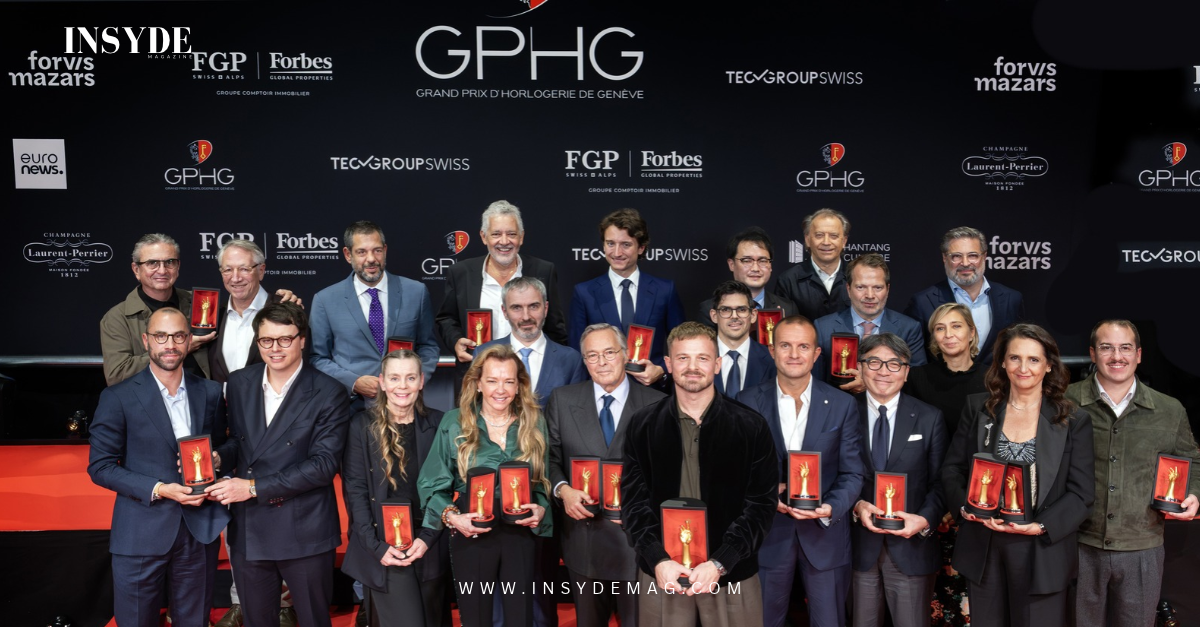
Rexhep Rexhepi takes horology’s highest honour as the 26th edition of the Grand Prix d’Horlogerie de Genève celebrates independent watchmaking, technical ingenuity and the evolving language of haute horlogerie.
LUXURY | WATCHMAKING | INDUSTRY
On 7 November 2026, Geneva once again became the centre of the international watchmaking conversation. The 26th edition of the Grand Prix d’Horlogerie de Genève (GPHG) brought together established maisons, independent watchmakers, collectors and industry figures for an evening recognising some of the year’s most notable achievements in horology.
The evening’s highest distinction, the Aiguille d’Or Grand Prix, went to independent watchmaker Rexhep Rexhepi for his Chronograph Flyback. The result placed an independent creator at the summit of an awards programme that continues to bring together the full breadth of contemporary watchmaking — from technically ambitious complications and traditional craftsmanship to jewellery watches and accessible mechanical design.
Across 20 prizes, the 2026 winners reflected an industry that is not defined by a single aesthetic or commercial model. Heritage maisons and independent ateliers shared the spotlight, while the revised award categories brought a different structure to the competition. The result was a particularly revealing snapshot of where fine watchmaking stands today.


THE AIGUILLE D’OR: REXHEP REXHEPI’S DEFINING MOMENT
The defining moment of the 2026 ceremony belonged to Rexhep Rexhepi, whose Chronograph Flyback received the Aiguille d’Or — the competition’s highest award.
Rexhepi has built his reputation through a commitment to traditional watchmaking and an independent approach to design and mechanical construction. Through his Geneva-based atelier, Akrivia, he has become one of the prominent figures in a generation of independent watchmakers attracting international attention for their highly considered, technically focused work.
The award is significant not simply because of the recognition it gives one watch. It also reflects the growing cultural and institutional standing of independent watchmaking. While the industry’s largest maisons benefit from extensive manufacturing capabilities, global distribution and established heritage, independent creators often operate with smaller teams and more concentrated production. Their influence, however, increasingly extends well beyond their production numbers.
Rexhepi’s win reinforces the idea that the highest levels of horology are not exclusively the domain of the largest luxury groups. Technical discipline, an identifiable creative vision and the ability to execute a movement to exceptional standards can command recognition on their own terms.
The Chronograph Flyback therefore becomes more than the winning timepiece of the year. It is a statement about the continuing relevance of independent craftsmanship in a market where scale and visibility do not necessarily determine artistic or horological importance.
Explore the watch and the watchmaker through the official Rexhep Rexhepi website.
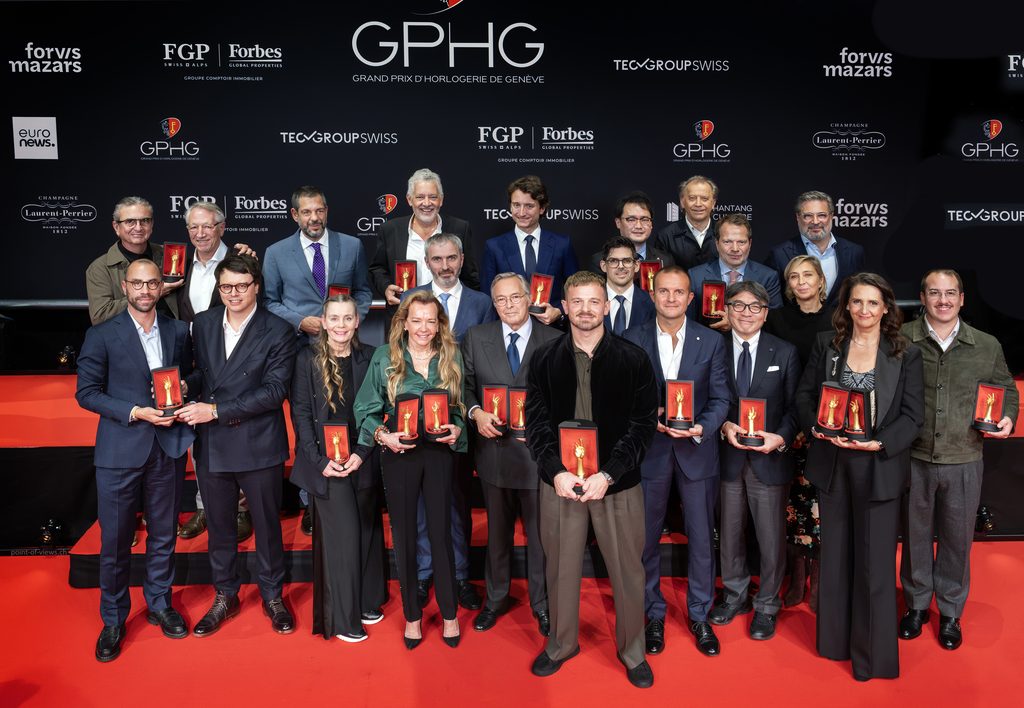
THE 2026 WINNERS: ALL 20 PRIZES
The 2026 GPHG recognised 20 winners across a broad range of disciplines. The complete prize list demonstrates the diversity of contemporary horology, with awards spanning precision, complications, sports watches, artistic crafts, jewellery and mechanical clocks.
| Award | 2026 winner | Winning creation |
|---|---|---|
| Aiguille d’Or Grand Prix | Rexhep Rexhepi | Chronograph Flyback |
| Iconic Watch Prize | Audemars Piguet | Royal Oak “Jumbo” Extra-thin Selfwinding Flying Tourbillon Chronograph RD#5 “150th Anniversary” |
| Special Jury Prize | Patek Philippe | Watch Art Grand Exhibition |
| Audacity Prize | Konstantin Chaykin | ThinKing Mystery |
| Chronometry Prize | Ferdinand Berthoud | Naissance d’une Montre 3 |
| Horological Revelation Prize | Dominique Renaud | Pulse60 Titanium Black |
| Mechanical Exception Watch Prize | Blancpain | Grande Double Sonnerie |
| Complication Watch Prize | Cleguer | Inspiration One |
| Chronograph Watch Prize | Parmigiani Fleurier | Tonda PF Chronographe Mystérieux |
| Tourbillon Watch Prize | Ferdinand Berthoud | Chronomètre FB 2TV |
| Sports Watch Prize | Grand Seiko | Spring Drive U.F.A. Ushio 300 Diver |
| Calendar and Astronomy Watch Prize | Audemars Piguet | 150 Heritage |
| Essential Watch Prize | Daniel Roth | Extra Plat Rose Gold Skeleton |
| Time Only Watch Prize | Chopard | L.U.C 1860 |
| Jewellery Watch Prize | Chopard | Mystery Nut |
| Artistic Crafts Watch Prize | Louis Vuitton | Tambour Taiko Arty Automata |
| Gemset Watch Prize | Piaget | Swinging Pebble |
| Petite Aiguille Watch Prize | Otsuka Lotec | No.8 |
| Challenge Watch Prize | SpaceOne × Baltic | Seconde Majeure |
| Mechanical Clock Prize | La Vallée | Cosmo |
The full results are available through the official GPHG 2026 prize list.
AUDemars PIGUET AND THE POWER OF AN ICON
Among the evening’s most closely watched recognitions was the Iconic Watch Prize, awarded to Audemars Piguet for its Royal Oak “Jumbo” Extra-thin Selfwinding Flying Tourbillon Chronograph RD#5 “150th Anniversary”.
The Royal Oak is one of the defining designs of modern luxury watchmaking. Since its introduction in 1972, the collection has challenged conventional distinctions between sports watches and high-end horology. Its recognisable architecture and integrated-bracelet design have helped establish it as one of the most influential watch families in the luxury sector.
The RD#5 takes that established identity into a more technically ambitious territory, combining the Royal Oak’s familiar design language with an elaborate complication. Its recognition is particularly notable in the context of the maison’s 150th anniversary, connecting a landmark moment in the brand’s history with contemporary mechanical development.
Audemars Piguet also received the Calendar and Astronomy Watch Prize for its 150 Heritage. The double recognition illustrates the maison’s ability to work across two different dimensions of watchmaking: the cultural significance of an enduring design and the technical ambition of complex horological mechanisms.
For a maison whose identity is so closely associated with one of watchmaking’s most recognisable silhouettes, the awards demonstrate how heritage can remain relevant when it is supported by continued innovation.
Discover the maison’s collections and anniversary creations at Audemars Piguet.
THE ART OF MECHANICAL EXCELLENCE
Technical achievement remained central to the 2026 awards, with several prizes recognising the complexity and precision that continue to distinguish haute horlogerie.
Blancpain received the Mechanical Exception Watch Prize for the Grande Double Sonnerie. Grande sonnerie mechanisms are among the most demanding complications in traditional watchmaking. They are designed to strike the hours and quarters automatically, requiring intricate coordination between the movement’s components. The category recognises work that pushes the boundaries of mechanical construction.
Ferdinand Berthoud was another prominent name, receiving two awards. Its Naissance d’une Montre 3 won the Chronometry Prize, while the Chronomètre FB 2TV received the Tourbillon Watch Prize. Together, the awards highlight the maison’s emphasis on precision, traditional construction and the preservation of demanding horological techniques.
The Chronograph Watch Prize went to Parmigiani Fleurier for the Tonda PF Chronographe Mystérieux, while Cleguer received the Complication Watch Prize for Inspiration One. These results underline the range of approaches being taken to mechanical complications, from established manufacture expertise to more individual interpretations.
The awards also recognised Dominique Renaud, whose Pulse60 Titanium Black received the Horological Revelation Prize. Renaud’s recognition adds another independent voice to a year in which individual watchmakers and specialist ateliers made a particularly strong impression.
WHEN WATCHMAKING BECOMES ART
Fine watchmaking has always existed at the intersection of engineering and artistic expression. The 2026 winners offered several examples of how far that relationship can extend.
Louis Vuitton received the Artistic Crafts Watch Prize for its Tambour Taiko Arty Automata. The recognition reflects the importance of decorative techniques and artistic execution in luxury watchmaking, where the dial, case and mechanical display can become a canvas for specialist craftsmanship.
Chopard won two awards. Its L.U.C 1860 received the Time Only Watch Prize, while the Mystery Nut was recognised in the Jewellery Watch category. The two creations represent different expressions of the maison’s expertise: one focused on the refinement of traditional time display, the other on the relationship between jewellery and horological construction.
Piaget received the Gemset Watch Prize for the Swinging Pebble, bringing attention to the role of gemsetting and jewellery techniques in contemporary watch design.
These awards are a reminder that the value of a high-end watch is not measured by mechanical complexity alone. The quality of finishing, material selection, decorative skill and visual imagination remain essential elements of the discipline.


THE INDEPENDENT WATCHMAKERS CHANGING THE CONVERSATION
One of the most interesting themes emerging from the 2026 results was the visibility of independent watchmaking.
Alongside Rexhep Rexhepi’s Aiguille d’Or victory, Konstantin Chaykin received the Audacity Prize for ThinKing Mystery. Chaykin has become known for an inventive approach to mechanical displays and unconventional watch design. His recognition reflects the importance of creative experimentation within an industry often associated with tradition.
Otsuka Lotec, a Japanese independent watchmaking name, received the Petite Aiguille Watch Prize for No.8. The award brought attention to a creator operating outside the conventional Swiss luxury-house structure.
The Challenge Watch Prize went to SpaceOne × Baltic for Seconde Majeure, another collaboration demonstrating how smaller watchmaking businesses can develop distinctive mechanical propositions.
These results matter because independent watchmakers contribute something that larger organisations may find harder to institutionalise: a highly individual creative point of view. Their production may be limited, but their influence can be considerable among collectors who value originality, specialist knowledge and a direct connection with the maker.
The GPHG does not measure the commercial scale of each participant. Its value lies in creating a shared platform where established manufacturers and smaller independent creators can be considered within the same broader conversation about horological achievement.
A NEW STRUCTURE FOR THE AWARDS
The 2026 edition also introduced a notable change to the competition’s category structure.
The traditional Men’s and Ladies’ Watch categories were replaced by a revised framework that included Essential Watch, Complication Watch and Gemset Watch categories. This shift moves the competition towards classifications based more directly on a watch’s functions, construction and defining characteristics rather than the gender-based divisions used in previous editions.
The change reflects a wider conversation across luxury watchmaking. Product design, marketing and consumer preferences are increasingly moving beyond conventional assumptions about who a particular watch is designed for. A watch’s complication, dimensions, materials and visual identity can be more meaningful points of distinction than the gender category under which it is marketed.
The revised structure also gives the awards a broader framework for recognising different forms of horological achievement. It is a meaningful evolution for an event that must balance the preservation of watchmaking tradition with the changing expectations of a global audience.
HOW THE GPHG SELECTS ITS WINNERS
The Grand Prix d’Horlogerie de Genève is more than a ceremony. It is the culmination of a selection process involving the GPHG Academy and an international jury.
For 2026, the Academy comprised more than 1,000 members drawn from the international watchmaking ecosystem. The nominated timepieces were assessed through a process involving the Academy and a specialist jury chaired by Wei Koh, founder of Revolution.
The 2026 selection brought 84 nominated timepieces to the competition, with 20 prizes awarded at the ceremony. The process is designed to bring together different forms of expertise, including watchmaking knowledge, industry experience, collecting perspectives and editorial understanding.
The awards are therefore not a simple popularity contest. They provide a structured assessment of the year’s creations, although, as with any juried award, the final results represent the judgement of the participating experts rather than an objective ranking of every watch produced during the year.
Further details about the competition, its jury and its selection process are available through the official GPHG website.
THE INDUSTRY BEHIND THE AWARDS: A MARKET IN MOTION
The importance of the GPHG becomes clearer when considered against the wider performance of the Swiss watch industry.
According to the Federation of the Swiss Watch Industry (FH), Swiss watch exports rose by 11.7% in September 2026, marking a fourth consecutive month of growth. Across the first nine months of the year, cumulative export value reached approximately CHF 19.5 billion, an increase of 2.7% compared with the same period in 2025.
The September figures offer a positive signal after a more uneven period for the industry. They also underline the importance of international demand to Swiss watchmaking, with the United States, France, Japan, the United Kingdom, Hong Kong, China and Singapore among the leading export destinations in the first nine months of 2026.
These figures need to be read carefully. Swiss export statistics are recorded at declared export prices; they are not equivalent to final retail sales, brand revenues or the total value of the global luxury watch market. They nevertheless provide one of the most useful official indicators of the industry’s international trade performance.
The broader picture is one of a sector navigating changing consumer demand, geopolitical uncertainty, pricing pressures and the growing importance of brand desirability. In that environment, the GPHG offers more than an annual celebration. It helps draw attention to the creative and technical achievements that sustain the industry’s cultural relevance.
The latest statistics can be followed through the Federation of the Swiss Watch Industry’s official export data.
INDIA’S PLACE IN THE GLOBAL WATCHMAKING CONVERSATION
The 2026 GPHG also had a meaningful connection with India. Before arriving in Geneva, the exhibition of nominated watches travelled to Mumbai from 28 September to 1 October 2026, bringing a selection of the year’s creations to an important luxury market.
The Mumbai presentation placed Indian collectors and watch enthusiasts within the international GPHG exhibition calendar. It also reflected the growing relevance of India to global luxury businesses, as international maisons continue to engage with a market shaped by rising wealth, expanding luxury retail and a younger generation of affluent consumers.
India’s luxury watch opportunity should not be reduced to sales volume alone. The market’s development also depends on collector education, access to authorised retail, after-sales service, brand storytelling and the growth of specialist communities. Events and exhibitions can help build that ecosystem by giving audiences the opportunity to encounter exceptional timepieces beyond digital campaigns and retail displays.
For Indian collectors, the GPHG provides a useful reference point for understanding the different dimensions of fine watchmaking — from traditional Swiss manufacture to independent creators and contemporary design.
FROM GENEVA TO LONDON: THE WINNING WATCHES ON DISPLAY
The GPHG is not confined to the ceremony itself. Its exhibition programme gives the nominated timepieces an opportunity to reach audiences in different markets.
Following earlier presentations in Mumbai and Bangkok, the exhibition featuring all 84 nominated timepieces remains at Geneva’s Musée d’Art et d’Histoire until 15 November 2026.
The winning watches are then scheduled to be presented in London at Watches of Switzerland, Knightsbridge, from 18 to 23 November 2026.
This travelling exhibition is an important part of the event’s identity. It allows collectors, enthusiasts and members of the public to experience the watches in person, compare different approaches to design and mechanics, and engage with the work of both established maisons and independent watchmakers.
For those unable to attend the Geneva ceremony, the exhibition programme extends the life of the awards beyond a single evening and brings the results into direct contact with international audiences.
The full programme is available through the GPHG 2026 exhibition schedule.
WHAT THE 2026 RESULTS TELL US ABOUT THE FUTURE OF LUXURY WATCHES
The 2026 GPHG results reveal an industry that continues to draw strength from its contrasts.
The established maisons remain central to the luxury watch landscape, with Audemars Piguet, Patek Philippe, Blancpain, Chopard, Louis Vuitton, Piaget and Grand Seiko among the recognised names. At the same time, the highest award went to an independent watchmaker, while other smaller creators received recognition for technical ambition and original design.
That balance is important. The future of luxury watchmaking is unlikely to be shaped by one dominant aesthetic or a single business model. It will depend on the ability of manufacturers to protect the knowledge and skills that define traditional horology while finding new ways to interpret them.
For established brands, heritage remains a powerful asset, but heritage alone is not enough. Collectors increasingly expect meaningful innovation, strong design identities, technical credibility and a clear reason for a watch to exist beyond its name.
For independent watchmakers, the opportunity lies in originality and specialist expertise. Their challenge is to maintain the quality and identity of their work while managing the realities of production, distribution and long-term business sustainability.
For the industry as a whole, the GPHG offers an annual reminder that mechanical watchmaking remains a living discipline — one capable of evolving without abandoning the traditions that made it valuable in the first place.
THE FINAL WORD
The 26th Grand Prix d’Horlogerie de Genève was not simply a celebration of the year’s most remarkable timepieces. It was a reflection of an industry negotiating the relationship between heritage and innovation, established maisons and independent creators, mechanical precision and artistic expression.
Rexhep Rexhepi’s Aiguille d’Or victory gave the evening a compelling centrepiece. The wider list of winners, however, revealed a more expansive story: one in which technical mastery, creative risk-taking and the preservation of specialist craftsmanship continue to define the highest ambitions of watchmaking.
In a luxury market increasingly shaped by visibility, scale and commercial performance, the GPHG places the focus back on the object itself — the movement, the materials, the finishing and the human expertise required to bring a remarkable timepiece to life.
And that may be its most important contribution. The future of fine watchmaking will not be decided by heritage alone, nor by innovation for its own sake. It will belong to the makers capable of bringing the two together.
For INSYDE, the 2026 GPHG is a reminder that the most compelling luxury creations are not simply products of prestige. They are expressions of knowledge, imagination and an enduring commitment to craft.
INSYDE MAGAZINE – No.1 Luxury Magazine In Bengaluru
Leave a Reply