

India has one of the world’s largest music audiences, billions of streams and a rapidly growing generation of artists reaching listeners beyond its borders. Yet its recorded-music economy remains far behind the world’s leading markets. The question is no longer whether India can make music the world wants to hear. It is whether India can build the business to match it.
Music has never been difficult to find in India.
It is everywhere.
It lives inside films, weddings, clubs, festivals, cars, headphones, Instagram Reels and late-night playlists. It crosses languages, generations and social classes. A song can travel from a bedroom studio in Chandigarh to a million phones in London, from Chennai to Toronto, or from Kerala to New York without ever needing a passport.
India has no shortage of listeners.
No shortage of artists.
No shortage of songs.
And increasingly, no shortage of global attention.
Yet there is a strange contradiction at the centre of India’s music economy.
India is one of the world’s great music-consuming nations. But it is not yet one of the world’s great music markets.
The latest FICCI-EY data puts India’s music sector at approximately ₹59 billion in 2025, up 10% from the previous year. The sector is estimated at ₹64 billion for 2026 and projected to reach ₹75 billion by 2028. (EY)
The global recorded-music industry, meanwhile, reached US$31.7 billion in 2025, growing 6.4% and marking its eleventh consecutive year of growth. Paid streaming alone generated more than half of global recorded-music revenue. (IFPI)
India is growing.
But the global race is moving too.
And that raises the uncomfortable question:
Why has India’s enormous cultural influence not yet translated into equivalent music-industry power?
THE GREAT INDIAN MUSIC PARADOX
The numbers are almost difficult to reconcile.
According to the 2026 EY–Indian Music Industry study, 96% of Indian smartphone users listen to music, and 80% spend more than an hour a day doing so. Yet India had only around 14 million paid music subscriptions in 2025, compared with more than 200 million paid video subscriptions. (EY)
That is the paradox.
India has built a massive listening economy without yet building an equally large payment economy.
And that distinction is crucial.
Because music-market rankings are ultimately about revenue—not how many people love music, how many songs are played at weddings, or how many reels use an Indian track.
The global recorded-music business rewards the markets that successfully turn listening into subscriptions, royalties, licensing, physical sales and other forms of monetisation.
India has mastered the first half.
The second is still being built.
THE WORLD’S MUSIC BUSINESS HAS ALREADY MOVED ON
The global music industry is no longer the business it was a decade ago.
Streaming has transformed the economics of music.
In 2025, global recorded-music revenue reached US$31.7 billion. Streaming revenue surpassed US$22 billion, while paid subscription streaming revenue grew 8.8% and accounted for 52.4% of global recorded-music revenue. There were approximately 837 million paid streaming subscription accounts worldwide. (IFPI)
And the global market is becoming increasingly international.
Language is no longer the barrier it once was.
In 2025, Rosé and Bruno Mars’ “APT.” became the first song featuring non-English lyrics to top IFPI’s Global Single Chart. IFPI described the result as evidence of the increasingly global nature of recorded music and the growing ability of artists to cross language and market boundaries. (IFPI)
That matters enormously for India.
Because India possesses something few countries can match:
dozens of musical cultures, hundreds of millions of potential listeners and a vast global diaspora.
The question is why that advantage has not yet produced a music economy of comparable scale.

1. INDIA HAS A MONETISATION PROBLEM
This is perhaps the biggest weakness in the Indian music business.
The EY–IMI study surveyed 15,373 smartphone users across India in March and April 2026.
The findings are striking.
While 86% of respondents had paid for video OTT services at some point, only 38% had ever paid for a music streaming service, including bundled services. (EY)
The problem, therefore, isn’t that Indians refuse to pay for digital entertainment.
They already do.
They pay for films.
They pay for sports.
They pay for streaming television.
They pay for premium experiences.
But music has historically been treated differently.
Why pay for a song when the song can be found somewhere else for free?
That question has shaped the Indian music economy for years.
EY identifies the availability of free alternatives and limited perceived differentiation between free and premium music services as major barriers to subscription growth. (EY)
There is, however, an intriguing opportunity hidden inside the problem.
61% of respondents said they would be willing to pay if free alternatives disappeared and the price was reasonable. (EY)
So the issue may not be a lack of love for music.
It may be a lack of perceived value.
2. INDIA HAS BILLIONS OF STREAMS. BUT STREAMS ARE NOT THE SAME AS MONEY.
This is where the conversation needs to move beyond vanity metrics.
A billion streams sounds enormous.
But a stream is not a universal unit of economic value.
The revenue generated by listening depends on the market, the platform, subscription mix, advertising, rights arrangements and other commercial factors.
That means a country can generate extraordinary volumes of listening while still producing a relatively modest music market by global revenue standards.
India has essentially built a gigantic attention economy around music.
The next challenge is building a much stronger value economy around it.
The distinction is simple:
Attention asks: How many people are listening?
Value asks: How much economic activity does that listening create?
India is exceptional at the first.
It is still developing the second.
3. INDIA’S FREE-MUSIC CULTURE IS BOTH ITS SUPERPOWER AND ITS PROBLEM
The digital revolution made music incredibly accessible.
YouTube.
Short-form video.
Ad-supported streaming.
Social platforms.
Film soundtracks.
User-generated content.
Music discovery has never been easier.
But abundance changes consumer behaviour.
When a listener can access an enormous amount of music without paying a conventional subscription, convincing that listener to upgrade becomes much harder.
The industry therefore faces a delicate problem.
Restrict free access too aggressively and platforms risk losing reach.
Leave free access too generous and consumers may never develop the habit of paying.
India’s streaming industry is still trying to find that balance.
And this is why the next stage of growth will probably depend less on simply acquiring listeners and more on making premium music experiences feel worth paying for.
Ad-free listening, offline access, better audio quality, personalisation, exclusive content, fan experiences and live-event integration are all becoming increasingly important to that proposition. (EY)
4. INDIA DOESN’T HAVE ONE MUSIC INDUSTRY
This may be one of India’s greatest cultural strengths.
And one of its biggest commercial complications.
India has:
Hindi.
Punjabi.
Tamil.
Telugu.
Malayalam.
Kannada.
Bengali.
Marathi.
Haryanvi.
Bhojpuri.
And many more.
For decades, Bollywood acted as the international shorthand for Indian popular music.
But streaming is breaking that model apart.
According to FICCI-EY analysis using IPRS data, Hindi accounted for 59% of music consumption in 2025, followed by Punjabi at 9%, Tamil at 7%, Telugu at 6%, Bhojpuri at 4%, Kannada at 3%, and several other regional languages. (EY)
That fragmentation can look like a weakness when compared with countries exporting a more unified musical identity.
But it may ultimately become India’s greatest competitive advantage.
Because India doesn’t need to export one sound.
It can export many.
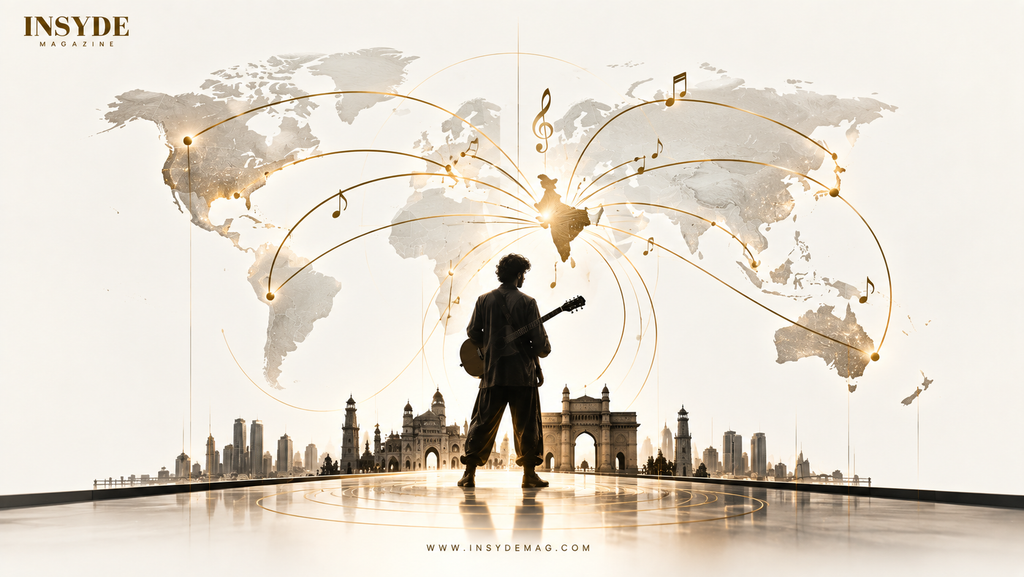
5. THE MOST IMPORTANT CHANGE: INDIAN MUSIC IS LEAVING INDIA
This is where the story becomes much more optimistic.
Spotify’s 2026 India Loud & Clear report found that royalties generated by Indian artists on Spotify grew 29% in 2025.
The number of artists generating more than ₹1 crore annually grew 21%, while the number generating more than ₹5 crore doubled compared with 2023. (Spotify)
But the more interesting number is geographical.
More than 40% of royalties earned by Indian artists on Spotify in 2025 came from listeners outside India. (Spotify)
That changes the argument.
Indian music isn’t simply popular at home.
It is becoming an export.
Spotify says listeners streamed Indian artists nearly 335 billion times in 2025, equivalent to more than 20 billion hours of music. Listeners also played an Indian artist they had never previously heard approximately 12.8 billion times during the year. (Spotify)
The audience is crossing borders.
And it isn’t happening only through Bollywood.
FROM BOLLYWOOD MUSIC TO INDIAN MUSIC
For generations, India’s global musical identity was heavily connected to cinema.
A song became internationally recognised because a film became internationally recognised.
But streaming has begun to separate the artist from the film.
Spotify’s latest data shows that half of its Top 10 India tracks in 2025 came from I-Pop—music outside Bollywood film soundtracks. Eleven of the 15 most-exported Indian songs on Spotify’s 2025 Global Impact List came directly from artists rather than film soundtracks. (Spotify)
That is a significant structural shift.
The Indian music industry is slowly moving from:
Bollywood music
to:
Indian music.
The distinction matters.
An independent artist can build an audience without waiting for a film.
They can release internationally.
They can collaborate across borders.
They can tour.
They can sell merchandise.
They can work with brands.
They can own and develop a catalogue.
They can build a business around their identity.
That is how a music market becomes bigger than the soundtrack business.
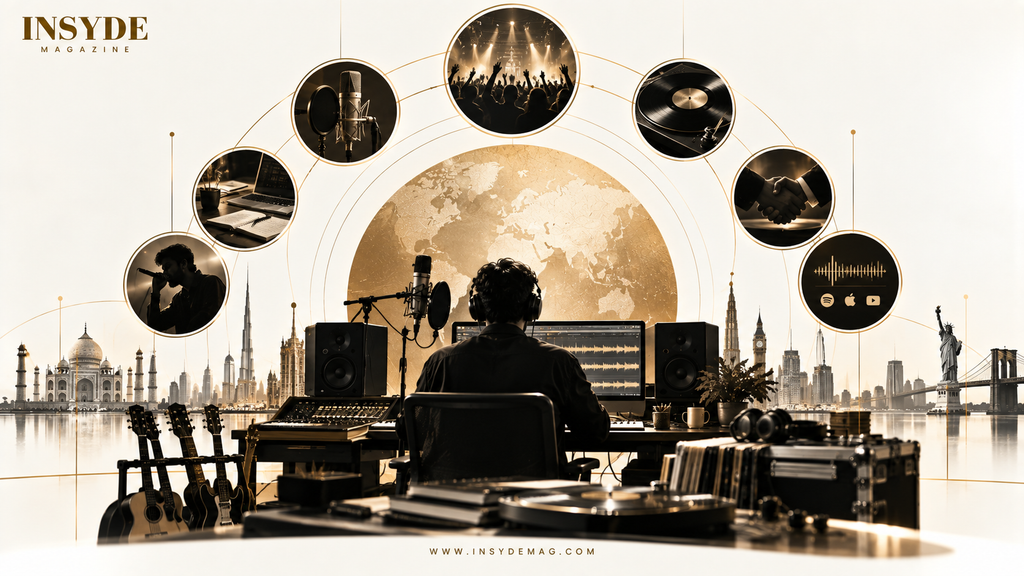
6. INDIA HAS TALENT. WHAT IT NEEDS IS INFRASTRUCTURE.
India’s problem has never been a lack of talented musicians.
The country produces extraordinary singers, rappers, composers, producers and songwriters.
But a global music economy requires far more than artists.
It requires:
A&R.
Artist management.
Publishing.
Music lawyers.
International PR.
Global distribution.
Touring infrastructure.
Sync licensing.
Catalogue investment.
Songwriting networks.
Festival relationships.
Merchandising.
Data and rights management.
India has many of these pieces.
What it is still developing is the scale and integration of the system.
A great song can come from Bengaluru, Mumbai, Chennai, Delhi or Chandigarh.
But getting that song systematically into global markets requires an ecosystem around the artist.
The world’s most powerful music industries have spent decades building that machinery.
India is building it now.
7. THE RIGHTS BUSINESS IS FINALLY BECOMING BIGGER
There is another part of the music economy that rarely gets the attention it deserves.
Rights.
A song isn’t one asset.
It can generate value through recordings, publishing, performance, synchronisation, digital platforms, broadcasts, live performances and licensing.
Globally, music creator royalties collected through collective management organisations reached €12.59 billion in 2024, up 7.2%. Digital music collections reached more than €5 billion for the first time. (CISAC)
India is moving rapidly toward a digital rights economy.
CISAC’s 2025 Global Collections Report shows digital income accounted for 82.7% of creator-rights collections in India in 2024, while India’s digital collections grew dramatically over the previous decade from a low base. (CISAC)
That is a sign of an industry becoming more sophisticated.
The music business is no longer simply about releasing songs.
It is about owning, managing, licensing and monetising intellectual property.
And India is increasingly learning that language.
8. THEN THERE IS THE LIVE MUSIC BOOM
If streaming is one side of India’s music future, live entertainment could be the other.
India’s organised live-events segment grew 44% in 2025, according to FICCI-EY. The growth was driven by ticketed concerts and other large-scale live experiences. (EY)
This matters because the economics of a concert are fundamentally different from those of a stream.
A concert creates revenue through:
tickets.
VIP experiences.
sponsorships.
merchandise.
hospitality.
brand partnerships.
tourism.
content.
The artist therefore becomes more than a recording act.
They become an experience brand.
That shift is already visible in India’s growing concert economy and in the increasing ability of Indian artists to build audiences beyond their home cities.
The next great Indian music company may therefore look less like a traditional record label and more like a combination of:
label + management company + live-entertainment business + media company + brand studio.
9. INDIA’S REGIONAL DIVERSITY COULD BECOME ITS GLOBAL ADVANTAGE
For years, India’s linguistic fragmentation was often treated as a commercial obstacle.
The global streaming era changes that calculation.
Spotify’s 2026 data shows Indian music gaining traction across multiple languages and genres. Royalties for Indian artists rose across major language markets, while Spotify has expanded artist-development initiatives into regional-language ecosystems including Malayalam, following earlier programmes in Punjabi and Tamil. (Spotify)
This matters because the world no longer needs to understand every lyric to discover a song.
Algorithms can recommend it.
Short-form video can amplify it.
Fans can translate it.
Diaspora communities can carry it.
Collaborations can cross language barriers.
And global audiences are increasingly comfortable consuming music they don’t completely understand.
India doesn’t need to make its music less Indian to make it global.
It may simply need to make it easier to discover.
10. INDIA SHOULDN’T TRY TO BECOME THE NEXT AMERICA
There is a temptation to compare India with the United States, South Korea or the UK and ask why India hasn’t replicated their music industries.
But perhaps that is the wrong question.
South Korea built a highly integrated cultural-export model around music, television, fashion, beauty and fandom.
The United States benefited from the global reach of English and decades of music-industry infrastructure.
India has a different starting point.
It has something neither model possesses in quite the same combination:
multiple languages, massive domestic scale, a global diaspora, a powerful film industry, enormous digital consumption and a deep regional music culture.
India’s opportunity may therefore be to build the world’s most powerful multilingual music ecosystem rather than trying to create a second American or Korean model.
Imagine the commercial possibilities:
Punjabi music travelling through the diaspora.
Tamil music reaching Southeast Asia.
Hindi music expanding across the Middle East and beyond.
Telugu and Malayalam music finding new international audiences.
Independent Indian hip-hop crossing borders.
Electronic producers collaborating globally.
Classical and contemporary Indian sounds entering new markets.
The future of Indian music may not have one sound.
It may have thousands.
THE NUMBERS SAY INDIA ISN’T DYING
This is where the headline becomes deliberately provocative.
India’s music market is not dying.
In fact, the latest data says the opposite.
The Indian music sector grew approximately 10% in 2025. Paid music subscriptions increased 37% to 14.4 million. Music labels also saw their other income streams grow, supported by events, branded content and talent management. (EY)
Spotify reported a 29% increase in royalties generated by Indian artists in 2025. (Spotify)
The global recorded-music industry itself grew 6.4% in 2025. (IFPI)
So the more accurate diagnosis isn’t:
India’s music industry is dying.
It is:
India’s music industry is under-monetised relative to the size of its audience and cultural influence.
And that is a very different problem.
THE REAL GAP IS BETWEEN ATTENTION AND VALUE
This may ultimately be India’s biggest opportunity.
The country has already solved the hardest part of entertainment:
people care.
They listen.
They share.
They discover.
They dance.
They sing.
They attend concerts.
They follow artists.
They create trends around songs.
They export culture through the diaspora.
What remains is converting more of that attention into sustainable economic value.
That means:
more paid subscribers.
stronger publishing.
better rights management.
larger international tours.
more global collaborations.
better artist development.
stronger management companies.
premium fan experiences.
merchandise.
sync licensing.
catalogue ownership.
international marketing.
And, perhaps most importantly, a culture in which paying for music is understood as supporting the people who make it.
THE RACE INDIA ACTUALLY NEEDS TO WIN
The question isn’t whether India can produce another global hit.
It already can.
The question isn’t whether Indian artists can find international audiences.
They already are.
The question is whether India can build the infrastructure to make those successes repeatable, scalable and economically meaningful.
That is the real global music race.
Because a hit is not an industry.
One artist is not an industry.
One viral song is not an industry.
A truly powerful music economy is the ecosystem that allows thousands of artists to build sustainable careers, while labels, publishers, platforms, promoters, managers and rights organisations capture and reinvest value throughout the system.
India is moving in that direction.
But it is still early.
SO, WHY IS INDIA NOWHERE IN THE GLOBAL MUSIC RACE?
Perhaps the premise needs one final adjustment.
India isn’t nowhere.
It is actually moving in several important directions at once.
Its artists are travelling.
Its regional languages are travelling.
Its streaming economy is growing.
Its concert economy is expanding.
Its rights infrastructure is becoming more sophisticated.
Its international audience is getting larger.
Its independent music scene is becoming more important.
And global platforms are increasingly investing in discovering Indian talent.
The problem is that India’s cultural influence is still ahead of its commercial infrastructure.
The country has built the audience before fully building the business.
And now comes the difficult part.
Turning:
listeners into customers.
songs into intellectual property.
artists into global brands.
fans into communities.
concerts into experiences.
regional sounds into international exports.
And cultural influence into economic power.
India doesn’t need another billion people to listen.
It needs to make the people already listening worth more to the ecosystem—and make the ecosystem worth more to them.
The next Indian music revolution may therefore not be about producing more music.
It may be about finally learning how to build an industry around it.
And when India figures that out, the global music map may have to be redrawn.
Because the country with the audience has already arrived.
Now it needs the music economy to match.
SOURCES & METHODOLOGY
This editorial uses the latest full-year market data available as of October 2026. Global recorded-music figures are from IFPI’s Global Music Report 2026, covering calendar year 2025. Indian music-industry figures are primarily from the 2026 FICCI-EY Stories, Scale and Impact: Unlocking India’s Media and Entertainment Economy report and the EY–Indian Music Industry How India Listens, Streams and Pays for Music study, which surveyed 15,373 smartphone users in March–April 2026. Spotify figures come from its India Loud & Clear report published in September 2026. Rights-market figures are from CISAC’s Global Collections Report 2025, covering 2024 collections. (Global Music Report)
Important: “Music market” can mean different things. IFPI’s global ranking measures recorded-music revenue, while FICCI-EY measures India’s music-sector revenue and CISAC measures creator-rights collections. These datasets are complementary but are not directly interchangeable. This distinction is important when comparing India’s position with other countries.