Category: Society

Conversations about how changing values and behaviours are reshaping contemporary life

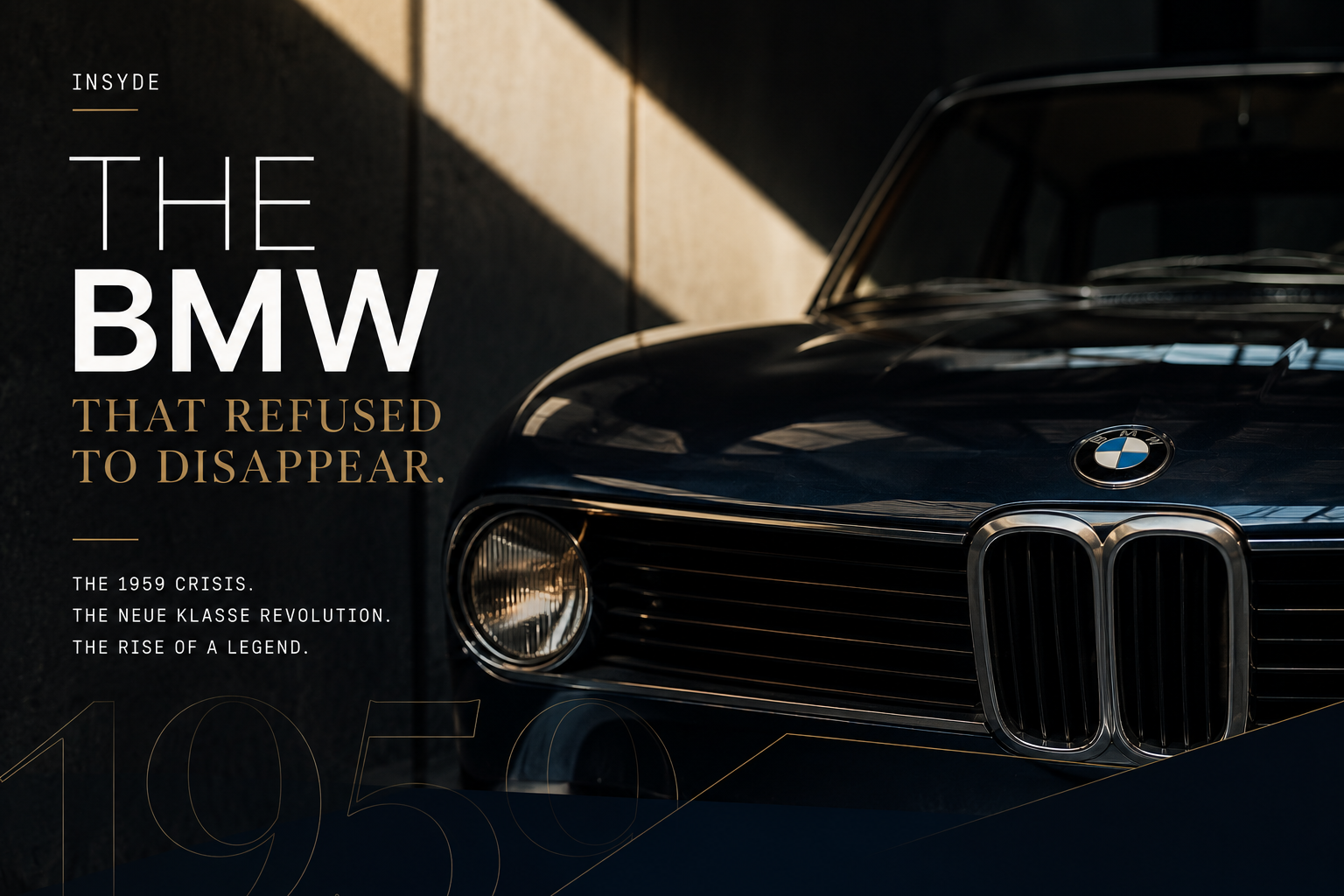
  • THE BMW THAT REFUSED TO DISAPPEAR

    THE BMW THAT REFUSED TO DISAPPEAR

    How a company that nearly fell into Daimler-Benz’s hands reinvented itself — and became one of the world’s defining premium automotive brands.

    Today, the BMW badge carries a certain expectation.

    Performance.
    Precision.
    Design.
    Status.

    For millions of drivers, it represents something more specific than simply owning an expensive car: the idea that luxury should still be felt from behind the wheel.

    But in 1959, BMW was fighting for something much more basic.

    Survival.

    The company was in serious financial difficulty. Its automobile and motorcycle businesses were struggling, and its future independence was in question. Daimler-Benz — the company behind Mercedes-Benz — submitted a time-limited restructuring offer that could have brought BMW under its control.

    At BMW’s Annual General Meeting on 9 December 1959, the proposed takeover was rejected after determined opposition from small shareholders and employees. The offer subsequently expired. BMW remained independent, but its financial crisis was far from over. (BMW Group)

    What happened next would become one of the most remarkable transformations in automotive history.

    BMW didn’t simply survive the crisis.

    It discovered what it could become.


    THE BMW THAT ALMOST BECAME MERCEDES

    The BMW of the late 1950s was a very different company from the one the world knows today.

    It had built beautiful and technically ambitious automobiles, including the 503 and 507, but its larger cars were expensive to produce and difficult to sell profitably. The company was caught between expensive luxury automobiles at one end and smaller, lower-margin products at the other.

    The result was a dangerous financial position.

    By the end of the decade, the possibility of BMW losing its independence was no longer theoretical.

    Daimler-Benz had presented a restructuring proposal.

    The situation reached a dramatic point at the December 1959 shareholders’ meeting. Small shareholders challenged the proposed restructuring, including the valuation assigned to BMW’s brand and workforce. The meeting was adjourned, and the time-limited Daimler-Benz offer expired. (BMW Group Press)

    BMW had escaped.

    But escaping Mercedes was not the same as saving BMW.

    The company still needed a future.


    THEN CAME HERBERT QUANDT

    That future was closely tied to industrialist Herbert Quandt.

    Impressed by the determination of BMW’s shareholders and employees, Quandt increased his investment in the company and backed a restructuring built around keeping BMW independent. Temporary government assistance also helped give the company room to reorganise. (BMW Group)

    The strategy was simple in principle and enormous in consequence:

    BMW would not survive by standing still.

    It needed new products.

    The BMW 700 helped put the company back on a path toward recovery.

    But the decisive breakthrough was still ahead.

    It would arrive in 1961.

    And it would wear a name that would eventually become one of the most important phrases in BMW’s history:

    Neue Klasse.


    THE CAR THAT CHANGED EVERYTHING

    At the 1961 Frankfurt Motor Show, BMW unveiled the BMW 1500.

    It was compact by the standards of the time. Sporty. Modern. Four-door. Engineered around a new approach to performance and everyday usability.

    And people noticed.

    BMW says the car filled a gap in the market and became the breakthrough that established the company as a successful, contemporary automaker. Demand was so strong that initial orders exceeded production capacity. (BMW Group)

    The 1500 was more than a successful model.

    It gave BMW a direction.

    It showed that the company didn’t need to compete by simply building larger, softer or more traditionally prestigious cars.

    It could build something different.

    A premium automobile designed around the person driving it.

    The philosophy was beginning to take shape.


    BMW DIDN’T TRY TO BECOME MERCEDES

    This is where the story becomes more interesting.

    BMW’s great strategic victory wasn’t beating Mercedes at Mercedes’ own game.

    It was refusing to play the same game.

    Mercedes-Benz already had extraordinary heritage, engineering credibility and a powerful association with prestige.

    BMW needed its own territory.

    The Neue Klasse gave it one.

    The company increasingly built its identity around agility, performance, design and the relationship between driver and machine.

    Mercedes could represent arrival.

    BMW could represent the journey.

    That distinction would become incredibly valuable.

    Because BMW wasn’t simply selling another interpretation of luxury.

    It was creating a different one.


    WHEN PERFORMANCE BECAME LUXURY

    Traditional luxury had always been associated with refinement.

    Leather.

    Wood.

    Comfort.

    Silence.

    Status.

    BMW added something else.

    Emotion.

    The driving experience itself became part of the luxury proposition.

    The steering.

    The balance.

    The response of the engine.

    The position of the driver.

    The way the car behaved through a corner.

    These weren’t merely engineering specifications.

    They became part of the emotional value of owning a BMW.

    The brand’s promise of “Sheer Driving Pleasure” eventually gave that philosophy a simple expression — and the roots of that promise can be traced directly back to the Neue Klasse era. (BMW Group)

    BMW had discovered a powerful idea:

    Luxury doesn’t have to separate you from the machine. It can bring you closer to it.


    THE 02 SERIES MADE THE IDEA SCALABLE

    The Neue Klasse created the foundation.

    The 02 Series helped turn that foundation into a brand identity.

    Introduced in the 1960s, the compact two-door models brought BMW’s sporting character to a wider audience. BMW describes the 02 Series as a benchmark for the brand’s approach to combining everyday usability with driving pleasure. (BMW Group)

    This mattered enormously.

    BMW wasn’t creating one successful car.

    It was developing a repeatable philosophy.

    Compact could still be premium.

    Practical could still be exciting.

    Everyday transportation could still have character.

    And that gave BMW something luxury brands desperately want:

    a recognisable point of view.


    THE 3 SERIES CHANGED THE GAME AGAIN

    Then came the car that would turn BMW’s philosophy into a global phenomenon.

    The BMW 3 Series arrived in 1975.

    Compact dimensions.

    Rear-wheel drive.

    Driver-focused ergonomics.

    Sporty proportions.

    Premium quality.

    Everyday practicality.

    BMW describes the 3 Series as the world’s bestselling premium car and says the model has attracted more than 20 million customers worldwide across seven generations. (BMW Group)

    Its importance goes beyond sales.

    The 3 Series made the BMW formula understandable.

    You didn’t have to be a racing driver.

    You didn’t have to own a chauffeur-driven limousine.

    You simply had to enjoy driving.

    That was the genius.

    BMW had taken something traditionally associated with sports cars and integrated it into a practical premium sedan.

    Luxury became something you could experience every morning on the way to work.


    THE MERCEDES RIVALRY BECAME A CULTURAL ONE

    By this point, the relationship between BMW and Mercedes had changed.

    BMW was no longer the company that had nearly been absorbed.

    It was becoming one of Mercedes-Benz’s defining competitors.

    But the rivalry wasn’t simply about price or horsepower.

    It was about identity.

    Mercedes could represent authority, heritage and formal prestige.

    BMW increasingly represented performance, independence and the pleasure of driving.

    Neither interpretation needed to destroy the other.

    In fact, their differences made both brands stronger.

    The competition created a question that would shape the premium automotive market for decades:

    What should a luxury car make you feel?

    BMW had its answer.


    THEN BMW TURNED PERFORMANCE INTO MYTH

    BMW’s relationship with motorsport added another layer to the brand.

    Performance was no longer merely something engineers claimed.

    It could be demonstrated on a track.

    That credibility eventually became central to BMW M.

    Motorsport technology, performance engineering and road-car development began reinforcing one another.

    The M badge became more than a specification.

    It became a symbol.

    That matters in luxury.

    Because luxury consumers don’t only buy features.

    They buy provenance.

    A reason to believe.

    A story that existed before the product arrived.

    BMW had one.


    THE BRAND BECAME PART OF THE PRODUCT

    Eventually, BMW reached a point that every luxury company dreams of reaching.

    The product no longer had to explain the brand.

    The brand explained the product.

    You could recognise a BMW from its proportions.

    Its design language.

    Its cockpit.

    Its grille.

    Its stance.

    And, increasingly, the way it behaved on the road.

    The badge itself had accumulated meaning.

    This is when a manufacturer becomes more than a manufacturer.

    It becomes a brand with a worldview.

    BMW wasn’t simply selling cars anymore.

    It was selling a particular relationship between the driver and the machine.


    BMW DIDN’T BEAT MERCEDES BY COPYING IT

    This is the part of the story that matters most.

    BMW’s eventual success was not built on becoming a cheaper Mercedes.

    It wasn’t built on becoming a louder Mercedes.

    And it wasn’t built on simply offering more luxury features.

    BMW found a different route to desirability.

    It made performance aspirational.

    It made driving part of luxury.

    It turned engineering into emotion.

    And it created a customer who didn’t simply want to be transported.

    They wanted to be involved.

    That distinction became BMW’s competitive advantage.


    FROM SURVIVAL TO GLOBAL POWER

    The transformation took decades.

    The Neue Klasse established the direction.

    The 02 Series broadened the philosophy.

    The 3 Series turned it into a global formula.

    BMW M gave performance a halo.

    The 5 Series and 7 Series expanded the brand into higher segments.

    The X family opened another enormous market.

    And BMW continued evolving as luxury itself changed.

    Today, BMW operates at enormous global scale. In financial year 2025, BMW Group delivered 2.46 million premium vehicles, while BMW M reached a record 213,449 deliveries. (BMW Group Press)

    That doesn’t mean BMW literally “defeated” Mercedes-Benz.

    Mercedes remains one of the world’s most important luxury automotive brands.

    The more significant achievement is that BMW became powerful enough to challenge Mercedes from a completely different position.

    It didn’t need to become Mercedes.

    It built an identity Mercedes couldn’t own.


    THE REAL BMW LUXURY

    That is why BMW’s story is ultimately not about cars.

    It is about positioning.

    A company that was nearly absorbed had to decide what made it worth saving.

    The answer wasn’t simply its factory.

    It wasn’t simply its engineering.

    It wasn’t simply its history.

    It was the possibility of creating something distinctive.

    BMW realised that it could make luxury emotional.

    That it could make engineering desirable.

    That it could make performance aspirational.

    And, most importantly, that independence could itself become part of the brand.


    THE BMW THAT REFUSED TO DISAPPEAR

    In 1959, BMW was fighting to remain independent.

    One year later, Herbert Quandt backed a restructuring that kept the company on its own path.

    In 1961, the BMW 1500 gave that path a product.

    The Neue Klasse gave it a philosophy.

    The 02 Series gave it momentum.

    The 3 Series gave it scale.

    BMW M gave it mythology.

    And the decades that followed turned that philosophy into one of the world’s most recognisable premium automotive brands. (BMW Group)

    That is the extraordinary part of the story.

    BMW didn’t inherit its position at the top.

    It engineered its way there.

    And perhaps the most important lesson is not about automobiles at all.

    When a company is pushed to the edge, the instinct is often to become more like the competitor that appears to be winning.

    BMW did something more difficult.

    It discovered what it could become that its competitor couldn’t.

    It didn’t survive by becoming Mercedes.

    It survived by becoming BMW.

    And that may be the most valuable luxury of all:

    having an identity nobody else can own.

    INSYDE — Beyond the Spotlight.
  • Inside Bengaluru’s New Luxury Real Estate

    Inside Bengaluru’s New Luxury Real Estate

    Technology wealth, changing consumer expectations and a new appetite for design are reshaping Bengaluru’s high-end housing market. At the top end, a home is no longer simply a property—it is becoming an expression of how the city wants to live.

    Bengaluru has always understood the language of growth.

    For decades, the city built its reputation on technology, entrepreneurship and the companies that transformed India’s relationship with the global economy. But as that wealth has matured, another transformation is becoming increasingly visible.

    The city is beginning to spend its wealth differently.

    Nowhere is that more apparent than in luxury real estate.

    Bengaluru’s most expensive homes are no longer being defined simply by their size or their address. Increasingly, buyers are paying for privacy, architecture, wellness, technology, service and the experience of living well.

    The numbers suggest that this is no longer a niche phenomenon.

    It is becoming a market of its own.

    When ₹10 Crore Became a Market

    In FY2025, Bengaluru’s residential market for homes priced at ₹10 crore and above crossed ₹1,000 crore in annual sales for the first time. Seventy-eight homes in the segment were sold that year, compared with 51 in the previous financial year.

    The momentum continued into FY2026.

    Data from CRE Matrix and India Sotheby’s International Realty recorded 128 Bengaluru homes priced at ₹10 crore and above sold during FY2026, representing ₹1,957 crore in transaction value. Unit sales increased 52% year on year, making Bengaluru the fastest-growing southern market covered in their report.

    The significance of those numbers is not simply that more expensive homes are being sold.

    It is that Bengaluru now has a sufficiently deep pool of affluent buyers for ultra-premium residential property to behave like a distinct consumer market.

    The ₹10 crore threshold is no longer merely a marker of exceptional wealth.

    It is becoming part of the city’s expanding luxury economy.

    The New Bengaluru Buyer

    Bengaluru’s luxury consumer is different from the traditional image of the Indian high-net-worth buyer.

    The city’s wealth has been shaped heavily by technology, entrepreneurship, global businesses and the startup ecosystem. Its affluent population includes founders, CXOs, senior technology executives, entrepreneurs, HNIs and globally mobile Indians.

    That background influences what they expect from a home.

    The FY2025 luxury housing data identified startup founders, CXOs, HNIs and global Indians among the key buyers in the ₹10 crore-plus segment.

    For this consumer, luxury is increasingly about what the price enables.

    More privacy.

    More space.

    Better design.

    Better security.

    Better amenities.

    Better access.

    And, perhaps most importantly, a home that feels aligned with the life they have built.

    That distinction matters.

    Because when buyers begin choosing residences based on experience rather than square footage alone, real estate starts behaving like luxury.

    When a Home Becomes an Experience

    The traditional luxury residence was often defined by scale.

    The larger the home, the greater the sense of status.

    That equation is changing.

    Today’s premium developments increasingly compete through what surrounds the residence: architecture, landscape, wellness facilities, private amenities, smart-home technology, hospitality-style services and carefully designed communal spaces.

    The home is becoming an ecosystem.

    This reflects a broader transformation in luxury consumption. Across India, affluent consumers are increasingly placing value on experiences, personalisation, hospitality and environments rather than visible symbols of wealth.

    Bengaluru is particularly suited to this evolution.

    A city accustomed to paying a premium for technology, convenience and efficiency is beginning to apply the same logic to where it lives.

    The Rise of the Design-Led Residence

    At the upper end of the market, architecture is no longer background.

    It is part of the product.

    Natural materials. Generous proportions. Landscape design. Light. Privacy. Technology. Wellness.

    These details are increasingly becoming part of the value proposition.

    Knight Frank’s H1 2026 research recorded a 9% year-on-year increase in Bengaluru’s average weighted residential price, reaching ₹9,354 per square foot. The research also found continued momentum in premium housing, with the ₹2–5 crore segment recording a 50% year-on-year increase in new launches.

    The figures point to a broader premiumisation of the market.

    But at the very top end, the competition is less about simply adding square footage.

    It is about creating differentiation.

    A luxury residence needs to feel considered.

    Bengaluru’s Luxury Map Is Moving

    Luxury has traditionally been associated with Bengaluru’s established central neighbourhoods.

    But the geography of premium living is expanding.

    Hebbal has emerged as one of the city’s strongest luxury markets. In FY2025, it accounted for 22% of Bengaluru’s ₹10 crore-plus luxury apartment sales value, while markets including Domlur, Sudhamnagar and Bommanahalli also featured among emerging high-end locations.

    North Bengaluru is particularly significant.

    Knight Frank identified North Bengaluru as the city’s fastest-growing residential corridor in H1 2026, with launches increasing 10% and sales rising 11% year on year. Infrastructure development, expanding commercial activity, employment growth and airport connectivity are helping reshape the area’s residential appeal.

    This matters beyond property.

    When the geography of wealth changes, the geography of the city changes with it.

    Restaurants follow affluent neighbourhoods.

    Retail follows.

    Hospitality follows.

    Wellness, design and premium services follow.

    Real estate is therefore not simply responding to Bengaluru’s growth.

    It is helping create the next version of the city.

    The Space Equation

    One of the clearest indicators of changing expectations is the demand for larger residences.

    In FY2025, luxury apartments in the 5,000–7,000 square-foot range attracted particularly strong buyer interest.

    But space itself is becoming more nuanced.

    The value of a large residence increasingly lies in what that space allows.

    A private office.

    A library.

    A home gym.

    A guest suite.

    A larger kitchen designed for entertaining.

    A terrace that functions as an outdoor room.

    A private garden.

    A space for art.

    The modern luxury residence is beginning to resemble a private hospitality environment—one designed around the rituals of its occupants.

    That is a very different proposition from simply buying a bigger apartment.

    The Business of Premiumisation

    For developers and luxury brands, this shift has significant implications.

    A growing affluent consumer base creates opportunities well beyond residential property. Architecture, interiors, furniture, fashion, jewellery, automobiles, hospitality, wellness and premium entertainment increasingly occupy the same ecosystem.

    India’s luxury retail market is expanding alongside this affluent consumer base, while brands are increasing their presence in major metropolitan markets and experimenting with more experience-led physical spaces.

    Bengaluru is becoming an important part of that story.

    The city’s luxury real estate market can therefore be understood as more than a property segment.

    It is a gateway into a broader premium economy.

    A high-value residence can create demand for interior design.

    A new luxury neighbourhood can create demand for restaurants and hospitality.

    A concentration of affluent households can attract international brands.

    And a sophisticated consumer base can raise expectations across the entire market.

    The luxury home becomes the starting point rather than the end product.

    The Limits of Luxury

    There is another side to Bengaluru’s premiumisation.

    Prices are rising, but buyers are also becoming more selective.

    Knight Frank reported that Bengaluru’s residential sales moderated sequentially in H1 2026, even as year-on-year demand remained positive. The report also identified affordability pressures and elevated property prices as factors influencing buyer and developer behaviour.

    For the luxury segment, that selectivity may ultimately be healthy.

    When buyers have more choices and higher expectations, developers cannot rely solely on a prestigious address or a large floor plan.

    They have to create a reason for the premium.

    That means better architecture.

    Better service.

    Better design.

    Better experiences.

    Luxury, after all, only works when the buyer believes there is something genuinely rare about what is being offered.

    What Bengaluru Is Building

    The most interesting part of Bengaluru’s luxury real estate story is not the price of its homes.

    It is what those homes represent.

    For a technology entrepreneur, a residence can be a private retreat from an intensely connected professional life.

    For a global Indian, it can be a return to Bengaluru with expectations shaped by international cities.

    For a young founder or CXO, it can be both an asset and an expression of identity.

    For developers, it represents an opportunity to move beyond conventional residential construction and create complete lifestyle environments.

    And for Bengaluru itself, it signals something larger:

    A city that once built its identity around creating wealth is becoming increasingly comfortable with living it.

    The Next Address

    Bengaluru’s luxury real estate market is entering a more sophisticated phase.

    The first chapter was about accumulation.

    The next is about curation.

    As affluent buyers become more discerning, the winning residences will not necessarily be the largest or the most conspicuous.

    They will be the ones that understand what luxury increasingly means:

    Privacy without isolation. Technology without intrusion. Architecture without excess. Comfort without compromise.

    Bengaluru’s luxury real estate story is ultimately not about houses.

    It is about what the city’s wealth wants its future to look like.

    And increasingly, that future has an address.

    — INSYDE Editorial

    Sources: CRE Matrix & India Sotheby’s International Realty; Knight Frank India; Fortune India; Business Standard.

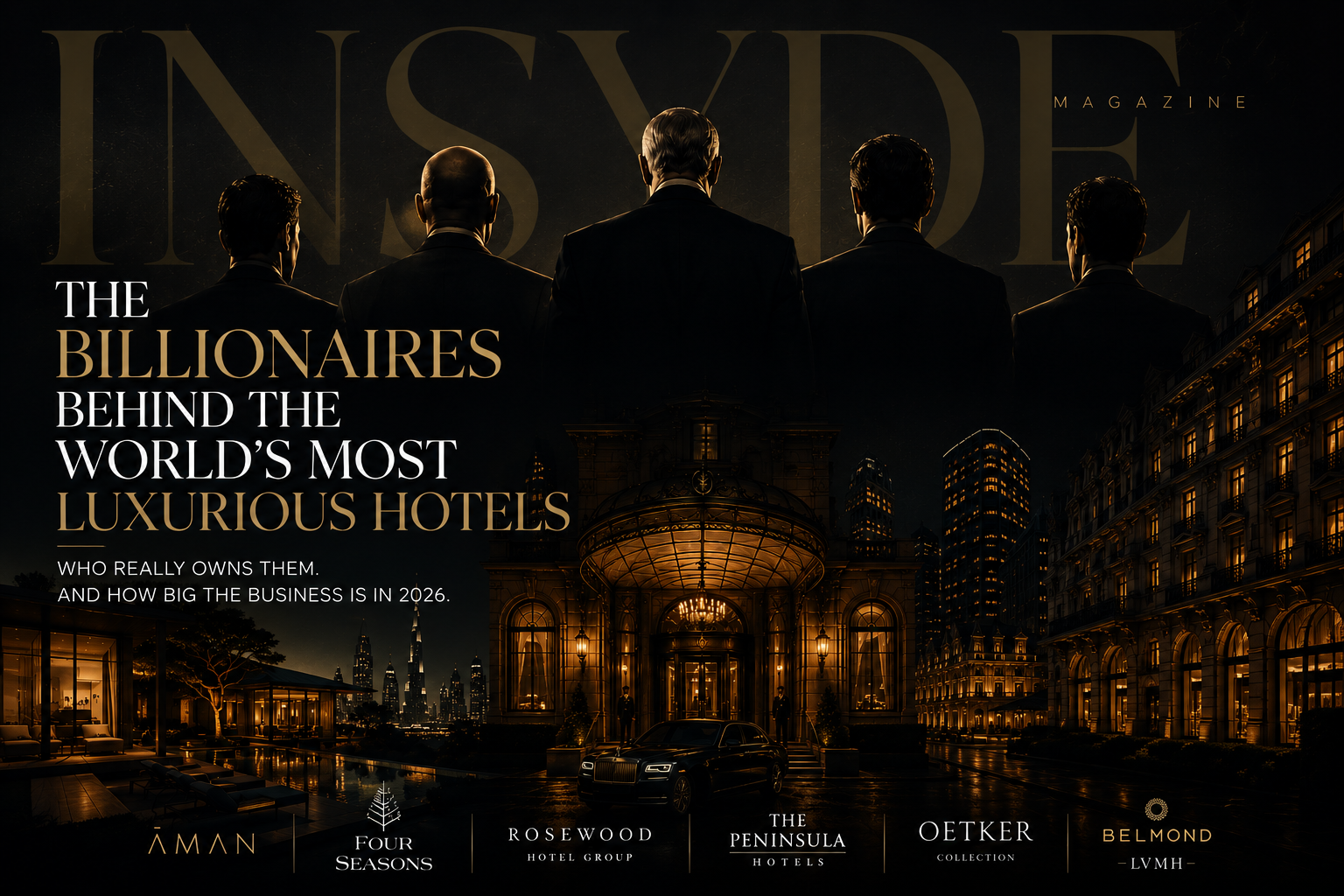
  • THE BILLIONAIRES BEHIND THE WORLD’S MOST LUXURIOUS HOTELS

    THE BILLIONAIRES BEHIND THE WORLD’S MOST LUXURIOUS HOTELS

    You know the hotel. You know the name. But do you know who actually owns the world behind it?

    Walk into one of the world’s great luxury hotels and you see the same things.

    Marble.

    Chandeliers.

    Immaculate suites.

    Private entrances.

    Restaurants where reservations can feel harder to secure than flights.

    Service so polished that almost everything appears effortless.

    But behind that effortless experience is a business most guests never think about.

    Who owns it?

    The answer is rarely as simple as the name above the entrance.

    A billionaire might own the hotel company.

    A family office might own the building.

    An investment fund might own the land.

    Another company might operate the property.

    And a global luxury group might own the brand and manage the experience.

    That complexity is not a technical footnote.

    It is the story.

    Because in 2026, some of the world’s most powerful fortunes are increasingly connected to the business of luxury hospitality.

    And the money involved is enormous.

    A $10 billion valuation for Four Seasons.

    A $3.2 billion enterprise-value acquisition of Belmond by LVMH.

    A $500 million new investment vehicle targeting Aman and Janu hotels, residences and mixed-use developments.

    A $230 million acquisition of Rosewood that helped turn it into a global luxury-hospitality group.

    These aren’t simply hotel deals.

    They are bets on the future of luxury itself.


    THE HOTEL YOU SEE IS ONLY THE FRONT END

    The first thing to understand about luxury hotels is that the brand and the building are not necessarily the same business.

    This is where the industry becomes fascinating.

    A hotel group can create the brand, design the service standards and manage the property without owning the real estate.

    A property company can own the building and hire a hotel company to operate it.

    An investment group can finance the development.

    And a billionaire can ultimately control the company sitting somewhere above all of them.

    So when someone says a billionaire “owns a hotel”, that can mean several different things.

    They may own:

    The hotel brand.

    The operating company.

    The property.

    The development company.

    Or simply a controlling stake in the company that controls the brand.

    At the top end of hospitality, understanding that distinction is essential.

    Because sometimes the most valuable thing in the building isn’t the building at all.

    It’s the name.


    AMAN: THE BILLIONAIRE WHO TURNED PRIVACY INTO AN EMPIRE

    Few names represent ultra-luxury quite like Aman.

    The brand began in 1988 with Amanpuri in Phuket and built its reputation around something that was almost the opposite of conventional luxury-hotel expansion:

    scarcity.

    Then came Vlad Doronin.

    The billionaire real-estate entrepreneur acquired Aman in 2014, after having been a long-time Aman guest himself. Since then, he has expanded the brand from secluded resorts into city hotels, residences, private clubs, interiors and new forms of travel.

    Aman has now grown into a global portfolio of hotels and resorts, while its ecosystem has expanded far beyond traditional hospitality.

    And then came the number that reveals where Aman is really heading.

    In July 2026, Doronin’s OKO Group announced a $500 million joint venture with Shinsegae Property to develop Aman and Janu hotels, branded residences and mixed-use properties.

    But the most striking part may be the residential business.

    Doronin told Bloomberg that Aman had sold close to $9 billion in branded residences over the previous four years, according to Forbes.

    Suddenly, Aman looks very different.

    It isn’t simply a company selling extraordinarily expensive hotel rooms.

    It is building a world where the same customer can stay at Aman, live at Aman, join Aman and eventually travel with Aman.

    The hotel becomes the entry point.

    The brand becomes the real asset.


    FOUR SEASONS: THE $10 BILLION BET

    If Aman represents scarcity, Four Seasons represents something else:

    global scale without abandoning luxury.

    Four Seasons is backed by Cascade Investment, associated with Bill Gates, alongside Kingdom Holding Company and founder Isadore Sharp.

    In 2021, Cascade agreed to acquire an additional 23.75% stake for $2.21 billion, taking its ownership to 71.25% and valuing Four Seasons at approximately $10 billion in enterprise value.

    That wasn’t a bet on one hotel.

    It was a bet on a global luxury machine.

    Four Seasons has continued expanding and says it has 135 hotels and resorts and 61 residential properties across 47 countries.

    And this is what makes the Four Seasons strategy so interesting.

    Aman tells the customer:

    You are entering a world very few people can access.

    Four Seasons tells the customer:

    You can expect an extraordinary standard wherever in the world you go.

    Two completely different interpretations of luxury.

    Both extraordinarily valuable.


    ROSEWOOD: THE $230 MILLION ACQUISITION

    Rosewood’s story demonstrates another way fortunes enter luxury.

    In 2011, Chow Tai Fook Enterprises, the Hong Kong company behind the Cheng family’s business empire, acquired Rosewood for roughly $230 million.

    The interesting part isn’t simply what they paid.

    It is what happened afterwards.

    Rosewood Hotel Group has expanded into a global hospitality platform, with 60 properties across 26 countries and territories and more than 30 additional properties in development.

    The group also operates other hospitality and lifestyle businesses.

    That makes Rosewood an important example of a larger trend:

    wealthy owners aren’t necessarily buying hotels to collect hotels.

    They’re buying brands that can be expanded across multiple categories.

    Hotels.

    Residences.

    Wellness.

    Private clubs.

    Experiences.

    And eventually, entire lifestyles.


    THE PENINSULA: WHEN LUXURY BECOMES A FAMILY LEGACY

    Then there is The Peninsula.

    Its story feels almost completely different.

    The Peninsula Hotels are part of Hongkong and Shanghai Hotels, a business with roots going back to 1866 and long associated with the Kadoorie family.

    Its chairman, Sir Michael Kadoorie, represents a very different model of luxury ownership: generational wealth.

    The Peninsula portfolio remains deliberately selective, with properties across major cities and destinations including Hong Kong, Shanghai, Tokyo, New York, London and Paris.

    This is not the story of a billionaire buying a trendy hospitality brand and rapidly multiplying its properties.

    It is something much older:

    generational ownership.

    That distinction matters.

    Because luxury isn’t always built through growth.

    Sometimes it is built through continuity.

    The Peninsula doesn’t need to be everywhere.

    Its power comes partly from the fact that it isn’t.


    OETKER: THE FAMILY BUSINESS BEHIND EUROPEAN HOTEL ROYALTY

    If there is one group that demonstrates the relationship between family wealth and luxury heritage, it is Oetker.

    Oetker Collection sits within the family-owned Oetker business, whose interests extend well beyond hotels.

    The group identifies Dr. Alfred Oetker and Ferdinand Oetker among its shareholders, while the wider family business spans multiple industries, including real estate and luxury hospitality.

    Its hotel portfolio includes names such as Le Bristol Paris and Hotel du Cap-Eden-Roc.

    And this is where luxury hospitality becomes different from almost every other industry.

    You can spend billions building a new hotel.

    But you cannot spend billions and instantly purchase a century of history.

    A historic address has something money alone cannot manufacture:

    memory.

    That is why heritage itself has become a luxury asset.

    You can construct a spectacular hotel in three years.

    You cannot manufacture decades of mythology.


    LVMH: WHEN THE LUXURY CONGLOMERATE ENTERS THE HOTEL BUSINESS

    Then there is the world’s ultimate luxury conglomerate.

    LVMH.

    The group already controlled brands across fashion, jewellery, watches, beauty and wine and spirits.

    Then it went deeper into hospitality.

    In 2018, LVMH agreed to acquire Belmond for $2.6 billion in equity value and $3.2 billion in enterprise value. The transaction was completed in 2019.

    Belmond brought with it hotels, restaurants, luxury trains and river cruises.

    That acquisition was important because it revealed a larger strategy.

    Luxury doesn’t have to mean selling a handbag.

    It can mean selling the entire journey surrounding the customer.

    A hotel.

    A train.

    A yacht.

    A destination.

    A restaurant.

    A fashion house.

    A piece of jewellery.

    Different products.

    One customer.

    One ecosystem.

    And in 2026, that strategy is becoming even more relevant as luxury groups push further into travel and experiential hospitality.


    THE BILLIONAIRE DOESN’T ALWAYS OWN THE HOTEL

    This is perhaps the most important part of the entire story.

    Imagine a luxury hotel carrying one of the world’s most famous names.

    The guest assumes the company behind that name owns everything.

    Not necessarily.

    The brand could belong to one company.

    The real estate could belong to another.

    The hotel operator could be a third.

    The financing could come from a fourth.

    And the ultimate investor could sit several layers above them.

    That structure is extremely common in modern hospitality.

    It allows hotel companies to expand without buying every building themselves.

    And it allows property investors to use powerful luxury brands to make their real estate more valuable.

    Which leads to perhaps the biggest transformation happening in luxury right now.


    THE REAL GOLDMINE: BRANDED RESIDENCES

    The hotel room is no longer necessarily the biggest prize.

    The residence might be.

    Luxury hotel brands are increasingly attaching their names to private residences.

    Why?

    Because selling a hotel room generates revenue from a stay.

    Selling a branded residence can create an enormous property transaction — while allowing the hotel company to earn branding, management and service fees without necessarily owning the entire building.

    Aman is one of the clearest examples.

    According to Forbes’ 2026 reporting, Aman has sold close to $9 billion in branded residences in four years, while Savills data cited in the same report indicated that buyers globally were willing to pay an average 33% premium for branded residences over comparable unbranded homes.

    That is a staggering proposition.

    Imagine buying an apartment.

    Now put a globally recognised luxury hotel brand on the front.

    Add hotel-level service.

    Concierge.

    Housekeeping.

    Wellness.

    Restaurants.

    Private clubs.

    Then charge a premium for the privilege.

    Suddenly the hotel brand is no longer just selling hospitality.

    It is selling real estate at a premium.


    WHY BILLIONAIRES WANT INTO HOSPITALITY

    So why would someone who already has billions want to own hotels?

    The obvious answer is money.

    But it isn’t the only answer.

    Luxury hospitality sits at an unusual intersection of industries.

    Real estate.

    Travel.

    Food.

    Fashion.

    Entertainment.

    Culture.

    Private wealth.

    A luxury hotel can become a meeting place for CEOs.

    A destination for celebrities.

    A home-away-from-home for billionaires.

    A platform for restaurants and chefs.

    A gateway into a city.

    A launchpad for branded residences.

    A private club.

    And a physical expression of a luxury brand.

    That makes the hotel much more powerful than a simple accommodation business.

    It becomes a social and commercial ecosystem.


    FROM ROOMS TO WORLDS

    This is where the luxury-hospitality business is ultimately heading.

    A hotel room was once the product.

    Then came the suite.

    Then the villa.

    Then the residence.

    Then the private club.

    Then the yacht.

    Then the private travel experience.

    The customer doesn’t necessarily want to buy one thing anymore.

    They want an entire world that feels consistent with their lifestyle.

    Aman understands this.

    Four Seasons understands this.

    LVMH understands this.

    Rosewood understands this.

    And the investors behind these companies understand something even more important:

    The luxury customer doesn’t stop being a luxury customer when they leave the hotel.

    So why should the brand stop selling to them?


    THE NEW LUXURY POWER PLAY

    This changes the economics of luxury.

    The most valuable hospitality brands aren’t necessarily the ones with the most rooms.

    They may be the ones that can convince customers to spend across the greatest number of categories.

    Stay at the hotel.

    Buy the residence.

    Join the club.

    Book the experience.

    Take the yacht.

    Return to another property.

    Bring the same brand into your lifestyle.

    That is a much bigger business than hotel occupancy.

    And it explains why billionaires, family fortunes and luxury conglomerates continue to look at hospitality as more than a place to park capital.

    They are buying access to a customer.


    SO, WHO REALLY OWNS LUXURY?

    There is no single answer.

    Vlad Doronin controls Aman.

    Cascade Investment is the controlling shareholder behind Four Seasons.

    The Cheng family’s Chow Tai Fook Enterprises controls Rosewood.

    The Kadoorie family sits behind The Peninsula’s long-running ownership structure.

    The Oetker family controls its luxury hospitality and wider family business.

    LVMH controls Belmond and has built a growing luxury-hospitality ecosystem around it.

    Different fortunes.

    Different generations.

    Different strategies.

    But they are all betting on the same fundamental idea:

    Luxury is becoming less about a product and more about an ecosystem.


    THE PEOPLE YOU NEVER SEE

    The guests are visible.

    The hotel is visible.

    The logo is visible.

    The billionaire behind the business usually isn’t.

    You won’t see them standing in the lobby.

    You probably won’t know which investment vehicle owns the building.

    You may never know which company controls the brand.

    And you certainly won’t see the spreadsheets behind the marble.

    But those decisions determine where the next hotel opens.

    Which neighbourhood becomes fashionable.

    Which destination receives billions in development.

    Which brands remain exclusive.

    Which become global.

    And which luxury experiences become available only to those who can afford them.

    That is the hidden side of hospitality.

    Not the room.

    Not the restaurant.

    Not the view.

    The ownership.

    Because the next time you walk into one of the world’s most luxurious hotels, look beyond the chandelier.

    Ask who owns the building.

    Who owns the brand.

    Who operates it.

    Who financed it.

    And who stands to benefit when the world’s wealthiest people decide they want to stay there.

    Because sometimes, the most interesting person in the hotel…

    is the one you never see.

    INSYDE — Beyond the Spotlight.

  • Bengaluru’s New Luxury: How the City Learned to Spend Differently

    Bengaluru’s New Luxury: How the City Learned to Spend Differently

    The city’s relationship with luxury is changing. Beyond logos and excess, Bengaluru is building a more considered culture of premium living—shaped by design, privacy, experience and a new generation of affluent consumers.

    There was a time when Bengaluru’s idea of success was relatively straightforward.

    A good career. A successful company. A home in a desirable neighbourhood. Perhaps a luxury car parked outside it.

    But the city has become wealthier, more global and considerably more sophisticated—and its relationship with luxury is evolving with it.

    Today, luxury in Bengaluru is increasingly less about simply owning something expensive and more about how one lives.

    A beautifully designed residence. A restaurant where the experience matters as much as the plate. A private club. A watch chosen for its craftsmanship rather than its recognisability. A fashion label that feels personal rather than obvious.

    It is a subtle shift, but an important one.

    Bengaluru is developing its own language of luxury.

    From Technology Wealth to Lifestyle Wealth

    For years, Bengaluru’s economic identity was dominated by technology.

    The city became synonymous with startups, software, multinational corporations and a generation of entrepreneurs who accumulated wealth differently from the traditional industrial and business families of older Indian metros.

    That wealth is now influencing the city’s consumption patterns.

    Bengaluru’s luxury market is no longer restricted to a small group of established families. Startup founders, CXOs, entrepreneurs, global Indians and high-net-worth professionals are becoming an increasingly visible part of the premium consumer landscape.

    The transformation is particularly clear in real estate.

    In FY2025, Bengaluru’s market for homes priced at ₹10 crore and above crossed ₹1,000 crore in annual sales for the first time. According to data from India Sotheby’s International Realty and CRE Matrix, 78 such homes were sold during the year, compared with 51 the previous year, while 42% of the city’s ₹10 crore-plus sales over the preceding four years occurred in FY2025 alone.

    The numbers are significant. But what matters more is what they reveal about the consumer behind them.

    The purchase of a luxury home is increasingly being framed around more than an address or an investment. Space, privacy, design, amenities and quality of life are becoming part of the proposition.

    Bengaluru is, in other words, becoming a city where wealth increasingly seeks quality of life.

    The New Luxury Is More Private

    Luxury has traditionally relied on visibility.

    The logo. The statement piece. The grand entrance.

    But contemporary luxury is moving in another direction.

    For an increasingly sophisticated consumer, exclusivity can mean something much quieter: an address with limited access, architecture that does not need to announce itself, personalised service, rare materials, thoughtful interiors or simply the freedom to enjoy something without an audience.

    This shift is particularly visible in Bengaluru’s premium residential market.

    The city’s high-end housing segment has seen strong price appreciation, while newer developments are increasingly competing through specifications, amenities, sustainability and future-ready design. In H1 2025, under-construction premium homes in Bengaluru recorded capital-value growth of roughly 32–35% year-on-year, according to Fortune India’s reporting on market data.

    The implication is clear.

    Luxury is becoming less about bigger and more about better.

    A City Learning to Buy Experiences

    The same shift extends beyond property.

    Luxury hospitality, fine dining, premium retail, wellness and entertainment are increasingly competing for the same consumer: someone willing to pay more when the experience feels distinctive.

    This matters because modern luxury is rarely confined to a product.

    A luxury restaurant is selling atmosphere, service, design and memory alongside food.

    A premium fashion boutique is selling curation and personal attention alongside clothing.

    A high-end residence is selling privacy, architecture, convenience and community alongside square footage.

    And a luxury hotel is selling a temporary version of a lifestyle.

    The wider Indian luxury market is moving in the same direction. Industry research has identified experiential categories—including fine dining, travel, hospitality and wellness—as increasingly important to affluent consumers, while luxury brands continue expanding their physical presence across India’s major cities.

    Bengaluru is particularly well placed for this evolution.

    It has the wealth, international exposure and young professional population to support it—and a consumer base increasingly comfortable moving between global and Indian ideas of luxury.

    The Bengaluru Consumer Doesn’t Need Everything to Look Expensive

    Perhaps the most interesting part of Bengaluru’s luxury story is that it does not necessarily resemble the traditional image of Indian affluence.

    Mumbai has its unmistakable glamour.

    Delhi has its grander, more visibly opulent side.

    Bengaluru has historically been more understated.

    The city’s relationship with fashion reflects this personality. A consumer might move between a technology office, a contemporary restaurant, an art space and a luxury retail environment in the same week.

    That creates a consumer who is not necessarily looking for one fixed definition of status.

    Instead, there is a growing appetite for curated luxury.

    A well-made garment.

    A beautifully designed home.

    A rare watch.

    A destination dinner.

    A thoughtfully planned weekend.

    A piece of art.

    A car that reflects taste rather than simply price.

    The common thread is discernment.

    And discernment is increasingly becoming one of luxury’s most valuable currencies.

    Bengaluru’s Luxury Map Is Expanding

    The geography of premium Bengaluru is changing too.

    Central Bengaluru remains synonymous with some of the city’s most established luxury addresses, while newer premium developments are expanding the map into emerging and well-connected micro-markets.

    That expansion is visible in the residential market. Bengaluru’s ₹10 crore-plus housing demand is no longer confined to a handful of traditional luxury neighbourhoods; the FY2025 data highlighted markets including Hebbal, Domlur, Sudhamnagar and Bommanahalli, with Hebbal accounting for 22% of luxury sales value among the high-end markets tracked in the report.

    This creates an interesting tension.

    Bengaluru’s old luxury is rooted in location, heritage and scarcity.

    Its new luxury is increasingly built around design, technology, convenience and experience.

    The future will likely be defined by the meeting point between the two.

    The Business of Becoming Luxury

    For brands, this shift matters.

    A growing luxury consumer base creates opportunities well beyond residential real estate. Fashion, jewellery, watches, automobiles, hospitality, restaurants, wellness, interiors and premium entertainment all compete for a consumer whose expectations are becoming more sophisticated.

    India’s luxury retail market is already expanding rapidly. Luxury and bridge-to-luxury brands accounted for a significant increase in retail leasing activity in 2025, reflecting an aggressive push by brands to capture India’s growing affluent consumer base.

    Bengaluru is part of that story—and increasingly, it is becoming an important market within it.

    The city’s retail environment is also evolving. In 2024, Bengaluru led retail space absorption among India’s top eight cities, while the wider retail landscape increasingly shifted towards destinations combining shopping, dining and entertainment.

    That convergence is important.

    The future of luxury may not be a store, a restaurant, a hotel or a residence in isolation.

    It may be the ecosystem around them.

    A neighbourhood where fashion, food, art, hospitality and design exist within the same cultural orbit.

    A place where consumers do not simply purchase products—they participate in a lifestyle.

    What Comes Next

    The most interesting question is no longer whether Bengaluru will become a luxury city.

    It already is.

    The more important question is what kind of luxury city it will become.

    Bengaluru has the economic foundation, entrepreneurial wealth and increasingly sophisticated consumer base to become one of India’s defining premium markets.

    But its opportunity lies in doing luxury differently.

    Not louder.

    Not necessarily bigger.

    Better.

    More personal. More experiential. More design-conscious. More connected to the way people actually want to live.

    For a city built on innovation, perhaps that is the most natural evolution of all.

    Bengaluru’s new luxury is not simply about having more.

    It is about having better—and knowing why it matters.

    — INSYDE Editorial