Category: Fashion Business

The brands, strategies and business stories behind the fashion industry.

  • Jaya Misra: The Making of a  Modern Indian Fashion Language

    Jaya Misra: The Making of a Modern Indian Fashion Language

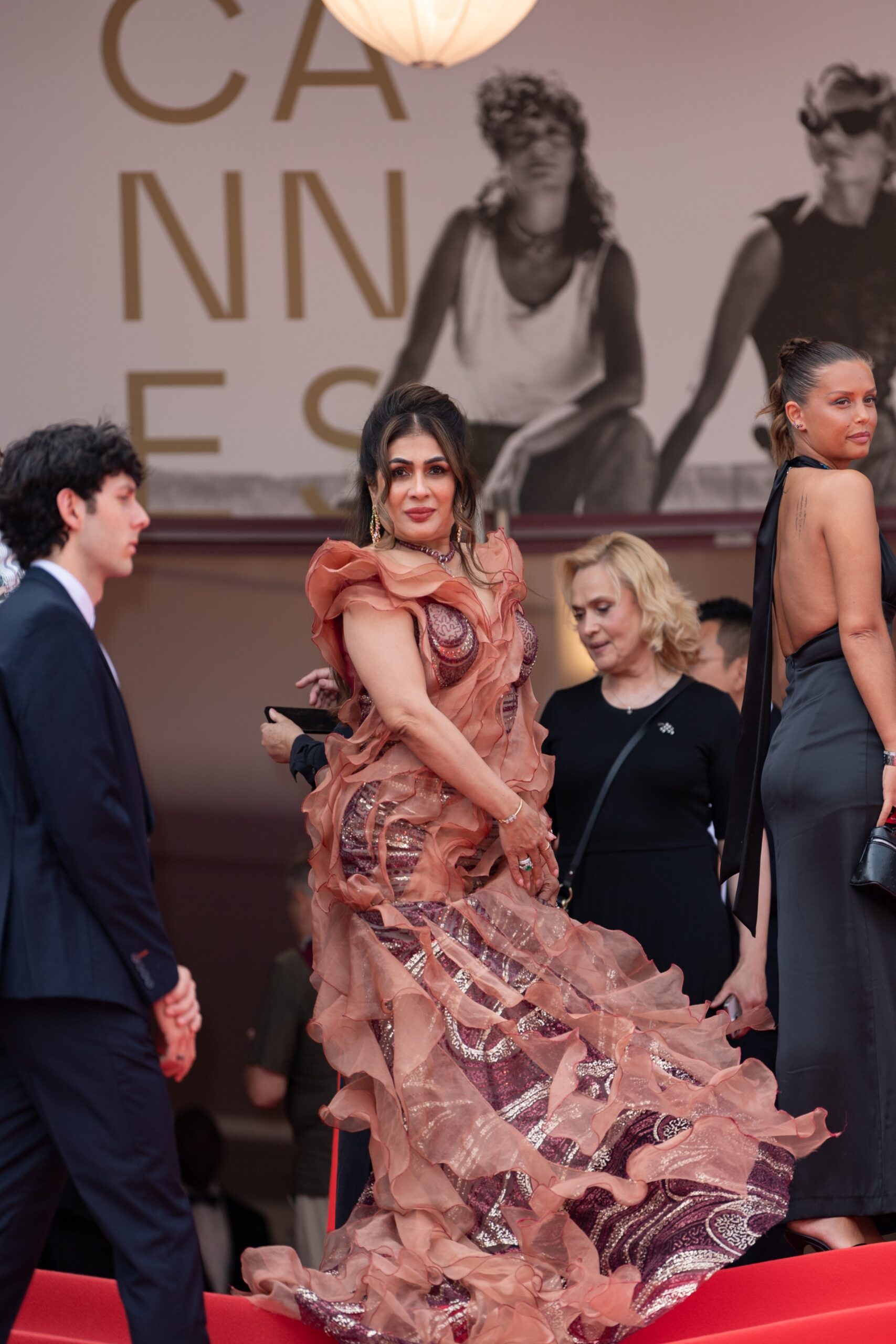
    Jaya Misra at the Cannes Film Festival,

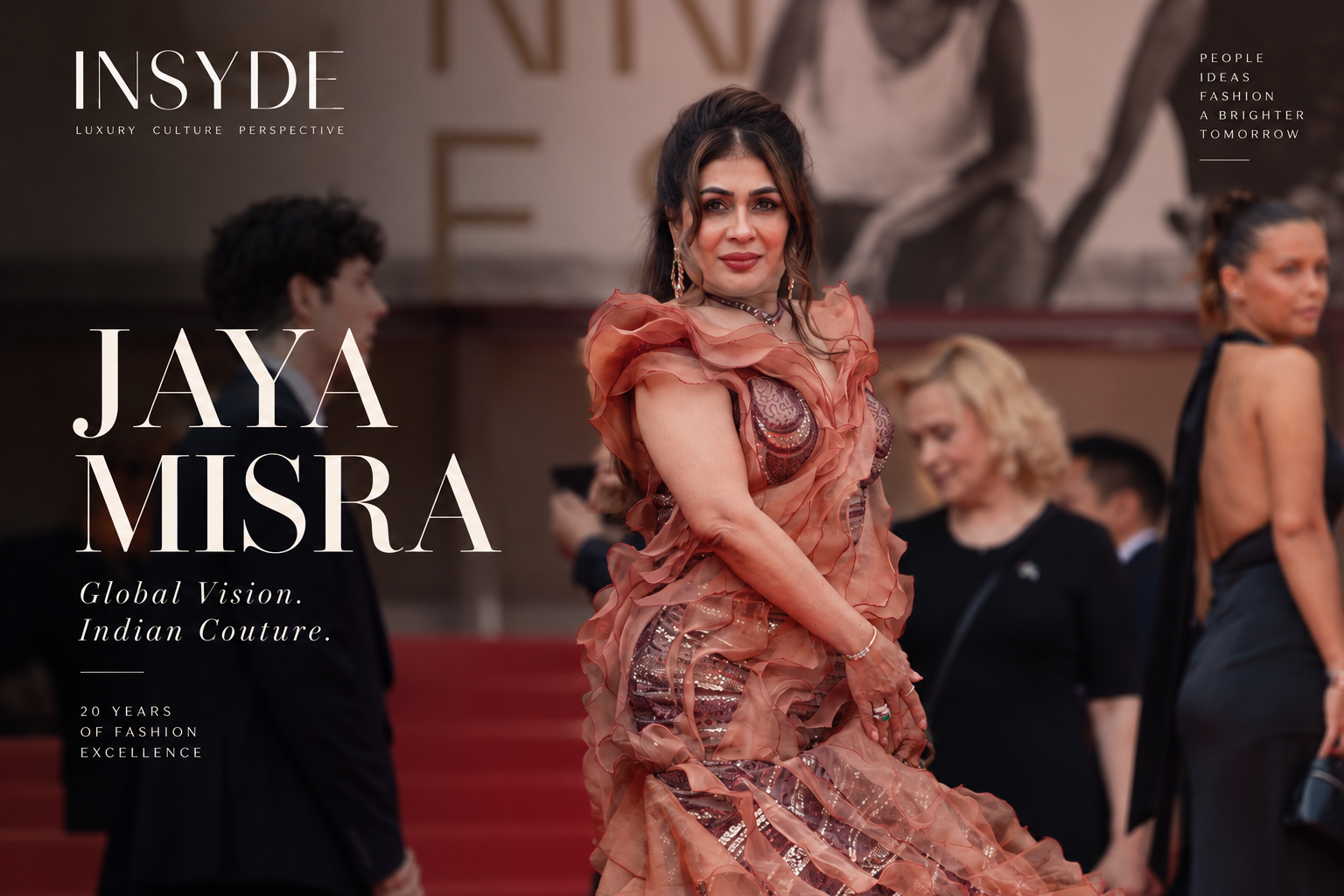
    As Jaya Misra marks 20 years in fashion, the designer reflects on Indian identity, global ambition, craftsmanship, personal style and why the future of fashion may depend on knowing when to say less.

    Indian fashion is having a global moment.

    But the conversation around it is changing.

    For decades, international perceptions of Indian fashion were often reduced to a familiar vocabulary: elaborate embroidery, vivid colour, weddings, traditional silhouettes and the extraordinary work of its artisans.

    Those elements remain important. But they were never the whole story.

    India possesses one of the world’s richest design languages — shaped by textiles, regional craftsmanship, architecture, jewellery, history and generations of accumulated knowledge. Increasingly, Indian designers are taking those foundations into contemporary territory, creating work that can speak to an international audience without surrendering its identity.

    For Jaya Misra, that distinction is fundamental.

    “I have always believed that we do not need to become Western to be international. We can take something deeply Indian and give it a modern expression.”

    It is an idea that has accompanied her through two decades in fashion.

    In 2026, Jaya Misra India marks 20 years since its establishment. A graduate of NIFT, Jaya founded the house in 2006 and has since presented her work across national and international fashion platforms, with showcases spanning cities including Milan, New York, London, Dubai, Tokyo, Toronto and Vancouver. Her career has also included serving as an official designer for Femina Miss India and working across multiple international couture and fashion showcases.

    But after twenty years, the more interesting question is not simply where Indian fashion has travelled.

    It is what Indian fashion is becoming.

    Indian, Without Explanation

    For a long time, Indian fashion was introduced to the world through its most recognisable elements.

    Colour. Embroidery. Weddings. Ornamentation.

    Jaya believes that perception is becoming more nuanced.

    “Indian fashion is so much more than that,” she says, pointing to the country’s textiles, craftsmanship and techniques passed down through generations.

    The shift, she believes, is happening as designers begin presenting those traditions through a contemporary language that feels relevant around the world.

    There is still a tendency, she acknowledges, to measure luxury against Western standards. But that is gradually changing as Indian fashion becomes more confident in defining its own value.

    That distinction matters.

    Global relevance does not have to mean cultural translation.

    Indian fashion does not need to become Western in order to become international.

    Its challenge may instead be to become more confident about what is already uniquely its own — and to find new ways of expressing it.

    The goal is not simply to make Indian fashion visible.

    It is to make it understood on its own terms.
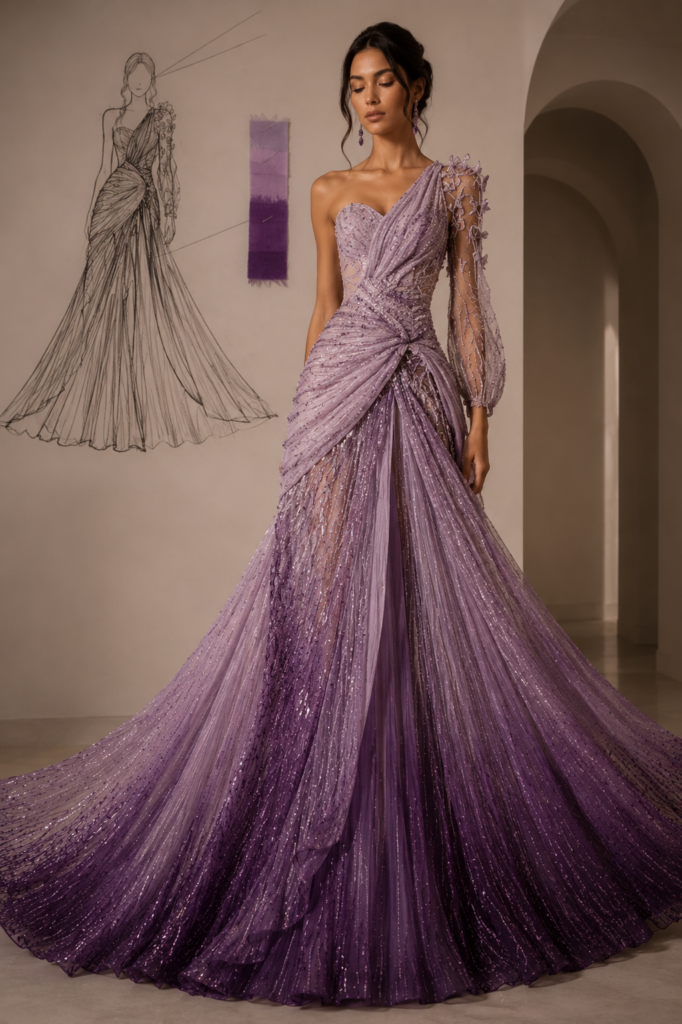
    When Heritage Is Allowed to Move

    Fashion has always had a complicated relationship with tradition.

    Preserve it too rigidly and it can become something admired rather than lived. Change it too completely and the knowledge behind it can disappear.

    For Jaya, evolution is part of preservation.

    “For me, preservation does not mean freezing something in time.”

    A traditional craft, she believes, needs room to move.

    A historic weave can become a contemporary jacket, corset or gown. An established technique can enter an unexpected silhouette without losing the heritage from which it came.

    The form can change.

    The essence should remain.

    But there is one boundary she considers essential: respect for the maker.

    “Evolution should never erase the artisan or the story behind the craft.”

    That places craftsmanship somewhere beyond decoration. The artisan is not simply part of a production process; the knowledge, patience and human skill behind the technique are part of the value of the final piece.

    For Indian fashion, keeping craft alive may therefore depend not on protecting it from change, but on giving it enough relevance to continue being worn, interpreted and desired.

    Tradition survives not only when it is preserved.

    Sometimes, it survives because it is allowed to evolve.

    The Luxury of Time

    Luxury has accumulated plenty of definitions.

    Price. Exclusivity. Rarity. Status.

    Jaya’s understanding is quieter.

    “For me, luxury is not defined by a price tag.”

    Instead, she associates it with time, craftsmanship, individuality and intention.

    That perspective feels particularly relevant in an industry increasingly shaped by immediacy.

    Fashion moves quickly. Trends appear and disappear almost overnight. Digital platforms encourage constant consumption, constant visibility and constant newness.

    Against that speed, something made slowly begins to feel almost radical.

    “Something handmade, created especially for you or marked by the subtle imperfections of the human hand has a unique soul.”

    But there is another form of luxury that cannot be measured through material value.

    Memory.

    “If a garment makes you feel powerful, beautiful or connected to a memory, its value goes far beyond its price,” she says.

    A couture garment can therefore become more than an object of consumption. It can become part of an experience, a milestone or a personal history.

    Perhaps that is why craftsmanship continues to matter.

    It gives an object something mass production struggles to replicate:

    a sense of having been made for a person rather than simply made for a market.

    The Problem With Seeing Everything

    Social media has changed fashion more radically than almost any runway could.

    A designer can now be discovered by someone thousands of kilometres away without passing through the traditional gatekeepers of the industry. Emerging talent can build an audience independently, while consumers have access to more fashion than ever before.

    Jaya sees that democratisation as a positive development.

    But accessibility has created its own contradiction.

    When everyone is looking at the same images, references can begin to converge.

    “The same silhouette, styling and trend can appear everywhere almost overnight.”

    The result is an industry with more access but, sometimes, less distinction.

    In that environment, personal style becomes less about knowing what is trending and more about knowing what feels authentic.

    “Personal style begins when you stop asking, ‘What is everyone wearing?’ and start asking, ‘What feels authentic to me?’”

    It is a question that extends beyond clothing.

    When algorithms can constantly tell us what to see, buy and desire, individuality requires a degree of resistance.

    Fashion can inspire you.

    It should not have to define you.
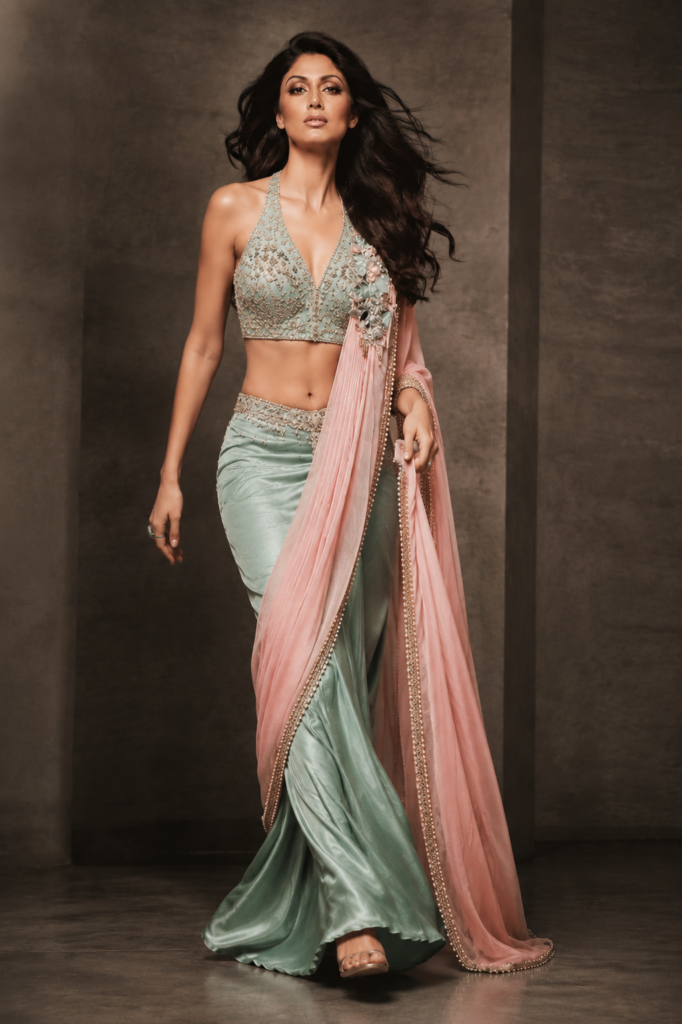
    Indian by Instinct

    Should an Indian designer have a responsibility to represent Indian culture?

    Jaya does not believe creativity should come with a compulsory assignment.

    An Indian designer should be free to create something minimal, futuristic, Western, traditional or experimental.

    “Creativity needs freedom.”

    Yet freedom from obligation does not mean freedom from influence.

    India’s textiles, embroideries, colours, architecture, jewellery, history and crafts inevitably form part of the visual memory of someone who grows up within that environment.

    “So even when I create something highly international, my Indian sensibility often comes through,” she says.

    “I do not have to force it; it is already an intrinsic part of who I am.”

    There is something significant in that idea.

    Identity does not always need to be announced to be present.

    For a designer working between Indian heritage and contemporary global silhouettes, being Indian does not necessarily mean reproducing recognisable symbols of India.

    Sometimes it is simply part of the way one sees.

    The Case for Editing

    Indian fashion has never struggled to make an entrance.

    Drama, colour, surface, craftsmanship and occasion are among its natural strengths. On a red carpet or international platform, that visual confidence can be extraordinarily powerful.

    But Jaya believes the next stage of India’s global fashion story may require a different skill.

    Editing.

    “Sometimes, we assume that showcasing craftsmanship means showing everything at once.”

    Her counterargument is particularly relevant to contemporary luxury: restraint can communicate just as much as abundance.

    “A single extraordinary detail can sometimes say more than twenty.”

    It is a deceptively simple observation in an industry where more is often mistaken for more luxurious.

    India already possesses extraordinary craftsmanship. The challenge now is not proving that it exists.

    The challenge is how it is presented.

    Jaya argues that Indian fashion needs stronger global business structures, presentation, communication and consistency.

    “Talent is not our challenge; we have an abundance of it.”

    That may be one of the most important questions facing Indian fashion today.

    The next chapter may be less about proving what India can create and more about deciding how that creativity is edited, positioned and communicated to the world.

    Jaya Misra at the House of Lords, London

    Dream First. Then Find the Woman.

    Every designer eventually confronts the tension between creativity and commercial reality.

    Focus too heavily on commerce and creative identity can disappear. Create only for yourself and the relationship with the person wearing the garment can become distant.

    Jaya sees the two as a dialogue.

    “I like to create a dream first. Then I ask myself: how can a real woman enter that dream?”

    The runway can remain dramatic and imaginative while its essence is translated into something that can exist beyond the show — a jacket, saree, dress or another silhouette.

    The idea begins as fantasy.

    The wearer gives it a life.

    That balance is particularly important in couture, where the distance between spectacle and reality can be enormous.

    The most successful design does not necessarily force the customer into the designer’s imagination.

    It gives the customer a way into it.

    A Generation in a Hurry

    Looking toward the future, Jaya is optimistic about the fearlessness of younger designers.

    Today’s generation has access to global references almost instantly. They experiment with gender, technology, sustainability, textiles, silhouettes and storytelling, while rediscovering Indian crafts through increasingly unconventional approaches.

    But that access also comes with pressure.

    Everything is expected to happen faster.

    Collections. Trends. Content. Recognition.

    “There can be enormous pressure to succeed before you have had the chance to discover who you are as a designer.”

    For Jaya, identity cannot be rushed.

    “A strong identity takes time.”

    After two decades in fashion, she says she is still learning, evolving and discovering new possibilities.

    That process, she believes, never really ends.

    Perhaps that is the most revealing lesson in her twenty years of fashion.

    Longevity is not simply about remaining relevant.

    It is about continuing to evolve without losing the thread that makes the work recognisably yours.

    Her advice to the next generation is therefore less about visibility than substance:

    “Do not be so eager to be seen that you forget to develop something worth remembering.”

    It is a thought that feels particularly relevant in an industry where visibility can arrive instantly and disappear just as quickly.

    Because ultimately, Jaya’s understanding of fashion is not about creating a moment.

    It is about creating a language.

    An identity.

    A body of work.

    Something that can travel across borders without losing its origin, evolve without abandoning its memory, and remain unmistakably its own.

    For Jaya Misra, Global Vision and Indian Couture are not opposing ideas.

    They are part of the same conversation.

    And after twenty years, that conversation is still evolving.


    JAYA MISRA INDIA

    Jaya Misra — Founder & Creative Director

    20 Years of Fashion Excellence · 2006–2026

    Design Signature: Modern Indian Couture · Heritage Textiles & Indian Craftsmanship · Contemporary Draping & Global Silhouettes · Luxury with Individuality · Tradition Reimagined for the Modern Woman

    Brand Philosophy: Global Vision. Indian Couture.

    INSYDE Exclusive
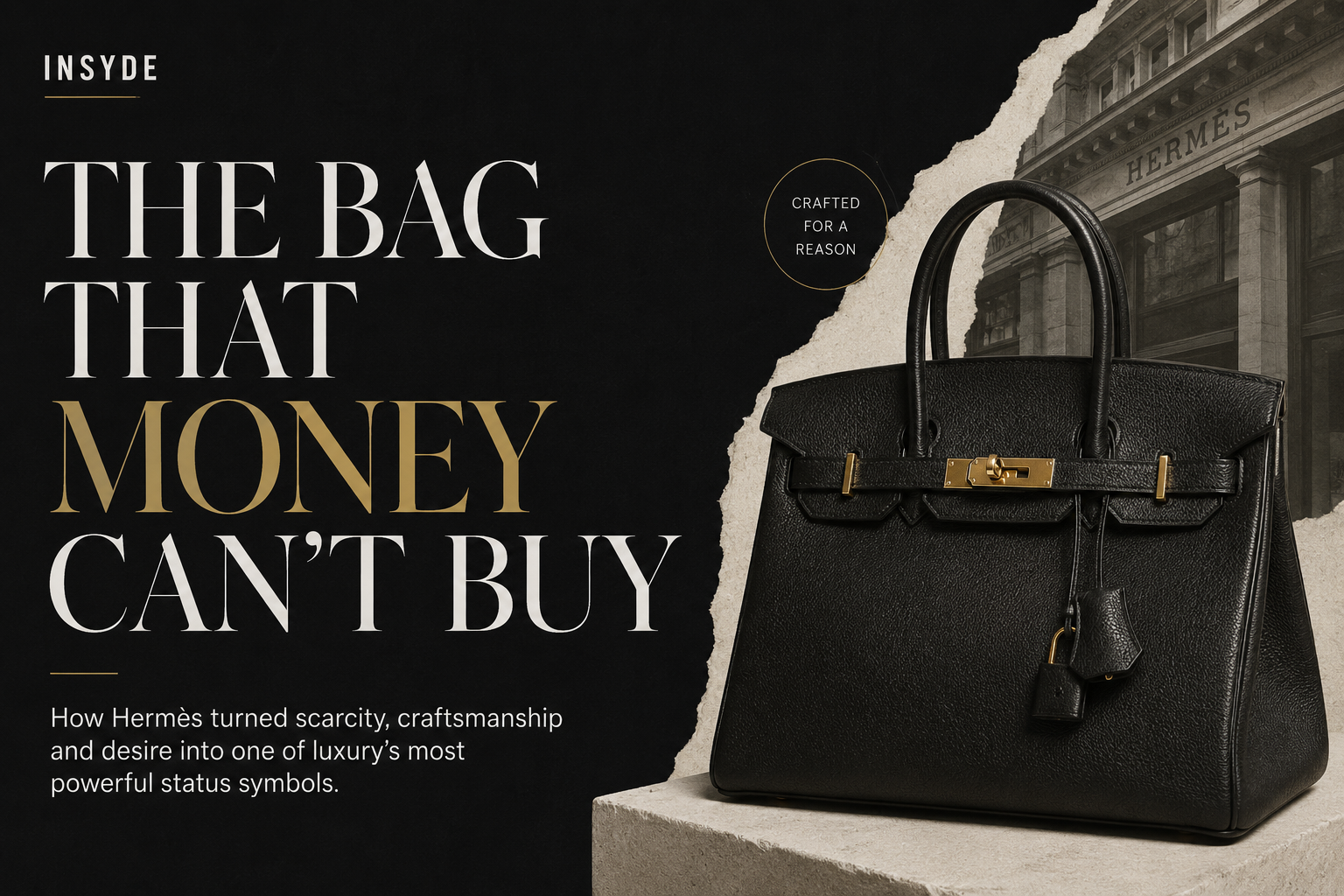
  • THE BAG THAT MONEY CAN’T BUY

    THE BAG THAT MONEY CAN’T BUY

    How Hermès turned scarcity, craftsmanship and desire into one of luxury’s most powerful status symbols.

    There are handbags that cost hundreds.

    There are handbags that cost thousands.

    And then there is the Hermès Birkin — a handbag so deeply embedded in the language of luxury that its price is no longer the most interesting thing about it.

    The real question is much simpler:

    What happens when having the money still doesn’t guarantee that you can have the thing you want?

    That is where Hermès becomes fascinating.

    Because luxury has traditionally followed a straightforward formula:

    More money. Better things.

    Hermès built something more complicated:

    More money gives you access to luxury. But it doesn’t necessarily give you access to everything.

    And that distinction transformed a handbag into something far bigger than a fashion accessory.

    The Birkin became a symbol of wealth, yes.

    But also of taste.

    Scarcity.

    Craftsmanship.

    Access.

    And, perhaps most importantly, desire.

    Because when something is difficult to obtain, the price is only the beginning of the story.


    THE BAG WAS NEVER DESIGNED TO BECOME A STATUS SYMBOL

    The origin of the Birkin is almost too ordinary for the mythology that eventually surrounded it.

    In 1984, British actress and singer Jane Birkin found herself seated next to Jean-Louis Dumas, then chairman and chief executive of Hermès, on a flight from Paris to London.

    Birkin explained that she couldn’t find a leather bag that worked for her as an everyday carryall.

    Dumas listened.

    The idea evolved into a new handbag.

    The Birkin was born.

    There was no grand plan to create one of the world’s most recognisable symbols of extreme wealth.

    It began with functionality.

    Make it practical.

    Make it beautiful.

    Make it exceptionally well.

    The mythology came later.

    And that may be one of the most important details in the entire story.

    Because Hermès didn’t begin by manufacturing status.

    It manufactured quality.

    Status followed.


    HERMÈS WAS BUILDING LUXURY LONG BEFORE THE BIRKIN

    To understand why the Birkin became so powerful, you have to go back much further.

    Hermès was founded in Paris in 1837 by Thierry Hermès, originally as a workshop producing harnesses and other equestrian equipment.

    Its early clientele included members of Europe’s wealthy and aristocratic society.

    As transportation changed, Hermès changed with it.

    The company moved into bags, luggage, silk, fashion, jewellery and other categories while maintaining a central commitment to craftsmanship.

    That history matters.

    Because the Birkin didn’t create Hermès’ luxury reputation.

    Hermès’ reputation created the environment in which the Birkin could become legendary.

    The bag arrived with decades of credibility already behind the name.


    THE REAL LUXURY IS IN THE MAKING

    A Birkin is not valuable simply because it carries the Hermès name.

    The construction itself is part of the story.

    Hermès leather goods are made by highly trained artisans, with the house emphasising manual craftsmanship and individual attention throughout the production process. The company says leather artisans undergo extensive training before becoming fully qualified.

    The leather is selected carefully.

    Pieces are cut and prepared.

    Edges are finished.

    Hardware is fitted.

    Stitching is performed by hand.

    And the artisan’s work becomes part of the character of the finished bag.

    This is important because modern luxury often creates the illusion of infinite choice.

    Hermès does something different.

    It reminds the customer that human time is finite.

    A skilled artisan can only make so many pieces.

    A particular material can only exist in a certain quantity.

    A particular finish requires a certain amount of attention.

    And suddenly, scarcity isn’t just a marketing strategy.

    It is built into the production process.


    THE DIFFERENCE BETWEEN EXPENSIVE AND EXCLUSIVE

    This is where the Birkin story becomes particularly interesting.

    An expensive product asks:

    Can you afford it?

    An exclusive product asks:

    Can you get it?

    Those are completely different questions.

    A wealthy customer can have the financial means to purchase a Birkin and still not be able to walk into a boutique and simply select any model, colour or leather they want.

    Availability varies.

    Relationships matter.

    Specific pieces are limited.

    And the exact bag someone wants may not be waiting behind the counter.

    That creates a psychological effect that money cannot completely eliminate:

    anticipation.

    You want it.

    You search for it.

    You wait.

    And the longer the desire survives, the more emotionally valuable the eventual acquisition can become.


    WHEN “NO” BECOMES PART OF THE LUXURY

    Modern commerce has been built around convenience.

    See it.

    Click it.

    Buy it.

    Tomorrow, it’s at your door.

    Luxury operates differently.

    At its highest level, friction can become part of the experience.

    The wait.

    The discovery.

    The relationship.

    The invitation.

    The moment when the right piece finally appears.

    That is a radical idea in a world obsessed with instant gratification.

    Hermès doesn’t need to make the Birkin feel like something everyone can have immediately.

    In fact, the opposite can make the product more desirable.

    The less ordinary the acquisition feels, the less ordinary the object can feel.

    The purchase becomes an event.


    THE BOUTIQUE ISN’T JUST A STORE

    This is another important distinction.

    For most consumer products, the store exists to facilitate the transaction.

    In luxury, the environment is part of the product.

    The boutique.

    The service.

    The packaging.

    The conversation.

    The anticipation.

    The feeling of discovering something rather than simply ordering it.

    These details matter because luxury is fundamentally emotional.

    A customer isn’t only purchasing leather and hardware.

    They’re purchasing an experience around the object.

    And Hermès has spent generations protecting that experience.


    THEN THE BIRKIN BECAME A CULTURAL SYMBOL

    The bag’s transformation accelerated as it became associated with celebrities, socialites, entrepreneurs and some of the world’s wealthiest consumers.

    Its shape became recognisable.

    Its hardware became recognisable.

    Its name became recognisable.

    The Birkin became something you could identify without seeing the logo.

    That is powerful branding.

    Hermès didn’t need to cover the bag in enormous symbols.

    The silhouette did much of the work.

    And this created an interesting form of status:

    the people who knew, knew.

    The bag could be visible without being loud.

    It could communicate wealth without announcing a price.

    It could sit quietly on an arm while carrying an enormous amount of cultural meaning.


    WHY THE BIRKIN DOESN’T NEED A GIANT LOGO

    Modern luxury has spent decades teaching consumers to recognise logos.

    Hermès took a different route.

    The Birkin’s identity comes from its proportions, construction, hardware, craftsmanship and association with the house.

    That makes the bag part of a more sophisticated form of luxury communication.

    A large logo says:

    Look at the brand.

    A recognisable object can say:

    If you know, you know.

    And that distinction has become increasingly relevant as luxury consumers become more interested in subtlety, provenance and craftsmanship.

    The most sophisticated status signal isn’t necessarily the loudest one.

    Sometimes it is the thing only a certain audience recognises.


    THEN THE SECONDARY MARKET CHANGED THE GAME

    The Birkin became even more fascinating when it entered the world of resale and collecting.

    Certain colours.

    Certain leathers.

    Certain sizes.

    Certain years.

    Exceptional condition.

    Rare examples.

    All can influence desirability in the secondary market.

    Some Birkins have sold for extraordinary sums at auction, particularly rare or historically significant examples.

    But there is an important distinction:

    A Birkin is not automatically an investment.

    The resale market is influenced by condition, provenance, rarity, demand and market conditions.

    The existence of a strong secondary market doesn’t guarantee appreciation.

    But it does demonstrate something important.

    The Birkin can exist simultaneously as:

    a handbag,

    a collectible,

    a status symbol,

    and a cultural asset.

    That is an extraordinary amount of meaning for an object originally designed to carry personal belongings.


    THE PSYCHOLOGY OF SCARCITY

    Why does scarcity work?

    Because humans don’t always value things according to their practical usefulness.

    When something is limited, difficult to obtain or perceived as disappearing, its psychological value can increase.

    Luxury brands have understood this for generations.

    But scarcity only works when the underlying product deserves desire.

    Make something rare without making it desirable and you have nothing.

    Hermès combined the two.

    Exceptional craftsmanship created the desire.

    Limited availability intensified it.

    And the result became a self-reinforcing cycle.

    Desire creates demand.

    Demand reinforces scarcity.

    Scarcity increases desirability.

    And the cycle continues.


    THE MOST POWERFUL WORD IN LUXURY

    No.

    No mass-market production.

    No constant discounting.

    No desperate promotions.

    No need to make every product available to everyone immediately.

    That ability to say no is one of the most powerful tools a luxury brand can possess.

    Because the moment a luxury product becomes permanently available at a discount, something changes.

    The consumer stops asking:

    “Can I get it?”

    and starts asking:

    “Should I buy it?”

    Hermès has spent decades making the first question more important.

    And that is incredibly powerful.


    WHEN THE BAG BECAME CULTURAL CURRENCY

    Eventually, owning a Birkin stopped being solely about owning an exceptional handbag.

    It became a form of cultural knowledge.

    You could recognise the bag.

    Understand the leather.

    Understand the construction.

    Understand why one version might attract more attention than another.

    Understand why rarity matters.

    That knowledge becomes part of the luxury experience.

    And suddenly, the Birkin communicates something beyond financial capability.

    It can communicate:

    I know this world.

    That’s cultural capital.

    And cultural capital is one of the most powerful currencies in luxury.


    HERMÈS DOESN’T NEED TO CHASE THE MOMENT

    Fashion is built around change.

    New season.

    New collection.

    New trend.

    New colour.

    New obsession.

    Luxury operates on a different clock.

    Hermès has the advantage of being able to build on heritage rather than constantly replacing it.

    The Birkin doesn’t need to become radically different every season.

    Its enduring appeal comes partly from consistency.

    The design can evolve.

    Materials can vary.

    Colours can change.

    But the underlying identity remains recognisable.

    That gives the brand something most fashion businesses desperately want:

    timelessness.


    THE BAG MONEY ALONE CAN’T GUARANTEE

    This is where the title becomes meaningful.

    The Bag That Money Can’t Buy.

    Of course money matters.

    A Birkin is a luxury purchase, and financial ability is an obvious part of accessing the category.

    But money isn’t the entire equation.

    There is availability.

    There is demand.

    There is craftsmanship.

    There is scarcity.

    There is knowledge.

    There is patience.

    There is the relationship with the house.

    And there is something even more important:

    desire.

    Because a luxury brand’s greatest achievement isn’t convincing you that you need its product.

    It’s convincing you that you want this particular product.

    Even when you could buy something else.


    WHEN THE WAIT BECOMES PART OF THE PRODUCT

    Think about the psychology.

    If something arrives tomorrow, you enjoy it tomorrow.

    If you’ve spent months wanting something, searching for it and imagining owning it, the moment you finally receive it carries something else:

    a story.

    The acquisition has emotional history.

    You remember the search.

    You remember the anticipation.

    You remember finally finding it.

    And that story becomes part of the object.

    This is one of luxury’s greatest tricks:

    the journey can become part of the value.


    THE BIRKIN ISN’T REALLY ABOUT THE BAG

    This is the point where the story becomes bigger than Hermès.

    The Birkin reveals something fundamental about modern luxury.

    People don’t simply buy objects.

    They buy:

    identity.

    belonging.

    recognition.

    craftsmanship.

    scarcity.

    emotion.

    And sometimes, they buy the feeling of possessing something that most people cannot simply obtain.

    That is why luxury cannot be measured purely by material cost.

    A handbag doesn’t become extraordinary because leather suddenly became priceless.

    It becomes extraordinary because people collectively decided that it means something.

    Hermès understood that better than most.


    WHAT HERMÈS REALLY SELLS

    It would be easy to say Hermès sells handbags.

    It doesn’t.

    Not entirely.

    Hermès sells craftsmanship.

    It sells heritage.

    It sells patience.

    It sells scarcity.

    It sells access.

    And, above everything else, it sells desire.

    The Birkin is simply one of the most successful containers for all of those ideas.

    And that’s why copying the shape isn’t enough.

    Another company can make a beautiful leather bag.

    Another company can use expensive hardware.

    Another company can create limited editions.

    But it cannot instantly manufacture decades of heritage.

    It cannot manufacture the artisans.

    It cannot manufacture the cultural mythology.

    And it cannot simply manufacture desire.

    That has to be earned.


    THE BAG THAT MONEY CAN’T BUY

    The Birkin became one of the world’s most powerful luxury symbols because Hermès understood a principle that many brands eventually forget:

    Luxury isn’t created by making something expensive.

    It’s created by making something desirable, distinctive and difficult to replace.

    The craftsmanship matters.

    The leather matters.

    The history matters.

    The scarcity matters.

    But the real magic happens when all of those things meet.

    Then a handbag becomes something else.

    A statement.

    A collectible.

    A cultural signal.

    A piece of personal identity.

    And perhaps that is the ultimate lesson of the Birkin.

    In a world where almost anything can be bought instantly, luxury has discovered a new form of power:

    making you wait for what you already have the money to buy.

    Because when money stops being the only barrier between you and the thing you want—

    desire becomes the real currency.

    And Hermès has spent generations becoming one of the world’s greatest masters of it.

    INSYDE — Beyond the Spotlight.

  • The Rise of the Luxury Sneaker

    The Rise of the Luxury Sneaker

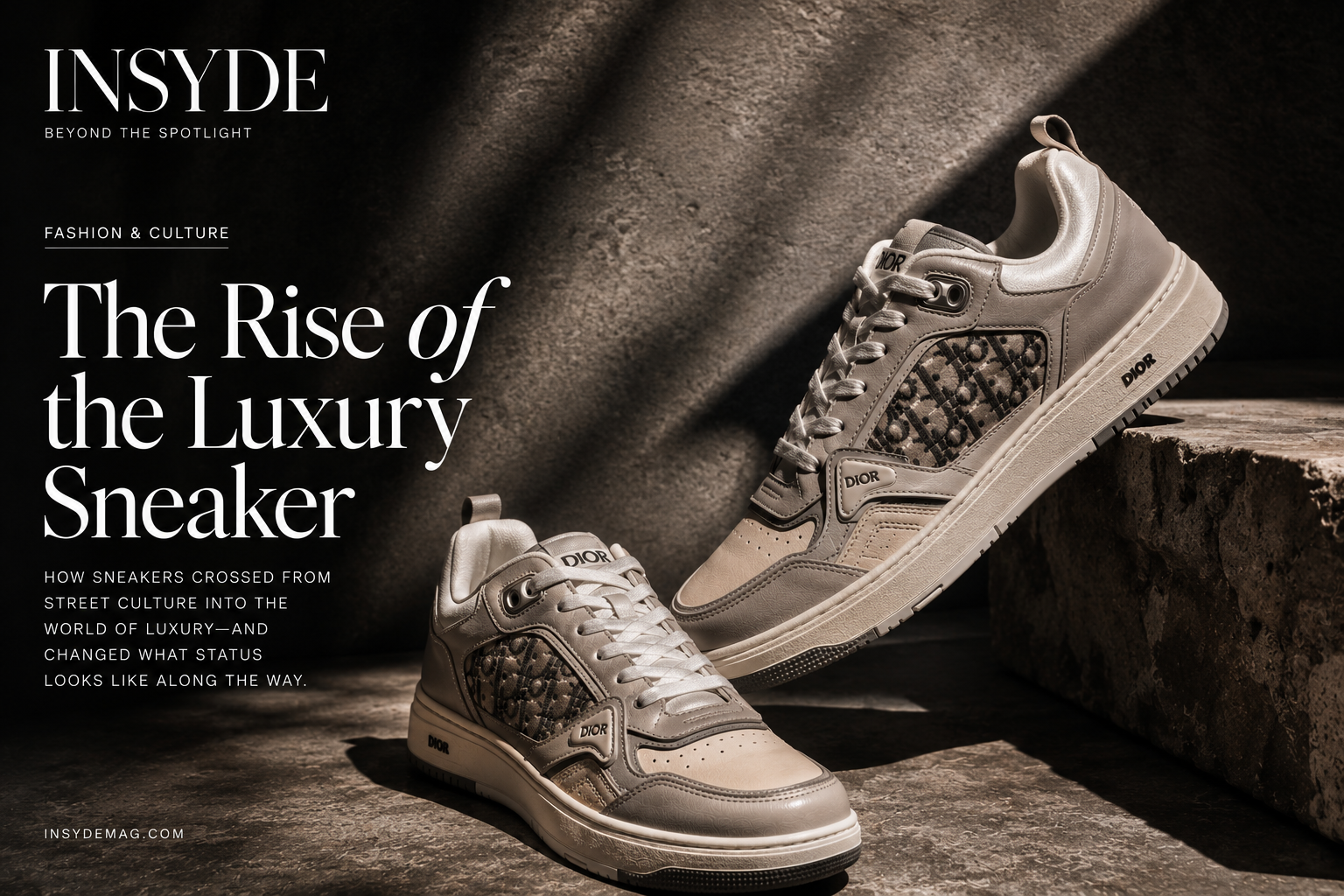
    How sneakers crossed from street culture into the world of luxury — and changed what status looks like along the way.

    There was a time when luxury had a dress code.

    A tailored jacket. A fine watch. Polished leather. A recognisable handbag. Objects whose value was understood almost immediately.

    Then came the sneaker.

    Casual. Familiar. Democratic. Designed for movement rather than ceremony.

    And somehow, it became one of fashion’s most powerful expressions of status.

    That transformation is more interesting than the sneaker’s price tag.

    Because the luxury sneaker did not become important simply because fashion houses decided to make expensive shoes. It became important because culture changed what people wanted luxury to mean.

    The sneaker brought together sport, music, youth culture, fashion and design. Luxury gave it craftsmanship, scarcity and prestige.

    The result was something neither world could have created alone.

    A new language of luxury.


    The Object That Wasn’t Supposed to Be Luxury

    The sneaker was never designed to communicate wealth.

    Its original purpose was practical: movement, comfort and performance.

    But practicality gave it something luxury could not manufacture.

    Cultural credibility.

    Sneakers were worn on basketball courts, running tracks, city streets and stages. They became intertwined with music, particularly hip-hop, and with the rise of streetwear.

    The sneaker began appearing everywhere culture was being created.

    And that changed its meaning.

    It was no longer simply footwear.

    A particular pair could communicate what music you listened to, which athletes you admired, what subculture you belonged to or how closely you followed fashion.

    The sneaker became an identity marker.

    Luxury eventually noticed.


    When the Street Met the Maison

    For decades, high fashion and street culture occupied very different territories.

    One represented heritage, craftsmanship and exclusivity.

    The other represented youth, rebellion and cultural immediacy.

    Then the boundary began to disappear.

    Luxury houses started incorporating sneakers into their collections, while streetwear gained increasing influence over the wider fashion industry.

    The meeting was inevitable.

    But it wasn’t simply luxury moving downward.

    It was luxury learning from the street.

    The sneaker offered fashion something extremely valuable: relevance.

    It was already connected to communities, music, sport and youth culture.

    Luxury could provide materials and craftsmanship.

    The street provided cultural energy.

    Together, they created a new category.


    The Collaboration Changed the Rules

    Few developments accelerated the sneaker’s transformation more than the collaboration.

    When a sneaker became the meeting point between an athlete, musician, artist, designer or fashion house, it became more than a product.

    It became a cultural event.

    Suddenly, the story surrounding the shoe could matter as much as the shoe itself.

    Who designed it?

    Who wore it?

    Why was it created?

    How many were produced?

    When was it released?

    And, perhaps most importantly:

    Could everyone get one?

    Scarcity introduced a new kind of desire.

    The sneaker began behaving less like ordinary footwear and more like a collectible.

    That was a significant moment.

    Because luxury has always understood that desire grows when access becomes selective.


    Scarcity Became a Status Symbol

    Luxury has never been purely about price.

    It is about access.

    The rare watch.

    The difficult-to-book restaurant.

    The limited edition automobile.

    The handbag that isn’t simply waiting on a shelf.

    Sneakers adopted the same psychology.

    Limited releases created urgency.

    Exclusive collaborations created communities.

    Rare editions developed their own markets.

    But there is an important distinction.

    Scarcity alone does not create value.

    There must be a reason to care.

    The most desirable sneakers usually combine rarity with cultural significance.

    They represent an athlete.

    A designer.

    A collaboration.

    A particular era.

    A moment that mattered.

    The shoe becomes valuable because it carries a story.


    When the Sneaker Became Collectible

    This is where sneaker culture began moving closer to traditional luxury collecting.

    Collectors stopped looking only at whether a shoe looked good.

    They began considering provenance.

    Condition.

    Originality.

    Production history.

    Collaboration.

    Cultural relevance.

    A rare sneaker can become interesting in much the same way as a vintage watch or classic automobile.

    Not because it is necessary.

    Precisely because it isn’t.

    The object exists beyond function.

    It becomes something to preserve, study and appreciate.

    That is one of luxury’s oldest ideas.

    And sneakers have adopted it remarkably well.


    The Luxury of Craft

    There is another reason luxury sneakers command attention: craftsmanship.

    Once high fashion began taking the category seriously, the sneaker became a canvas for experimentation.

    Leather.

    Suede.

    Technical textiles.

    Metal hardware.

    Specialised construction.

    Unexpected proportions.

    Complex soles.

    Hand-finishing.

    Details that might once have been invisible became part of the conversation.

    The sneaker could now be examined rather than simply worn.

    And that changed the perception of the object.

    It didn’t have to stop being comfortable to become luxurious.

    It could be both.

    Function and craftsmanship could coexist.

    That combination is central to modern luxury.


    The End of the Formal Luxury Uniform

    Perhaps the sneaker’s greatest cultural victory is that it helped make luxury less formal.

    The modern luxury wardrobe doesn’t necessarily require a polished leather shoe.

    A tailored trouser can meet a minimalist sneaker.

    A fine watch can sit above a relaxed silhouette.

    A luxury jacket can be paired with something deliberately casual.

    The contrast isn’t accidental.

    It is part of the language.

    Today’s sophisticated consumer often has less interest in proving that something is expensive.

    They are more interested in demonstrating that they know what works.

    That is a profound change.

    Luxury becomes less about dressing according to a rulebook and more about knowing when to break one.


    The New Status Symbol Doesn’t Always Shout

    For decades, luxury was designed to be recognised.

    Logos were visible.

    Signatures were obvious.

    The product announced itself.

    The sneaker introduced another possibility.

    Recognition could become selective.

    Someone who doesn’t follow fashion might see an ordinary pair of shoes.

    Someone who does might immediately recognise the silhouette, collaboration or material.

    That creates a subtle form of status.

    Not:

    “Everyone should know what I’m wearing.”

    But:

    “The people who understand it will know.”

    That distinction has become increasingly important in contemporary luxury.

    The audience for the signal has become smaller.

    The meaning of the signal has become deeper.


    From Logo to Language

    The most interesting luxury sneakers aren’t necessarily the loudest.

    They can be minimal.

    Almost anonymous.

    Their luxury might exist in the leather, construction, proportion or silhouette rather than a giant logo.

    That reflects a broader evolution in fashion.

    The conversation is moving from visibility to discernment.

    The question isn’t simply whether something looks expensive.

    It is whether it looks considered.

    A sneaker can now communicate taste without demanding attention.

    And that may be one of the reasons the category has become so powerful.

    It fits the psychology of a consumer who already knows what luxury looks like.

    They don’t need to announce it.


    The New Luxury Consumer

    The rise of the luxury sneaker also reflects a generational change.

    Younger consumers have never experienced fashion as a series of isolated categories.

    Music influences fashion.

    Sport influences fashion.

    Streetwear influences luxury.

    Luxury influences streetwear.

    Film, gaming, art and social media all participate in the same cultural conversation.

    For this audience, a sneaker does not need permission to belong in a luxury wardrobe.

    It already belongs.

    The old hierarchy has weakened.

    A rare sneaker can sit beside a mechanical watch.

    A vintage piece can sit beside a new luxury garment.

    A streetwear collaboration can become as culturally significant as a traditional fashion collection.

    Luxury is no longer a closed room.

    It has become a conversation.


    What Makes a Sneaker Luxury?

    The obvious answer is price.

    But price is only one ingredient.

    True luxury requires something more difficult to manufacture.

    Desire.

    A sneaker becomes luxurious when people want it for reasons beyond its practical purpose.

    Craftsmanship can create desire.

    Scarcity can create desire.

    Design can create desire.

    History can create desire.

    Cultural relevance can create desire.

    And the strongest products combine several of them.

    That is why a very expensive sneaker can feel completely unremarkable, while a much simpler pair can become iconic.

    Luxury is not the number on the receipt.

    It is the meaning attached to the object.


    The Sneaker and the Collector’s Mind

    The luxury world has always been fascinated by objects that don’t need to exist.

    Collectors buy watches even when their phones tell time more accurately.

    They collect automobiles they cannot drive every day.

    They acquire art they may rarely display.

    The value lies somewhere beyond utility.

    Sneakers now occupy that same territory.

    A collector can own dozens of pairs without needing another pair of shoes.

    The purchase is no longer about necessity.

    It is about appreciation.

    Memory.

    Identity.

    Curation.

    The collection becomes a portrait of the collector.

    And perhaps that is the final transformation of the sneaker:

    from something you wear to something that represents what you value.


    The Luxury Sneaker Is Here to Stay

    The sneaker’s rise tells us something larger about luxury.

    The definition of status has changed.

    For one generation, luxury meant formality.

    For another, it meant recognisable logos.

    Today, luxury increasingly means choice.

    Knowing what to buy.

    Knowing what not to buy.

    Understanding craftsmanship.

    Recognising cultural significance.

    Being able to move between worlds without looking as though you’re trying too hard.

    The sneaker fits perfectly into that new definition.

    It can be casual without being careless.

    Expensive without being obvious.

    Rare without being theatrical.

    Cultural without losing craftsmanship.

    That is an extraordinary amount of territory for one object to occupy.


    The Rise of the Luxury Sneaker

    The sneaker didn’t become luxurious simply because luxury fashion decided to put its name on it.

    Its transformation happened much earlier.

    Culture made it desirable.

    Sport made it iconic.

    Music gave it attitude.

    Streetwear gave it identity.

    Fashion gave it craftsmanship.

    Scarcity gave it collectability.

    And consumers gave it something even more powerful:

    meaning.

    That is why the luxury sneaker represents more than another category for fashion houses.

    It represents the changing definition of status itself.

    The old luxury question was:

    “How much does it cost?”

    The newer question is:

    “Why does it matter?”

    And perhaps that is the most modern luxury of all.

    To own something not because everyone wants it—

    but because you understand why you do.

    INSYDE — Beyond the Spotlight.

  • How Sabyasachi Built a Global Indian Luxury House | INSYDE

    How Sabyasachi Built a Global Indian Luxury House | INSYDE

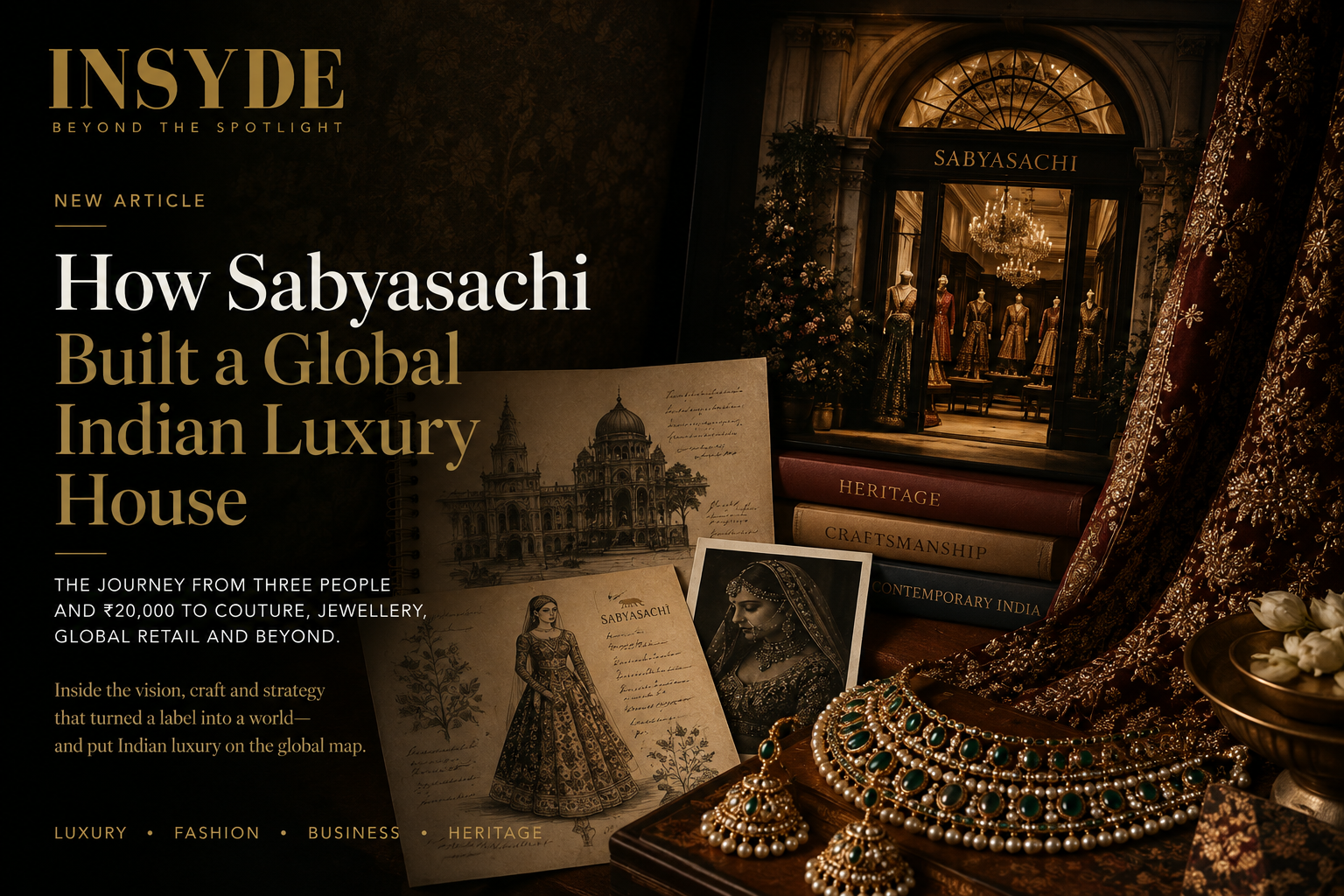
    The Sabyasachi label began with three people and ₹20,000. Today, it spans couture, jewellery, retail, beauty, art and international markets. The real story is how a designer turned an aesthetic into an entire luxury ecosystem.

    A fashion label sells clothes.

    A luxury house sells something much harder to manufacture:

    a world.

    Sabyasachi has spent more than two decades building one.

    The clothes came first.

    Then came bridalwear.

    Then jewellery.

    Then accessories.

    Then stores that looked more like museums.

    Then international expansion.

    Then beauty.

    Then art.

    Then collaborations with global companies.

    At some point, calling Sabyasachi simply a fashion label stopped being enough.

    The more interesting question became:

    How did one designer turn a very specific idea of India into a global luxury business?

    The original ambition was never small

    The Sabyasachi story starts with an unusually clear ambition.

    After graduating from NIFT Kolkata in 1999, Sabyasachi rejected job offers from established designers and started his own label. His official history says he borrowed ₹20,000 from his family and began with a workforce of three.

    The ambition, according to the brand, was to create India’s biggest luxury house.

    That is important because it changes how we read everything that followed.

    The jewellery wasn’t a random extension.

    The stores weren’t simply retail expansion.

    The beauty collaboration wasn’t just another licensing opportunity.

    They were pieces of a larger plan.

    The goal was never only to design clothes.

    It was to build a house.

    The luxury proposition was craft

    The foundation of the business is not celebrity.

    It is craftsmanship.

    Sabyasachi’s official history describes work with weavers, block printers, embroiderers, dyers, goldsmiths, furniture artisans and other craftspeople across India. It currently says the house employs around 1,000 craftspeople and works regularly with more than 3,000 craftspeople and master weavers.

    That network gives the brand something modern luxury increasingly values:

    provenance.

    Where was it made?

    Who made it?

    How long did it take?

    What technique was used?

    What region does it come from?

    These questions turn an object into a story.

    And luxury has always been very good at selling stories.

    Sabyasachi’s innovation was to argue that India’s enormous craft tradition could be the foundation of a luxury proposition rather than simply a source of inspiration.

    The house explicitly describes the future of artisanal crafts and handwoven textiles as lying in luxury.

    That is not just a design philosophy.

    It is a business philosophy.

    The bridal business created the ecosystem

    Couture created prestige.

    Bridalwear created demand.

    Jewellery expanded the relationship.

    The wedding became the perfect environment for a luxury house because the customer often needs multiple categories at once.

    Clothing.

    Jewellery.

    Accessories.

    Beauty.

    Sometimes even décor and hospitality.

    Sabyasachi’s first bridal collection, Chand Bibi, marked a major turning point in the brand’s growth and helped establish what became known as the “Sabyasachi bride.”

    But the important business insight was broader.

    A bride doesn’t necessarily want a single product.

    She wants a world around the occasion.

    Sabyasachi was well positioned to provide it.

    Then jewellery became its own business

    The launch of Sabyasachi Jewellery was a significant step because jewellery is not simply another category of fashion.

    It changes the economics and lifespan of the relationship with the customer.

    A couture garment may be purchased for an occasion.

    Jewellery can become an heirloom.

    The house developed its jewellery language around Indian heritage, North Calcutta references and Byzantine influences. It also introduced a branded mangalsutra, presenting the traditional wedding necklace through a contemporary luxury lens.

    The jewellery business expanded internationally, including retail at Bergdorf Goodman and dedicated spaces in the brand’s New York and Mumbai stores.

    This was an important evolution.

    The customer no longer had to leave the Sabyasachi universe to complete the look.

    The house could increasingly provide the look itself.

    The store became the advertisement

    Then came retail.

    But Sabyasachi did not treat the store as somewhere to put clothes.

    The brand describes its retail spaces as “living museums.”

    The Mumbai flagship, opened in the city’s heritage district in 2023, expanded the idea dramatically. The brand describes the 25,862-square-foot space as its largest flagship, bringing together bridal and couture, ready-to-wear, jewellery, archival pieces and other elements of the Sabyasachi world.

    The New York flagship had already opened in 2022.

    The current official store network includes Kolkata, Mumbai, Delhi, Hyderabad, Bengaluru and New York.

    This is more than expansion.

    It is brand theatre.

    A luxury customer isn’t simply entering a shop.

    They are entering the story.

    And once the physical environment becomes distinctive enough, the store itself becomes marketing.

    People photograph it.

    Publications cover it.

    Visitors remember it.

    The building becomes part of the brand.

    New York wasn’t just another store

    The New York expansion carried a specific ambition.

    The brand described the goal as changing perceptions of Indian luxury—from “made in India” to “designed and made in India.”

    That distinction goes to the heart of Sabyasachi’s global strategy.

    The brand did not want India to be viewed simply as a production location.

    It wanted India to be understood as a source of design authority.

    That is a much bigger proposition.

    It changes the relationship between Indian luxury and the rest of the world.

    India is no longer merely where the artisan sits.

    India is where the luxury story begins.

    Collaboration without losing the identity

    Sabyasachi has also used collaborations as a way of extending the brand without abandoning its visual language.

    The house has worked with names including Christian Louboutin, H&M, Pottery Barn, Starbucks and Estée Lauder.

    The H&M collaboration is particularly interesting.

    It brought Sabyasachi into a mass global retail environment and included the retailer’s first sari. The collection was made available across approximately 50 countries, and the brand’s own history says the Indian online launch saw Myntra crash shortly after release, with the collection selling out rapidly.

    That kind of collaboration can easily dilute a luxury brand.

    Instead, it demonstrated something useful:

    recognition can travel across price points.

    People who could not access couture could still encounter the Sabyasachi universe.

    The brand remained aspirational.

    Then came beauty

    Beauty was a more significant move than it might initially appear.

    In its 25th year, Sabyasachi became the first Indian brand to collaborate with Estée Lauder on a global collection, launched across more than 20 countries.

    Why beauty?

    Because luxury houses don’t only sell what people wear.

    They sell codes.

    Colours.

    Textures.

    Packaging.

    Objects.

    Rituals.

    Beauty allowed Sabyasachi to take its visual identity into a category with a different price structure and a much wider global audience.

    The product changed.

    The world did not.

    That’s the real power of a luxury house.

    The corporate engine

    Behind the romance is another reality.

    Scaling a luxury business requires capital and infrastructure.

    In 2021, Aditya Birla Fashion and Retail acquired a 51% stake in Sabyasachi Calcutta LLP. ABFRL continues to include Sabyasachi within its designer-led ethnic portfolio.

    This relationship matters because it gives the house access to a larger corporate platform while the Sabyasachi identity remains the creative centre.

    And there is a larger lesson here.

    A designer can create desire.

    But a business has to deliver it.

    Supply chains.

    Retail.

    Inventory.

    International distribution.

    People.

    Technology.

    Capital.

    A global luxury house needs all of them.

    The glamour is the visible part.

    The infrastructure is the reason the glamour can exist at scale.

    The art foundation changes the definition again

    Another recent development pushes Sabyasachi beyond conventional fashion.

    The Sabyasachi Art Foundation opened its first gallery at Nilaya Anthology, with an inaugural exhibition by artist Atish Mukherjee. The brand describes the initiative as part of its commitment to cultural stewardship and to creating a permanent home where art can be nurtured and exhibited.

    This is strategically interesting.

    Because once a fashion brand begins collecting, exhibiting and supporting art, its cultural authority starts to change.

    It is no longer only making products.

    It is participating in cultural preservation.

    That is a much more ambitious position.

    Twenty-five years later, the house looks back

    The 25th-anniversary show in Mumbai in 2025 made the evolution visible.

    More than 150 looks revisited the Sabyasachi vocabulary while mixing traditional Indian craft with international references. Vogue described the show as a return to Calcutta and to the designer’s foundational aesthetic.

    The timing was significant.

    The house had spent years expanding outward.

    Now it was looking backward.

    But not nostalgically for nostalgia’s sake.

    The past had become an asset.

    The archive had become a resource.

    The signature had become a business advantage.

    And now the house is going back to New York

    The next chapter is already taking shape.

    The CFDA’s official preliminary September 2026 schedule lists Sabyasachi by Sabyasachi Mukherjee for New York Fashion Week on September 15, 2026.

    The return matters because the house is no longer arriving in New York as an ambitious young Indian label.

    It arrives with:

    A mature couture business.

    A global jewellery operation.

    International retail.

    A recognised visual identity.

    A craft ecosystem.

    Corporate backing.

    And a much larger understanding of what an Indian luxury house can be.

    The runway is almost the least interesting part.

    The interesting part is everything that had to be built before the runway could matter.

    So, what actually makes Sabyasachi a luxury house?

    It isn’t the price.

    It isn’t the celebrity list.

    It isn’t even the craftsmanship on its own.

    It is consistency.

    The same world appears across clothing.

    Jewellery.

    Stores.

    Beauty.

    Art.

    Packaging.

    Photography.

    Collaborations.

    The customer knows what Sabyasachi means before seeing the product.

    That is one of the hardest things to build in luxury.

    A recognisable world.

    The real Sabyasachi business

    There is a reason Sabyasachi has become such an interesting case study for Indian luxury.

    He didn’t build the business by abandoning India.

    He built it by making India itself part of the brand proposition.

    The craft is Indian.

    The references are Indian.

    The nostalgia is Indian.

    The jewellery is Indian.

    The wedding is Indian.

    But the ambition is global.

    That combination is what makes the house interesting.

    Because the real product isn’t a lehenga.

    It isn’t a necklace.

    It isn’t a store in New York.

    The product is the belief that all of these things belong together.

    That they can form one coherent world.

    And perhaps that is what separates a successful designer from a luxury house.

    A designer creates beautiful things.

    A luxury house creates meaning around those things.

    Sabyasachi has spent twenty-five years building that meaning.

    Now the question is no longer whether Indian luxury can travel.

    It already has.

    The question is how far the Sabyasachi idea of India can travel with it.

    — INSYDE