

Inside the NFL’s $300 Billion Empire
The NFL has transformed American football into one of the most valuable entertainment businesses on the planet. But is it really the richest sport in the world?
There are sports leagues.
And then there is the NFL.
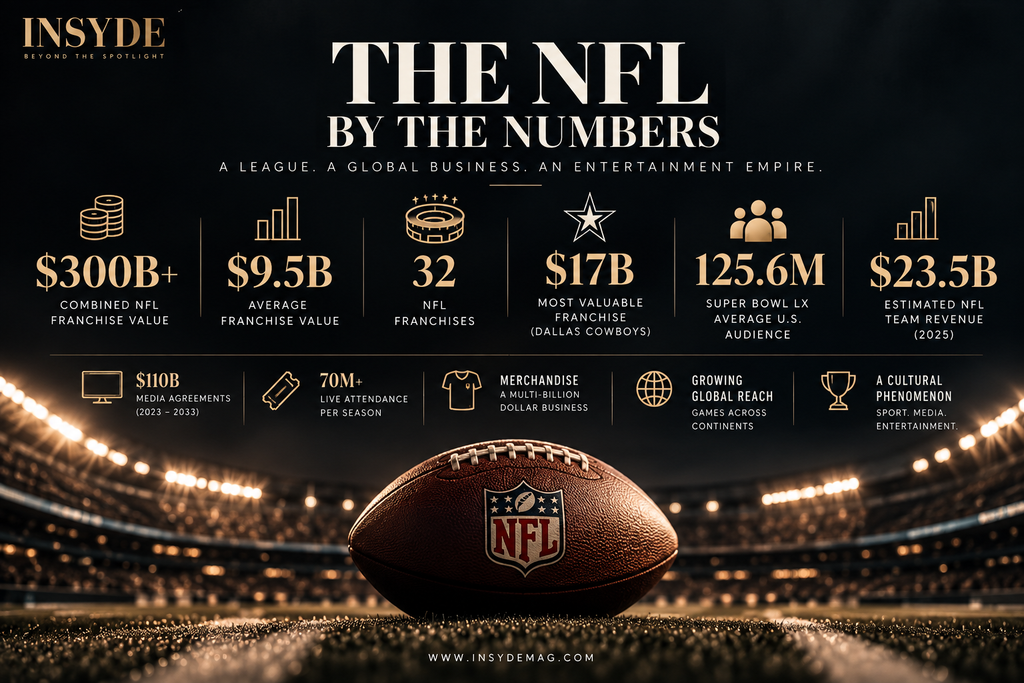
With just 32 franchises, the National Football League has built a commercial machine that generates more than $23 billion in annual revenue, commands nearly $110 billion in long-term media rights agreements, and has pushed the average value of an NFL franchise to approximately $9.5 billion in 2026.
The Dallas Cowboys alone are now valued at $17 billion.
The league’s financial scale has become so extraordinary that the least valuable NFL franchise is now worth around $8 billion.
But there is a catch.
The NFL is not the world’s biggest sport by global audience. Football — or soccer — has a vastly broader international footprint, with the FIFA World Cup continuing to demonstrate its enormous global reach.
So what exactly has the NFL built?
The answer is perhaps more interesting than the question.
The NFL has created one of the most powerful sports-business ecosystems in the world — a combination of media rights, advertising, sponsorship, franchise scarcity, stadium economics, merchandising, celebrity and live entertainment that has turned American football into a financial powerhouse.
And the numbers tell the story.
$300 BILLION AND COUNTING
In September 2026, Forbes valued the average NFL franchise at approximately $9.5 billion, up 34% from the previous year.
Collectively, the 32 franchises are therefore worth more than $300 billion.
Every team in the league is now valued at at least $8 billion.
That is an extraordinary change from just a few years ago.
The Dallas Cowboys sit at the top of the market with a valuation of $17 billion, according to Forbes. The Los Angeles Rams follow at $13.5 billion, the New York Giants at $12 billion, the New England Patriots at $10.6 billion and the San Francisco 49ers at $10.5 billion.
The Cowboys have held the position as the NFL’s most valuable franchise for 20 consecutive years.
The striking part isn’t simply that the Cowboys are worth $17 billion.
It is how quickly the entire league has moved upward.
The Seattle Seahawks, for example, were sold in 2026 at a reported $9.6 billion valuation — a price that would have represented an extraordinary franchise value only a few years ago.
Today, it places the club around the middle of the NFL’s valuation hierarchy.
This is what happens when a scarce asset class meets rapidly growing media economics.

THE NFL DOESN’T NEED 100 TEAMS
There are only 32 NFL franchises.
That scarcity is fundamental to the economics.
An investor cannot simply create another NFL franchise and begin competing with the existing clubs.
Ownership opportunities are exceptionally rare, while the number of ultra-high-net-worth individuals and investment groups capable of participating in major sports ownership has expanded.
At the same time, NFL media rights have continued to grow.
The result is a remarkably powerful equation:
limited supply + growing demand + predictable media revenue = rising franchise valuations.
S&P Global’s 2026 analysis points to several forces behind the rise in NFL valuations, including expanding television rights, the influx of private equity and higher revenue multiples.
The value of an NFL franchise is therefore not determined simply by how well its team performs on the field.
The business surrounding the team can be just as important.
THE $23 BILLION MACHINE
The NFL’s scale becomes even clearer when looking at revenue.
NFL teams generated an estimated $23.5 billion in revenue in 2025, according to recent industry reporting, while total NFL revenue surpassed $23 billion.
That places the NFL substantially ahead of several other major individual sports leagues on commonly reported revenue measures.
The NBA’s teams generated an estimated $12.25 billion during the 2024–25 season.
The Premier League’s clubs generated approximately £6.8 billion during 2024–25, equivalent to roughly $9 billion depending on exchange rates.
These comparisons need some caution because leagues report their finances differently and operate under different structures.
But the broad picture is clear:
The NFL is an extraordinary revenue-generating machine.
And much of that machine is powered by something increasingly valuable in modern media:
live attention.
THE $14.5 BILLION DISTRIBUTION
One of the NFL’s most important structural advantages is its centralized revenue model.
In 2025, NFL teams received approximately $14.5 billion in shared league revenue, according to S&P Global.
That works out to more than $450 million per team before considering many locally generated revenue streams.
The shared revenue pool includes national media rights, sponsorships, licensing and other leaguewide commercial income.
This structure creates an unusually strong financial floor for individual franchises.
The NFL isn’t simply a collection of 32 independent businesses.
It functions as a connected commercial ecosystem.
The league sells its most valuable national inventory collectively.
The teams share substantial portions of that income.
And the result is greater financial stability across the franchise base.
TELEVISION IS THE REAL MVP
The NFL’s greatest commercial asset may not be the stadium.
It may not even be the Super Bowl.
It is the league’s control over premium live media.
The NFL’s current media agreements with CBS, NBC, FOX, ESPN/ABC and Amazon run through the 2033 season and are worth nearly $110 billion over 11 years, according to S&P Global.
The agreements cover television and digital distribution, including major regular-season packages and Super Bowl rights.
The significance goes beyond the size of the cheque.
Live sport is one of the few forms of entertainment that people still have a powerful reason to watch immediately.
A film can wait.
A series can wait.
A YouTube video can wait.
A game cannot.
The outcome exists only once.
That makes live sport incredibly valuable to broadcasters and advertisers.
And the NFL has an enormous amount of it.
83 OF AMERICA’S TOP 100
The league’s dominance of U.S. television illustrates the strength of the model.
NFL games accounted for 83 of the 100 most-watched television broadcasts in the United States during 2025, according to recent industry reporting.
The NFL also averaged approximately 18.7 million viewers per game during the 2025 season, according to S&P Global, making it one of the most powerful recurring television properties in the United States.
That concentration of attention is commercially rare.
And advertisers know it.
THE SUPER BOWL EFFECT
Then there is the Super Bowl.
Super Bowl LX, played in February 2026, averaged 125.6 million viewers across NBC, Peacock, Telemundo, NBC Sports Digital and NFL+, according to Nielsen figures reported by NBC Sports.
The broadcast peaked at 137.8 million viewers, setting a U.S. television viewership record for a single moment of programming.
Those numbers explain why the Super Bowl exists in a category of its own.
It is simultaneously a championship game, television spectacle, advertising platform, celebrity event and entertainment property.
For brands, it is not simply a media buy.
It is access to one of the largest concentrated audiences available in American entertainment.
The Super Bowl has therefore become something larger than the game itself.
It is a cultural event built around a sporting event.
THE PRICE OF 30 SECONDS
The economics of Super Bowl advertising make that point even clearer.
A 30-second commercial during the 2026 Super Bowl cost advertisers roughly $8 million on average, with some placements reaching higher levels.
But the real cost of participating in the Super Bowl ecosystem can be substantially greater.
Brands don’t just purchase airtime.
They produce campaigns.
Hire celebrities.
Create social content.
Launch teasers.
Build activations.
Extend the campaign across digital platforms.
And then compete for attention around the advertisement itself.
The commercial becomes part of the entertainment.
That is one of the NFL’s greatest commercial advantages.
It doesn’t simply sell advertising space.
It sells participation in a cultural moment.

THE COWBOYS: A BUSINESS BEYOND FOOTBALL
Nothing illustrates the NFL’s economics better than the Dallas Cowboys.
Forbes estimates the Cowboys generated nearly $1.28 billion in revenue during the 2025 season and approximately $677 million in operating income.
Their franchise valuation reached $17 billion in 2026.
The Cowboys are therefore not simply monetizing football games.
Their business encompasses sponsorships, premium seating, merchandise, media exposure, stadium activity, hospitality and the enormous commercial value of the Cowboys brand.
AT&T Stadium itself functions as an entertainment destination.
The franchise has effectively turned team ownership into a large-scale entertainment and commercial platform.
And that model increasingly defines modern sports ownership.
THE STADIUM HAS BECOME A LUXURY PRODUCT
The modern sports stadium is no longer simply a place to watch a game.
Premium suites.
Private clubs.
Corporate hospitality.
Restaurants.
Luxury seating.
Concerts.
Naming rights.
Merchandise.
Non-sporting events.
The stadium has become a destination where sport meets hospitality, entertainment and business.
This matters because the highest-value fan isn’t necessarily the person buying the cheapest seat.
The premium customer may be paying thousands for access, privacy, hospitality and networking.
The experience becomes the product.
And that is increasingly where sports begins to overlap with luxury.
THE ATHLETE IS A BUSINESS, TOO
The commercial ecosystem doesn’t end with the franchise.
Players themselves have become brands.
The modern NFL star can generate value through:
Endorsements.
Merchandise.
Social media.
Fashion.
Collectibles.
Media appearances.
Personal businesses.
The NFL Players Association reported more than $1.9 billion in retail sales of officially licensed player merchandise during the March 2025–February 2026 period.
A jersey isn’t simply merchandise.
It is identity.
Fans don’t only consume the sport.
They participate in it through the athletes and teams they choose to represent.
That creates another layer of commercial value.
THE SALARY CAP AND THE ECONOMIC ENGINE
The players are also directly connected to the league’s financial growth.
The NFL’s salary cap reached approximately $301.2 million per team in 2026, crossing the $300 million threshold for the first time.
That is a dramatic increase from the approximately $208.2 million cap in 2022.
The growth reflects the increasing size of the league’s revenue pool.
More media money means more league revenue.
More league revenue means a larger pool available under the league’s labor agreement.
The result is a cycle in which media growth, player compensation and franchise economics are closely connected.
BUT IS THE NFL REALLY THE BIGGEST SPORT ON EARTH?
This is where the story gets complicated.
If “biggest” means financial power as an individual sports league, the NFL has a compelling claim.
If “biggest” means global audience and worldwide cultural reach, the answer is different.
Football — soccer — is played and followed across far more countries and markets.
The 2026 FIFA World Cup once again demonstrated that reach.
FIFA reported record-breaking audiences across multiple countries during the tournament’s opening stages and described the World Cup as the world’s biggest and most-watched global sporting event.
That distinction is crucial.
The NFL is one centralized league with 32 franchises.
Global football is a massive ecosystem made up of domestic leagues, continental competitions, national teams and international tournaments.
Comparing the two directly is therefore imperfect.
But the contrast is revealing.
Soccer has the world’s broader global footprint.
The NFL has one of the world’s most powerful individual league businesses.
Those are not the same achievement.
THE GLOBAL EXPANSION
The NFL understands the difference.
And it is increasingly looking outside the United States.
The league is scheduled to play a record nine international games during the 2026 season, expanding its presence across markets including the United Kingdom, Germany, Brazil, Spain, Ireland, Australia and other international destinations.
All 32 NFL teams are also involved in the league’s Global Markets Program, which gives franchises commercial rights in selected international markets.
The strategy is straightforward:
The NFL already has enormous commercial power in the United States.
Now it wants more of the world’s attention.
That means international games.
Streaming.
Merchandise.
Sponsorships.
Local partnerships.
Player marketing.
And eventually, deeper grassroots development.
The opportunity is enormous.
So is the challenge.
THE GLOBAL GAP
American football does not yet have the worldwide cultural penetration of soccer.
In many countries, football is not simply another sport.
It is part of everyday culture.
The NFL therefore faces a different problem from many global sports organizations.
It does not need to prove that its business works.
It needs to prove that its business model can travel.
That is a much harder question.
The United States provides the NFL with an enormous and highly monetized domestic market.
The rest of the world offers something different:
scale.
If the NFL can convert even a fraction of international curiosity into long-term fandom, merchandise sales, media audiences and commercial partnerships, the league’s economic ceiling could move significantly higher.
WHY THE NFL BUSINESS MODEL WORKS
The league’s extraordinary economics come down to several structural advantages.
SCARCITY
Only 32 franchises exist.
MEDIA POWER
The league controls some of the most valuable live sports content in the world.
CENTRALIZED REVENUE
Large portions of national commercial revenue are shared among franchises.
LIVE ATTENTION
The outcome of a game cannot be replicated after the fact.
ADVERTISING
The Super Bowl provides one of the world’s most concentrated advertising audiences.
BRAND VALUE
NFL franchises have become powerful entertainment brands in their own right.
PREMIUM HOSPITALITY
Luxury suites, clubs and premium experiences create additional high-value revenue.
GLOBAL EXPANSION
The league still has significant international markets to develop.
Put together, these factors create something unusually powerful:
a scarce asset with recurring media demand and growing global commercial potential.
THE NEXT BILLION-DOLLAR QUESTION
The NFL’s next phase is not simply about increasing ticket sales.
It is about increasing the value of attention.
Streaming will become increasingly important.
International markets will become increasingly important.
Sports betting and fantasy will remain part of the broader engagement ecosystem.
Premium hospitality will continue to evolve.
Digital content will extend the life of games beyond the broadcast.
And future media negotiations could become even more valuable.
The league’s current media agreements already approach $110 billion over 11 years.
Several agreements contain opt-out provisions that could allow the NFL to renegotiate before the contracts fully expire. S&P Global reports that most of the current agreements can be opted out of after the 2029 season.
That creates another potential inflection point.
The next major NFL media cycle could become one of the most closely watched transactions in global sports entertainment.
SO, IS THE NFL THE RICHEST SPORT IN THE WORLD?
There is no single answer because the question itself mixes different measurements.
BY INDIVIDUAL LEAGUE REVENUE
The NFL is the clear financial heavyweight among major individual sports leagues on commonly reported figures, with team revenue estimated at $23.5 billion in 2025 and total league revenue above $23 billion.
BY FRANCHISE VALUE
The NFL is extraordinary.
Its 32 franchises have an average value of approximately $9.5 billion, while the league’s combined franchise value exceeds $300 billion.
BY GLOBAL SPORTING REACH
Soccer remains the larger worldwide phenomenon.
The FIFA World Cup continues to generate enormous audiences across continents and FIFA describes it as the world’s biggest and most-watched global sporting event.
BY SINGLE-EVENT COMMERCIAL POWER
The Super Bowl occupies an unusually powerful position.
Its 125.6 million average U.S. viewers in 2026 demonstrate the scale of the event, while its advertising market turns the championship into a major commercial spectacle.
So the most defensible conclusion is not that the NFL is simply “the biggest sport on Earth.”
It is this:
The NFL is arguably the world’s most powerful individual sports-league business.
And that distinction matters.
THE REAL PRODUCT IS ATTENTION
Football is what happens on the field.
The real business happens everywhere else.
In television studios.
Inside advertising agencies.
In luxury suites.
At sponsorship meetings.
Across streaming platforms.
Inside stadiums.
On social media.
In merchandise stores.
And increasingly, in markets outside the United States.
The NFL has created an ecosystem where broadcasters pay billions for access to games, advertisers pay millions for access to viewers, investors pay billions for access to franchises, fans pay for access to experiences, and brands pay for access to the cultural conversation.
Everyone is buying the same thing.
Attention.
The NFL has simply become exceptionally good at converting that attention into economic value.
THE FINAL WHISTLE
The NFL may not be the world’s most globally popular sport.
That distinction belongs to a much broader football ecosystem.
But measuring the NFL only by audience would miss the extraordinary business it has created.
Thirty-two franchises.
More than $23 billion in annual revenue.
More than $300 billion in combined franchise value.
A $17 billion flagship franchise.
Nearly $110 billion in current media agreements.
A Super Bowl attracting 125.6 million viewers in the United States.
And a league now aggressively expanding into international markets.
The NFL is no longer simply selling football.
It is selling media.
It is selling access.
It is selling identity.
It is selling entertainment.
It is selling scarcity.
And above all, it is selling attention.
The game lasts a few hours.
The business never stops.
INSYDE VERDICT
The NFL isn’t necessarily the biggest sport on Earth.
But it may be the clearest example of how sport can be transformed into a global-scale entertainment and financial business.
And as franchise valuations climb, media rights expand and the league pushes further beyond America, the most interesting question may no longer be whether the NFL is the richest sports league.
It may be: