
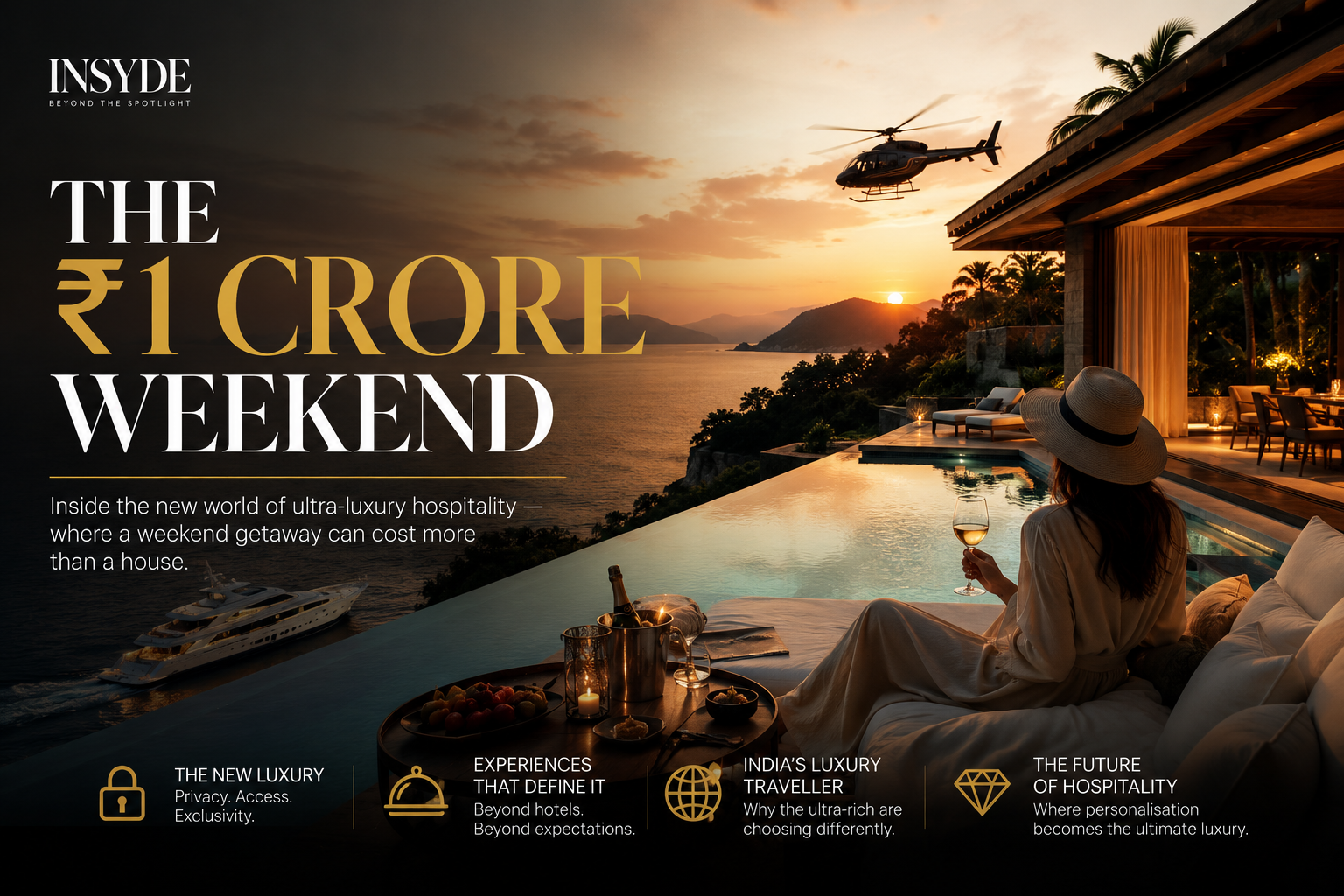
What happens when luxury stops being about where you stay — and becomes about having the entire world arranged around you.
Imagine arriving at an airport where there is no queue, no waiting lounge and no schedule to follow.
A private aircraft is waiting.
You land somewhere remote. A villa has been prepared exclusively for you. A chef is cooking exactly what you want. A yacht is waiting offshore. A therapist arrives for a treatment in your suite. Your itinerary changes whenever you feel like it.
There are no crowds.
No strangers.
No compromises.
And by the time the weekend is over, the bill could reach ₹1 crore.
Not because the room costs ₹1 crore.
Because the room is only the beginning.
This is where luxury hospitality is heading.
WHEN THE HOTEL ROOM STOPPED BEING THE PRODUCT
For decades, luxury hospitality was relatively easy to understand.
The better the suite, the better the hotel.
More space. Better views. Better restaurants. Better service. Better design.
But at the very top of the market, the definition of luxury is changing.
The wealthiest traveller may already have access to beautiful homes, private cars, first-class cabins, personal staff and extraordinary restaurants.
So what can a hotel actually offer that money hasn’t already made available?
Privacy.
And increasingly, control.
The ability to arrive without being noticed. Eat without sharing a restaurant. Move without following a timetable. Spend an entire day without encountering another guest.
Luxury is becoming less about adding things to an experience and more about removing everything that gets in the way of it.
THE RISE OF THE PRIVATE WORLD
Across the luxury-travel industry, private villas and exclusive-use properties are becoming increasingly important.
The shift is simple.
Instead of booking the best room in a resort, some ultra-high-net-worth travellers are booking the resort itself.
In 2026, Mint reported growing interest among wealthy Indian travellers in buying out entire resorts, highlighting a Mumbai business family’s private booking of all 13 villas at Soneva Secret in the Maldives.
The experience went far beyond accommodation, incorporating private aviation, butlers, chefs, yachts and spa services.
At that level, you are no longer really buying a hotel stay.
You are buying a temporary private world.
And that distinction matters.
Because the next generation of luxury hospitality isn’t necessarily competing to build the biggest hotel.
It is competing to create the most personalised version of one.
₹1 CRORE ISN’T REALLY ABOUT THE ROOM
A ₹1 crore weekend sounds outrageous.
And it should.
But the number is useful because it illustrates how quickly luxury can compound when every element of a journey becomes bespoke.
Consider what can sit behind a single weekend:
A private aircraft.
A secluded villa.
Dedicated staff.
A personal chef.
A yacht or private boat.
Wellness treatments.
Exclusive dining.
Helicopter transfers.
Rare experiences arranged around the guest.
Security and privacy.
A completely customised itinerary.
None of these things individually has to cost ₹1 crore.
Together, at the extreme end of the market, they can create an experience where the accommodation becomes almost incidental.
The luxury isn’t the villa.
It’s everything that happens around it.
INDIA’S LUXURY TRAVELLER IS CHANGING TOO
India’s luxury market is becoming increasingly sophisticated.
The country’s wealth creation has produced a larger population of travellers who are not discovering luxury for the first time.
They are choosing between versions of it.
That changes the conversation.
A traveller who has stayed at the world’s most recognisable hotels may no longer be impressed simply because a property has five stars.
They want something harder to replicate.
Privacy.
Space.
Personalisation.
Access.
And increasingly, experiences that don’t feel mass-produced.
This helps explain the growing appeal of private villas, destination celebrations, exclusive resorts and highly customised itineraries among India’s affluent travellers.
For someone flying out of Bengaluru, Mumbai or Delhi, the question is no longer simply:
“Where should we stay?”
It can become:
“What do we want the entire trip to feel like?”
That is a very different luxury proposition.
THE HOTEL IS BECOMING A LIFESTYLE
Luxury hospitality is also moving beyond the traditional hotel.
Branded residences are becoming a major part of the premium property market, combining private ownership with services traditionally associated with five-star hotels.
Housekeeping.
Concierge.
Private dining.
Wellness.
Hospitality management.
Personalised services.
The boundary between home and hotel is becoming increasingly blurred.
The same thing is happening with resort design.
The emphasis is shifting toward villas, private pools, secluded landscapes, wellness spaces and low-density environments.
The message is clear:
Luxury doesn’t always need to look bigger.
Sometimes it needs to feel more personal.
THE NEW STATUS SYMBOL IS PRIVACY
There was a time when luxury was designed to be seen.
The enormous logo.
The front-row seat.
The most recognisable suite.
The car everyone noticed.
But luxury culture is changing.
The most valuable experience may now be the one nobody else knows you had.
A private dining room instead of a crowded restaurant.
A villa instead of a hotel floor.
A secluded beach instead of a famous beach club.
A private jet instead of an airport lounge.
This is the paradox of modern luxury:
The more exclusive it becomes, the less it needs to announce itself.
Quiet luxury was never just about neutral colours and understated clothing.
In travel, it can mean something much more literal.
Quiet.
EXPERIENCE HAS BECOME THE REAL PRODUCT
The wealthiest traveller isn’t necessarily buying a bed.
They are buying time.
They are buying convenience.
They are buying access.
They are buying the ability to say, “I want this,” and have someone figure out how to make it happen.
That might mean arranging a dinner that isn’t normally available.
Finding a particular ingredient.
Opening an experience outside normal hours.
Organising a yacht around a sunset.
Bringing a specialist wellness practitioner to a remote property.
Or simply changing tomorrow’s plans because the guest woke up and decided they wanted to go somewhere else.
That is the real evolution of luxury hospitality.
The itinerary is no longer fixed.
The service adapts to the person.
AND THEN THERE IS THE PSYCHOLOGY OF IT
Luxury has always been about scarcity.
But the most powerful scarcity isn’t necessarily a rare object.
It is access.
You can buy another handbag.
Another watch.
Another car.
But you cannot always buy a private moment in a place where almost nobody else can go.
That makes privacy one of the most powerful luxury currencies of the next decade.
And it explains why the world’s most sophisticated hospitality brands are investing heavily in secluded villas, private residences, bespoke experiences and exclusive-use offerings.
They aren’t simply selling accommodation.
They are selling distance from the ordinary.
THE ₹1 CRORE WEEKEND IS A PREVIEW, NOT THE POINT
Most luxury travellers will never spend ₹1 crore on a weekend.
They don’t need to.
The significance of the number is what it reveals about the upper edge of the market.
At a certain level of wealth, the question changes from:
“How much does this cost?”
to:
“How completely can this be customised?”
That is a very different definition of luxury.
And it is one that hospitality companies are beginning to understand.
The future may belong to properties that can give guests not simply beautiful surroundings, but the feeling that those surroundings have temporarily been designed around them.
THE FUTURE OF LUXURY MAY BE SMALLER
For years, luxury was associated with excess.
Bigger suites.
Bigger resorts.
Bigger lobbies.
Bigger experiences.
But the next era could move in the opposite direction.
Fewer rooms.
More space.
Fewer guests.
More privacy.
Less spectacle.
More personalisation.
The luxury traveller doesn’t necessarily want more of everything.
They want more of what matters to them.
And that is a much harder product to create.
Because it requires hospitality to understand the individual rather than simply impress the customer.
SO, WHAT IS THE ₹1 CRORE WEEKEND REALLY BUYING?
Not a hotel room.
Not a villa.
Not a yacht.
Not even a destination.
It is buying something much more difficult to put a price on:
Control over your own time.
The ability to disappear.
To change the plan.
To have the world move around you instead of moving around the world.
That may be the ultimate evolution of luxury hospitality.
Because when money stops being the measure of what you can buy, privacy, access and personalisation become the new currency.
The ₹1 crore weekend isn’t really about spending ₹1 crore.
It’s about what happens when luxury stops asking,
“How much can we give you?”
and starts asking,
“How much of the world can we arrange around you?”
INSYDE — Beyond the Spotlight.