Category: Architecture

Buildings, architects and ideas shaping India’s evolving built environment.

  • The Bhansali Aesthetic

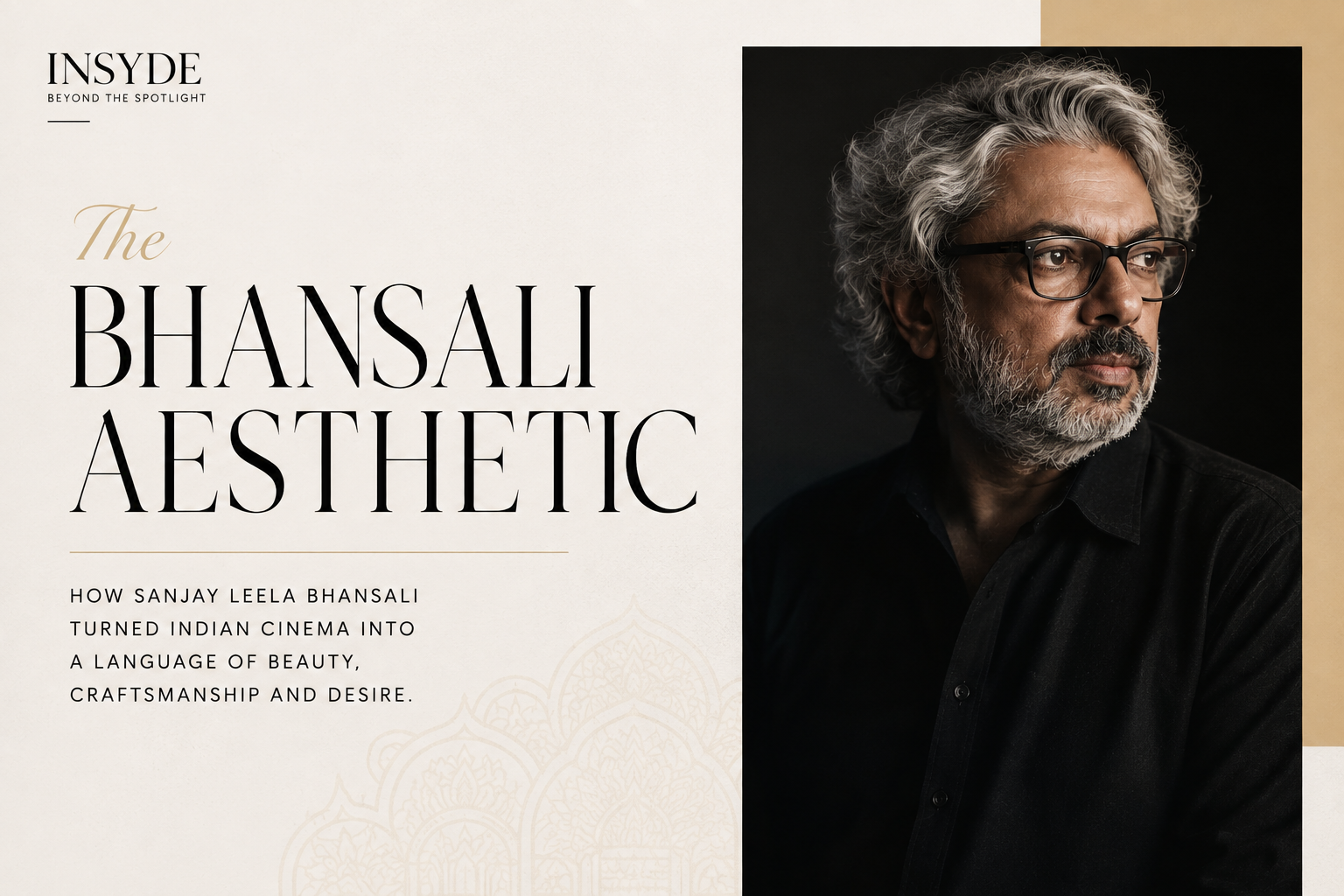
    The Bhansali Aesthetic

    How Sanjay Leela Bhansali turned Indian cinema into a language of beauty, craftsmanship and desire.

    Some filmmakers tell stories.

    Sanjay Leela Bhansali builds worlds.

    Before a character speaks, there may already be a chandelier glowing above her, silk moving through the frame, jewellery catching the light, music rising somewhere beyond the room.

    In his cinema, beauty is rarely background.

    Beauty is part of the narrative.

    That is what makes Bhansali particularly interesting to INSYDE.

    His work sits at an intersection of cinema, fashion, architecture, music, craftsmanship and desire — a place where visual richness becomes storytelling and detail becomes identity.

    Over more than three decades, he has developed an aesthetic so recognisable that a frame can sometimes feel like a Bhansali frame before the audience consciously understands why.

    And perhaps that is the real achievement.

    He didn’t simply create films with a distinctive look. He created a visual language.

    When Cinema Becomes a World

    There is a difference between designing a beautiful frame and constructing an entire universe.

    Bhansali has consistently pursued the latter.

    His films are populated by elaborate interiors, dramatic architecture, intricate costumes, jewellery, carefully choreographed movement and compositions in which even the smallest visual element can feel deliberate.

    Those details do not exist independently.

    They speak to one another.

    Architecture establishes scale.

    Costume establishes character.

    Lighting establishes mood.

    Music establishes emotion.

    Movement establishes rhythm.

    Together, they create something closer to an immersive environment than a conventional film set.

    That precision has become part of the Bhansali method. On Heeramandi, Architectural Digest India documented his insistence on repeatedly adjusting elements of the set — from furniture and wall textures to seemingly minor decorative details — and quoted Bhansali explaining that architecture plays an important role in how he constructs a frame. (Architectural Digest)

    The point is not simply to make a set look expensive.

    The environment has to belong to the story.

    The Luxury of Detail

    Luxury has always depended on detail.

    The difference between something expensive and something exceptional is often invisible from a distance.

    A stitch.

    A setting.

    A finish.

    A proportion.

    A material chosen because of how it responds to light.

    Bhansali approaches cinema with a similar sensitivity.

    A costume isn’t simply clothing.

    A room isn’t simply a set.

    A chandelier isn’t simply decoration.

    A colour isn’t simply a colour.

    Everything contributes to the emotional architecture of the scene.

    The result is a cinema that can feel almost tactile.

    You sense the weight of the fabric.

    The warmth of the light.

    The scale of the room.

    The movement of jewellery.

    The silence before the music begins.

    The effect is extravagant, but the underlying principle is surprisingly disciplined:

    nothing is there without intention.

    Where the Obsession With Beauty Began

    The grandeur of Bhansali’s cinema has a deeply personal origin.

    He has spoken about growing up in a chawl in Mumbai and about the lack of space and visual beauty around him during his childhood. His mother, a dancer, performed in a small space, while Bhansali imagined larger, more ordered environments. He has connected those experiences directly to the expansive sets, central framing and visual symmetry that later became signatures of his filmmaking. (Indian Express)

    It is an important detail because it changes the way his aesthetic can be understood.

    The grandeur is not simply extravagance for its own sake.

    It is a response to limitation.

    Small spaces became expansive ones.

    Plain walls became elaborate environments.

    Disorder became symmetry.

    Limited movement became choreography.

    The absence of beauty became an obsession with creating it.

    And perhaps that is why his sets rarely feel merely expensive.

    They feel imagined.

    The Architecture of Desire

    Bhansali understands something that luxury brands have understood for generations:

    objects become more powerful when placed inside a world.

    A necklace is one thing.

    A necklace worn with a particular fabric, under a particular light, inside a particular room, accompanied by music and movement, becomes something else.

    The object acquires context.

    That is one of the reasons his cinema has such a strong relationship with fashion and jewellery.

    The visual elements do not sit around the characters.

    They help construct them.

    Jewellery as Storytelling

    There may be no better example than jewellery.

    In Bhansali’s worlds, jewellery rarely feels incidental.

    It can establish hierarchy.

    It can indicate wealth.

    It can communicate tradition.

    It can transform the silhouette of a character.

    And, importantly, it interacts with light.

    A necklace catching the light during a close-up is doing more than displaying craftsmanship.

    It is participating in the image.

    This is where Bhansali’s cinema naturally intersects with the language of luxury.

    The finest luxury objects are designed to reward attention.

    So are his frames.

    The closer you look, the more there is to discover.

    Fashion Without the Fashion Show

    Bhansali’s relationship with fashion is more sophisticated than simply dressing actors beautifully.

    His costumes establish an entire visual vocabulary.

    Silhouette, fabric, colour, ornamentation and movement work together.

    The clothes have to survive choreography.

    They have to respond to lighting.

    They have to communicate period and cultural context.

    And they have to remain emotionally connected to the character.

    That requires something closer to design than conventional styling.

    The result is fashion that belongs to the world of the film rather than being placed on top of it.

    The costume doesn’t interrupt the story. It becomes part of the story.

    The Women at the Centre

    Bhansali’s cinema has repeatedly placed women at the centre of its visual and emotional worlds.

    From Devdas and Black to Ram-Leela, Bajirao Mastani, Padmaavat, Gangubai Kathiawadi and Heeramandi, his women are rarely treated as background figures.

    Their clothes, jewellery, movement and environments often become extensions of their emotional and social position.

    The scale of the world around them can communicate power.

    A crowded room can become a stage.

    A palace can become a prison.

    A costume can become armour.

    A jewel can become status.

    A dance can become defiance.

    That visual treatment has become one of the recognisable elements of his cinema. Actors from Heeramandi have also described his approach to presenting women as central to his filmmaking language. (Indian Express)

    The important point is not simply that Bhansali makes beautiful images of women.

    It is that he uses beauty as part of the language through which their stories are told.

    Music Is Architecture

    There is another defining element of the Bhansali aesthetic: music.

    For Bhansali, music has long been central to the construction of his films rather than something added after the visual world is complete.

    A song can become a room.

    A room can become choreography.

    Choreography can become emotion.

    Emotion becomes narrative.

    This is why some of his most memorable sequences can communicate enormous amounts without conventional dialogue.

    The music carries the architecture of the scene.

    The performers move through it.

    The camera becomes part of the choreography.

    The result is closer to a fully composed theatrical experience than a conventional musical interlude.

    The Discipline Beneath the Spectacle

    The word “grand” is often used to describe Bhansali.

    It is accurate, but incomplete.

    What is more interesting is the discipline underneath it.

    He has spoken about his fascination with central framing and the desire to create order from the disorder he experienced growing up. (Indian Express)

    Architectural Digest India has similarly documented his attention to the smallest details of his sets, including furniture placement, textures, colours and architectural elements. (Architectural Digest)

    That reveals the secret beneath the spectacle.

    The image may be extravagant.

    The composition is controlled.

    That is why his frames can feel so immediately recognisable.

    Grandeur With a Purpose

    Bhansali’s films are often described using words such as lavish, opulent and larger-than-life.

    But spectacle alone would not explain their longevity.

    The real fascination lies in what the grandeur communicates.

    A palace can represent power.

    A crowded courtyard can represent society.

    A vast stage can make an individual appear small.

    An empty room can make an emotion feel enormous.

    A chandelier can suggest wealth, desire or decay.

    A costume can tell you where a character belongs before the dialogue does.

    The visual scale is therefore not simply decoration.

    It is emotional scale.

    India Through a More Cinematic Lens

    There is also something distinctly Indian about Bhansali’s understanding of grandeur.

    India has never treated beauty as purely architectural.

    It exists in textiles.

    Jewellery.

    Music.

    Dance.

    Wedding traditions.

    Craftsmanship.

    Palaces.

    Festivals.

    Theatre.

    Ceremony.

    Bhansali understands that instinctively.

    His cinema draws from a cultural memory in which colour, ornamentation, music and movement can coexist without apology.

    The result is not simply an expensive-looking version of Indian cinema.

    It is an attempt to transform elements of Indian visual culture into a cinematic language of their own.

    And that distinction matters.

    He doesn’t simply decorate Indian stories. He builds worlds around them.

    From Cinema to a Wider Cultural Language

    With Heeramandi: The Diamond Bazaar, Bhansali extended this visual vocabulary into streaming.

    The series brought together his familiar concerns — music, performance, elaborate environments, costumes, historical atmosphere and female characters — for a global streaming audience. Netflix describes the series as a story of love, power, betrayal and freedom centred on the courtesans of pre-independence Lahore. (Indian Express)

    The significance goes beyond the move from cinema to television.

    It demonstrated that the Bhansali aesthetic could exist as a broader cultural world.

    The sets became part of the conversation.

    The costumes became part of the conversation.

    The jewellery became part of the conversation.

    The music became part of the conversation.

    The visual identity became almost as recognisable as the title itself.

    That is a powerful position for any filmmaker to reach.

    The Influence of the Past

    Bhansali’s visual references are not limited to cinema.

    Architectural Digest India has documented how his reference library has drawn from places and objects he encountered growing up, as well as artists, photographers and musicians including S. H. Raza, V. S. Gaitonde, Raghu Rai and Kishori Amonkar. (Architectural Digest)

    That is revealing.

    His aesthetic isn’t built from one source.

    It is accumulated.

    Painting.

    Photography.

    Music.

    Architecture.

    Theatre.

    Textiles.

    Indian history.

    Street life.

    Memory.

    The resulting world may look fantastical, but its ingredients are deeply rooted in observation.

    When Excess Becomes Restraint

    There is an irony in Bhansali’s work.

    The images can be enormous.

    The sets can be enormous.

    The costumes can be elaborate.

    The music can be overwhelming.

    Yet the composition is often highly controlled.

    Symmetry.

    Central framing.

    Colour relationships.

    Movement.

    Light.

    Negative space.

    Everything is competing for attention, yet everything is carefully placed.

    That tension is part of what makes the aesthetic work.

    The spectacle is large. The intention is precise.

    A Filmmaker With a Signature

    The ultimate achievement for an auteur is recognisability.

    Not fame.

    Not scale.

    Not even box-office success.

    A signature.

    Something that makes an audience recognise the creator before seeing the name.

    Bhansali has achieved that.

    The grand interiors.

    The controlled colour.

    The elaborate costumes.

    The music.

    The choreography.

    The central compositions.

    The emotional intensity.

    The women framed against enormous spaces.

    The sense that every object has been placed with intention.

    Together, they form a vocabulary.

    And once a filmmaker develops a vocabulary of that strength, individual films become chapters inside a much larger artistic language.

    What Comes Next

    Bhansali’s next chapter is already taking shape.

    His much-anticipated Love & War, starring Ranbir Kapoor, Alia Bhatt and Vicky Kaushal, is nearing completion, with reports now pointing toward his next major project, a Madhubala biopic. (The Times of India)

    For a filmmaker whose aesthetic is already so established, the interesting question is not whether the next project will be visually ambitious.

    We know the answer.

    The more compelling question is:

    What will he do with that language next?

    Can grandeur evolve without becoming repetition?

    Can spectacle remain emotionally intimate?

    Can a recognisable aesthetic continue to surprise?

    Those are the questions that matter when an artist has spent decades refining a signature.

    The Bhansali Aesthetic

    Perhaps the easiest way to misunderstand Sanjay Leela Bhansali is to think his cinema is simply about luxury.

    It isn’t.

    Luxury is the surface.

    The deeper obsession is craft.

    The craft of composition.

    The craft of music.

    The craft of costume.

    The craft of movement.

    The craft of light.

    The craft of architecture.

    The craft of creating an environment that feels larger than reality.

    That is why his images remain so persistent.

    Long after a film’s plot has been discussed, individual frames remain.

    A room.

    A colour.

    A piece of jewellery.

    A costume.

    A song.

    A gesture beneath a chandelier.

    A character standing alone in an enormous space.

    These are not simply beautiful moments.

    They are fragments of a language.

    And perhaps that is Bhansali’s most enduring contribution to Indian cinema.

    He has shown that grandeur, when treated with enough discipline and imagination, can become more than spectacle.

    It can become storytelling.

    In a culture increasingly consumed through fleeting images, there is something almost radical about a filmmaker who still believes a frame deserves to be constructed, considered and remembered.

    That may be the real Bhansali aesthetic.

    Not simply the luxury of seeing more — but the discipline of making every detail matter.

    INSYDE — Beyond the Spotlight.
  • THE BILLIONAIRES BEHIND THE WORLD’S MOST LUXURIOUS HOTELS

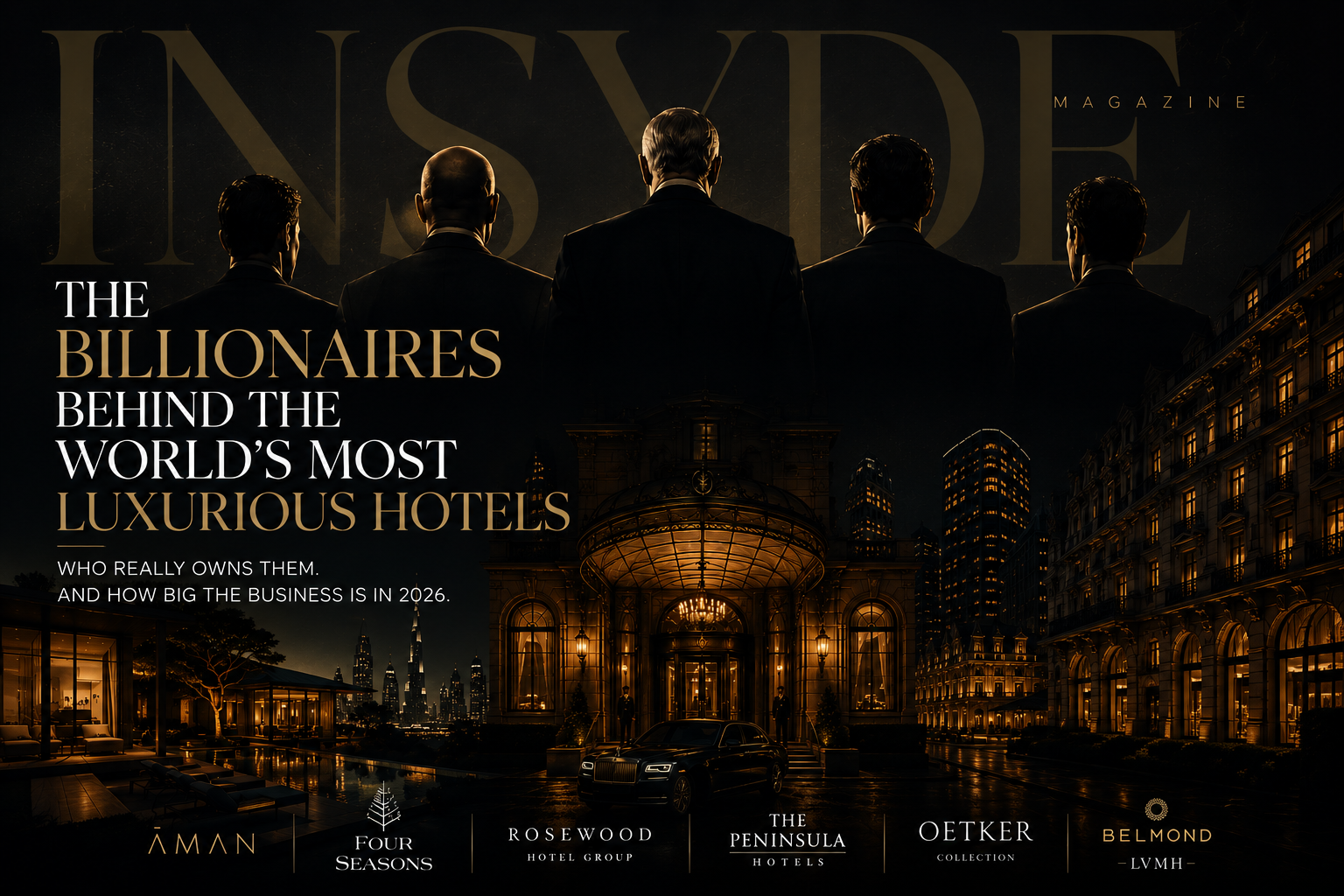
    THE BILLIONAIRES BEHIND THE WORLD’S MOST LUXURIOUS HOTELS

    You know the hotel. You know the name. But do you know who actually owns the world behind it?

    Walk into one of the world’s great luxury hotels and you see the same things.

    Marble.

    Chandeliers.

    Immaculate suites.

    Private entrances.

    Restaurants where reservations can feel harder to secure than flights.

    Service so polished that almost everything appears effortless.

    But behind that effortless experience is a business most guests never think about.

    Who owns it?

    The answer is rarely as simple as the name above the entrance.

    A billionaire might own the hotel company.

    A family office might own the building.

    An investment fund might own the land.

    Another company might operate the property.

    And a global luxury group might own the brand and manage the experience.

    That complexity is not a technical footnote.

    It is the story.

    Because in 2026, some of the world’s most powerful fortunes are increasingly connected to the business of luxury hospitality.

    And the money involved is enormous.

    A $10 billion valuation for Four Seasons.

    A $3.2 billion enterprise-value acquisition of Belmond by LVMH.

    A $500 million new investment vehicle targeting Aman and Janu hotels, residences and mixed-use developments.

    A $230 million acquisition of Rosewood that helped turn it into a global luxury-hospitality group.

    These aren’t simply hotel deals.

    They are bets on the future of luxury itself.


    THE HOTEL YOU SEE IS ONLY THE FRONT END

    The first thing to understand about luxury hotels is that the brand and the building are not necessarily the same business.

    This is where the industry becomes fascinating.

    A hotel group can create the brand, design the service standards and manage the property without owning the real estate.

    A property company can own the building and hire a hotel company to operate it.

    An investment group can finance the development.

    And a billionaire can ultimately control the company sitting somewhere above all of them.

    So when someone says a billionaire “owns a hotel”, that can mean several different things.

    They may own:

    The hotel brand.

    The operating company.

    The property.

    The development company.

    Or simply a controlling stake in the company that controls the brand.

    At the top end of hospitality, understanding that distinction is essential.

    Because sometimes the most valuable thing in the building isn’t the building at all.

    It’s the name.


    AMAN: THE BILLIONAIRE WHO TURNED PRIVACY INTO AN EMPIRE

    Few names represent ultra-luxury quite like Aman.

    The brand began in 1988 with Amanpuri in Phuket and built its reputation around something that was almost the opposite of conventional luxury-hotel expansion:

    scarcity.

    Then came Vlad Doronin.

    The billionaire real-estate entrepreneur acquired Aman in 2014, after having been a long-time Aman guest himself. Since then, he has expanded the brand from secluded resorts into city hotels, residences, private clubs, interiors and new forms of travel.

    Aman has now grown into a global portfolio of hotels and resorts, while its ecosystem has expanded far beyond traditional hospitality.

    And then came the number that reveals where Aman is really heading.

    In July 2026, Doronin’s OKO Group announced a $500 million joint venture with Shinsegae Property to develop Aman and Janu hotels, branded residences and mixed-use properties.

    But the most striking part may be the residential business.

    Doronin told Bloomberg that Aman had sold close to $9 billion in branded residences over the previous four years, according to Forbes.

    Suddenly, Aman looks very different.

    It isn’t simply a company selling extraordinarily expensive hotel rooms.

    It is building a world where the same customer can stay at Aman, live at Aman, join Aman and eventually travel with Aman.

    The hotel becomes the entry point.

    The brand becomes the real asset.


    FOUR SEASONS: THE $10 BILLION BET

    If Aman represents scarcity, Four Seasons represents something else:

    global scale without abandoning luxury.

    Four Seasons is backed by Cascade Investment, associated with Bill Gates, alongside Kingdom Holding Company and founder Isadore Sharp.

    In 2021, Cascade agreed to acquire an additional 23.75% stake for $2.21 billion, taking its ownership to 71.25% and valuing Four Seasons at approximately $10 billion in enterprise value.

    That wasn’t a bet on one hotel.

    It was a bet on a global luxury machine.

    Four Seasons has continued expanding and says it has 135 hotels and resorts and 61 residential properties across 47 countries.

    And this is what makes the Four Seasons strategy so interesting.

    Aman tells the customer:

    You are entering a world very few people can access.

    Four Seasons tells the customer:

    You can expect an extraordinary standard wherever in the world you go.

    Two completely different interpretations of luxury.

    Both extraordinarily valuable.


    ROSEWOOD: THE $230 MILLION ACQUISITION

    Rosewood’s story demonstrates another way fortunes enter luxury.

    In 2011, Chow Tai Fook Enterprises, the Hong Kong company behind the Cheng family’s business empire, acquired Rosewood for roughly $230 million.

    The interesting part isn’t simply what they paid.

    It is what happened afterwards.

    Rosewood Hotel Group has expanded into a global hospitality platform, with 60 properties across 26 countries and territories and more than 30 additional properties in development.

    The group also operates other hospitality and lifestyle businesses.

    That makes Rosewood an important example of a larger trend:

    wealthy owners aren’t necessarily buying hotels to collect hotels.

    They’re buying brands that can be expanded across multiple categories.

    Hotels.

    Residences.

    Wellness.

    Private clubs.

    Experiences.

    And eventually, entire lifestyles.


    THE PENINSULA: WHEN LUXURY BECOMES A FAMILY LEGACY

    Then there is The Peninsula.

    Its story feels almost completely different.

    The Peninsula Hotels are part of Hongkong and Shanghai Hotels, a business with roots going back to 1866 and long associated with the Kadoorie family.

    Its chairman, Sir Michael Kadoorie, represents a very different model of luxury ownership: generational wealth.

    The Peninsula portfolio remains deliberately selective, with properties across major cities and destinations including Hong Kong, Shanghai, Tokyo, New York, London and Paris.

    This is not the story of a billionaire buying a trendy hospitality brand and rapidly multiplying its properties.

    It is something much older:

    generational ownership.

    That distinction matters.

    Because luxury isn’t always built through growth.

    Sometimes it is built through continuity.

    The Peninsula doesn’t need to be everywhere.

    Its power comes partly from the fact that it isn’t.


    OETKER: THE FAMILY BUSINESS BEHIND EUROPEAN HOTEL ROYALTY

    If there is one group that demonstrates the relationship between family wealth and luxury heritage, it is Oetker.

    Oetker Collection sits within the family-owned Oetker business, whose interests extend well beyond hotels.

    The group identifies Dr. Alfred Oetker and Ferdinand Oetker among its shareholders, while the wider family business spans multiple industries, including real estate and luxury hospitality.

    Its hotel portfolio includes names such as Le Bristol Paris and Hotel du Cap-Eden-Roc.

    And this is where luxury hospitality becomes different from almost every other industry.

    You can spend billions building a new hotel.

    But you cannot spend billions and instantly purchase a century of history.

    A historic address has something money alone cannot manufacture:

    memory.

    That is why heritage itself has become a luxury asset.

    You can construct a spectacular hotel in three years.

    You cannot manufacture decades of mythology.


    LVMH: WHEN THE LUXURY CONGLOMERATE ENTERS THE HOTEL BUSINESS

    Then there is the world’s ultimate luxury conglomerate.

    LVMH.

    The group already controlled brands across fashion, jewellery, watches, beauty and wine and spirits.

    Then it went deeper into hospitality.

    In 2018, LVMH agreed to acquire Belmond for $2.6 billion in equity value and $3.2 billion in enterprise value. The transaction was completed in 2019.

    Belmond brought with it hotels, restaurants, luxury trains and river cruises.

    That acquisition was important because it revealed a larger strategy.

    Luxury doesn’t have to mean selling a handbag.

    It can mean selling the entire journey surrounding the customer.

    A hotel.

    A train.

    A yacht.

    A destination.

    A restaurant.

    A fashion house.

    A piece of jewellery.

    Different products.

    One customer.

    One ecosystem.

    And in 2026, that strategy is becoming even more relevant as luxury groups push further into travel and experiential hospitality.


    THE BILLIONAIRE DOESN’T ALWAYS OWN THE HOTEL

    This is perhaps the most important part of the entire story.

    Imagine a luxury hotel carrying one of the world’s most famous names.

    The guest assumes the company behind that name owns everything.

    Not necessarily.

    The brand could belong to one company.

    The real estate could belong to another.

    The hotel operator could be a third.

    The financing could come from a fourth.

    And the ultimate investor could sit several layers above them.

    That structure is extremely common in modern hospitality.

    It allows hotel companies to expand without buying every building themselves.

    And it allows property investors to use powerful luxury brands to make their real estate more valuable.

    Which leads to perhaps the biggest transformation happening in luxury right now.


    THE REAL GOLDMINE: BRANDED RESIDENCES

    The hotel room is no longer necessarily the biggest prize.

    The residence might be.

    Luxury hotel brands are increasingly attaching their names to private residences.

    Why?

    Because selling a hotel room generates revenue from a stay.

    Selling a branded residence can create an enormous property transaction — while allowing the hotel company to earn branding, management and service fees without necessarily owning the entire building.

    Aman is one of the clearest examples.

    According to Forbes’ 2026 reporting, Aman has sold close to $9 billion in branded residences in four years, while Savills data cited in the same report indicated that buyers globally were willing to pay an average 33% premium for branded residences over comparable unbranded homes.

    That is a staggering proposition.

    Imagine buying an apartment.

    Now put a globally recognised luxury hotel brand on the front.

    Add hotel-level service.

    Concierge.

    Housekeeping.

    Wellness.

    Restaurants.

    Private clubs.

    Then charge a premium for the privilege.

    Suddenly the hotel brand is no longer just selling hospitality.

    It is selling real estate at a premium.


    WHY BILLIONAIRES WANT INTO HOSPITALITY

    So why would someone who already has billions want to own hotels?

    The obvious answer is money.

    But it isn’t the only answer.

    Luxury hospitality sits at an unusual intersection of industries.

    Real estate.

    Travel.

    Food.

    Fashion.

    Entertainment.

    Culture.

    Private wealth.

    A luxury hotel can become a meeting place for CEOs.

    A destination for celebrities.

    A home-away-from-home for billionaires.

    A platform for restaurants and chefs.

    A gateway into a city.

    A launchpad for branded residences.

    A private club.

    And a physical expression of a luxury brand.

    That makes the hotel much more powerful than a simple accommodation business.

    It becomes a social and commercial ecosystem.


    FROM ROOMS TO WORLDS

    This is where the luxury-hospitality business is ultimately heading.

    A hotel room was once the product.

    Then came the suite.

    Then the villa.

    Then the residence.

    Then the private club.

    Then the yacht.

    Then the private travel experience.

    The customer doesn’t necessarily want to buy one thing anymore.

    They want an entire world that feels consistent with their lifestyle.

    Aman understands this.

    Four Seasons understands this.

    LVMH understands this.

    Rosewood understands this.

    And the investors behind these companies understand something even more important:

    The luxury customer doesn’t stop being a luxury customer when they leave the hotel.

    So why should the brand stop selling to them?


    THE NEW LUXURY POWER PLAY

    This changes the economics of luxury.

    The most valuable hospitality brands aren’t necessarily the ones with the most rooms.

    They may be the ones that can convince customers to spend across the greatest number of categories.

    Stay at the hotel.

    Buy the residence.

    Join the club.

    Book the experience.

    Take the yacht.

    Return to another property.

    Bring the same brand into your lifestyle.

    That is a much bigger business than hotel occupancy.

    And it explains why billionaires, family fortunes and luxury conglomerates continue to look at hospitality as more than a place to park capital.

    They are buying access to a customer.


    SO, WHO REALLY OWNS LUXURY?

    There is no single answer.

    Vlad Doronin controls Aman.

    Cascade Investment is the controlling shareholder behind Four Seasons.

    The Cheng family’s Chow Tai Fook Enterprises controls Rosewood.

    The Kadoorie family sits behind The Peninsula’s long-running ownership structure.

    The Oetker family controls its luxury hospitality and wider family business.

    LVMH controls Belmond and has built a growing luxury-hospitality ecosystem around it.

    Different fortunes.

    Different generations.

    Different strategies.

    But they are all betting on the same fundamental idea:

    Luxury is becoming less about a product and more about an ecosystem.


    THE PEOPLE YOU NEVER SEE

    The guests are visible.

    The hotel is visible.

    The logo is visible.

    The billionaire behind the business usually isn’t.

    You won’t see them standing in the lobby.

    You probably won’t know which investment vehicle owns the building.

    You may never know which company controls the brand.

    And you certainly won’t see the spreadsheets behind the marble.

    But those decisions determine where the next hotel opens.

    Which neighbourhood becomes fashionable.

    Which destination receives billions in development.

    Which brands remain exclusive.

    Which become global.

    And which luxury experiences become available only to those who can afford them.

    That is the hidden side of hospitality.

    Not the room.

    Not the restaurant.

    Not the view.

    The ownership.

    Because the next time you walk into one of the world’s most luxurious hotels, look beyond the chandelier.

    Ask who owns the building.

    Who owns the brand.

    Who operates it.

    Who financed it.

    And who stands to benefit when the world’s wealthiest people decide they want to stay there.

    Because sometimes, the most interesting person in the hotel…

    is the one you never see.

    INSYDE — Beyond the Spotlight.