
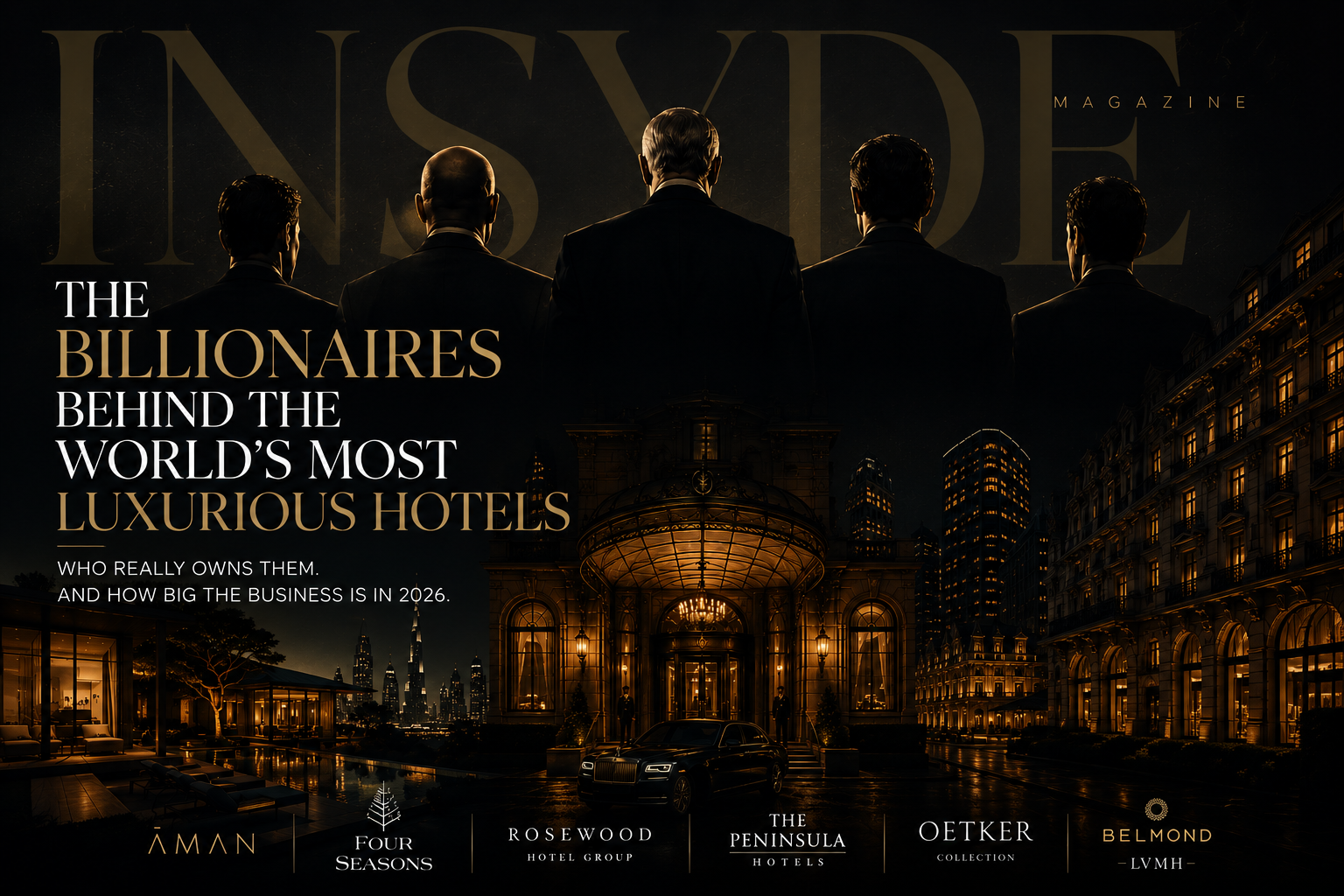
You know the hotel. You know the name. But do you know who actually owns the world behind it?
Walk into one of the world’s great luxury hotels and you see the same things.
Marble.
Chandeliers.
Immaculate suites.
Private entrances.
Restaurants where reservations can feel harder to secure than flights.
Service so polished that almost everything appears effortless.
But behind that effortless experience is a business most guests never think about.
Who owns it?
The answer is rarely as simple as the name above the entrance.
A billionaire might own the hotel company.
A family office might own the building.
An investment fund might own the land.
Another company might operate the property.
And a global luxury group might own the brand and manage the experience.
That complexity is not a technical footnote.
It is the story.
Because in 2026, some of the world’s most powerful fortunes are increasingly connected to the business of luxury hospitality.
And the money involved is enormous.
A $10 billion valuation for Four Seasons.
A $3.2 billion enterprise-value acquisition of Belmond by LVMH.
A $500 million new investment vehicle targeting Aman and Janu hotels, residences and mixed-use developments.
A $230 million acquisition of Rosewood that helped turn it into a global luxury-hospitality group.
These aren’t simply hotel deals.
They are bets on the future of luxury itself.
THE HOTEL YOU SEE IS ONLY THE FRONT END
The first thing to understand about luxury hotels is that the brand and the building are not necessarily the same business.
This is where the industry becomes fascinating.
A hotel group can create the brand, design the service standards and manage the property without owning the real estate.
A property company can own the building and hire a hotel company to operate it.
An investment group can finance the development.
And a billionaire can ultimately control the company sitting somewhere above all of them.
So when someone says a billionaire “owns a hotel”, that can mean several different things.
They may own:
The hotel brand.
The operating company.
The property.
The development company.
Or simply a controlling stake in the company that controls the brand.
At the top end of hospitality, understanding that distinction is essential.
Because sometimes the most valuable thing in the building isn’t the building at all.
It’s the name.
AMAN: THE BILLIONAIRE WHO TURNED PRIVACY INTO AN EMPIRE
Few names represent ultra-luxury quite like Aman.
The brand began in 1988 with Amanpuri in Phuket and built its reputation around something that was almost the opposite of conventional luxury-hotel expansion:
scarcity.
Then came Vlad Doronin.
The billionaire real-estate entrepreneur acquired Aman in 2014, after having been a long-time Aman guest himself. Since then, he has expanded the brand from secluded resorts into city hotels, residences, private clubs, interiors and new forms of travel.
Aman has now grown into a global portfolio of hotels and resorts, while its ecosystem has expanded far beyond traditional hospitality.
And then came the number that reveals where Aman is really heading.
In July 2026, Doronin’s OKO Group announced a $500 million joint venture with Shinsegae Property to develop Aman and Janu hotels, branded residences and mixed-use properties.
But the most striking part may be the residential business.
Doronin told Bloomberg that Aman had sold close to $9 billion in branded residences over the previous four years, according to Forbes.
Suddenly, Aman looks very different.
It isn’t simply a company selling extraordinarily expensive hotel rooms.
It is building a world where the same customer can stay at Aman, live at Aman, join Aman and eventually travel with Aman.
The hotel becomes the entry point.
The brand becomes the real asset.
FOUR SEASONS: THE $10 BILLION BET
If Aman represents scarcity, Four Seasons represents something else:
global scale without abandoning luxury.
Four Seasons is backed by Cascade Investment, associated with Bill Gates, alongside Kingdom Holding Company and founder Isadore Sharp.
In 2021, Cascade agreed to acquire an additional 23.75% stake for $2.21 billion, taking its ownership to 71.25% and valuing Four Seasons at approximately $10 billion in enterprise value.
That wasn’t a bet on one hotel.
It was a bet on a global luxury machine.
Four Seasons has continued expanding and says it has 135 hotels and resorts and 61 residential properties across 47 countries.
And this is what makes the Four Seasons strategy so interesting.
Aman tells the customer:
You are entering a world very few people can access.
Four Seasons tells the customer:
You can expect an extraordinary standard wherever in the world you go.
Two completely different interpretations of luxury.
Both extraordinarily valuable.
ROSEWOOD: THE $230 MILLION ACQUISITION
Rosewood’s story demonstrates another way fortunes enter luxury.
In 2011, Chow Tai Fook Enterprises, the Hong Kong company behind the Cheng family’s business empire, acquired Rosewood for roughly $230 million.
The interesting part isn’t simply what they paid.
It is what happened afterwards.
Rosewood Hotel Group has expanded into a global hospitality platform, with 60 properties across 26 countries and territories and more than 30 additional properties in development.
The group also operates other hospitality and lifestyle businesses.
That makes Rosewood an important example of a larger trend:
wealthy owners aren’t necessarily buying hotels to collect hotels.
They’re buying brands that can be expanded across multiple categories.
Hotels.
Residences.
Wellness.
Private clubs.
Experiences.
And eventually, entire lifestyles.
THE PENINSULA: WHEN LUXURY BECOMES A FAMILY LEGACY
Then there is The Peninsula.
Its story feels almost completely different.
The Peninsula Hotels are part of Hongkong and Shanghai Hotels, a business with roots going back to 1866 and long associated with the Kadoorie family.
Its chairman, Sir Michael Kadoorie, represents a very different model of luxury ownership: generational wealth.
The Peninsula portfolio remains deliberately selective, with properties across major cities and destinations including Hong Kong, Shanghai, Tokyo, New York, London and Paris.
This is not the story of a billionaire buying a trendy hospitality brand and rapidly multiplying its properties.
It is something much older:
generational ownership.
That distinction matters.
Because luxury isn’t always built through growth.
Sometimes it is built through continuity.
The Peninsula doesn’t need to be everywhere.
Its power comes partly from the fact that it isn’t.
OETKER: THE FAMILY BUSINESS BEHIND EUROPEAN HOTEL ROYALTY
If there is one group that demonstrates the relationship between family wealth and luxury heritage, it is Oetker.
Oetker Collection sits within the family-owned Oetker business, whose interests extend well beyond hotels.
The group identifies Dr. Alfred Oetker and Ferdinand Oetker among its shareholders, while the wider family business spans multiple industries, including real estate and luxury hospitality.
Its hotel portfolio includes names such as Le Bristol Paris and Hotel du Cap-Eden-Roc.
And this is where luxury hospitality becomes different from almost every other industry.
You can spend billions building a new hotel.
But you cannot spend billions and instantly purchase a century of history.
A historic address has something money alone cannot manufacture:
memory.
That is why heritage itself has become a luxury asset.
You can construct a spectacular hotel in three years.
You cannot manufacture decades of mythology.
LVMH: WHEN THE LUXURY CONGLOMERATE ENTERS THE HOTEL BUSINESS
Then there is the world’s ultimate luxury conglomerate.
LVMH.
The group already controlled brands across fashion, jewellery, watches, beauty and wine and spirits.
Then it went deeper into hospitality.
In 2018, LVMH agreed to acquire Belmond for $2.6 billion in equity value and $3.2 billion in enterprise value. The transaction was completed in 2019.
Belmond brought with it hotels, restaurants, luxury trains and river cruises.
That acquisition was important because it revealed a larger strategy.
Luxury doesn’t have to mean selling a handbag.
It can mean selling the entire journey surrounding the customer.
A hotel.
A train.
A yacht.
A destination.
A restaurant.
A fashion house.
A piece of jewellery.
Different products.
One customer.
One ecosystem.
And in 2026, that strategy is becoming even more relevant as luxury groups push further into travel and experiential hospitality.
THE BILLIONAIRE DOESN’T ALWAYS OWN THE HOTEL
This is perhaps the most important part of the entire story.
Imagine a luxury hotel carrying one of the world’s most famous names.
The guest assumes the company behind that name owns everything.
Not necessarily.
The brand could belong to one company.
The real estate could belong to another.
The hotel operator could be a third.
The financing could come from a fourth.
And the ultimate investor could sit several layers above them.
That structure is extremely common in modern hospitality.
It allows hotel companies to expand without buying every building themselves.
And it allows property investors to use powerful luxury brands to make their real estate more valuable.
Which leads to perhaps the biggest transformation happening in luxury right now.
THE REAL GOLDMINE: BRANDED RESIDENCES
The hotel room is no longer necessarily the biggest prize.
The residence might be.
Luxury hotel brands are increasingly attaching their names to private residences.
Why?
Because selling a hotel room generates revenue from a stay.
Selling a branded residence can create an enormous property transaction — while allowing the hotel company to earn branding, management and service fees without necessarily owning the entire building.
Aman is one of the clearest examples.
According to Forbes’ 2026 reporting, Aman has sold close to $9 billion in branded residences in four years, while Savills data cited in the same report indicated that buyers globally were willing to pay an average 33% premium for branded residences over comparable unbranded homes.
That is a staggering proposition.
Imagine buying an apartment.
Now put a globally recognised luxury hotel brand on the front.
Add hotel-level service.
Concierge.
Housekeeping.
Wellness.
Restaurants.
Private clubs.
Then charge a premium for the privilege.
Suddenly the hotel brand is no longer just selling hospitality.
It is selling real estate at a premium.
WHY BILLIONAIRES WANT INTO HOSPITALITY
So why would someone who already has billions want to own hotels?
The obvious answer is money.
But it isn’t the only answer.
Luxury hospitality sits at an unusual intersection of industries.
Real estate.
Travel.
Food.
Fashion.
Entertainment.
Culture.
Private wealth.
A luxury hotel can become a meeting place for CEOs.
A destination for celebrities.
A home-away-from-home for billionaires.
A platform for restaurants and chefs.
A gateway into a city.
A launchpad for branded residences.
A private club.
And a physical expression of a luxury brand.
That makes the hotel much more powerful than a simple accommodation business.
It becomes a social and commercial ecosystem.
FROM ROOMS TO WORLDS
This is where the luxury-hospitality business is ultimately heading.
A hotel room was once the product.
Then came the suite.
Then the villa.
Then the residence.
Then the private club.
Then the yacht.
Then the private travel experience.
The customer doesn’t necessarily want to buy one thing anymore.
They want an entire world that feels consistent with their lifestyle.
Aman understands this.
Four Seasons understands this.
LVMH understands this.
Rosewood understands this.
And the investors behind these companies understand something even more important:
The luxury customer doesn’t stop being a luxury customer when they leave the hotel.
So why should the brand stop selling to them?
THE NEW LUXURY POWER PLAY
This changes the economics of luxury.
The most valuable hospitality brands aren’t necessarily the ones with the most rooms.
They may be the ones that can convince customers to spend across the greatest number of categories.
Stay at the hotel.
Buy the residence.
Join the club.
Book the experience.
Take the yacht.
Return to another property.
Bring the same brand into your lifestyle.
That is a much bigger business than hotel occupancy.
And it explains why billionaires, family fortunes and luxury conglomerates continue to look at hospitality as more than a place to park capital.
They are buying access to a customer.
SO, WHO REALLY OWNS LUXURY?
There is no single answer.
Vlad Doronin controls Aman.
Cascade Investment is the controlling shareholder behind Four Seasons.
The Cheng family’s Chow Tai Fook Enterprises controls Rosewood.
The Kadoorie family sits behind The Peninsula’s long-running ownership structure.
The Oetker family controls its luxury hospitality and wider family business.
LVMH controls Belmond and has built a growing luxury-hospitality ecosystem around it.
Different fortunes.
Different generations.
Different strategies.
But they are all betting on the same fundamental idea:
Luxury is becoming less about a product and more about an ecosystem.
THE PEOPLE YOU NEVER SEE
The guests are visible.
The hotel is visible.
The logo is visible.
The billionaire behind the business usually isn’t.
You won’t see them standing in the lobby.
You probably won’t know which investment vehicle owns the building.
You may never know which company controls the brand.
And you certainly won’t see the spreadsheets behind the marble.
But those decisions determine where the next hotel opens.
Which neighbourhood becomes fashionable.
Which destination receives billions in development.
Which brands remain exclusive.
Which become global.
And which luxury experiences become available only to those who can afford them.
That is the hidden side of hospitality.
Not the room.
Not the restaurant.
Not the view.
The ownership.
Because the next time you walk into one of the world’s most luxurious hotels, look beyond the chandelier.
Ask who owns the building.
Who owns the brand.
Who operates it.
Who financed it.
And who stands to benefit when the world’s wealthiest people decide they want to stay there.
Because sometimes, the most interesting person in the hotel…
is the one you never see.
INSYDE — Beyond the Spotlight.